
TL;DR
- Building a B2B ecommerce strategy for growth and scale in 2026 requires more than launching a website.
- You need ERP-connected commerce that handles contract pricing, bulk ordering, and real-time inventory without manual intervention.
- Start by mapping your current processes, assessing integration readiness, and designing workflows that treat your online channel as an extension of operations.
- The businesses winning in 2026 are those treating ecommerce as operational infrastructure, not a marketing project.
Why This Matters for B2B Manufacturing & Industrial Supply
The global B2B e-commerce market is projected to reach $36 trillion by 2026, growing at a 14.5% CAGR, according to Shopify. For manufacturers and industrial suppliers, this shift represents both opportunity and urgency. Digital channels are expected to generate 56% of B2B revenue in 2025, up from 32% in 2020, as reported by BigCommerce.
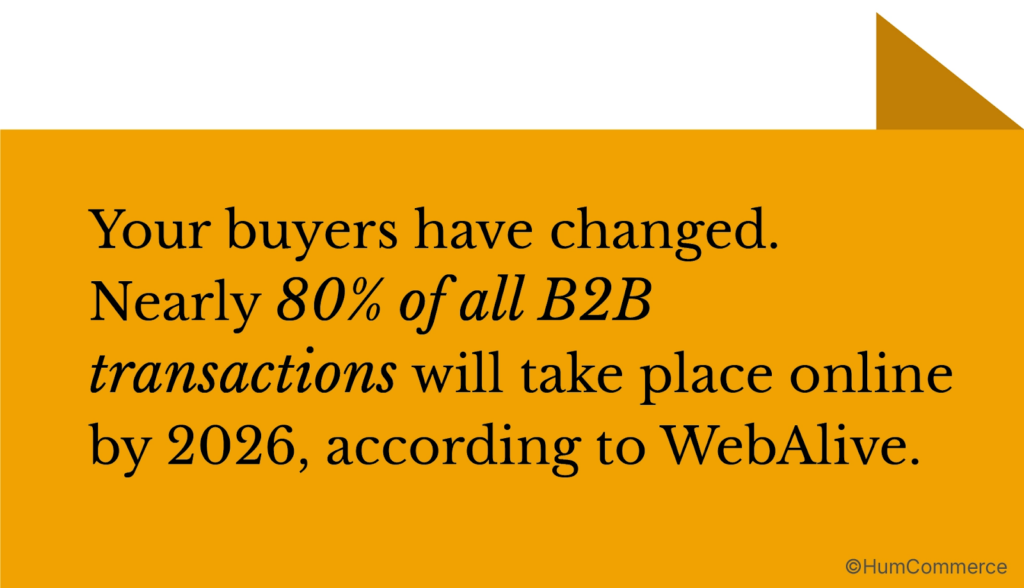
These aren’t casual browsers. They’re procurement managers, operations leads, and purchasing agents who expect the same speed and accuracy they get from consumer platforms. The difference is they’re ordering 500 units with tiered pricing, checking real-time stock across three warehouses, and needing approval workflows before checkout.
For manufacturing and industrial supply businesses, a disconnected ecommerce presence creates friction at every touchpoint. Orders entered manually into ERPs introduce errors. Pricing discrepancies between your website and contract terms frustrate customers. Inventory shown online that doesn’t match warehouse reality leads to backorders and lost trust. The cost isn’t just operational inefficiency: it’s revenue walking out the door.
Why Creating a B2B Ecommerce Strategy for Growth, Integration, and Scale in 2026 Is a Priority Now
The pressure to act comes from multiple directions. Buyer expectations have shifted permanently. Shopify reports that 75% of B2B buyers prefer a rep-free sales experience, favoring self-service and independent research. Your sales team shouldn’t spend hours answering questions about stock levels or pricing that a well-integrated platform could handle automatically.
Competitive dynamics have changed too. Distributors and manufacturers who built integrated ecommerce platforms during 2020-2024 are now capturing market share from competitors still relying on phone orders and PDF catalogs. The U.S. B2B e-commerce market alone is valued at $10.1 trillion in 2026, representing roughly one-third of global volume, according to Trade.gov. The window to establish digital market position is narrowing.
“Integration is no longer just an IT project but a revenue strategy,” notes Echidna. This perspective shift matters. When your ecommerce platform pulls pricing directly from your ERP, displays accurate inventory in real-time, and pushes orders back without manual entry, you’ve removed friction from the buying process while reducing your cost-to-serve.
What ‘Done’ Looks Like When You Create a B2B Ecommerce Strategy for Growth, Integration, and Scale in 2026
A completed B2B ecommerce strategy for growth and scale doesn’t look like a standalone website. It looks like an operational extension of your business where the boundaries between your ERP, warehouse management, and customer-facing commerce blur into a single system.
Here’s what success looks like in practice:
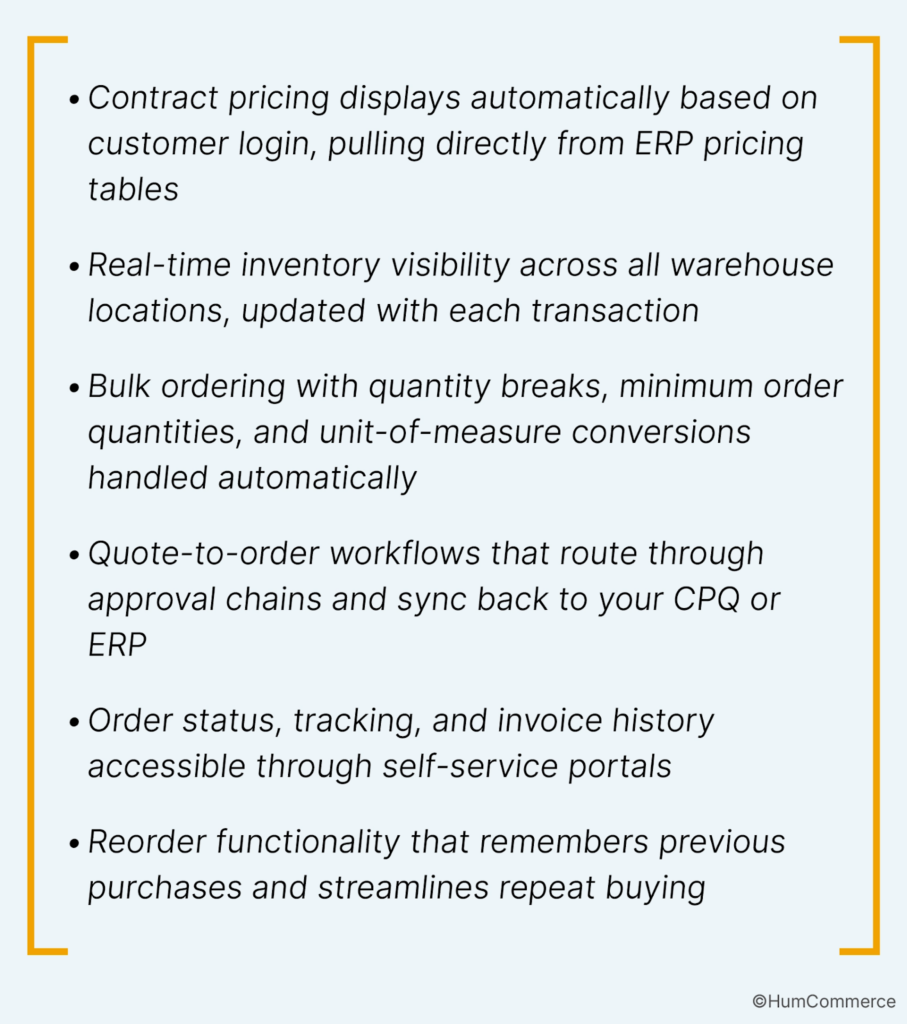
The outcome is measurable. Businesses implementing this approach have seen quote turnaround time reduced from 3-5 days to just hours by automating quote capture, approvals, and ERP/CPQ checks. That’s the difference between winning and losing time-sensitive orders.
Step 1: Map How You Create a B2B Ecommerce Strategy for Growth, Integration, and Scale in 2026 Today
Before building anything new, document your current state with precision. This isn’t a theoretical exercise: it’s the foundation for every decision that follows.
Start with order flow. Track a typical order from initial customer inquiry through fulfillment and invoicing. Note every system touched, every manual handoff, and every point where data is re-entered or verified. Most manufacturers discover their orders pass through five to eight systems with multiple manual interventions.
Document your pricing complexity. How many pricing tiers exist? How are contract prices maintained? Who updates them, and how often do discrepancies occur between what’s quoted and what’s invoiced? For many distributors, pricing logic lives in spreadsheets maintained by individual sales reps: a liability waiting to become a customer service crisis.
Map your inventory visibility. Can your sales team see real-time stock levels? Can your customers? What’s the lag between a warehouse transaction and system updates? If your current ecommerce platform shows “in stock” while your warehouse shows zero, you’ve identified a critical integration gap.
Finally, assess your data quality. Product information, customer records, and pricing tables need to be clean before they can flow between systems. Garbage in, garbage out applies doubly when you’re connecting multiple platforms.
Step 2: Check If You’re Ready to Create a B2B Ecommerce Strategy for Growth, Integration, and Scale in 2026
Readiness assessment prevents expensive false starts. Not every organization is positioned to execute a complex integration project, and recognizing gaps early saves time and budget.
Evaluate your ERP maturity. Is your ERP the actual source of truth for pricing, inventory, and customer data? Or do teams maintain shadow systems because the ERP data is incomplete or unreliable? Integration amplifies whatever state your core systems are in. If your ERP data is messy, that mess will flow directly to your ecommerce platform.
Consider your technical capacity. Do you have internal resources who understand your ERP’s API capabilities? Adobe Commerce integration requires technical expertise on both sides of the connection. Some organizations need to build internal capability, while others partner with specialists who understand both the commerce platform and specific ERP systems like Epicor, SAP, or Microsoft Dynamics.
Assess organizational alignment. A B2B ecommerce strategy touches sales, operations, IT, and customer service. If these teams operate in silos with competing priorities, the project will stall. Executive sponsorship and cross-functional commitment aren’t optional: they’re prerequisites.
Budget realistically. Integration projects cost more than platform licenses. Plan for data migration, custom development, testing, training, and ongoing maintenance. Underfunded projects deliver underfunctional results.
Step 3: Prepare Your Systems and Data
Data preparation is unglamorous work that determines project success. Most integration failures trace back to data quality issues discovered too late in the process.
Clean your product data first. Every SKU needs complete, accurate attributes: descriptions, specifications, categories, images, and pricing. If your product information lives in multiple systems with inconsistencies, consolidate into a PIM (Product Information Management) system before attempting ecommerce integration. This becomes the single source of truth that feeds both your ERP and commerce platform.
Standardize customer records. Duplicate accounts, inconsistent naming conventions, and incomplete contact information create problems when you’re syncing customer data between systems. Establish clear rules for customer master data and clean existing records before migration.
Document your pricing rules. B2B pricing complexity is often the biggest integration challenge. Contract pricing, volume discounts, customer-specific pricing, promotional pricing, and regional variations all need to be captured in logic that your ecommerce platform can execute. If pricing rules exist only in sales reps’ heads, extract and formalize them.
Prepare your ERP for integration. Work with your ERP vendor or implementation partner to understand API capabilities, data formats, and any customizations that might affect integration. Some legacy ERP systems require middleware to communicate with modern commerce platforms.
Step 4: Design the Improved Process
Process design comes before technology selection. Define what you want your integrated commerce operation to accomplish, then configure systems to support those workflows.
Design your order flow end-to-end. A customer logs in, sees their contract pricing, checks inventory, builds an order, routes it for approval if required, and submits. The order flows to your ERP without manual entry, triggers fulfillment workflows, and updates the customer portal with status. Define each step, each system interaction, and each exception handling scenario.
Map your pricing logic precisely. When a customer with contract pricing adds an item to cart, where does the price come from? How quickly does it update if the contract changes? What happens when a product isn’t covered by their contract: does it fall back to list price or require a quote? These decisions need documentation before development begins.
Plan for complexity. B2B buying isn’t linear. Customers request quotes, modify orders, split shipments, and need approval workflows. Design for these realities rather than forcing buyers into simplified flows that don’t match how they actually purchase.
Consider the customer experience holistically. Self-service portals should show order history, invoices, tracking information, and account balances. Reordering should be simple. Product search should handle part numbers, descriptions, and specifications. Humcommerce B2B AI Assist addresses this by letting buyers ask questions in plain language and get instant answers from your commerce and ERP data: particularly valuable for large, complex catalogs where traditional navigation falls short.
Step 5: Implement Changes in Your Stack
Implementation requires careful sequencing. Rushing to launch before integrations are solid creates more problems than it solves.
Start with your commerce platform foundation. Adobe Commerce (Magento) provides the B2B-specific functionality manufacturers and distributors need: company accounts, purchase approval workflows, requisition lists, negotiated quotes, and shared catalogs. Configure these features to match your business requirements before adding integration complexity.
Build ERP integration incrementally. Start with product and pricing sync, validate accuracy, then add inventory. Once product data flows correctly, implement order integration. Test each layer thoroughly before adding the next. One manufacturer working with HumCommerce achieved 75% faster quote workflows after integrating Epicor CPQ with Magento, eliminating back-and-forth manual quoting: but this result came from methodical implementation, not rushed deployment.
Connect your PIM if you have one. Product information should flow from PIM to both ERP and commerce, ensuring consistency across all channels. If you’re managing high-SKU catalogs, a PIM isn’t optional: it’s essential infrastructure.
Implement proper error handling. Integration failures happen. Design your system to catch sync errors, alert appropriate team members, and provide clear paths to resolution. An order that fails to reach your ERP needs immediate visibility, not discovery three days later when the customer calls asking about shipment.
Step 6: Pilot, Measure, Improve
Launch to a controlled group before full rollout. Select customers who represent your typical buyer profiles and order patterns, then monitor closely.
Track the metrics that matter. Order accuracy, sync latency, pricing discrepancy rates, and customer support tickets related to the new platform all indicate integration health. Set baselines before launch so you can measure improvement.
Gather qualitative feedback. Talk to pilot customers about their experience. Where did they encounter friction? What features do they wish existed? What’s better than your old process, and what’s worse? This feedback shapes your optimization roadmap.
Iterate based on data. Pilot programs reveal issues that testing didn’t catch. Treat these as expected learning rather than failures. Adjust workflows, fix integration bugs, and refine the user experience before expanding to your full customer base.
Plan for ongoing optimization. B2B ecommerce isn’t a project with an end date: it’s an operational capability that requires continuous improvement. Performance monitoring, conversion optimization, and feature enhancement should be part of your ongoing operational rhythm.
Common Mistakes to Avoid When You Create a B2B Ecommerce Strategy for Growth, Integration, and Scale in 2026
The most expensive mistakes happen early. Recognizing common pitfalls helps you avoid them.
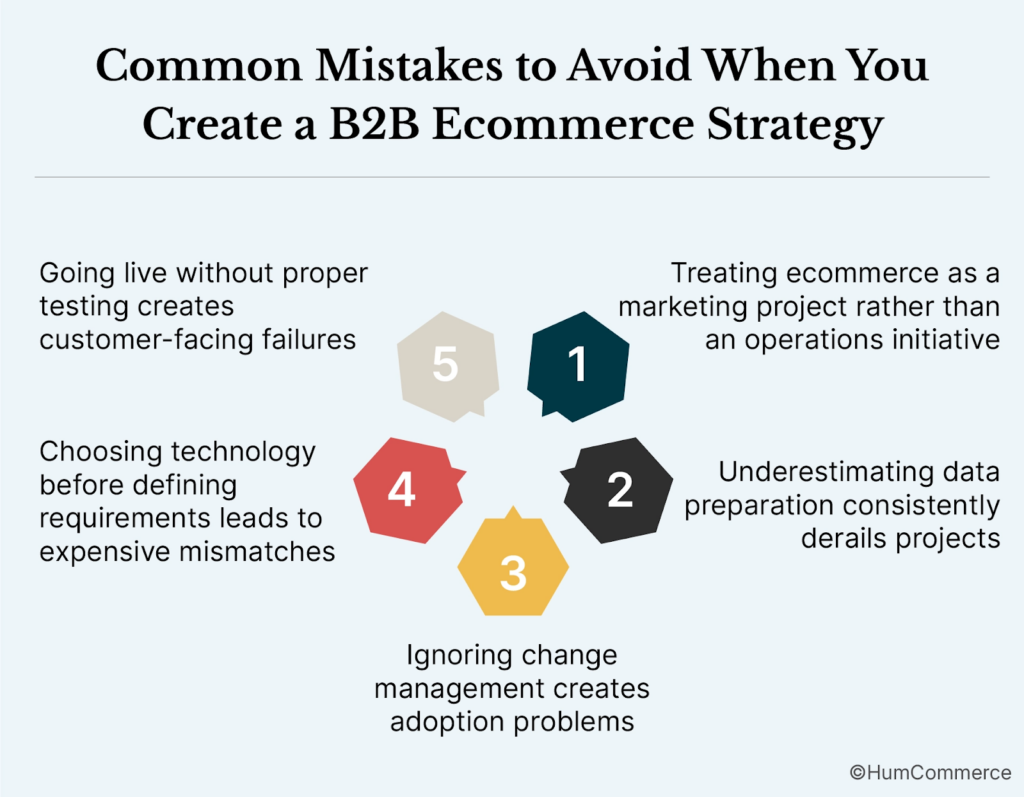
Treating ecommerce as a marketing project rather than an operations initiative leads to disconnected systems and manual workarounds. Your ecommerce platform should be designed by people who understand your ERP, warehouse operations, and pricing complexity: not just your brand guidelines.
Underestimating data preparation consistently derails projects. Organizations budget for platform licenses and development but skip the data cleanup work that makes integration possible. Plan for data preparation to consume 30-40% of your project timeline.
Ignoring change management creates adoption problems. Sales teams worried about commission changes, customer service reps unfamiliar with new workflows, and customers confused by new processes all slow down success. Invest in training and communication before, during, and after launch.
Choosing technology before defining requirements leads to expensive mismatches. Select platforms based on your specific B2B requirements: complex pricing, approval workflows, ERP integration capabilities. A platform optimized for B2C won’t handle manufacturer and distributor complexity without extensive customization.
Going live without proper testing creates customer-facing failures. Integration testing, load testing, and user acceptance testing all need adequate time. Launching with untested integrations damages customer relationships that took years to build.
Need Help Putting This Into Practice?
Building a B2B ecommerce strategy that connects your Adobe Commerce platform to ERP, handles complex pricing, and scales with your business requires expertise across multiple domains. The technical work of integration is only part of the challenge: understanding how manufacturers and distributors actually operate determines whether the technology delivers value.
HumCommerce specializes in exactly this intersection. We’ve helped manufacturers reduce quote turnaround from days to hours through automated, rules-driven quoting tied directly into Epicor CPQ and ERP. We build Adobe Commerce implementations that behave like part of your operations, not just a storefront.
If you’re planning a B2B ecommerce initiative for 2026 and want to discuss your specific requirements, reach out for a conversation about your current state, goals, and the path between them.