The industry average is 24-72 hours. Buyers decide in under 4. Here’s what the gap costs.
TL;DR
- B2B manufacturers and distributors take 24-72 hours on average to respond to a quote request, according to 2026 benchmark data.
- Buyers evaluating multiple suppliers simultaneously form preferences within 4 hours of sending the request.
- Deals where prospects receive answers within 4 hours have a 35% higher close rate than deals with response times exceeding 24 hours, based on analysis of nearly 2 million proposals.
- Manual quoting drives the delay. Pricing lookup, stock verification, and volume tier calculation account for 80% of quote assembly time.
- Automated quoting — with ERP-connected pricing and inventory — delivers standard quotes in under 10 minutes.
The buyer sent a quote request to you and two of your competitors at the same time. Your rep saw the request, pulled up the ERP, started looking up the account pricing tier, got interrupted by a phone call, came back 40 minutes later, finished the quote, and sent it.
Four hours into the process, the buyer had already decided to go with the supplier who responded first. Your quote arrived 20 hours later to an inbox that had stopped caring.
This is the mechanics of losing deals to response time. The product was fine. The price was competitive. The rep worked efficiently. The infrastructure made it too slow.
What the Benchmarks Say
Quote response time in B2B manufacturing and distribution averages 24-72 hours, according to 2026 data across manufacturing and distribution operations. The range reflects complexity:
- Standard repeat orders: 24-48 hours for most operations doing manual quoting
- Custom or configured products: 48-120 hours for operations requiring engineering review
- High-volume commodity orders: 12-24 hours for distributors with more structured pricing processes
The problem isn’t the 72-hour end of that range — complex products genuinely require review time. The problem is that standard repeat orders for established accounts, with known contract pricing and available inventory, are taking 24-48 hours when the data to generate them exists in the ERP and could be assembled in minutes.
The 4-Hour Decision Window
Research from Proposify, based on analysis of nearly 2 million sales proposals, found that deals where prospects receive responses within 4 hours have a 35% higher close rate than deals where response time exceeds 24 hours.
A separate body of research — including the well-cited Harvard Business Review lead response study — consistently finds that response speed has a disproportionate effect on win rate in competitive evaluations. When a buyer sends an RFQ to multiple suppliers, the first credible response anchors their expectations. Subsequent responses are evaluated against that anchor, not on their own merits.
Buyers in competitive B2B markets now form strong preferences within 4 hours of sending a quote request, according to 2026 benchmark reporting. That window is not enough time for manual quoting at most manufacturing and distribution operations.
What Makes Manual Quoting Slow
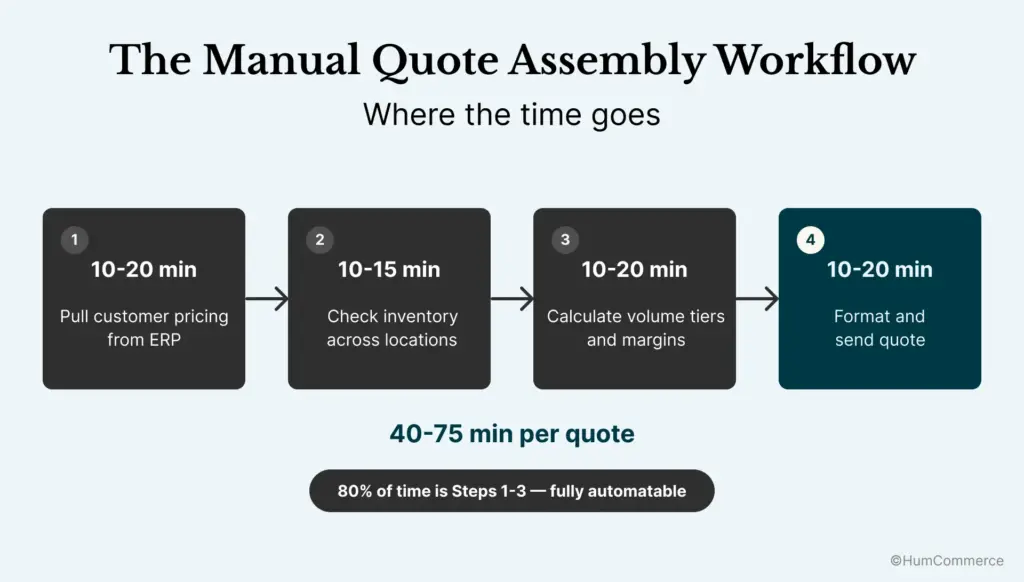
The four steps in a manual B2B quote are well-defined. The time each takes is where operations differ:
Step 1: Pull the customer’s pricing
For accounts with contract pricing, the rep opens the ERP, locates the customer record, finds the pricing tier, and verifies the current rate. This sounds simple. In practice it takes 10-20 minutes when price lists are complex, customer-specific overrides exist, or the rep needs to cross-reference a volume break schedule.
Step 2: Check inventory across locations
For distributors with multiple warehouses, this means checking each location manually or running a report. For manufacturers with production lead times, it means checking production schedules. 10-15 minutes.
Step 3: Calculate volume discounts and margins
Most B2B manufacturers have tiered pricing: the unit price at 100 units differs from the price at 500 units. Calculating the right tier, applying the discount, and verifying the margin is manual math. 10-20 minutes for non-standard quantities.
Step 4: Format and send the quote
Building the quote document, adding delivery terms, and sending it. 10-20 minutes.
Total: 40-75 minutes for a standard quote. Up to 90 minutes for anything with complexity.
80% of that time is Steps 1-3 — tasks that an ERP-connected system can perform in under 60 seconds.
What Automated Quoting Changes
An ERP-connected quoting system — whether a full CPQ integration, an AI assistant querying the ERP directly, or an automated workflow — eliminates Steps 1-3 for standard orders.
The rep receives the RFQ, opens the quoting tool, and the system:
- Pulls the customer’s contract pricing from the ERP in real time
- Checks inventory across all warehouse locations simultaneously
- Calculates volume tiers and margin automatically
- Pre-populates the quote document
The rep reviews the output, adjusts if needed, and sends. Total time: 5 to 15 minutes.
For standard repeat orders from established accounts — which represent the majority of quote volume at most manufacturers and distributors — the rep’s role shifts from data assembly to quality review and relationship management.
HumCommerce built this capability for Duke Manufacturing through a Salesforce CPQ and ERP integration. Duke achieved 88% faster quoting, with 100% real-time data accuracy because the system queried the ERP directly rather than relying on rep cross-referencing.
FHC achieved 75% faster workflows and 100% real-time quoting accuracy through an Epicor CPQ and Magento integration, eliminating pricing errors that had previously required manual correction after quotes were sent.
Calculating Your Current Quoting Cost
The formula is straightforward:
Weekly quoting labor cost = (quotes per week) x (hours per quote) x (rep loaded hourly rate)
Annual quoting labor cost = weekly figure x 52
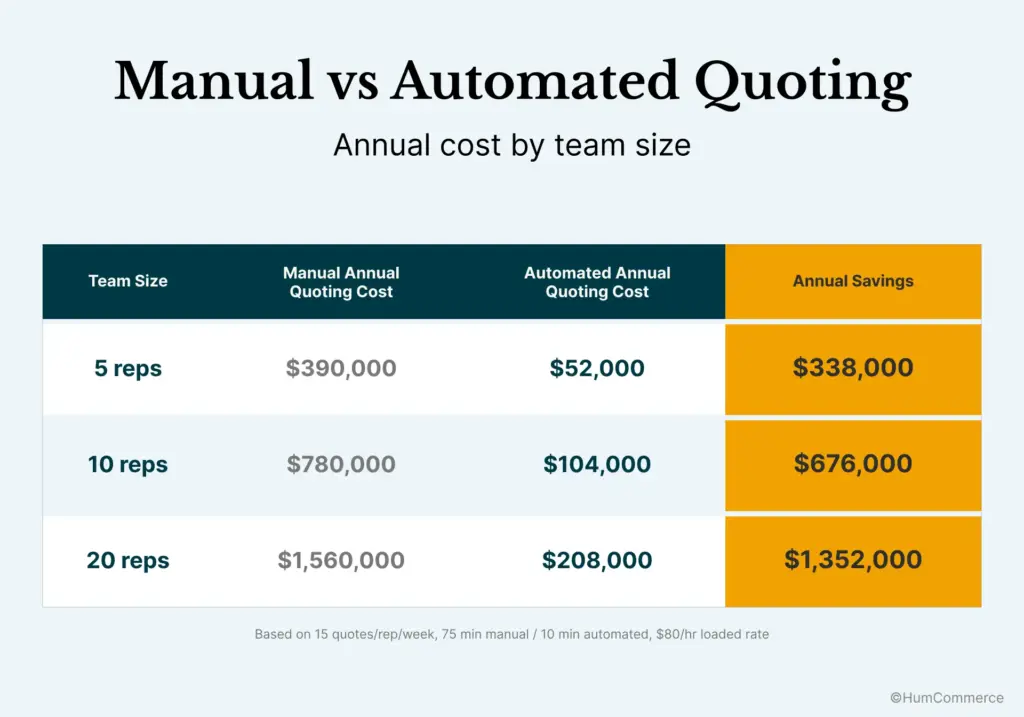
For a 10-rep team averaging 15 quotes per week per rep at 75 minutes per quote, with a loaded hourly rate of $80:
15 quotes x 10 reps x 1.25 hours x $80 = $15,000 per week
$15,000 x 52 = $780,000 per year in quoting labor
After automation (10 minutes per quote):
15 quotes x 10 reps x 0.167 hours x $80 = $2,000 per week
$2,000 x 52 = $104,000 per year
The difference — $676,000 — is your annual quoting automation ROI before accounting for the revenue impact of faster response times.
Which Operations Benefit Most From Quoting Speed
Not every manufacturing or distribution operation has the same urgency around quote response time. The operations where automated quoting has the highest impact are:
High quote volume, commodity or repeat products. The faster you can respond on standard repeat orders, the more orders you capture before buyers go elsewhere.
Competitive evaluations. When your buyers regularly compare you against two or three other suppliers, first-response advantage directly converts to market share.
National distributor accounts. Large accounts that purchase across multiple product lines expect fast turnaround. Slow quoting on standard items signals operational immaturity to sophisticated buyers.
After-hours and cross-time-zone orders. AI-assisted quoting doesn’t need to wait for a rep to start their workday. A buyer in another timezone gets a quote response within minutes, not the next morning.
Sources
- goautonomous.io, B2B Quote Response Time Benchmark 2026 — 24-72 hour industry average, 4-hour buyer decision window: https://goautonomous.io/blogs/b2b-quote-response-time-benchmark-2026-how-long-manufacturers-take-to-quote/
- Proposify, State of Proposals 2025 — 35% higher close rate for sub-4-hour responses, ~2 million proposals analyzed: https://www.cobl.ai/blog/sales-proposal-statistics-what-actually-closes-deals
- Duke Manufacturing case study, HumCommerce — 88% faster quoting, 100% real-time data sync
- FHC case study, HumCommerce — 75% faster workflows, 100% real-time quoting accuracy