It’s not a transformation. It’s a series of specific integration decisions.
TL;DR
- “Digital transformation” triggers fear of massive cost and operational disruption. For a $75M industrial distributor, going digital means something much more specific: getting your ERP pricing and inventory visible to buyers without a rep in the middle.
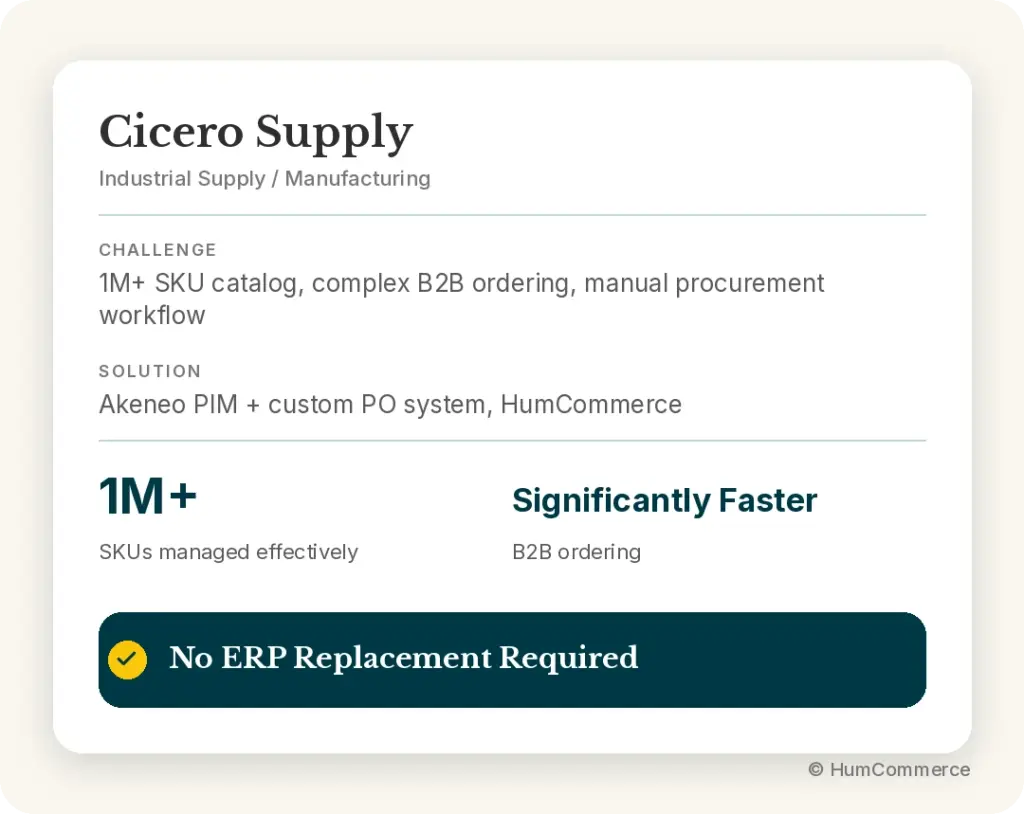
- The Cicero Supply case: over one million SKUs managed, faster B2B ordering, no ERP replacement — using Akeneo PIM and a custom PO system built by HumCommerce.
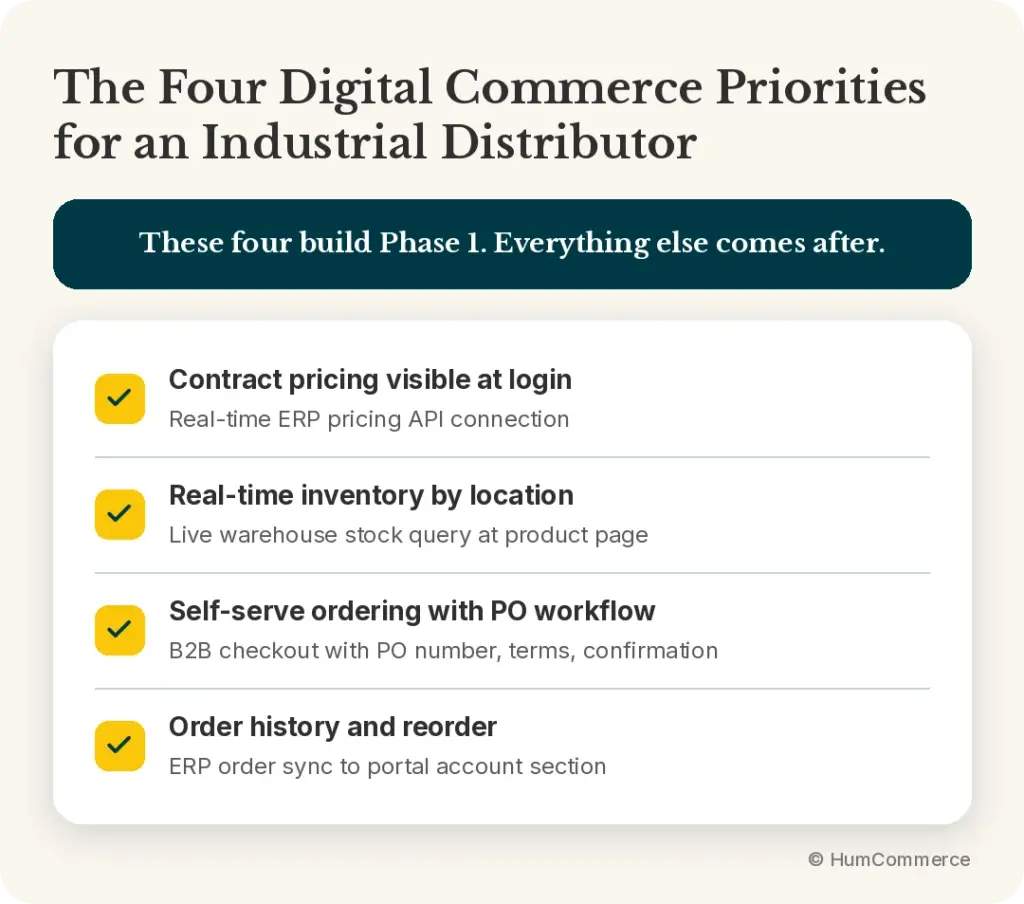
- A $75M industrial distributor needs four things from digital commerce: contract pricing online, real-time inventory, self-serve ordering with PO workflow, and order history access. That’s it for Phase 1.
- A 90-day phased build gets a distributor from phone/email ordering to 25-35% self-serve without disrupting current operations.
- The one risk that kills most portal launches: going live without real-time pricing sync, which destroys buyer trust in the first 30 days.
“Digital transformation” is the phrase that causes distributors to either over-invest or avoid the problem entirely.
Overspend camp: they interpret it as rebuilding everything — new ERP, new platform, new workflows, new team. Two years, seven figures, and an operation that may or may not work better than the one they had.
Avoidance camp: they hear “transformation” and decide now isn’t the right time. Maybe next year. The manual operations continue.
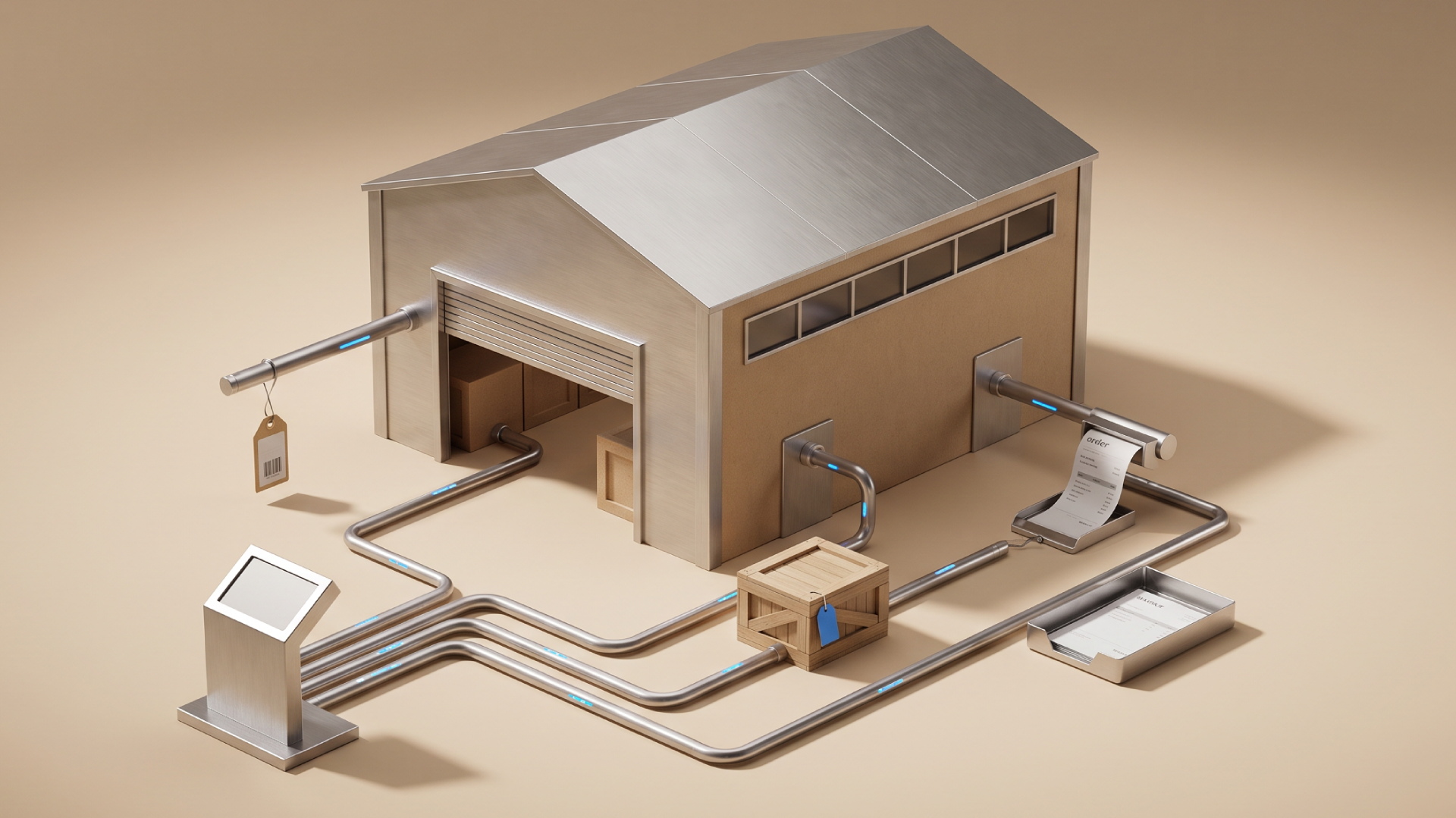
Both responses miss the actual problem. For a $75M industrial distributor, going digital is not a transformation. It’s a specific set of integration decisions that connect what already exists — your ERP, your product catalog, your buyer accounts — to a portal that buyers can use without calling your team.
Here’s what that looks like in practice.
What a $75M Industrial Distributor Actually Needs From Digital Commerce
Not everything. Four specific things.
Contract pricing visible to buyers without calling
This is the first and most important integration for any industrial distributor. Your accounts have negotiated rates. Those rates live in your ERP. When a buyer logs into your portal and sees their actual contract rate, they can place an order with confidence. When they see a number they don’t recognize, they call.
Every call to confirm pricing is a failure of the portal. It means the integration between your portal and your ERP’s pricing tables is incomplete. And it means the portal will never achieve meaningful self-serve adoption for the account that called, because they’ve learned the portal can’t be trusted.
Real-time inventory visibility by location
Industrial distributors operate across multiple warehouse locations. Buyers need to know not just whether a product is available, but whether it’s available at a location that can hit their delivery timeline.
Real-time inventory queries — pulling available stock by location at the moment the buyer checks — give them the information they need before they place the order. Batch sync (updating inventory on a schedule) creates oversell risk: a buyer orders on stock that moved since the last sync.
For industrial distribution specifically, an oversell isn’t just an operational inconvenience. It can disrupt a production run or a construction schedule that the buyer planned around your availability.
Self-serve ordering with PO workflow
Industrial distributors’ buyers are often procurement-oriented. They work within purchase order processes. They need to be able to reference a PO number, get an order confirmation they can attach to their internal records, and complete the transaction in a way that’s compliant with their procurement workflow.
This requires a B2B checkout that supports: PO number entry, account-specific credit terms, order confirmation email with full line-item detail, and confirmation in the portal account section. It’s not a standard B2C checkout with a PO field added. It’s a B2B-native order workflow.
Order history and account visibility
Repeat purchasing is the core of industrial distribution revenue. A buyer who placed the same order last month should be able to find it in their account history and reorder from it in two clicks.
This requires ERP order history synced to the portal’s account section. Without it, buyers reconstruct orders from memory or call to get their last order repeated — a call that costs your support team 5-10 minutes and the buyer their time.
What Doesn’t Change When You Go Digital
The fear attached to “digital transformation” is that it disrupts what’s working. It doesn’t have to, and for industrial distributors who approach it correctly, it doesn’t.
Your ERP stays. The integration connects your portal to the ERP’s APIs. You’re not replacing it.
Your warehouse management stays. Digital ordering creates a record in the ERP that your fulfillment team handles the same way they always have. The order comes in differently. The fulfillment process is the same.
Your sales team stays. Reps move from order-taking to relationship management and new account development. They still own the complex accounts, the custom orders, and the accounts that want a human in the process. What they stop doing is transcribing repeat orders and confirming pricing by phone.
Your pricing model stays. Contract pricing, volume tiers, account-specific rates — all of this comes from your ERP. The portal displays what the ERP says. Nothing changes in how you price.
The Cicero Supply Case: 1M+ SKUs, No ERP Replacement
Cicero Supply, an industrial supply company, came to HumCommerce with a product catalog that exceeded one million SKUs and a B2B ordering process that couldn’t scale. The complexity of their catalog — breadth, variation, technical specification — made standard catalog management approaches unworkable.
HumCommerce implemented Akeneo PIM (Product Information Management) as the data layer between Cicero’s existing systems and their B2B portal, alongside a custom PO system designed for their specific procurement workflow.
The outcome: Cicero could manage over one million SKUs effectively, with significantly faster B2B ordering for their accounts. Their ERP didn’t change. Their warehouse operation didn’t change. What changed was that their product data was structured, their portal was accurate, and their buyers could order without calling.
The lesson for industrial distributors with complex catalogs: the bottleneck is usually product data quality and structure, not platform capability. A PIM resolves this by creating a single authoritative source for product information that feeds the portal automatically.
A Realistic 90-Day Roadmap for a $75M Industrial Distributor
Month 1: Foundation and ERP integration
- Technical discovery: review ERP (Epicor, NetSuite, SAP B1, or similar), pricing hierarchy, warehouse locations, account structure
- Build the real-time pricing API connection
- Build the real-time inventory query by location
- Configure Adobe Commerce B2B features: company accounts, shared catalogs, PO workflow
- Set up account data sync from ERP
Month 2: Build and test
- Build the account section: order history, invoice access, reorder workflow
- Build the PO workflow: PO number entry, confirmation email, account sync
- Testing: pricing hierarchy test for all account types (base, contract, special price), inventory accuracy under concurrent query, order placement and ERP sync
Month 3: Pilot and launch
- Pilot with 5-10 accounts: high-volume repeat buyers who place predictable orders
- Monitor: pricing accuracy, inventory accuracy, self-serve order rate, support contact reduction
- Communicate: email pilot accounts, walk them through the portal, walk them through reordering from history
- Go-live with full account base in week 10-12
The One Risk That Kills Most Portal Launches
More portal launches fail in the first 30 days than in the first 12 months. The failure mode is almost always the same: the portal goes live with batch pricing sync instead of real-time pricing.
Buyers log in, see a price that doesn’t match their contract, and call to confirm. The rep confirms the real price and takes the order by phone. The buyer notes that the portal shows the wrong price. They don’t log in again.
By the time the team realizes adoption isn’t building, buyer behavior has calcified. The portal is a brochure again.
This is entirely preventable. Real-time pricing sync is not a nice-to-have for industrial distributors whose buyers have account-specific contract rates. It’s the baseline requirement for any adoption. If the real-time integration isn’t ready, don’t launch. Delay the launch by three weeks rather than launch with batch pricing and spend six months rebuilding buyer trust.
The operational rule: launch when pricing is real-time, or don’t launch.
Sources
- Cicero Supply case study, HumCommerce — 1M+ SKUs managed with Akeneo PIM + custom PO system
- HumCommerce industrial distributor implementation data, 2026
- Salesforce, State of Sales, 6th Edition, 2025
- McKinsey & Company, B2B Pulse Survey, 2025