
TL;DR
- Quoting bottlenecks cost B2B manufacturers and distributors real revenue.
- Deals stall, customers defect to faster competitors, and sales teams burn hours on manual configuration work.
- CPQ tools connected to your commerce platform and ERP can reduce quote turnaround from 3-5 days to hours.
- It can cut sales administrative burden by 40%, and boost lead conversion rates by 17%.
- This guide walks you through mapping your current quoting process, assessing readiness, preparing your systems, designing improved workflows, implementing changes, and measuring results.
- The goal is not just faster quotes but accurate, ERP-backed pricing that flows directly into orders without re-keying.
Why This Matters for B2B Manufacturing
Manual quoting in manufacturing and distribution is not just slow: it is expensive. When a sales rep spends two hours configuring a custom product quote in a spreadsheet, checking inventory in the ERP, emailing for pricing approval, and then re-entering the order into the commerce platform, you are paying for that labor while simultaneously frustrating a buyer who could have gone elsewhere.
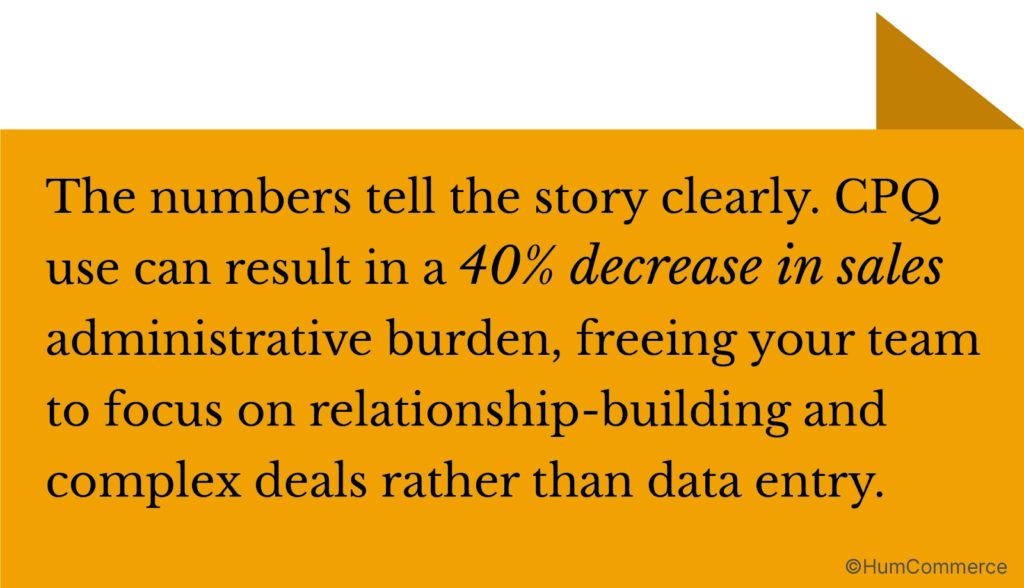
Companies using CPQ systems have seen a 17% higher lead conversion rate, because faster, more accurate quotes mean fewer abandoned opportunities.
For manufacturers with highly configurable products, the pain compounds. Every custom specification, every regional pricing variation, every volume discount tier adds complexity that manual processes struggle to handle consistently. One client we worked with at HumCommerce saw quote turnaround time reduced from 3-5 days to just hours after automating quote capture, approvals, and ERP/CPQ checks in their end-to-end workflow.
The competitive pressure is real. When your competitor can return an accurate, professional quote in 30 minutes while your team takes three days, the buyer’s decision often makes itself.
Why Use CPQ Tools to Eliminate Quoting Bottlenecks in B2B Ecommerce Is a Priority Now
The market is moving fast. The CPQ market is expected to reach $7.96 Billion by 2031 at a CAGR of 16.5%, signaling that your competitors are investing in these capabilities. If you are still relying on email chains, spreadsheets, and tribal knowledge for complex quotes, you are falling behind.
Buyer expectations have shifted permanently. B2B buyers now expect the speed and transparency they experience in consumer ecommerce. They want to configure products, see accurate pricing, and receive quotes without waiting for a sales rep to manually compile information from three different systems.
The integration landscape has matured. Modern CPQ platforms connect directly to ERP systems, commerce platforms, and CRM tools. This means quotes can pull real-time inventory, apply contract pricing rules automatically, and flow into orders without manual intervention. The technology exists: the question is whether you will implement it before your competitors do.
What ‘Done’ Looks Like When You Use CPQ Tools to Eliminate Quoting Bottlenecks in B2B Ecommerce
Before diving into implementation steps, you need a clear picture of the end state. A well-implemented CPQ solution creates a quoting workflow where:
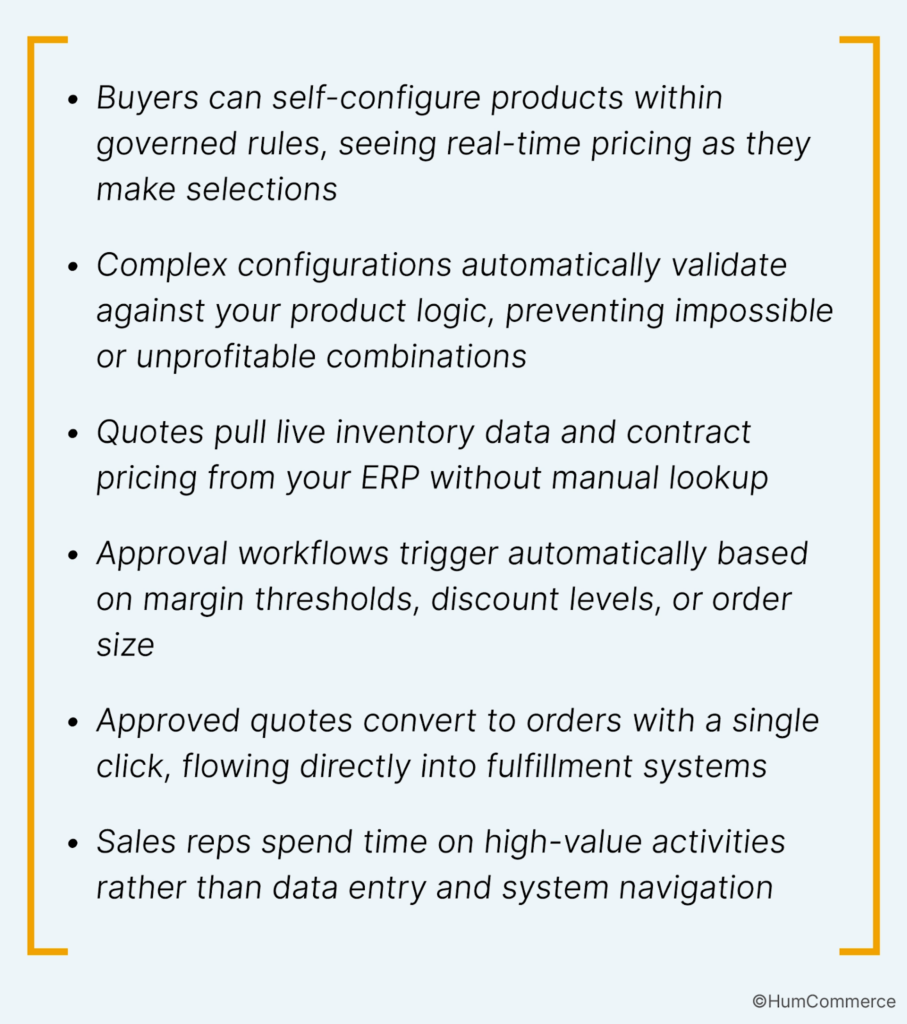
CPQ enables sales teams to generate accurate, error-free quotes in minutes instead of hours or days, with some reports indicating 10x faster quote generation. That is the benchmark you are working toward.
Step 1: Map How You Use CPQ Tools to Eliminate Quoting Bottlenecks in B2B Ecommerce Today
You cannot fix what you have not measured. Start by documenting your current quoting process in detail, including every handoff, every system, and every delay point.
Document the Current Workflow
Walk through a typical quote from initial customer request to signed order. Identify who touches the quote at each stage, which systems they access, and how long each step takes. Pay special attention to:
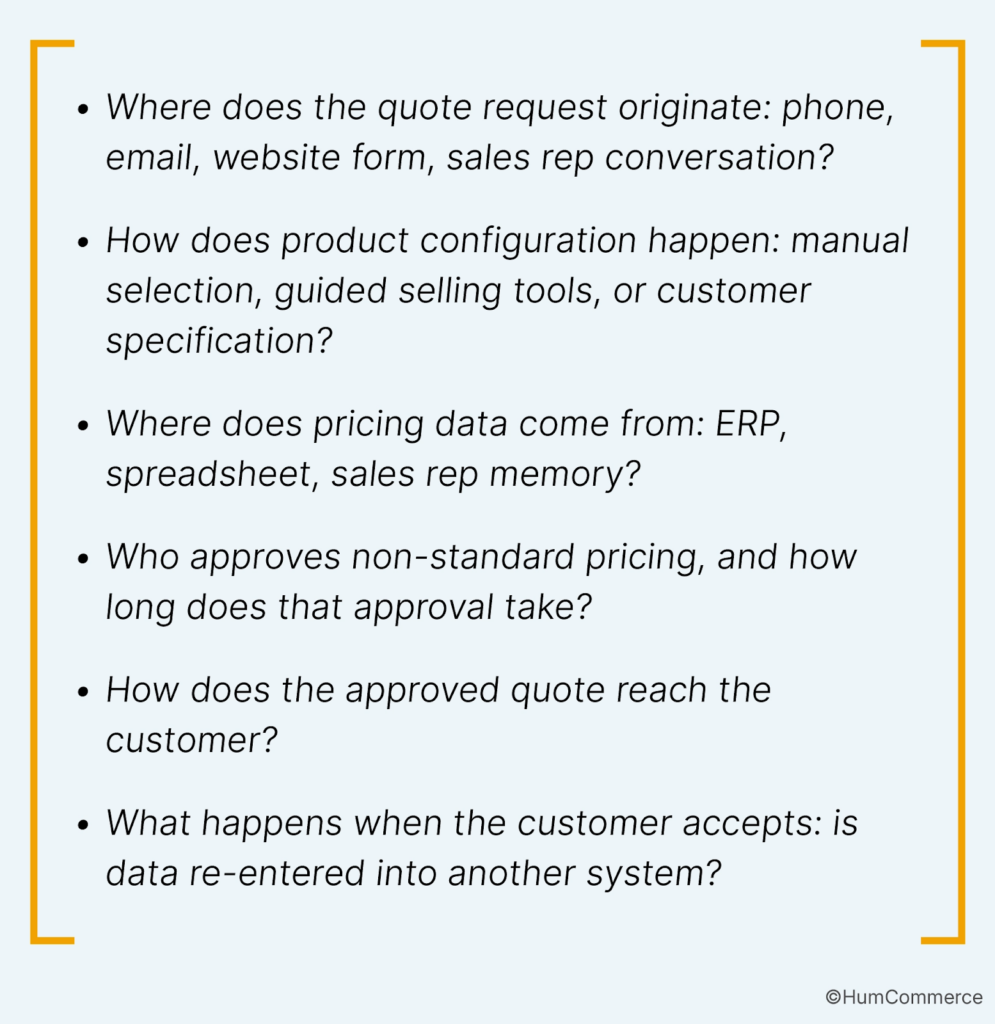
Identify Bottleneck Points
Common bottleneck patterns include approval delays when pricing authority sits with a single manager, configuration errors that require quote revision, inventory disconnects that force requoting when products are unavailable, and system handoffs where data must be manually transferred.
One manufacturing client discovered that 60% of their quote cycle time was consumed by internal approvals that could have been automated based on simple margin rules. Another found that sales reps were spending two hours per complex quote just navigating between their CRM, ERP, and commerce platform.
Step 2: Check If You’re Ready to Use CPQ Tools to Eliminate Quoting Bottlenecks in B2B Ecommerce
CPQ implementation requires certain foundational elements. Assess your readiness across these dimensions before selecting a platform or beginning implementation.
Data Readiness
Your product data must be structured, complete, and accurate. CPQ tools cannot configure products correctly if your product attributes, pricing rules, and configuration logic are not documented and digitized. Ask yourself:
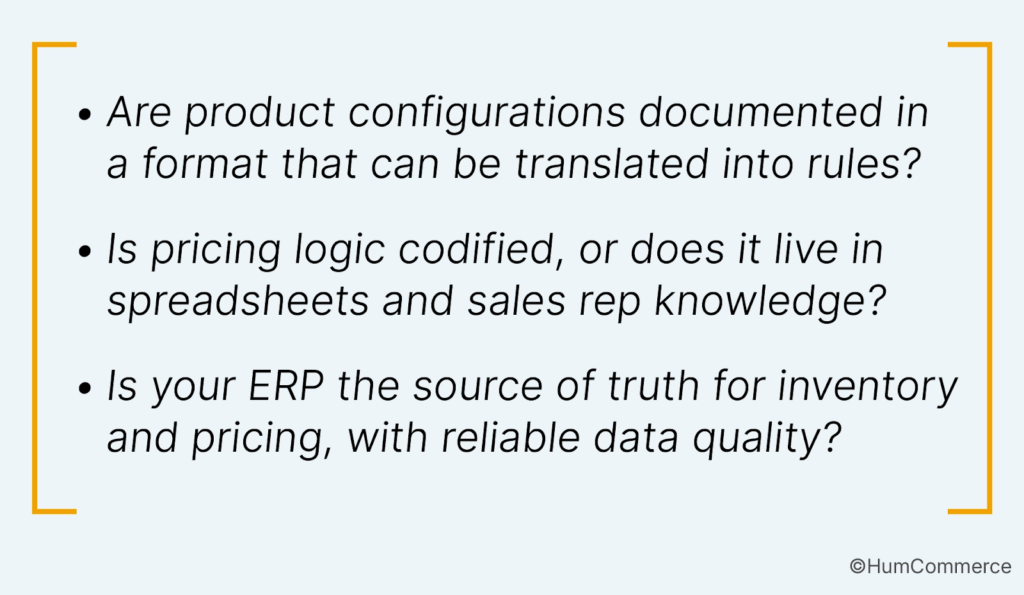
System Readiness
CPQ works best when connected to your commerce platform and ERP. Evaluate your current integration capabilities. Do you have APIs available for your ERP system? Is your commerce platform capable of real-time data exchange? HumCommerce specializes in these ERP-first integrations for Adobe Commerce, ensuring that CPQ capabilities connect directly to your operational systems rather than creating another data silo.
Organizational Readiness
Sales teams sometimes resist CPQ adoption, fearing it will cannibalize their commissions or make their expertise obsolete. Address this directly with commission protection plans that attribute online orders to assigned reps, transparent communication about how CPQ makes their jobs easier, and early adopter incentives.
Step 3: Prepare Your Systems and Data
With your current state documented and readiness assessed, focus on preparing the foundation for CPQ implementation.
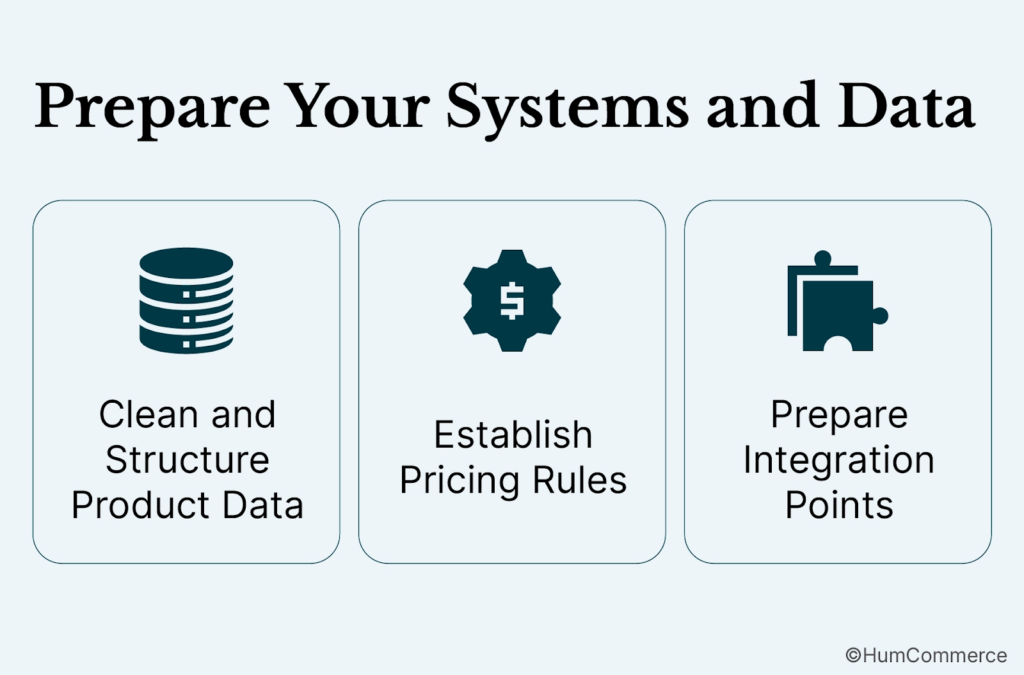
Clean and Structure Product Data
Product configuration logic must be explicit and complete. Work with your engineering and product teams to document every valid configuration, every constraint, and every dependency. This is often the most time-consuming step, but it is essential. CPQ systems are only as good as the rules they enforce.
Establish Pricing Rules
Document your pricing logic in a format that can be automated. This includes base pricing, volume discounts, customer-specific contract pricing, regional variations, and approval thresholds. The goal is to eliminate manual pricing decisions for standard scenarios while routing exceptions to appropriate approvers automatically.
Prepare Integration Points
Identify the specific data flows required between your CPQ tool, commerce platform, and ERP. At minimum, you will need:
- Real-time inventory availability from ERP to CPQ
- Contract pricing and customer-specific terms from ERP to CPQ
- Quote data from CPQ to commerce platform for customer visibility
- Order data from commerce platform to ERP for fulfillment
CPQ can reduce sales cycles by 28% and shorten pricing approval times by 95%, but only when these integrations work reliably.
Step 4: Design the Improved Process
With data and systems prepared, design your target-state quoting workflow. This is where you translate bottleneck elimination into specific process changes.
Define Self-Service Boundaries
Determine which configurations and pricing scenarios buyers can handle independently through your commerce portal, and which require sales rep involvement. The best implementations let buyers start self-serve, then invite a sales rep into the same cart or quote context when needed: no re-keying required.
Design Approval Workflows
Create automated approval routing based on clear business rules. For example:
- Quotes within standard margin thresholds approve automatically
- Quotes with discounts above 15% route to regional sales manager
- Quotes above $50,000 require VP approval
- Quotes with non-standard configurations route to engineering for validation
Plan the Quote-to-Order Transition
Design the handoff from approved quote to order entry. The goal is zero re-keying. When a customer accepts a quote, that acceptance should trigger order creation in your commerce platform with all configuration, pricing, and customer data intact, then flow automatically to your ERP for fulfillment.
Step 5: Implement Changes in Your Stack
Implementation approach depends on your specific technology stack and organizational constraints. However, certain principles apply universally.
Start with High-Volume, Standard Scenarios
Do not try to automate every possible configuration on day one. Begin with your most common product configurations and standard pricing scenarios. These represent the highest volume of quotes and the greatest opportunity for immediate impact.
Build Integration First
The connection between CPQ, commerce, and ERP is the backbone of the entire solution. Ensure these integrations are solid before adding complexity. HumCommerce achieved 75% faster quote workflows for a complex B2B manufacturer by integrating Epicor CPQ with Magento, with automated, rules-driven quoting tied directly to ERP pricing and approval logic.
Configure Validation Rules
Build in safeguards that prevent invalid configurations from reaching customers. This protects both your operations and your customer relationships. Nothing damages trust faster than quoting a configuration you cannot actually deliver.
Test with Real Scenarios
Use actual quote requests from your recent history to validate the system. Compare CPQ-generated quotes against manually created quotes to verify accuracy. Test edge cases and exception scenarios to ensure appropriate routing.
Step 6: Pilot, Measure, Improve
CPQ implementation is not a one-time project. Plan for iterative improvement based on real-world performance data.
Define Success Metrics
Establish baseline measurements before launch and track progress against them. Key metrics include:
- Quote turnaround time: from request to customer delivery
- Quote accuracy: percentage requiring revision after initial delivery
- Conversion rate: percentage of quotes that become orders
- Sales rep time allocation: hours spent on quoting versus selling
- Customer satisfaction: feedback on quoting experience
Run a Controlled Pilot
Select a subset of products, customers, or sales reps for initial deployment. This limits risk while generating real performance data. Monitor closely during the pilot period and address issues before broader rollout.
Iterate Based on Data
Use pilot results to refine configuration rules, approval workflows, and integration logic. Common adjustments include expanding self-service boundaries as confidence grows, refining approval thresholds based on actual exception patterns, and adding product configurations that were initially excluded.
Common Mistakes to Avoid When You Use CPQ Tools to Eliminate Quoting Bottlenecks in B2B Ecommerce
Experience across multiple implementations reveals consistent failure patterns. Avoid these common mistakes to improve your chances of success.
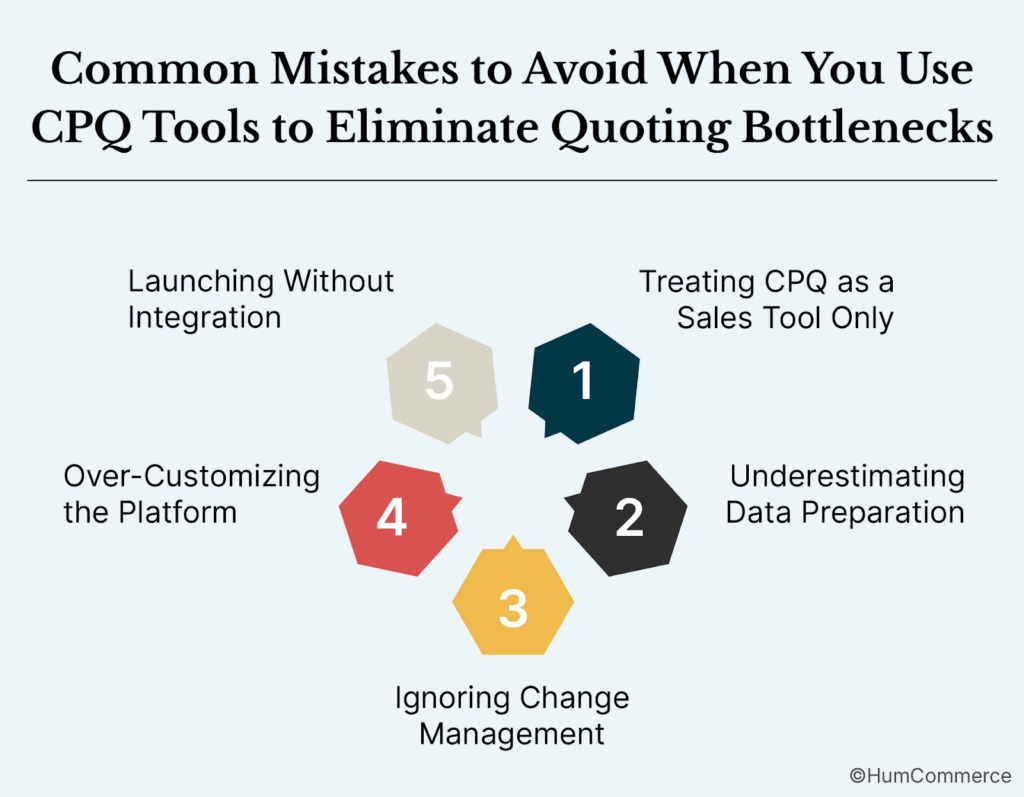
Treating CPQ as a Sales Tool Only
CPQ is an operational system, not just a sales enablement tool. When CPQ connects to the rest of the enterprise, quoting stops being a sales task and becomes part of the order-to-cash workflow. Implementations that treat CPQ as a standalone sales tool miss the integration benefits that drive real efficiency gains.
Underestimating Data Preparation
The single most common cause of CPQ project delays is incomplete or inaccurate product and pricing data. Budget significant time for data preparation, and do not assume your current documentation is sufficient. Test every configuration rule against real-world scenarios.
Ignoring Change Management
Sales teams accustomed to manual processes need training, support, and incentives to adopt new workflows. Provide live training sessions, role-specific video tutorials, and ongoing support channels. Make early adopters visible and celebrate their wins.
Over-Customizing the Platform
Resist the temptation to customize your CPQ platform to match every quirk of your current process. Sometimes current processes exist because of system limitations that no longer apply. Use CPQ implementation as an opportunity to standardize and simplify, not just automate existing complexity.
Launching Without Integration
A CPQ tool that is not connected to your ERP and commerce platform creates a new data silo rather than eliminating bottlenecks. Ensure integration is complete and reliable before launch. Quotes that require manual data transfer defeat the purpose of automation.
Need Help Putting This Into Practice?
Implementing CPQ to eliminate quoting bottlenecks requires expertise across commerce platforms, ERP systems, and B2B workflow design. The technical integration is complex, and the process design requires deep understanding of manufacturing and distribution operations.
HumCommerce specializes in exactly this type of implementation for Adobe Commerce environments. We design commerce systems that behave like part of your ERP and operations: real-time inventory visibility, two-way sync for orders and returns, and contract pricing that always follows ERP rules. Our work with complex B2B manufacturers has delivered measurable results, including 75% faster quote workflows and quote turnaround reduced from days to hours.If you are ready to move beyond spreadsheets and email chains to a connected quoting workflow, contact HumCommerce to discuss your specific situation. We will help you assess readiness, design the right approach, and implement a solution that actually works with your existing systems.