TL;DR
- B2B sales cycles are shrinking, and companies that don’t adapt risk losing deals to competitors who offer faster, more transparent buying experiences.
- The average B2B sales cycle dropped from 11.3 months in 2024 to 10.1 months in 2025, according to Venli Consulting.
- This compression isn’t accidental: it’s driven by ecommerce strategies that eliminate friction, automate approvals, and give buyers the information they need without waiting for a sales rep to respond.
- This guide walks through a six-step process for optimizing your B2B sales cycle using ecommerce tools, from mapping your current state to implementing changes that measurably reduce time-to-close.
Why This Matters for B2B Distributions
The global B2B e-commerce market is projected to reach $36 trillion by 2026, and distributors who rely on manual processes are watching deals slip away. Your competitors aren’t just offering better products: they’re offering faster purchasing experiences. When a buyer can log into a competitor’s portal, see their contract pricing, check real-time inventory, and submit a purchase order in fifteen minutes, your three-day quote turnaround becomes a liability.
Digital channels now influence over 70% of B2B purchasing decisions, according to WebAlive. This means buyers are forming opinions about your company long before they speak with a sales rep. If your digital experience creates friction: unclear pricing, manual quote requests, no inventory visibility: you’ve already lost ground.
For distributors managing thousands of SKUs, complex pricing tiers, and multi-location inventory, the challenge isn’t just having an ecommerce site. It’s having one that actually accelerates deals rather than creating another channel your team has to manage manually.
Why Optimize B2B Sales Cycles with Ecommerce Strategies That Shorten Time-to-Close Is a Priority Now
Buyer expectations have fundamentally shifted. As Chris M. Walker, Founder and CEO at Legiit, puts it: “B2B buyers now demand the same seamless, instant purchasing experience they have as B2C consumers.” Your buyers spend their personal time on Amazon, where they can see prices, availability, and delivery dates instantly. They don’t reset those expectations when they switch to procurement mode.
The data supports this urgency. Win rates increase by 3.1x when deals align with the ideal customer profile, according to Webolutions Marketing Agency. Ecommerce platforms help you identify and prioritize these high-fit prospects by tracking behavior, purchase history, and engagement patterns: information that’s invisible in phone-based selling.
AI adoption among sales teams has reached 43% in 2026, according to SwiftCloud. Companies using AI for lead scoring, quote generation, and buyer assistance are closing deals faster than those relying on manual processes. The gap between digital leaders and laggards is widening, and catching up gets harder every quarter.
What ‘Done’ Looks Like When You Optimize B2B Sales Cycles with Ecommerce Strategies That Shorten Time-to-Close
Before diving into implementation, you need a clear picture of the end state. A fully optimized B2B ecommerce operation looks different from a basic online catalog.
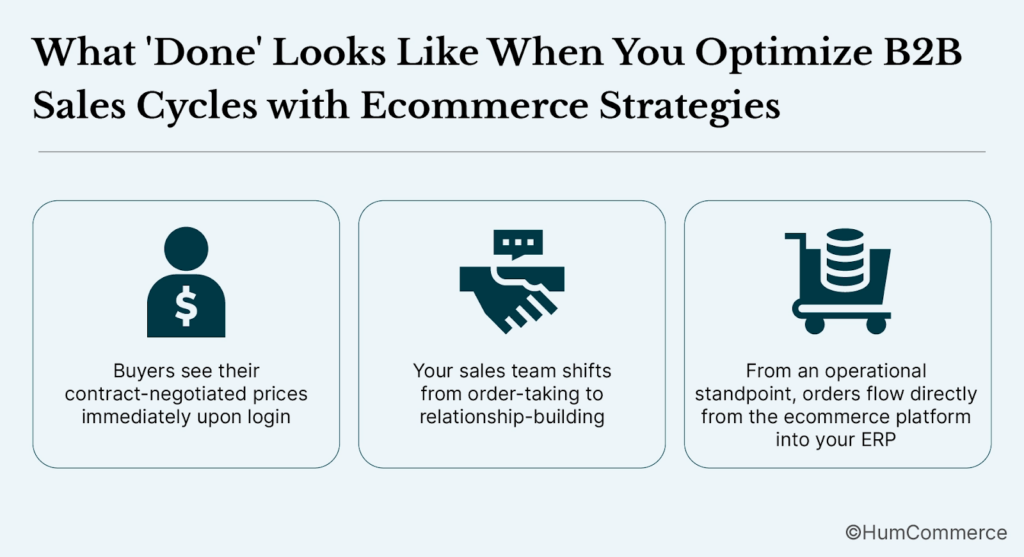
Buyers see their contract-negotiated prices immediately upon login: no waiting for a rep to pull up their account. Inventory levels update in real-time from your ERP, so buyers know what’s available before they commit. Quote requests that used to take three to five days now resolve in hours because approval workflows are automated and pricing rules are built into the system.
Your sales team shifts from order-taking to relationship-building. They spend time on complex negotiations and new account development, not answering “what’s my price” and “is it in stock” questions. The portal handles routine transactions, freeing reps to focus on deals that actually require human judgment.
From an operational standpoint, orders flow directly from the ecommerce platform into your ERP without manual re-entry. Returns, credits, and adjustments sync back automatically. Your finance team stops chasing discrepancies between what the website promised and what the ERP shows.
Step 1: Map How You Optimize B2B Sales Cycles with Ecommerce Strategies That Shorten Time-to-Close Today
Start by documenting your current sales cycle in detail. You can’t improve what you haven’t measured, and most companies underestimate how much time gets lost in their existing process.
Track a sample of recent deals from first contact to closed order. Note every handoff: marketing to sales, sales to quoting, quoting to approval, approval to order entry. Measure the time between each stage. You’ll likely find that the actual selling conversation represents a small fraction of the total cycle time. The rest is waiting: waiting for quotes, waiting for approvals, waiting for inventory confirmation.
Interview your sales team about their biggest time sinks. Common answers include: pulling customer-specific pricing from the ERP, checking inventory across multiple warehouses, getting credit approval for new accounts, and re-entering orders that came in via email or phone. Each of these represents an automation opportunity.
Map your buyer’s journey from their perspective. Where do they encounter friction? A 2025 Spryker/Statista+ study found that self-service portals are the second most preferred channel for B2B purchases, yet they rank only fourth in actual usage. This gap between preference and behavior usually indicates that existing portals don’t meet buyer needs.
Step 2: Check If You’re Ready to Optimize B2B Sales Cycles with Ecommerce Strategies That Shorten Time-to-Close
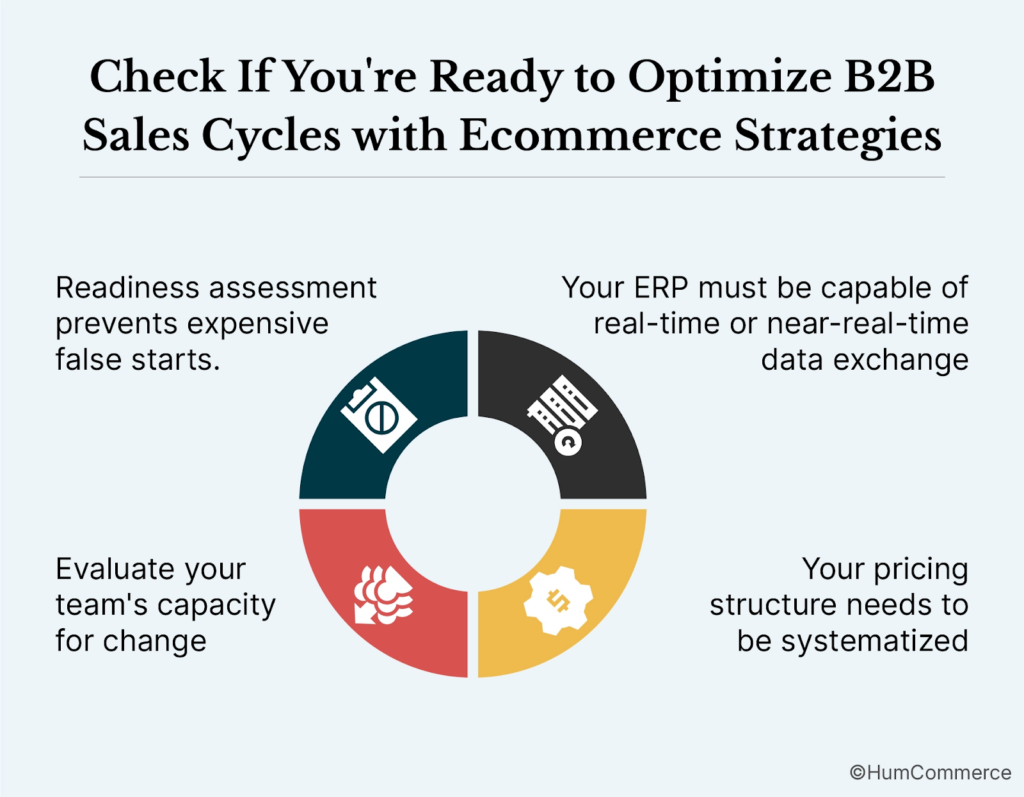
Readiness assessment prevents expensive false starts. Not every company is positioned to implement advanced ecommerce capabilities immediately.
Your ERP must be capable of real-time or near-real-time data exchange. If your inventory updates run as overnight batch jobs, buyers will see stale availability data, leading to order failures and frustrated customers. Modern API-based integrations can sync inventory, pricing, and order data in seconds, but your ERP needs to support this architecture.
Your pricing structure needs to be systematized. If every customer’s pricing exists only in a sales rep’s head or a scattered collection of spreadsheets, you’ll need to consolidate and standardize before automation is possible. This doesn’t mean eliminating custom pricing: it means documenting the rules that govern it.
Evaluate your team’s capacity for change. Sales teams sometimes resist ecommerce because they fear commission cannibalization. Address this early by designing attribution models that credit reps for online orders from their accounts. Operations teams need bandwidth to support implementation without dropping their daily responsibilities.
Step 3: Prepare Your Systems and Data
Data quality determines ecommerce success more than any other factor. A beautiful portal built on dirty data will fail.
Start with your product information. Every SKU needs accurate descriptions, specifications, images, and categorization. B2B buyers often search by part number, specification, or application: your catalog must support these search patterns. If you’re managing thousands of SKUs, a Product Information Management system becomes essential for maintaining consistency.
Audit your customer data. Each account needs accurate contact information, pricing tier assignments, credit terms, and shipping preferences. Consolidate duplicate records. Verify that the pricing in your ERP matches what sales has promised customers: discrepancies here create immediate trust problems when buyers see different prices online.
Plan your integration architecture. Adobe Commerce supports deep ERP integration through APIs, allowing real-time sync of inventory, pricing, orders, and customer data. The goal is a single source of truth: your ERP holds the master data, and the ecommerce platform reflects it accurately. HumCommerce specializes in these ERP-first implementations, designing Adobe Commerce to behave like part of your operations rather than a disconnected storefront.
Step 4: Design the Improved Process
With your current state mapped and systems prepared, you can design the target workflow that will shorten your sales cycle.
Prioritize self-service for routine transactions. Research shows that custom pricing rules integration delivers the highest conversion lift at 37% among all B2B portal features. When buyers can see their negotiated prices, check availability, and place orders without sales involvement, you’ve eliminated days from the cycle.
Build approval workflows into the platform. Multi-level purchase order approvals, credit limit checks, and exception handling should happen within the ecommerce system, not through email chains. Define clear rules: orders under a certain threshold auto-approve, orders above it route to the appropriate approver with all relevant information attached.
Design for the handoff between self-service and sales assistance. Not every transaction should be fully automated. Complex quotes, custom configurations, and new account negotiations still benefit from human involvement. The best implementations let buyers start self-serve, then invite a sales rep into the same cart or quote context without re-keying information. HumCommerce has helped manufacturers achieve 75% faster quote workflows by integrating Epicor CPQ with Magento, eliminating the back-and-forth of manual quoting.
Step 5: Implement Changes in Your Stack
Implementation sequencing matters. Attempting to launch everything simultaneously increases risk and extends timelines.
Phase one focuses on authenticated pricing and inventory visibility. These capabilities deliver immediate value with relatively contained scope. Buyers log in, see their prices, and check stock: no quotes required for standard items. This phase typically reduces sales cycle time for repeat orders by 40% or more.
Phase two adds quote management and approval workflows. Integrate your CPQ system if you have one, or build quote functionality into the commerce platform. Automate rules-driven quoting so standard configurations generate instant quotes while complex requests route to the appropriate team. One HumCommerce client reduced quote turnaround from three to five days to just hours by automating quote capture, approvals, and ERP/CPQ checks.
Phase three introduces advanced capabilities: AI-powered search and recommendations, conversational assistants for product discovery, predictive reordering based on purchase history. These features accelerate deals by helping buyers find what they need faster, particularly valuable for companies with large, complex catalogs.
Step 6: Pilot, Measure, Improve
Resist the temptation to launch broadly before validating with a controlled group. Pilots reveal problems that testing environments miss.
Select a pilot group that represents your broader customer base but is forgiving enough to tolerate early issues. Good candidates include long-standing accounts with strong relationships, buyers who have explicitly requested better digital tools, and accounts with high order frequency that will generate meaningful usage data quickly.
Define your success metrics before launch. Common measures include time from quote request to quote delivery, time from order placement to ERP confirmation, self-service adoption rate, and support ticket volume related to pricing or availability questions. Establish baselines from your current state mapping so you can demonstrate improvement.
Gather qualitative feedback alongside quantitative metrics. Watch buyers use the system. Ask what’s confusing, what’s missing, what would make them use it more. This feedback shapes iteration priorities and often reveals opportunities you hadn’t considered.
Common Mistakes to Avoid When You Optimize B2B Sales Cycles with Ecommerce Strategies That Shorten Time-to-Close
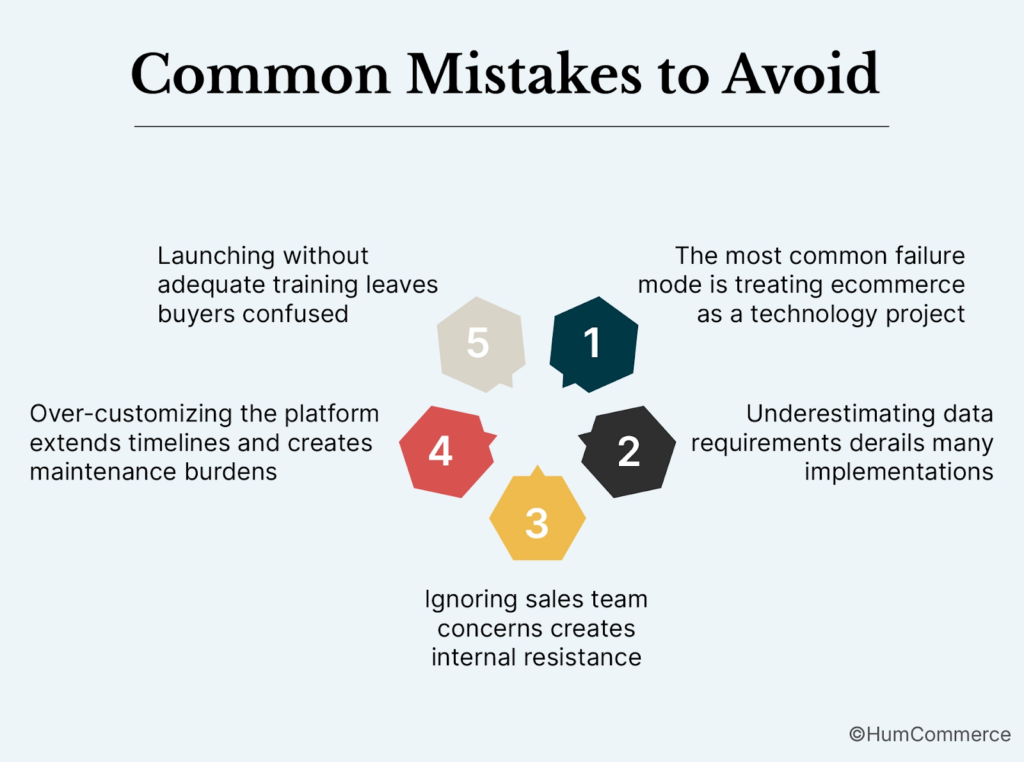
The most common failure mode is treating ecommerce as a technology project rather than a business transformation. Installing software doesn’t change behavior: you need to redesign processes and support people through the transition.
Underestimating data requirements derails many implementations. Companies assume they can clean up product and pricing data “as they go,” but dirty data creates immediate credibility problems with buyers. If a customer sees the wrong price or inaccurate inventory on day one, they won’t trust the system on day thirty.
Ignoring sales team concerns creates internal resistance. Reps who feel threatened by digital channels will actively discourage customers from using them. Involve sales early, design commission structures that reward online adoption, and position the portal as a tool that makes their jobs easier rather than obsolete.
Over-customizing the platform extends timelines and creates maintenance burdens. Adobe Commerce offers extensive B2B functionality out of the box: company accounts with hierarchical structures, shared catalogs with customer-specific pricing, quote management, quick order functionality, and purchase order workflows. Start with standard capabilities before building custom features.
Launching without adequate training leaves buyers confused. A portal that requires a manual to use won’t get adopted. Invest in onboarding: guided tours, video tutorials, and responsive support for the first few weeks after launch.
Need Help Putting This Into Practice?
Shortening your B2B sales cycle through ecommerce isn’t just about technology: it’s about connecting your commerce platform to the operational systems that run your business. When your Adobe Commerce store reflects real ERP data, enforces actual pricing rules, and automates genuine approval workflows, buyers get the instant, transparent experience they expect while your operations stay accurate.
HumCommerce specializes in exactly this kind of ERP-first, operations-led commerce for manufacturers, distributors, and wholesalers. We’ve helped companies achieve dramatic reductions in quote turnaround time, eliminate manual order re-entry, and give sales teams back hours of their week.If you’re ready to explore how ecommerce strategies can compress your sales cycle, start with a focused conversation about your current state and goals. Request a consultation with HumCommerce to discuss your specific situation.