This is not a productivity article. It’s a P&L analysis.
TL;DR
- Manual quoting costs a 10-rep B2B sales team $390,000-$780,000 per year in rep labor, depending on quote volume and complexity.
- The formula: quotes per week x hours per quote x loaded rep rate x 52 weeks.
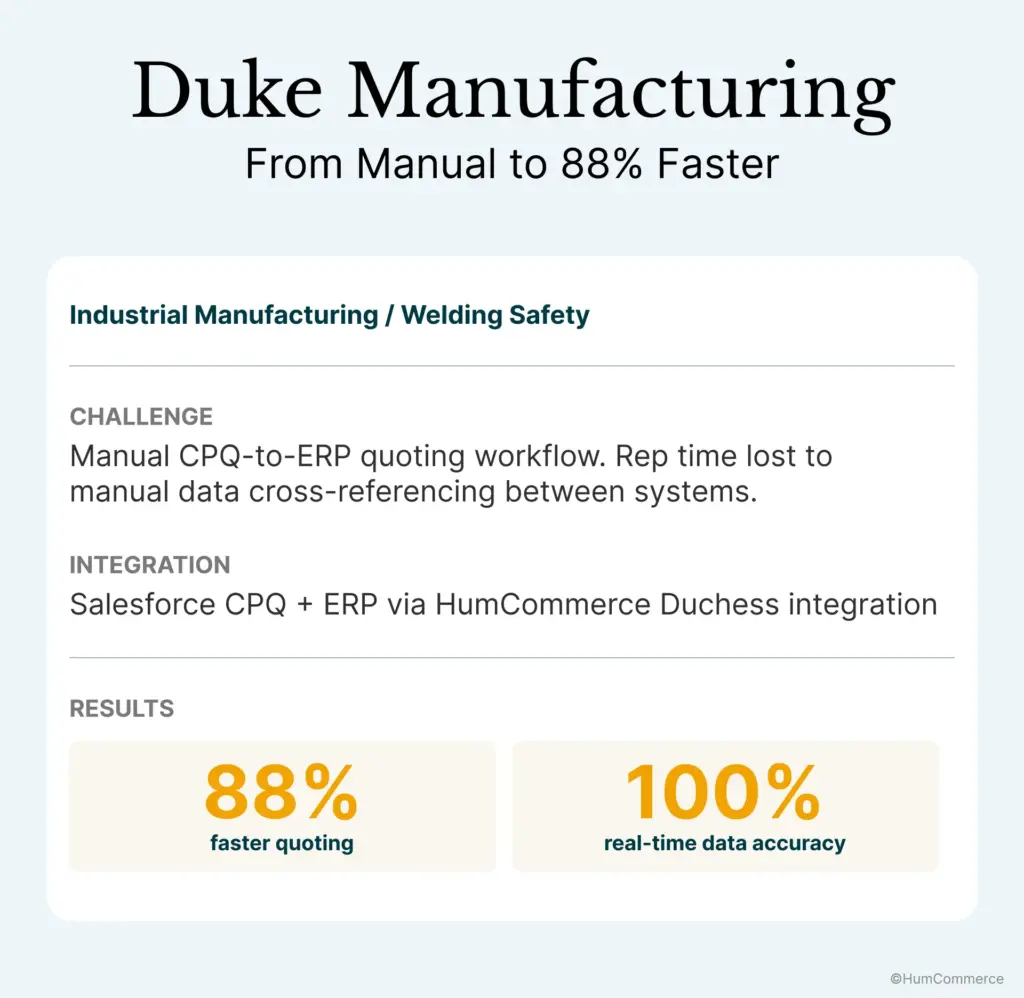
- Duke Manufacturing achieved 88% faster quoting and 100% real-time data accuracy after HumCommerce integrated their CPQ and ERP systems. Their ROI was positive within the first year.
- Automated quoting reduces quote time from 45-90 minutes to 5-15 minutes for standard orders — a 75-90% reduction.
- Beyond labor savings, faster quoting directly improves win rate. Research shows deals receiving responses within 4 hours close at a 35% higher rate than deals taking more than 24 hours.
There’s a number sitting inside your sales budget that doesn’t have a line item. It’s not labeled “quoting inefficiency” or “manual process cost.” It’s distributed across 10 salary lines, showing up as compensation for a team that spends a significant portion of every week on work that doesn’t require a human.
For most B2B manufacturers and distributors running manual quoting, that number is $390,000 to $780,000 per year for a 10-rep team. Here’s how to calculate yours, and what automated quoting does to it.
The Manual Quoting Cost Model
The cost model has three inputs: quote volume, time per quote, and rep loaded cost.
Quote volume: How many quotes does your team produce per week? For a 10-rep team at a mid-size manufacturer or distributor, 100-200 quotes per week is typical. That’s 10-20 per rep per week.
Time per quote: For standard orders with customer-specific pricing, the manual process takes 45-90 minutes. The majority of that time goes to three tasks that automation eliminates: pulling contract pricing from the ERP, checking inventory across locations, and calculating volume tier discounts.
Loaded rep cost: A B2B sales rep with total compensation of $80,000-$100,000 per year, including salary, commission, benefits, and overhead, costs roughly $40-$50 per hour fully loaded.
The formula:
(Quotes per week) x (Hours per quote) x (Loaded hourly rate) x 52 = Annual quoting labor cost
At three operating scales:
| Team size | Quotes/week | Hours/quote | Hourly rate | Annual cost |
| 5 reps | 75 | 1.0 hr | $45/hr | $175,500 |
| 10 reps | 150 | 1.25 hrs | $45/hr | $438,750 |
| 20 reps | 300 | 1.0 hr | $45/hr | $702,000 |
These numbers assume one hour per quote on average. For operations with complex pricing, multi-location inventory, or custom configuration, actual quote times run 75-90 minutes, which increases the annual cost by 25-50%.
What the Calculation Usually Misses
The formula above captures direct quoting labor. Two additional cost categories are real but harder to quantify:
Revenue lost to slow response
When a buyer submits an RFQ to three suppliers simultaneously and your quote arrives 24 hours after your competitor’s, you’re not competing on equal terms. Research from Proposify across nearly 2 million proposals found that deals where prospects receive responses within 4 hours close at a 35% higher rate than deals with 24-hour response times.
For a 10-rep team generating $20M in annual revenue through quotes, a 10% improvement in win rate on time-sensitive deals is $2M in additional revenue. That number doesn’t appear in the quoting cost model, but it’s part of the true cost of slow quoting.
Pricing errors and their downstream cost
Manual quoting depends on reps accurately cross-referencing current contract pricing. When they get it wrong — common with complex tiered pricing or recent contract updates — the result is a quote with an incorrect price. Once the buyer accepts and places the order, the error has to be corrected at the rep’s expense in time and goodwill.
FHC’s previous manual quoting process produced pricing errors that required correction after quotes were sent. After HumCommerce integrated their Epicor CPQ with Magento, they achieved 100% real-time quoting accuracy. The cost of those corrections — in rep time, customer friction, and delayed order processing — was eliminated.
What Automated Quoting Costs
Automated quoting via an ERP-connected CPQ or AI assistant reduces the three manually intensive steps to near zero:
- Pricing lookup: 10-20 manual minutes → under 2 seconds automated
- Inventory check: 10-15 manual minutes → under 2 seconds automated
- Volume tier calculation: 10-20 manual minutes → automated with ERP query
The rep’s remaining task: review the system-generated output and send or adjust. Total time: 5-15 minutes per quote for standard orders.
At the same three operating scales:
| Team size | Quotes/week | Hours/quote (automated) | Hourly rate | Annual cost |
| 5 reps | 75 | 0.17 hrs | $45/hr | $29,835 |
| 10 reps | 150 | 0.17 hrs | $45/hr | $59,670 |
| 20 reps | 300 | 0.17 hrs | $45/hr | $119,340 |
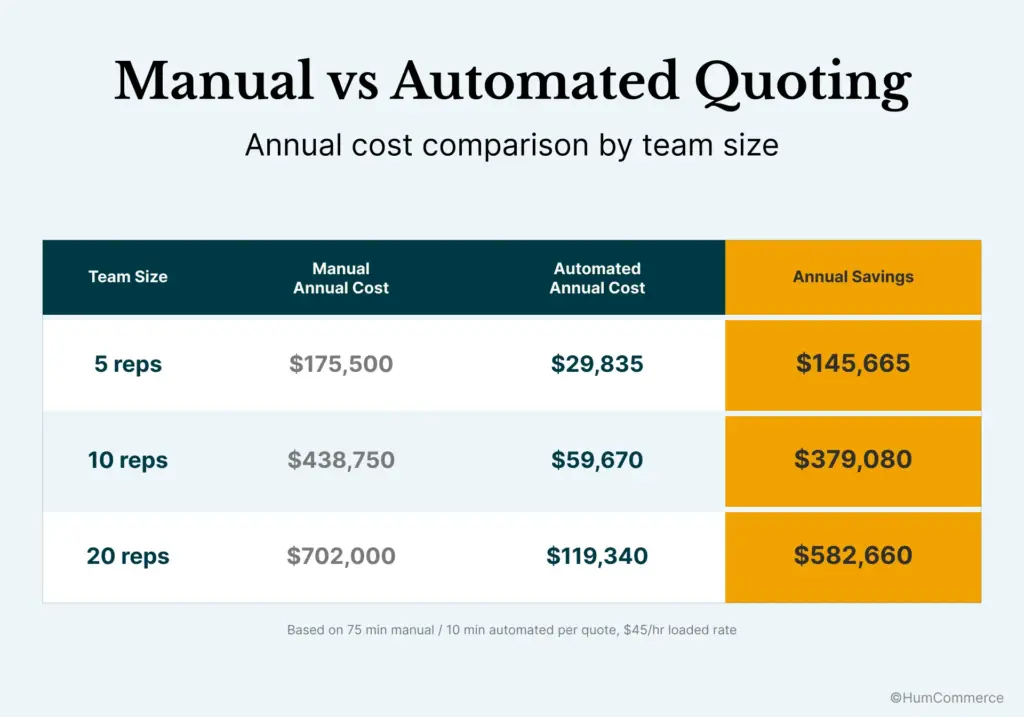
Annual quoting labor savings:
| Team size | Manual | Automated | Annual savings |
| 5 reps | $175,500 | $29,835 | $145,665 |
| 10 reps | $438,750 | $59,670 | $379,080 |
| 20 reps | $702,000 | $119,340 | $582,660 |
The Duke Manufacturing Case: 88% Faster Quoting
Duke Manufacturing, a US-based industrial manufacturer specializing in welding safety equipment, ran a manual quoting workflow that required reps to move between Salesforce CRM, CPQ, and their ERP to assemble each quote. The process was time-intensive and prone to errors when pricing data didn’t fully sync between systems.
HumCommerce integrated their Salesforce CPQ and ERP via a custom Duchess middleware integration, establishing real-time bidirectional data sync. The outcome: 88% faster quoting and 100% real-time data accuracy.
Their sales team’s time allocation shifted from quote assembly to customer relationship management and new account development — the work that requires judgment and generates revenue that manual quote processing cannot.
Building the ROI Case Internally
The conversation your CFO or COO needs to see is simple: what is the current annual cost of manual quoting, and what is the implementation cost to eliminate it?
Step 1: Run the cost model. Use your actual quote volume, average time per quote (track a sample week), and fully loaded rep rate. Get the annual number.
Step 2: Add the revenue component. If you track win rates by response time or can estimate the deals lost to slow turnaround, add that figure. If not, conservative estimates based on industry research (35% higher close rate for sub-4-hour response) are defensible.
Step 3: Get the implementation cost. A standard CPQ-to-ERP integration for quoting automation at a mid-size manufacturer or distributor typically costs a fraction of the annual labor savings. The payback period on a 10-rep operation is almost always under 12 months.
Step 4: Present the gap. “We currently spend approximately $X per year in quoting labor, plus an estimated $Y in revenue impact from slow response times. Automating quoting costs approximately $Z with a payback period of N months.” That’s a business conversation, not a technology conversation.
Sources
- Salesforce, State of Sales, 6th Edition, 2025
- Proposify, State of Proposals 2025 — 35% higher close rate for sub-4-hour responses: https://www.cobl.ai/blog/sales-proposal-statistics-what-actually-closes-deals
- goautonomous.io, B2B Quote Response Time Benchmark 2026: https://goautonomous.io/blogs/b2b-quote-response-time-benchmark-2026-how-long-manufacturers-take-to-quote/
- Duke Manufacturing case study, HumCommerce — 88% faster quoting, 100% real-time data sync
- FHC case study, HumCommerce — 75% faster workflows, 100% real-time quoting accuracy