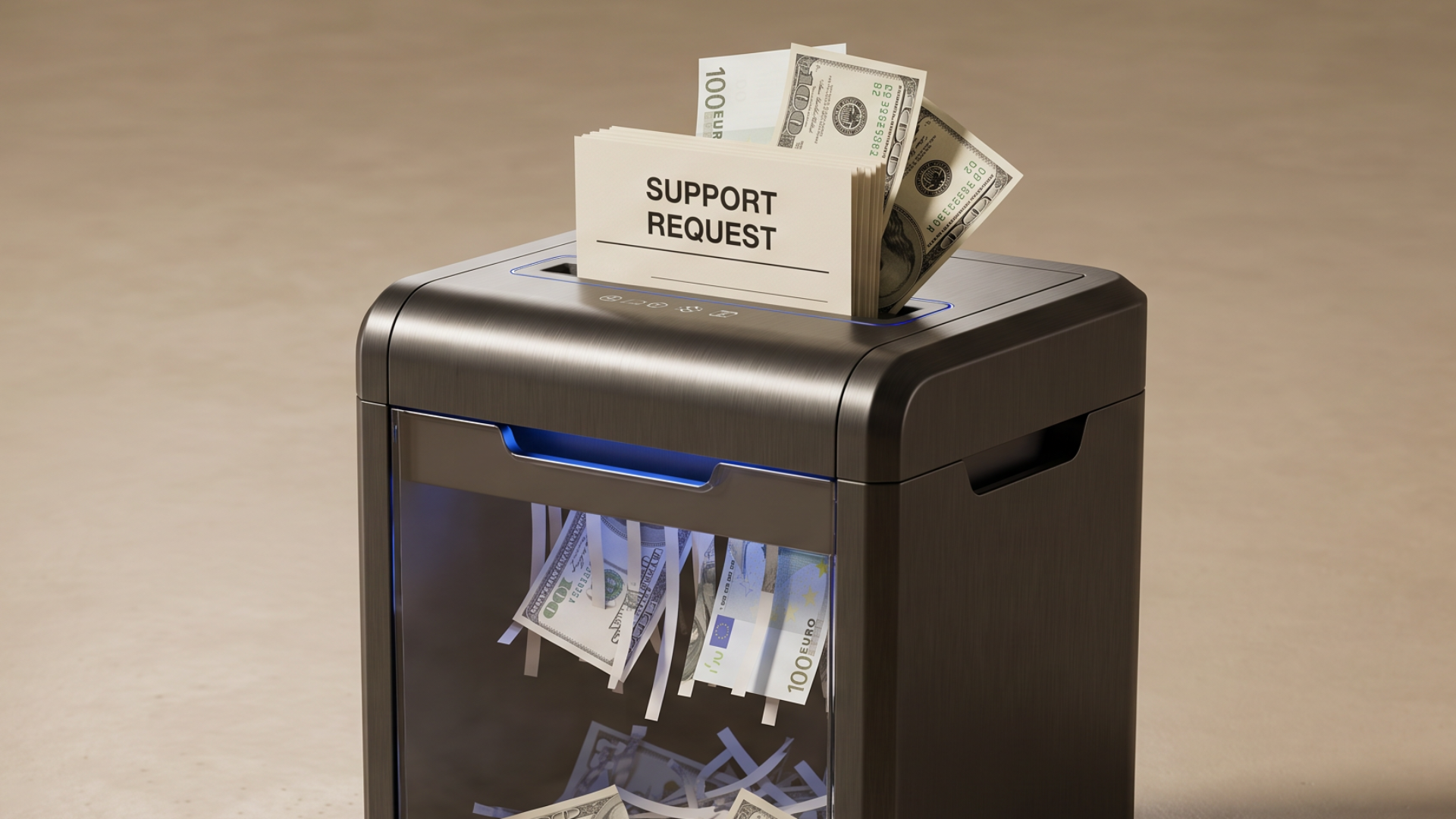
40-60% of what your support team handles today doesn’t require a human. Here’s what that costs annually.
TL;DR
- The average human-handled routine B2B support ticket costs $8-$15 in staff time. AI-handled interactions cost $0.10-$0.50.
- 40-60% of inbound contacts at B2B manufacturers and distributors are routine queries answerable with ERP data: order status, pricing, inventory, invoice history.
- For a 5-person support team handling 300 contacts per week, 60% AI deflection saves $100,000-$150,000 annually in support labor.
- Reducing routine tickets doesn’t require reducing headcount. It redirects your support team to complex and high-value interactions where they create more value.
- The cost model below uses your actual numbers. Run it yourself in 10 minutes.
Most B2B operations don’t track support cost per ticket. Support is a cost center, a headcount number, and a set of SLAs. The per-interaction cost sits inside salaries and doesn’t surface unless someone does the math.
Here’s the math.
What Routine B2B Support Actually Costs
The inputs:
- Support staff count
- Average hours worked per week
- Fully loaded hourly rate (salary + benefits + overhead)
- Tickets handled per week
The formula:
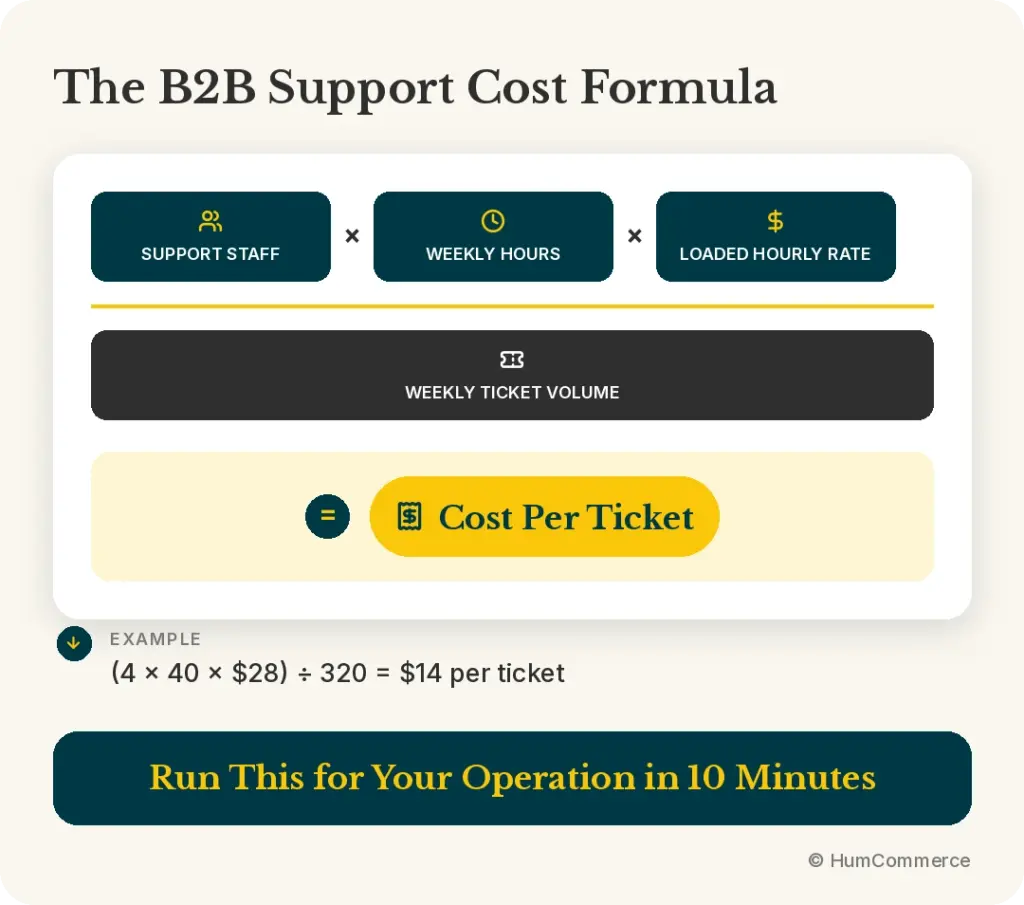
(Support staff x weekly hours x loaded hourly rate) / weekly ticket volume = cost per ticket
For a reference operation — 4 support staff, 40-hour weeks, $28/hour fully loaded, 320 tickets per week:
(4 x 40 x $28) / 320 = $14 per ticket
That’s $14 for every single inbound contact, whether it’s a complex complaint requiring 45 minutes or an order status check that takes 4 minutes.
The problem is that the 4-minute checks are generating the same cost per ticket as the 45-minute complex issues, and they’re crowding out the complex work.
The Ticket Taxonomy and What It Costs
Across B2B manufacturing and distribution, inbound support contacts break into three categories that matter for this calculation:
Tier 1: Routine queries (the automatable 40-60%)
These require ERP data retrieval, not human judgment. A support agent handling these interactions is performing a lookup task — opening the ERP, finding the data, communicating it back to the buyer.
Common examples:
- “Where is Order #89421?” — ERP order status lookup, 3-5 minutes
- “What’s my price for Part #IND-440 at 100 units?” — ERP pricing query, 3-4 minutes
- “Do you have 50 units of #FF-800 in Cincinnati?” — ERP inventory query, 2-3 minutes
- “Has Invoice #INV-7823 been paid?” — ERP AR query, 3-4 minutes
Average handle time: 4-6 minutes per Tier 1 contact.
What these cost: At 60% of 320 weekly contacts (192 Tier 1 contacts) at 5 minutes each = 16 hours per week in Tier 1 handling. At $28/hour: $448/week = $23,296/year per the reference operation.
That’s over $23,000 per year in staff time that ERP-connected AI handles at $0.10-$0.50 per interaction.
Tier 2: Semi-routine queries (the partway-automatable 20-30%)
These require data plus some interpretation: product compatibility questions where your database has the cross-reference, delivery timeline estimates for standard ship-from locations, account credit status checks.
AI handles the cases where the data exists in your system and escalates the rest. Partial deflection at 50% of Tier 2 volume produces meaningful savings with low error risk.
Tier 3: Complex interactions (the always-human 15-25%)
Custom negotiations, high-value complaints, regulatory questions, account retention conversations. These require judgment, empathy, and relationship context. AI doesn’t touch Tier 3.
This is where your support team should be spending most of their time. Every hour they spend on Tier 1 is an hour they don’t spend on Tier 3.
The Full Cost Model: Three Operations at Different Scales
Use the formula above with your actual numbers. Here’s what it looks like at three reference scales:
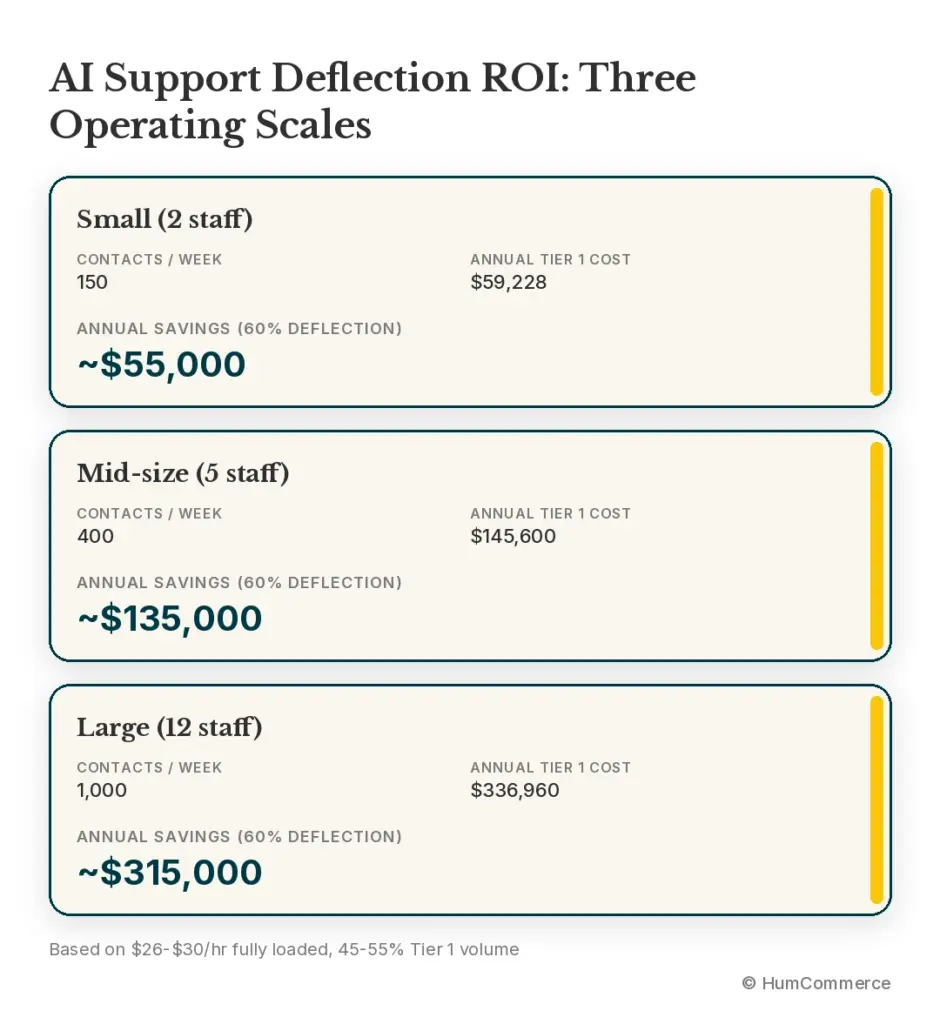
These are conservative estimates using standard industry assumptions on routine ticket percentage. Operations where buyers regularly contact support for pricing and inventory questions — because the self-serve portal doesn’t have accurate data — typically see Tier 1 volume at the higher end of the 40-60% range.
What Happens to the Support Team
The concern that follows every conversation about AI support deflection is: does this reduce headcount?
At most B2B manufacturing and distribution operations, the answer is no — at least not in the short to medium term. The reason is demand growth. Most operations that implement AI deflection don’t reduce support capacity; they absorb growth without adding headcount.
A distributor processing 400 support contacts per week at 12% annual order volume growth would need to handle 448 contacts per week in a year without AI deflection, requiring additional support capacity. With 60% AI deflection, their human-handled volume stays under 180 contacts per week while total contact volume grows.
What changes for the support team: the work is more interesting. Tier 3 interactions — the high-value, complex work that requires judgment — become a larger share of what the team handles. The routine lookup work disappears. Team members who were spending most of their day on order status queries shift to account management, complex problem-solving, and buyer relationship support.
That shift typically improves retention. Support team members who spend more time on meaningful work stay longer. The turnover cost alone — replacing a support team member typically costs $10,000-$20,000 in recruiting, onboarding, and ramp time — makes the quality-of-work improvement financially material.
How to Run This Calculation for Your Operation
Ten minutes and four numbers:
- Support team size: How many people handle inbound contacts?
- Weekly contact volume: How many contacts per week across all channels (phone, email, chat, web form)?
- Fully loaded hourly rate: Salary + benefits + overhead per support team member, divided by 2,080 annual hours.
- Estimated Tier 1 percentage: What share of your contacts are order status, pricing, inventory, and invoice questions? If you have contact type data from your support system, use it. If not, 50% is a conservative starting estimate for most B2B operations.
Apply the formula. That annual Tier 1 cost number is the upper bound of your AI deflection ROI — the amount you spend today on work that automation handles tomorrow.
Sources
- Industry B2B support ticket cost benchmarks: $8-$15 per human-handled ticket
- HumCommerce B2B AI Assistant deployment data and support deflection rates, 2026
- Salesforce, State of Sales, 6th Edition, 2025
- HumCommerce client support operations data