TL;DR
- Manual RFQ delays cost manufacturers deals before pricing ever matters
- Speed gaps create margin leaks that pricing alone cannot fix
- AI connects your live ERP data directly to the buyer
- Start automation with high-volume, low-complexity quotes first
- Quote faster than competitors or lose before the race starts
I was on a call with a distributor’s sales head recently. His team had a strong pipeline. Decent win rate. Reasonable pricing.
But he kept losing quotes he had no business losing.
Not on price. Not on relationship. On speed.
By the time his team had looked up the ERP, pulled the contract terms, built the quote in Excel, and routed it for internal approval, the buyer had already moved on. Chose someone else. Not because the other quote was better but because it arrived first.
His quoting process had an architecture problem. And it was costing him deals every single week.
The Leak Nobody Is Measuring
Most Sales and Commercial leaders look at their RFQ win rate and ask: Is our pricing off? Are we being undercut?
That is the wrong place to look.
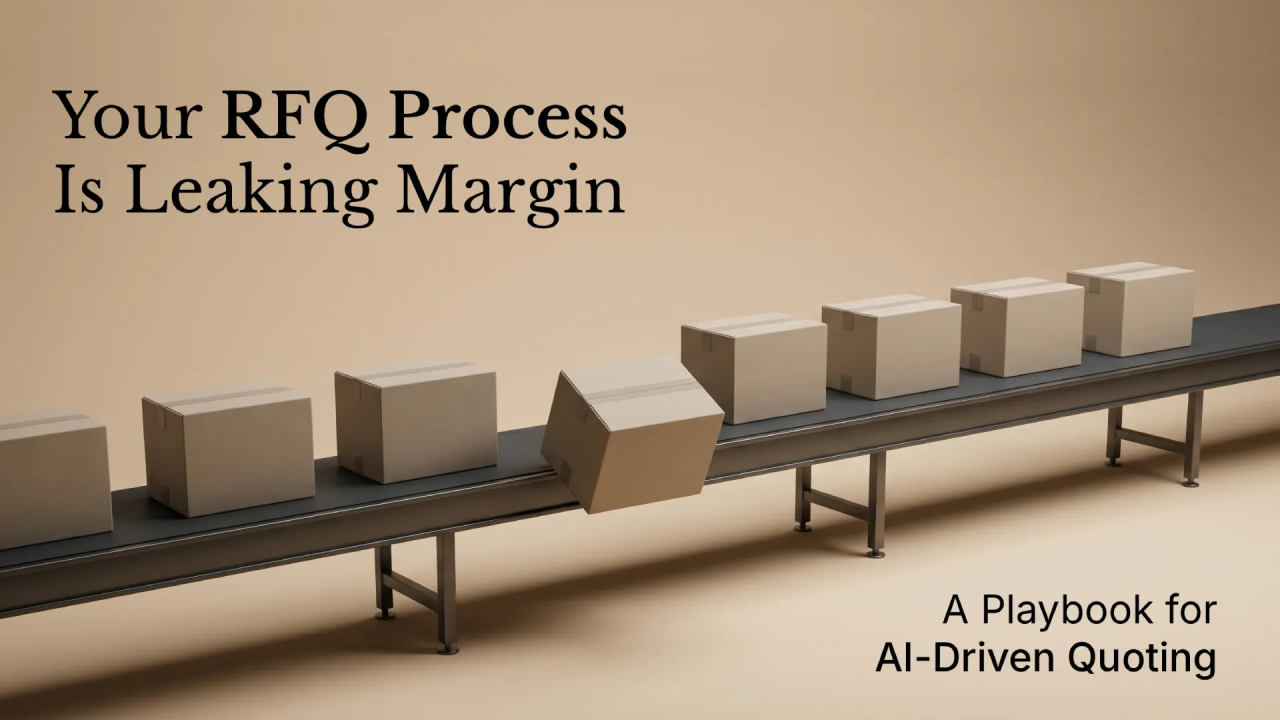
The margin leaks long before the price is even discussed. It leaks in the 48 hours between receiving an RFQ and sending a response. It leaks in the rework when a spec gets misread or a pricing tier gets manually mis-applied. It leaks every single time a rep opens four different systems to answer one buyer’s question.
And most businesses have never measured it.
Not approximately. Not properly. They know it takes “a few days.” They do not know it is costing them 5% of annual revenue, roughly $500,000 for a mid-sized manufacturer, every year it goes unfixed.
“Margin leaks fastest at the response queue. By the time you reach the negotiation table, deals are already gone.”
Three Places the Leak Is Happening Right Now
You do not need a consultancy report to find these. They are in your inbox, your ERP logs, and your sales team’s daily frustration.
1. The speed gap
B2B buyers contact an average of three vendors per RFQ. The first clean, accurate quote wins. Research consistently shows that companies who respond within the first few hours close at 3 to 4 times the rate of those who respond within 48 hours. Your competitors know this. Your process needs to reflect it.
2. The spec error loop
Manual quoting requires a rep to interpret an RFQ, cross-reference product specs, match SKUs, and apply the right pricing tier, often across multiple systems. Every handoff is a chance for error. Every error triggers rework. Every rework adds hours. In a business processing 50 or more RFQs a week, this is the default, not an edge case.
3. The approval bottleneck
Most B2B quoting processes include an internal approval step. Designed to protect margin. In practice, it adds half a day to every response. And the reason approvals are slow is rarely the approver. It is the inconsistency in what lands on their desk. Every rep builds quotes differently. Different formats, different templates, different levels of detail. The approver cannot scan quickly because they are hunting for errors in something that looks different every time.
What AI-Driven Quoting Actually Looks Like
Think of your current RFQ process like a restaurant where the chef has every ingredient ready. Live inventory. Current pricing. Customer contract terms. All of it sitting in the kitchen. But the customer still waits days to be served.
The kitchen is fully stocked. The data exists. The question is how fast it reaches the buyer.
Here is what a manual flow looks like today versus what an AI-driven flow can look like:
Manual: How it works today
- RFQ arrives by email or phone
- Rep manually searches ERP for stock and availability
- Cross-references customer-specific contract pricing
- Builds quote in Excel or email
- Routes for internal approval
- Sends, typically 3 to 7 days later
- Buyer has often already moved on
AI-Driven: How it should work
- Buyer submits RFQ via portal or chat in natural language
- AI Assistant reads the request, including fuzzy SKU matching and product aliases
- Pulls live pricing, contract terms, and stock from ERP in real time
- Generates a structured draft quote and places it in the rep’s inbox
- Rep reviews the draft, checks for accuracy, and makes any necessary changes
- Rep submits for approval, a faster review now because every quote follows the same consistent structure, with errors removed before they reach the approver
- Buyer receives a procurement-ready quote in 1 to 3 days, a fraction of the manual cycle
The difference is connection. The AI reads your existing pricing logic and ERP data instantly, so your rep focuses on decisions instead of lookups. And because every AI-generated draft follows the same structure, approvals that once took days start taking minutes.
The 4-Step Roadmap to Get There
This is not a 12-month transformation programme. These are four specific steps which you start this quarter.
Step 1: Audit your actual RFQ cycle time
Not approximately. Exactly. Pull the last 30 RFQs from your system. Measure from receipt to send. Map every handoff. Where does the quote sit idle? Where does it get stuck? Where does rework happen? Most companies have never done this. Most are surprised by what they find.
Step 2: Audit your data readiness
AI-driven quoting works when the underlying data is clean and connected. Ask three questions. Is your ERP pricing current and tiered by customer segment? Are your contract terms digitised? Can your product catalog handle natural language queries, or does it require exact SKU entry? If the answer to any of these is “sort of,” fix that first. The AI layer performs at the level of the data beneath it.
Step 3: Start with your highest-volume, lowest-complexity RFQs
Do not begin with the 43-line-item bespoke configuration orders. Begin with repeat orders and standard SKUs. The quotes your team processes on autopilot but still manually, every single day. This is where automation creates the fastest, most visible ROI. It is also where you build internal confidence before tackling complexity.
Step 4: Make speed a tracked metric
Set a new internal SLA. First quote within X days. Pick a number that stretches your team. Put it on a dashboard. Review it weekly. When speed becomes visible, behaviour changes. Sales reps who know their response time is tracked find ways to move faster. This step alone, before any AI is implemented, will close part of the gap.
“Your competitors are already quoting faster. They have built a system where speed is the default, and they are winning deals because of it.”
Where the HumCommerce AI Assistant Fits
This is exactly the problem the HumCommerce AI Assistant is built to solve.
It sits on top of your existing ERP and pricing infrastructure and gives both buyers and your own sales reps the ability to ask in plain language and get a procurement-ready draft in real time. No middleware. No manual lookup. No more reps building quotes from scratch across four different systems.
A buyer can ask: “Do you have 200 units of X in stock at my contract rate, and when can you ship?” and get an accurate, formatted draft answer in seconds. Your rep reviews it, makes any changes, and sends it to approval. And because the draft arrives consistent and clean every time, your approver starts seeing a pattern. The errors they used to hunt for are no longer there. Approvals get faster not because the process changed, but because the quality going into it did.
The Only Question Left
Your RFQ process is leaking margin right now. Today. On quotes sitting in someone’s inbox waiting to be built.
The inventory data exists. The pricing logic exists. The contract terms exist.
The buyers sending you RFQs are sending the same request to three vendors simultaneously. Speed decides who gets the conversation. Systems decide speed.
Your competitors are closing that gap. The question is whether you do it this quarter or spend another year explaining to your CFO why win rates are flat despite a full pipeline.