Think about the last trade show you attended.
Every vendor had a banner, a running demo, and enough product literature to fill a box. Thousands of products on display, all of it technically available to anyone who walked the floor.
And yet, the most useful person in that hall was the booth rep who asked you two questions and walked you straight to what you needed. Not because they had more information than the catalog. Because they knew how to use it on your behalf.
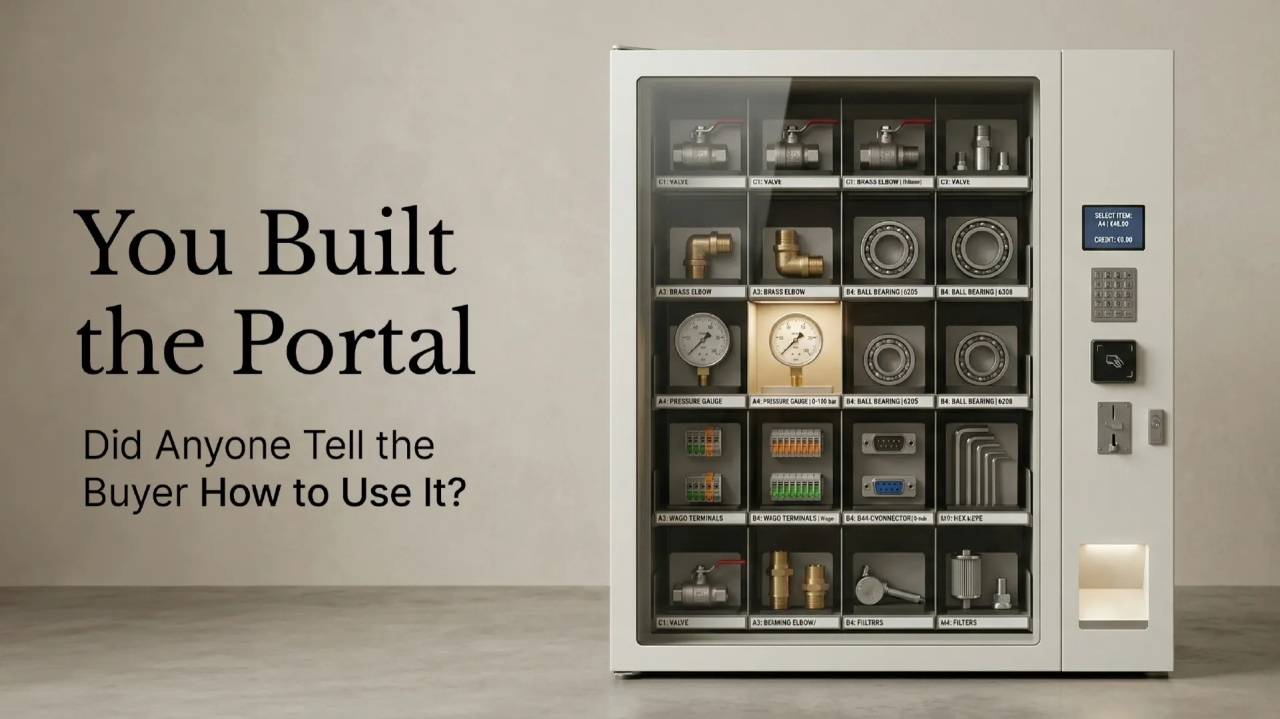
Your B2B ecommerce portal has the same problem. Everything is there but nobody is guiding the buyer through it.
The Real Problem With B2B Portals
Most B2B portals were built to replace a fax machine. We gave buyers a login, a search bar, and a product list and called it digital transformation.
But watch what happens when a buyer lands on that portal needing a food-grade pump that ships from a specific warehouse at their contract price. They search, they scroll, they open three product pages that do not quite answer their question, and then they close the browser and call their rep.
That phone call is the signal. The portal exists, the buyer chose not to use it.
After building B2B ecommerce for manufacturers and distributors for over a decade, I have seen this pattern repeat across industries. The portal itself is rarely the problem. The experience of navigating it is.
What Buyers Are Actually Asking
Here are the questions B2B buyers ask every day that a standard portal cannot answer:
“Do you have a flanged version of this in 316 stainless that ships from the Midwest DC?”
“What is my contract price on this versus the list price?”
“I ordered this last quarter. Can I reorder with the same specs and delivery address?”
“This item is out of stock. What is the closest compatible alternative?”
None of these is a complicated question. A good inside sales rep answers all four in under two minutes. But the portal cannot answer any of them.
What a B2B AI Assistant Actually Does
A B2B AI Assistant is not a system that places orders or approves quotes on your behalf. Think of it as a well-informed inside sales rep who lives inside your B2B ecommerce experience, always has your ERP open, and is available at any hour without putting a buyer on hold.
When a buyer types a question in plain language, the assistant reads the catalog, checks live inventory, applies their account pricing, and gives a specific answer, all inside the website and without a human rep involved. The assistant is only as useful as the systems it is connected to. Link it to your ERP, your PIM, and your ecommerce platform and it can answer questions your portal never could.
Three Conversations Worth Looking At
Product discovery: A procurement manager types “I need a food-grade pump that handles 200 GPM at 150 degrees.” The assistant pulls matching SKUs from the PIM, checks stock at the nearest warehouse, and shows the buyer’s account price in a single response. No scrolling and no separate search required.
RFQ handling: A buyer pastes a rough bill of materials into the chat. The assistant matches SKUs, flags items that need clarification, and drafts a quote summary. What was a two-day email chain becomes a ten-minute conversation.
Post-order support: A buyer asks about their order from last Tuesday. The assistant pulls live status from the ERP and the shipping carrier and responds immediately, with no ticket raised and no rep involved.
These are not hypothetical scenarios. These are workflows being built and deployed right now on real B2B ecommerce stacks.
Why This Feels Different From the Chatbot You Tried Before
Most B2B leaders have tried a chatbot and most were disappointed, for good reason.
That chatbot answered ten FAQ questions and escalated everything else. It had no access to your ERP, your PIM, or your pricing rules, knowing nothing about a buyer’s account history or contract terms.
A B2B AI Assistant connected to none of your core systems is still just an FAQ bot. Connected to your actual stack, it becomes a sales tool that works at three in the morning on a Sunday when no rep is available. The difference is not the AI. The difference is what the AI is reading from.
Where to Start
The question for anyone running B2B ecommerce today is not whether to add AI. The question is which workflow to start with.
Pick the one where buyers are most likely to abandon the portal and call a rep instead. Map what information the rep would need to answer the question, connect those systems to the assistant, and then measure one thing: did call volume to your CS team go down? That number tells you whether you built something genuinely useful or just something that looks impressive in a demo.
The companies pulling ahead in B2B ecommerce are not necessarily the ones with the most sophisticated platform. They are the ones who stopped making their buyers work harder than their reps. AI is the most powerful tool available right now to close that gap, but only if you start with the right problem.
What is the one question in your B2B ecommerce experience that buyers still call a rep to ask? I would genuinely like to know.