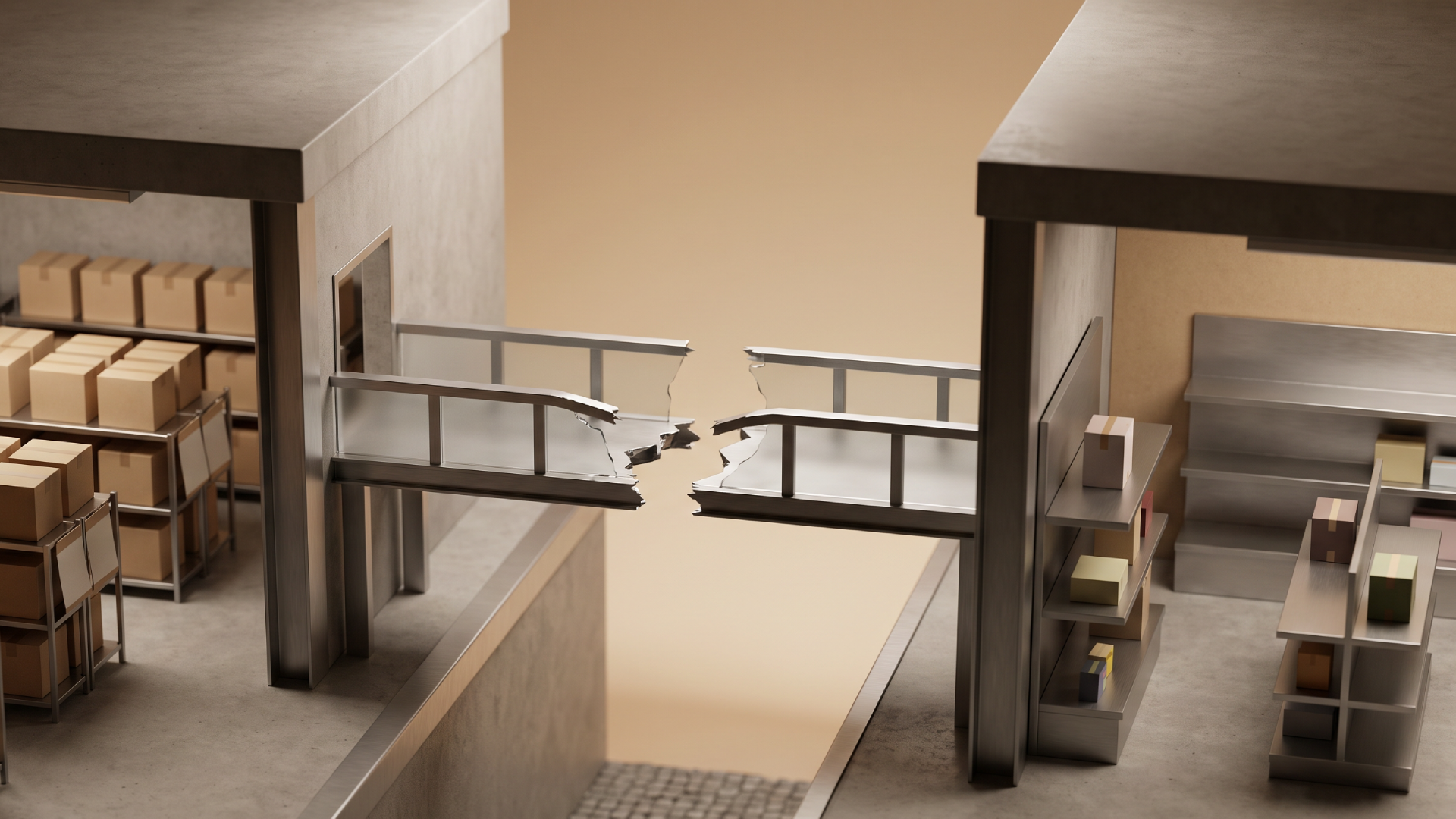
“Integrated” and “working correctly” are not the same thing.
TL;DR
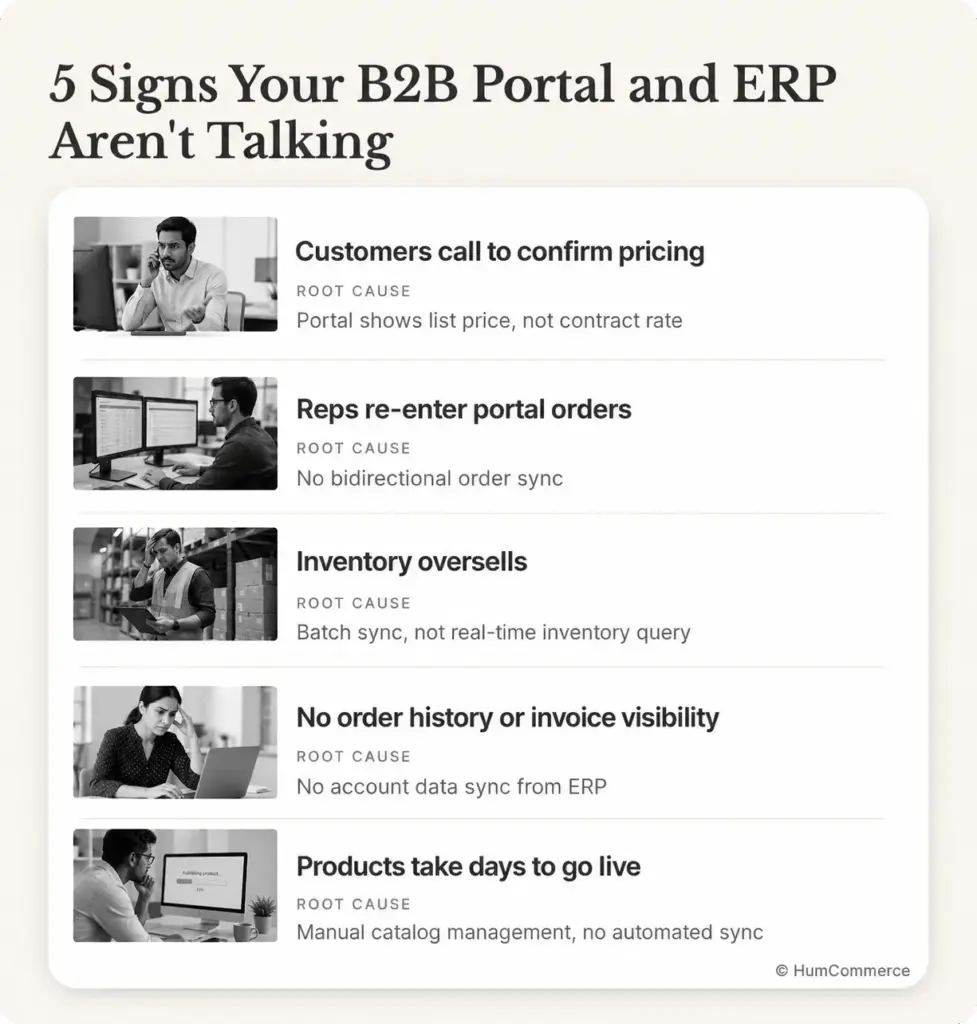
- Customers calling to confirm pricing before ordering: your portal is showing list price, not their contract rate.
- Reps manually re-entering portal orders into the ERP: your order sync is one-directional or broken.
- Inventory showing “in stock” when the order can’t ship: your sync is batch, not real-time.
- Customers unable to see their order history or invoice status: account data sync is missing.
- New products taking days to appear after an ERP update: no automated catalog sync.
- Every one of these problems looks like an operations or customer service issue. Every one is an integration problem.
Most B2B manufacturers and distributors believe they’re “integrated.” They have a B2B portal, and that portal is connected to their ERP in some way. What they often don’t realize is that “connected in some way” can mean a one-directional batch export that runs every four hours — and that this produces five very specific, very recognizable operational symptoms.
If you recognize three or more of these, you have an integration gap that’s costing you more than you’re tracking.
Sign 1: Customers Call or Email to Confirm Pricing Before Ordering
The scenario: your account at a regular customer places an order. Before placing it online, they email your rep asking to confirm the price. The rep confirms, takes the order by phone, and manually enters it into the ERP.
The portal is irrelevant to this transaction. The buyer used it to find the product and then left to get the information your portal couldn’t provide.
What’s happening: The portal is showing list price, base price list, or stale pricing that doesn’t reflect the buyer’s current contract rate. The buyer doesn’t trust the number they see, so they seek confirmation before committing.
The root cause: No live API connection between your portal and the ERP’s customer pricing tables. The integration either doesn’t exist, pulls from the wrong pricing level in the ERP hierarchy, or syncs on a schedule that makes it unreliable for fast-moving pricing.
What it costs: Rep time on order confirmation and manual order entry. Self-serve adoption stays low because buyers learn they can’t trust the portal. Over time, the portal becomes a product catalog people browse before calling — a brochure, not a commerce operation.
The fix: A real-time API connection to the ERP’s customer pricing tables, queried at login and at product page load. When the buyer logs in, the portal requests their pricing group from the ERP. What the ERP returns is what the buyer sees.
Sign 2: Your Reps Re-Enter Orders That Came Through the Portal
The scenario: buyers place orders through the portal. Those orders appear in the portal’s admin panel. A team member — usually in operations or inside sales — then opens the ERP and manually re-enters each order.
This is happening in more operations than most managers realize, because no one tracks it as a cost. It’s just “what the team does.”
What’s happening: Your order sync is either one-directional (portal sends no data to ERP), broken (sync was configured but is failing silently), or manual (the process was designed with a human in the loop).
The root cause: No bidirectional order sync. Orders placed in the portal don’t create records in the ERP automatically.
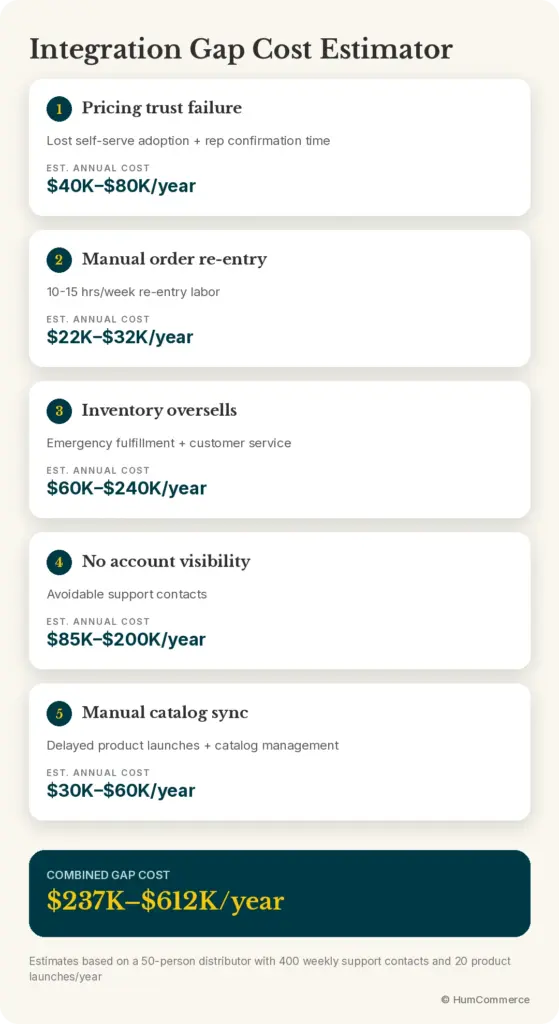
What it costs: For a 50-person distributor with 100 portal orders per week at 10-15 minutes per manual re-entry, this is 17-25 hours per week of labor. At $25/hour fully loaded, that’s $22,000-$32,000 annually in labor that produces zero value beyond data transcription. And every manual re-entry introduces error risk — wrong quantity, wrong part number, wrong shipping address.
The fix: Bidirectional order sync. When a buyer submits an order in the portal, it creates a Sales Order in the ERP automatically, within seconds. Order status updates flow back from the ERP to the portal as fulfillment progresses.
Sign 3: Customers Order Products That Turn Out Not to Be Available
The scenario: a buyer places an order for 50 units. Your team picks the order and finds 22 units available. Someone calls the buyer to explain, processes a partial shipment, and schedules a backorder. The buyer is frustrated. Your team spent 30 minutes managing the consequence.
What’s happening: Your portal is showing inventory from a batch sync file. By the time the buyer ordered, the inventory in that file was out of date. Orders processed since the last sync had consumed stock the portal didn’t know about.
The root cause: Batch inventory sync. The portal reads from a file rather than querying the ERP at checkout. The gap between sync intervals is where oversells happen.
What it costs: Emergency logistics, customer service labor, buyer trust. Oversell incidents at high-volume distributors can cost $500-$2,000 per incident when you account for emergency fulfillment, expedited shipping, and the 2-3 support interactions that follow. At a rate of even 10 oversell incidents per month, that’s $60,000-$240,000 annually.
The fix: Real-time inventory queries at the point of checkout. When a buyer proceeds to checkout, the portal queries the ERP’s inventory module for current available stock — total on-hand minus committed to open orders. If available stock is below the requested quantity, the portal flags it before the order is placed.
Sign 4: Buyers Can’t See Their Order History or Invoice Status Without Calling
The scenario: a buyer emails your accounts team asking whether invoice #INV-45673 has been paid and when order #ORD-89921 is expected to ship. Your accounts team pulls it up in the ERP and emails back. Time elapsed: 24 hours.
What’s happening: Your portal’s account section doesn’t show order history, invoice status, or payment records — because none of that data is synced from the ERP to the portal.
The root cause: No account data sync. Order history, invoices, and payment status live in the ERP’s order management and accounts receivable modules. Unless those are explicitly synced to the portal’s account section, buyers have no visibility.
What it costs: Inbound support contacts. For a distributor with 200 active accounts, even 2-3 order status and invoice inquiries per account per month is 400-600 contacts per month. At 5-10 minutes per contact and $20-$25/hour loaded support cost, that’s $7,000-$25,000 per month in avoidable support labor.
The fix: Account data sync from the ERP to the portal. Order history, shipment tracking, invoice records, and payment status displayed in the buyer’s account section. This requires the ERP’s order and AR modules to be queryable via API and a portal account section built to display them.
Sign 5: New Products Take Days to Appear in the Portal After You Add Them to the ERP
The scenario: your team adds a new product line in the ERP on Monday. Operations is ready to take orders. But the portal doesn’t show the new products until Thursday, because someone on the eCommerce team manually exports and re-imports the product catalog.
What’s happening: Your product catalog sync is manual. No automated pipeline connects product updates in the ERP to the portal.
The root cause: No PIM or automated catalog sync. Products are managed in the ERP and manually staged for the portal through an export-import process. The person doing this work is the bottleneck for every product launch, pricing update, and catalog change.
What it costs: Launch delays convert directly to delayed revenue. If a new product generates $30,000 per month in sales, a 3-day launch delay costs $3,000. Across 20 product launches per year at 3 days each, that’s $60,000 in delayed revenue — plus the labor cost of manual catalog management at estimated 3-5 hours per product update.
The fix: A PIM (Product Information Management system) or automated catalog sync pipeline that connects ERP product data to the portal without manual intervention. When a product is activated in the ERP, the portal reflects it automatically. HumCommerce implemented Akeneo PIM for Cicero Supply to manage over one million SKUs, eliminating the manual catalog management bottleneck entirely.
How Many of These Do You Have?
Most operations have at least two of these five symptoms at some point. Three or more is the threshold where integration gaps become a significant annual operational cost rather than an occasional inconvenience.
The cost across all five for a mid-size manufacturer or distributor typically runs $150,000-$400,000 annually in combined rep labor, support volume, oversell incidents, and delayed product revenue. That number sits inside your budget today, unmarked.
A structured 60-minute audit of your eCommerce and ERP integration across these five dimensions produces the specific figure for your operation. That’s what HumCommerce’s free B2B eCommerce audit delivers: a written report with your maturity score across each dimension and the annual cost estimate attached to each gap.
Sources
- HumCommerce B2B eCommerce audit data, 2026
- Cicero Supply case study, HumCommerce — 1M+ SKUs managed with Akeneo PIM
- Industry B2B support ticket cost benchmarks: $8-$15 per human-handled ticket
- HumCommerce ERP integration implementation data across Epicor, NetSuite, SAP B1, Acumatica, Dynamics 365