
Important Points
- Weak Performance Costs Millions: The slow performance of a typical Magento B2B store isn’t just a technical issue; it costs a lot of money. 7% of conversions are lost for every second of delay. That’s millions of dollars in business lost every year.
- Hyvä Is a Whole Forest: Hyvä is more than just a theme. This is the only way to fix Magento’s main design flaws on all levels, from the front end to the back end. It has Enterprise, Themes, Commerce, and Checkout.
- When companies switch to Hyvä, they see huge improvements. For example, their PageSpeed scores go from the 30s to 98+, their conversion rates go up by up to 50%, and their development cycle is 75% faster than with PWA alternatives.
- Working with a partner who is an expert is important. For a Hyvä migration to go smoothly, you need someone who knows a lot about Magento to handle tricky B2B workflows, making sure extensions work with each other, and integrating ERP systems. HumCommerce has a tried-and-true way to lower risks that will make sure the change goes smoothly.
- This method lets you make progress quickly since you don’t have to rebuild everything at once. Planned, phased use of the Luma fallback feature lets you get faster performance on key pages right away while keeping risk and cost in check.
- Performance is an issue for the C-suite. A slow site has many effects, such as high bounce rates, wasted resources, brand damage, and a direct loss of competitive advantage. Because of this, it’s a big problem for the people in charge.
Picture a stack of $100 bills.
Every 40 seconds, a business-to-business buyer gives up on a website that takes too long to load and leaves goods worth $15,000 in their cart. The order they didn’t pick up should be added to the pile. Put on another one after forty seconds. One more.
In less than 24 days, that mountain of lost cash flow would get taller than the world’s tallest building, the Burj Khalifa. More than $750 million in sales were lost in less than a month because of a bad digital experience. This is something that can be fixed.
Right now, leaders in B2B eCommerce are going through this crisis that no one can see.
Meet Sarah.
Meet Sarah. She is the VP of eCommerce at a $50 million company that sells industrial parts and uses Adobe Commerce for its business. To picture a lot of cash, she doesn’t need to. Her dashboard shows her how much money she has right now.
Her site’s mobile PageSpeed score has just dropped to 23, which is a very low number. It makes her sick to put the sales information on top of the performance chart. The 18% drop in conversions is a very good and scary sign that their page load times are getting longer.
What happened really happened and hurts people.
- A prospect lost a six-figure deal because their phone wouldn’t load a complicated quote.
- Long-time customers are calling her customer service team in a rage because they have to email their orders because the reordering process is broken.
- It’s making the chief financial officer of her company wonder why their “best-in-class” eCommerce platform is turning people away.
A lot of business leaders see Sarah’s story as something they see every day. They picked Magento because it can handle complex catalogs, tiered pricing, and complex B2B workflows the best. But now they’re stuck in what we call the “Magento Performance Paradox.”
They are limited, though, by a front-end architecture that wasn’t made for buyers today, who look at things on their phones first.
For years, the ideas that have been put forward have not worked:
- Use the Luma theme that came with your phone. The front end is big and out of date, and it needs expensive, ongoing maintenance just to work. It’s not even fast.
- Start a PWA (Progressive Web App) project that has a lot of risks. It takes a lot of time and money to build this project, which can cost up to $100,000 and take 6 to 12 months. The end result is usually a solution that isn’t connected to Magento’s core B2B features.
Goodbye! This is the only way to get out of that mess. For bosses like Sarah who know there’s a better way to do things.
You will learn how to fix this performance issue in a way that goes beyond a simple “theme,” and you will be given a clear, step-by-step plan for making Magento your biggest competitive advantage.
The Hyvä Ecosystem is not just a theme; it’s a whole new system that you need to understand.
There isn’t just one way to fix the Magento Performance Paradox that keeps leaders like Sarah stuck. The system as a whole is broken. Both the front end and the back end are slow and hard to understand. Also, the checkout process is not clear. All of it isn’t working well for a business-to-business (B2B) company.
Because of this, Hyvä is not just a “theme.” It’s an ecosystem with four different parts that are meant to work together to completely change how your Magento installation looks.
Let’s look at each part separately.
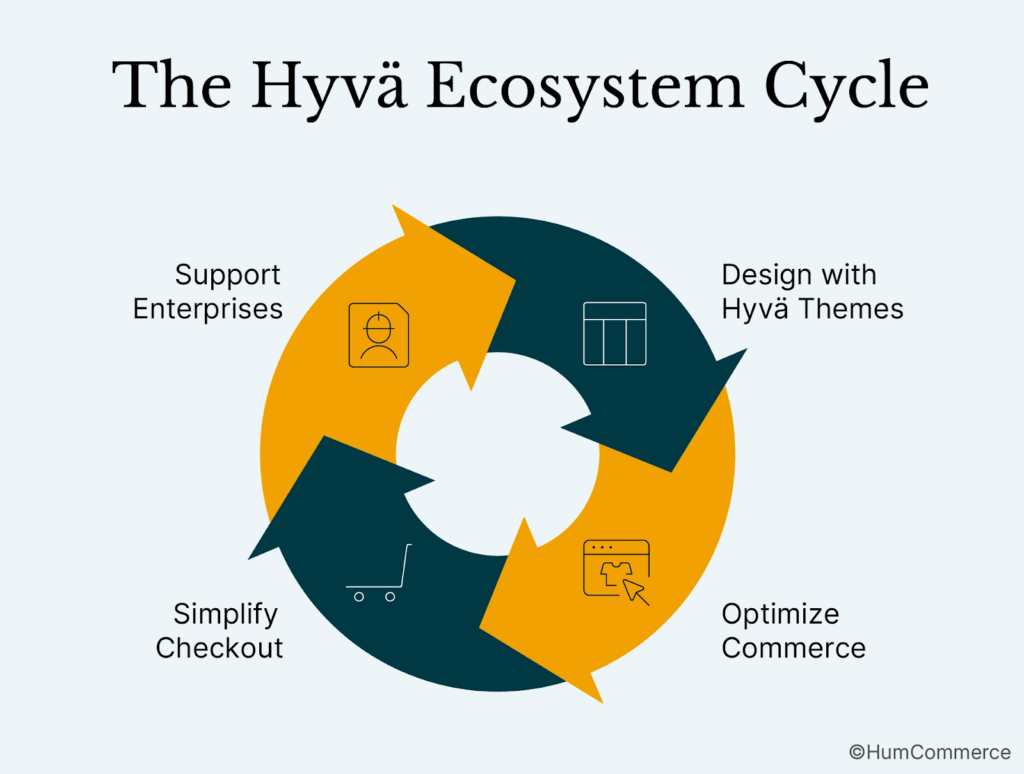
A. Hyvä Themes: The Changes in Front End Speed
This is what changes things. The shopfront is big and slow because the default Magento Luma theme is based on old technologies like RequireJS and KnockoutJS.
You have to put JavaScript, CSS, and third-party libraries into hundreds of containers every trip, even if you only need a few. Think of this as a big cargo ship. Because of this? With more than 200 initial HTTP requests and a page weight of over 3MB, load times are way too slow to watch.
Hyvä Themes throws that whole structure out the window.
It swaps the cargo ship for a brand-new speedboat that was built from scratch with just two strong but light tools:
- If you want to get rid of style sheets that aren’t needed and are taking up space, Tailwind CSS is the way to go.
- You don’t have to load a huge library like jQuery or KnockoutJS to use Alpine.js, which is a simple and reliable JavaScript framework for making interactive elements.
You can feel it right away, and it’s very strong. From more than 200 to less than 10, the first requests drop. The page’s size goes down from 3MB to less than 500KB. But this isn’t just a small step forward.
Because of the big change to the architecture, Core Web Vitals scores are almost perfect, and the user experience feels like it responds right away. Such as business-to-business buyers who use their phones to look through huge catalogs with lots of SKUs.
B. Getting rid of back-end pain with Hyvä Commerce
For every irate B2B buyer on the front end, there is an irate admin team behind it. A slow admin panel wastes time and money on clicks and load times, which hurts the efficiency of operations.
Hyvä Commerce is the answer. It aims to make the backend as quick and simple to use as the new frontend.
It’s a group of tools that improve the Magento admin by:
- Bringing the UI up to date means getting rid of the old, broken backend interface and putting in a new, clean one that is based on React.
- For better product management, it is now possible to work with catalogs that have a lot of SKUs without the system freezing up.
- By speeding up bulk operations, your team can change the prices and stock of many items in seconds instead of minutes.
You and your team will have more time to work on the strategy, launch new products, manage customer groups, and grow the business rather than fighting the system.
C. Hyvä Checkout: Getting Rid of the Pain of B2B Checkout
The number of people who have problems when they try to check out is shocking: 98% of B2B buyers. This is the end of the business deal.
When you buy something from another business, the default Magento checkout is known to be rigid and not able to handle the unique challenges that come with those transactions.
- Adding an order to the list
- Needs for money terms
- More than one step to approve
- Sending packages to more than one address
Hello, Hyvä Checkout is here to solve your problem. It’s a full replacement that you can change to suit your needs. The one-page app works lightning fast and is up to 13 times faster than Luma’s default checkout.
Plus, it can be changed to fit your specific B2B workflows, so you don’t have to deal with a frustrating wall of forms before you can buy something. Your most important conversion point goes from being an issue to being an edge over your competitors.
D. Getting Adobe Commerce to Work Better with Hyvä Enterprise
Many Adobe Commerce users are afraid that if they switch to a different frontend, they will lose the powerful B2B features that they paid for. The real bridge that takes away this fear is Hyvä Enterprise.
You can be sure that all of Adobe Commerce’s key business-to-business features will work perfectly in the quick Hyvä setting. These are some of them:
- Catalogs that everyone can use and prices that work for everyone
- Setting up user accounts for a business with different roles and rights
- What to Do with Purchase Orders and Requisition Lists
- Better ways to talk to businesses and get quotes
With Hyvä Enterprise, you can use all of Adobe’s B2B tools and the fastest frontend in the Magento ecosystem.
All four of these parts work together to make a whole solution. The system needs to be completely redesigned so that the Magento Performance Paradox can be fixed from the root.
When tech issues become crises in the C-suite, that’s when they really hurt business.
Businesses have a lot of problems when their websites take a long time to load. This is because it can affect their most important metrics, like revenue, operational costs, and market position.
CEOs and other people in charge need to understand this link in order to bring back growth that was lost. At HumCommerce, we know how to turn these technical issues into a clear business case. Our Hyvä page has more information about this process.
Direct Sales Lost Because the Storefront Is Slow
You can’t get out of math because it’s hard. Data from across the whole industry shows that for every second that your page takes to load, you lose 7% of conversions.
In the world of B2C, that hurts. Business-to-business (B2B) orders can be 10, 20, or even 100 times bigger, so this is a huge waste of money.
Let’s get this straight. Look at these conservative numbers for a mid-market B2B distributor:
- 50,000 people visit every month
- 2% is a standard rate for business-to-business sales.
- It costs about $1,500 to place an order on average.
A quick math problem shows how much a terrible delay of one second costs:
You could make $1,500,000 a month if you get 50,000 visitors and 2% of them buy something. The average order value is $1,500.
$1,500,000 x 7% loss = $105,000 a month
That’s $1.26 million in lost sales over the course of a year. Not because of your prices or goods, but because your website took too long to load.
The “performance tax” you pay every day that your site doesn’t work the way you want it to.
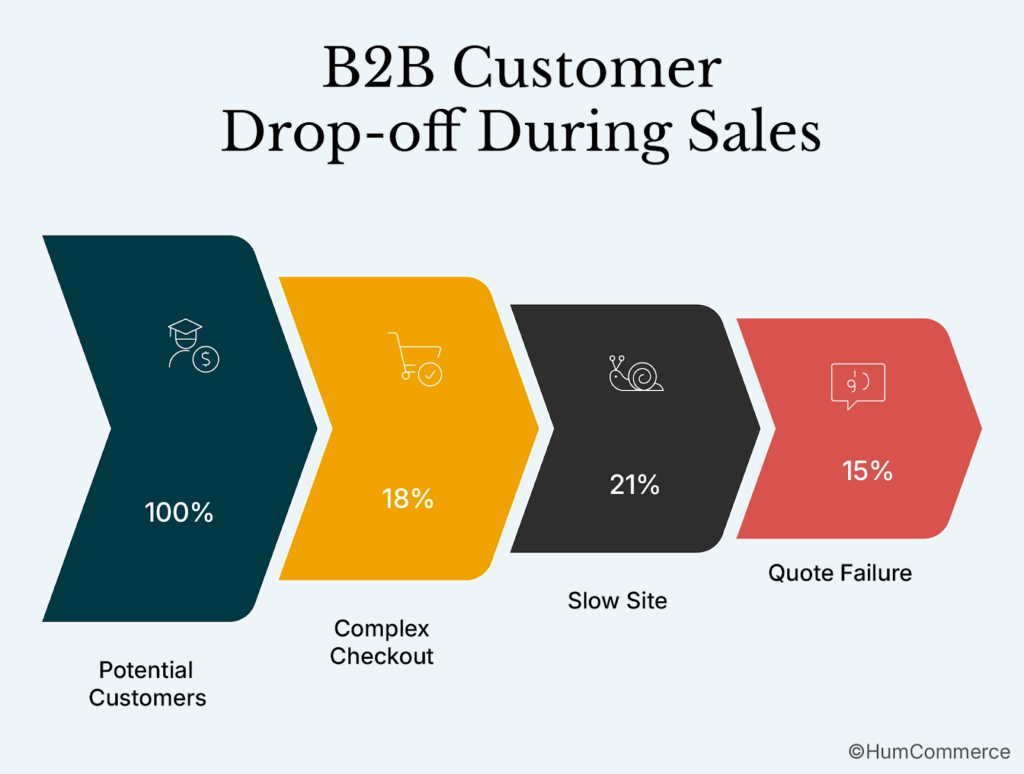
The Anchor: Operations that aren’t working well and are costing you money
It’s not just the front end that’s damaged. A Magento backend that is slow and hard to use will always slow down your operational teams. This will cost you more in the long run.
Bug fixes, manual inventory counts, and waiting for pages to load in the admin panel can take up to 60% of your operations team’s time. This is time and money that is wasted because work doesn’t get done.
This careless behavior starts a chain reaction —
- People have to work around system problems by hand, which means orders aren’t filled on time and customers are unhappy.
- More mistakes are made by people: Pricing, inventory, and customer information are more likely to be wrong when teams have to enter data between systems that aren’t linked.
- Growth Plans Stifled: Your team is too busy fixing a broken system every day to work on long-term projects that will help the business grow. One dollar is not spent on new ideas for every dollar that is spent on redoing work by hand.
People leaving because they had bad experiences with the brand and couldn’t remember it.
Your brand is what you do online. Why do 67% of B2B buyers say they switched vendors just to get a better, more modern digital experience? That’s crazy.
People who visit B2B sites now expect the same easy, personalized experience that they get from B2C sites. There will be no more trouble for them.
You lose more than just a sale when a loyal customer with a multimillion-dollar account can’t easily reorder a part or when a new prospect can’t call and get a price quote.
That it’s hard to work for your company, that you don’t value their time, and that you haven’t bought the right tools to help them. This damage to the brand isn’t obvious and lasts a long time. Customers will leave, which costs a lot to fix.
It really does cost about a third less to keep a customer than to get a new one.
A business keeps going in the wrong direction when it loses money, wastes time and money, and hurts its brand.
When performance is bad, money comes in less, which means there is less money to improve the platform. This makes the site run slowly, which is bad for customers and speeds up the slide toward decline. You need to plan ahead and get to the root of the problem if you want to break this cycle.
“Hyvä in Action: A Story of Change”
It is one thing to know what the problem is, but it is another thing to see how to fix it. We need to talk to Sarah again. She is our VP of eCommerce. She is stuck in the Magento Performance Paradox because her costs are going up and her sales are going down. Plus, she is getting a lot of pressure from all sides.
The third choice was better for her than the second two, which were more expensive and pointless “optimizations” or a high-risk, $100,000+ PWA project. She made a choice to change her plan. When she found out what the Hyvä Ecosystem could do, she joined forces with HumCommerce to make it happen.
It wasn’t just blind faith. As planned, there were three steps that were taken to get things under control.
Step 1: Do a diagnostic to build a plan based on facts instead of guesses.
We got rid of any doubt first. A thorough performance review helped us figure out what went wrong and who was really to blame:
- Over 200 initial HTTP requests and a PageSpeed score of 23 on mobile devices show that the front end is too big.
- When admins are managing orders or looking through their more than 50,000 SKU catalog, it takes a long time for them to respond.
- When there are a lot of steps in the checkout process, many people leave during the payment and shipping steps. This is called distraction-filled checkout.
Now that we know this, we can find a solution that will work best in the places that will be most affected. We didn’t want to do a full rebuild all at once, so we planned a phased implementation that focused on quick ROI while lowering risk.
Step 2: Putting it all together from a big, slow machine to a quick one
Our group went through a 12-week change with a clear goal in mind: to set up the whole Hyvä Ecosystem.
- Beginning in Weeks 1 through 4, we switched from the Luma theme to Hyvä Themes on the home page, category pages, and product detail pages. There were a few very complicated custom-built pages that we used the Luma fallback feature on to make sure that no functionality was lost. At the same time, the main part of the site became faster right away.
- Weeks 5–8 (Efficiency): We set up Hyvä Commerce and made the admin panel look completely different. The operations team for Sarah could now make changes to a lot of products and orders much more quickly. This gave them more time to work on strategy.
- From weeks 9 to 12, we converted people into customers. To do this, we set up Hyvä Checkout, which replaced the complicated default process with an easy flow that works well for businesses. Because we combined their custom quoting and PO modules, it was easy for their long-time customers to make the switch.
Step Three: The Results – From a Cost Center to a Source of Income
The change was technical, and everyone who took part made money. People were shocked by the results three months after the launch
With the power of the Hyvä Ecosystem and the deep, B2B-focused implementation expertise of a partner like HumCommerce, you get more than just a faster website. Sarah’s story shows this important truth.
In the end, your business is better. The weak site that was losing money had become a strong growth engine.
How to Get Things Done: The Implementation Game Plan
To make a Hyvä migration work, you can’t just flip a switch. To do it right, you need to know a lot about business-to-business (B2B) commerce, be very good at technology, and plan your steps very carefully.
A PageSpeed score of 98 or higher sounds great, but getting there without messing up important business logic is what really shows how good you are at what you do. This is the plan that HumCommerce has used to perfect dozens of tough B2B moves.
It’s important to know the risks when moving to Hyvä. Here are the mistakes most people make.
It’s not true when a company says the migration will be very simple. This process isn’t simple, especially for Magento stores that have been changed a lot. These are the issues that come up most often:
- Extensions that don’t work together: This is the main issue. Most of the third-party add-ons that were made for Luma’s architecture won’t work right away with Hyvä. This is especially true for those that handle complex B2B pricing, quotes, and ERP connections.
- Checkout Difficulty: Often, you have to rebuild or replace everything in order for the default Magento checkout and any changes that were made to it to work with the fast Hyvä Checkout.
- The “Blank Slate” Problem: Hyvä is not a template that is already made; it is a blank slate. Not having a good UX and design plan can lead to a fast site that is tough to use and doesn’t get any sales.
- If you depend on data and downtime, you might lose data or have to wait a long time for the store to be back online during a migration. Businesses that sell to other businesses can lose a lot of money and hurt their relationships with those businesses if they are down for even a few hours.
The HumCommerce Playbook shows you how to turn possible problems into a predictable process.
Our method for implementation is designed to anticipate and lower these risks, making sure that the change goes off without a hitch and works as planned.
Step 1: The Plan—Strategic Roadmap and Forensic Audit (Week 1 and Week 2)
Even before we write a single line of code, we do a full forensic audit of your whole Magento environment.
- Extension Triage: Each extension you use is put into one of these groups:
- It works right out of the box for people who already use Hyvä.
- Has to Be Replaced: There is an alternative that is known to work with Hyvä.
- Needs Custom Work: Our team will have to make an important custom add-on work with the system.
- It works right out of the box for people who already use Hyvä.
- Workflow Mapping: To make sure we understand how everything fits together, we make a map of all the important B2B processes, from syncing your ERP data to your most complicated CPQ workflow.
- Plan for a Phased Rollout: Based on this audit, we make a detailed, step-by-step plan for how to implement it. This strategic roadmap puts the most important pages at the top of the list and backs them up with Luma for areas that aren’t as important or are harder to understand. This speeds up your time-to-value.
Building: planned growth and design with a focus on business-to-business (Weeks 3–10)
This is where our in-depth B2B knowledge can assist you the most. We make a “fast theme” and a strong B2B sales engine.
- We make UI components that work with how your B2B buyers do their jobs, whether that’s with spec-driven product pages, bundled SKUs, or access to content based on role. This UX was made just for you.
- When we build Hyvä, we make sure that all of your important third-party and custom extensions work with it. This is called integration and compatibility. We make sure that your pricing logic, tools for quoting, and customer account portals always work quickly and correctly.
- Deployment with no downtime: We do all of our testing and development in a safe staging area. The last deployment has been carefully planned to happen when there isn’t a lot of demand. Your live store will never be down this way.
For the third step, strict testing and performance tuning (Weeks 11–12), also known as “hardening,”
When the site goes live, the work on it doesn’t end. Now we’re in the “hardening” phase, where we test and make the new site better in every way.
- Tests on Multiple Devices: We test each workflow on all major browsers and devices to make sure that all users have a great time.
- Load testing: We pretend there is a lot of traffic so we can find and fix any problems before they happen to your customers.
- Important CSS and CDN settings are just a few of the things we check to make sure we meet and beat Google’s Core Web Vitals standards.
A migration that could be risky is turned into a planned, highly successful strategic initiative with this organized, B2B-focused approach. This not only speeds up the site but also makes the business stronger and more profitable.
What it costs and how it grows: a return on investment (ROI) analysis and business case
Not if you work with someone who knows what they’re doing. Putting money into the Hyvä Ecosystem is not a waste. It is one of the best things a B2B Magento company can do to grow. To find out why, we need to look at the Total Cost of Ownership (TCO), guess how much money it will make, and compare the different strategies side by side.
When you break down the Total Cost of Ownership (TCO),
One of the best things about Hyvä is that its total cost of ownership (TCO) is clear and not too high and not too low either. Most PWA projects have a lot of risk and can cost anywhere from $50,000 to $150,000. They also need a lot of maintenance over time.
A smart Hyvä setup with HumCommerce, on the other hand, works a lot better.
Trying to guess the reward and how it will affect sales
This investment is very strong, as shown by the income side of the ledger. With the information from Sarah’s change, we can make a conservative ROI model.
- Baseline income per year: $25,000,000
- The conversion rate went up by 50% after Hyvä, which meant that more money came in.
- Expected income per year: $37,500,000
- +$12,500,000 in extra sales each year
- Plus $200,000. This is because the back end is now more efficient.
- Gain for the year: $12,700,000
The return on investment is huge for an initial investment of around $50,000. The business will grow a lot because of this big change, and the initial cost is now seen as a small price to pay for that chance.
The Strategic Choice: A Matrix for Comparing Technologies
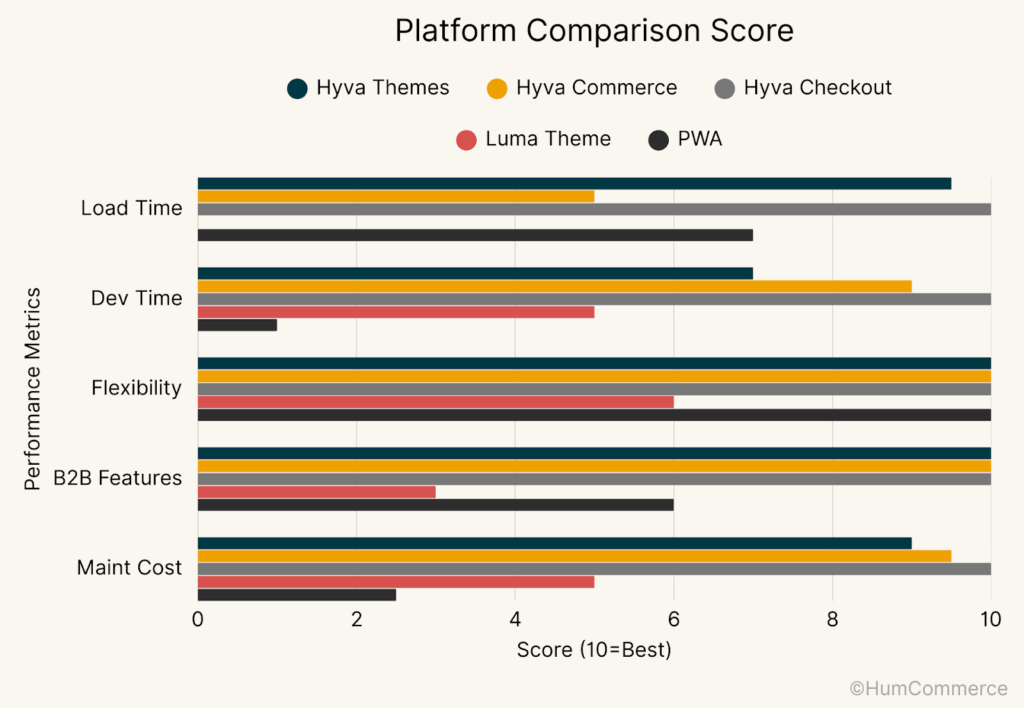
Once the choices are made, it’s clear that the Hyvä Ecosystem has a clear strategic edge. It’s the best because it has all the performance and modern features of a PWA without the huge cost and complexity. In every important way, it’s better than the default Luma theme.
When it comes to performance, development, customization, and maintenance, Hyvä Ecosystem Components beats Luma Theme and PWA.
This is where the real return on investment (ROI) can be seen in success stories.
This level of return on investment is real. Businesses that sell to other businesses can see it when they make the switch. Our clients have seen results that have changed their lives, as you can see on the HumCommerce Hyvä page:
- One of our biggest clients that makes things for industry has more than a million SKUs. This new system makes things faster for both customers and their own sales teams. It cuts the time it takes to make a sale by 88%.
- Another company was able to get more accurate quotes in real time and speed up their work by 75%. This got rid of operational bottlenecks and helped them make more money on orders that were hard to understand.
These big changes will help these companies do better and make more cash. Using the right technology with the right partner is the best way to grow.
Your plan for a high-performance future: what to do next and how to do it
You now know how much the Hyvä Ecosystem can help a business and how much bad performance costs. It’s simple to move past the “Magento Performance Paradox” and build a platform that can handle future growth and a lot of users.
It’s better to ask, “How should we start?“
Some people find it scary to change how they use technology. Making a clear, step-by-step plan can help you deal with this. The plan we use at HumCommerce to help our clients have a great launch is this one.
Make sure you’re ready to go by taking the Readiness Assessment first.
The first step to a successful journey is to know where you are starting from. Before you start development, you should make sure that both your technical and business domains are ready.
Checklist for Being Ready for Tech:
- What Kind of Platform Does Your Store Use? Does it use Magento 2.4s? The version of Magento that Hyvä needs to work is up to date.
- Extension Inventory: Have you made a list of all the extensions you’ve made and those you’ve bought from other people?
- Is it easy for you to understand your current Core Web Vitals, page load times, and conversion rates?
- Has your company made a map of all the important links between its ERP, PIM, CRM, and other back-end systems?
Ready for Business Checklist:
- Getting Stakeholders to Agree: Does everyone on your executive, marketing, IT, and sales teams agree on how important this project is for the business?
- Approval of the Budget: Have you set aside between $35,000 and $60,000 for the whole project?
- Availability of Resources: Can you commit the internal resources that are needed to support a 12- to 16-week project timeline?
- There are better ways to do things now, but do you have a plan for how you will train your team and help them get used to them?
This list will not only help you get ready for the project, but it will also help you get the company to support the project more.
Step 2: Make a plan for what to do in the next 90 days.
Clear 90-day plans for the next steps can be made once you know you’re ready.
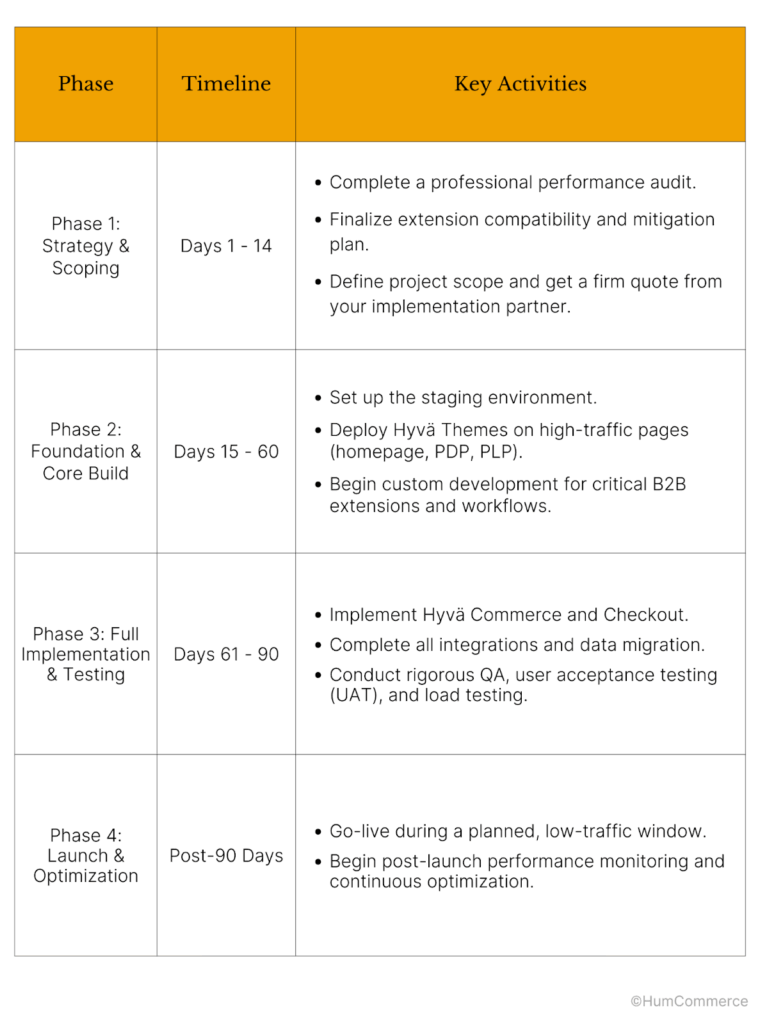
Step 3: Take the first step today without any risk.
You don’t have to follow this plan by yourself.
Our team of experienced Magento and B2B experts can help you get better at:
- Find the Root Cause: We’ll look past the scores to find the exact technical issues that are making your site load slowly.
- Quantify the Opportunity: We’ll give you a personalized ROI projection based on the metrics of your store.
- Put together your road map. When you’re done, you’ll have a plan for putting your ideas into action that fits your business’s needs.
That being said, this audit is the first and most important thing you need to do to stop performing badly and take your B2B growth to the next level.