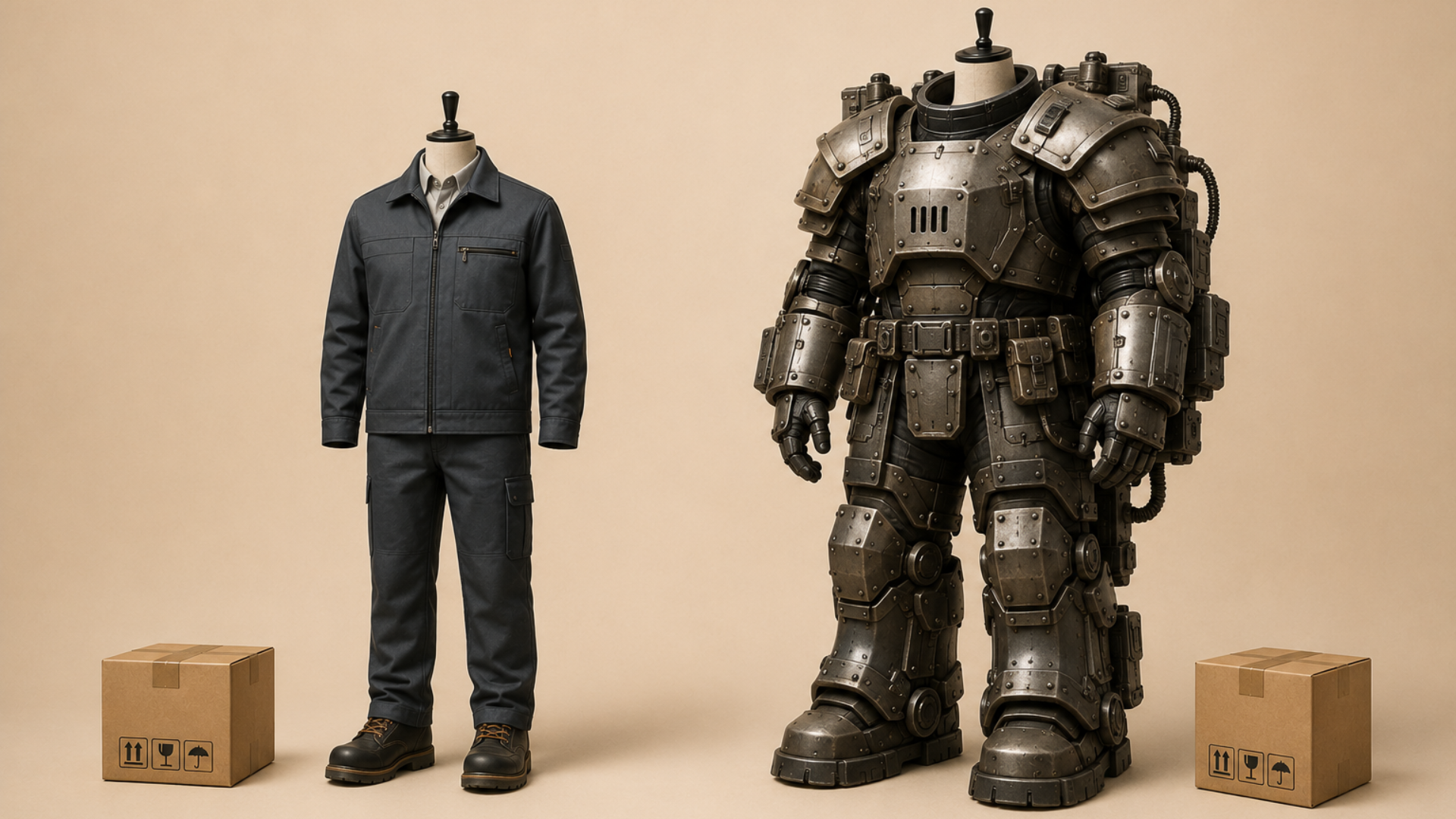
The gap is not about ambition. It’s about what each stage of growth makes operationally necessary.
TL;DR
- What a $50M manufacturer needs from their B2B portal is different from what a $150M distributor needs — and building beyond your current operational requirements is one of the most common mistakes in eCommerce investment.
- For $30M-$75M operations: contract pricing online, real-time inventory, basic self-serve ordering. That covers the highest-cost gaps without over-engineering.
- For $75M-$150M operations: full self-serve, AI-assisted support, automated quoting, multi-location inventory visibility. At this scale, manual operations become structurally expensive.
- Revenue is a proxy, not a prescription. Order volume, SKU count, rep headcount, and ERP complexity matter more than revenue in determining what your operation actually needs.
- The single most common mistake: $50M manufacturers building $150M infrastructure, or $150M distributors running $50M operations.
There’s a consulting habit in B2B eCommerce that causes real damage. A manufacturer or distributor sits down with an agency, explains their current setup, and gets shown a roadmap to a fully AI-augmented commerce operation — regardless of whether that’s what their current scale requires.
The $50M manufacturer walks away with a two-year, seven-figure build when they needed a 90-day ERP integration. The $150M distributor gets validation for staying at Stage 2 when their scale demands Stage 3. Both make the wrong call because they had no benchmark for their revenue tier.
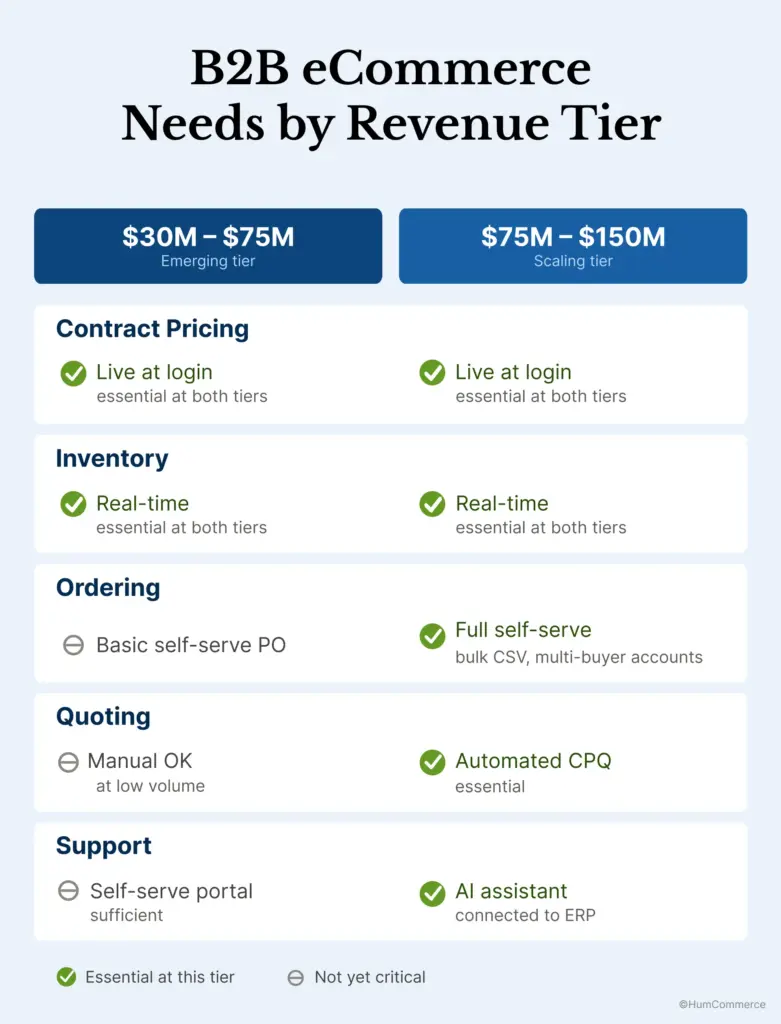
Here’s what good B2B eCommerce actually looks like at different revenue levels.
Why Revenue Is a Starting Point, Not a Blueprint
Before getting into benchmarks, a useful clarification: revenue is a proxy. Two $80M manufacturers can have completely different operational requirements.
The factors that actually determine what your eCommerce operation needs are:
- Order volume: How many transactions per week? More volume means greater cost difference between manual and self-serve.
- SKU count: 500 SKUs vs 50,000 SKUs requires different product data infrastructure.
- Customer count and account complexity: 20 accounts with simple pricing vs 200 accounts with individual contract rates creates different integration requirements.
- Rep headcount and quoting volume: The ROI of quoting automation scales with the number of reps and quotes per week.
Use revenue as your first filter, then adjust based on these operational factors.
What Good Looks Like at $30M-$75M
At this revenue tier, most manufacturers and distributors have an eCommerce presence — usually Adobe Commerce or Magento — that was built for online product display more than for operational efficiency.
The typical current state: Stage 1 or early Stage 2. A catalog with customer login, pricing that may or may not reflect contract rates, limited or no ERP integration, orders still primarily by phone or email with a portal that handles a small fraction.
What this tier actually needs:
Contract pricing visible at login
This is the single highest-ROI integration at the $30M-$75M tier. A live API connection between the portal and the ERP’s customer pricing tables ensures buyers see their rate when they log in. Without this, the portal can’t be trusted for ordering. With it, self-serve adoption typically reaches 25-35% of repeat orders within 90 days of launch.
Real-time inventory visibility
Buyers at this tier check stock before ordering. If the portal doesn’t show accurate inventory, they call. Real-time inventory query — pulling directly from the ERP at the moment the buyer checks — eliminates the most common reason for phone pre-orders.
Basic self-serve ordering with PO workflow
B2B buyers expect to be able to place a purchase order online, reference their account number, and get an order confirmation. This requires an ERP-connected order form with account-specific access, not a generic checkout. Once this is working, repeat orders move to self-serve, freeing reps for new business and complex accounts.
What this tier does not need yet: AI-assisted support, complex quoting automation, multi-location inventory management, or a dedicated PIM system. Adding these at $30M-$75M creates operational complexity that outpaces the ROI at that scale. Build the foundation first.
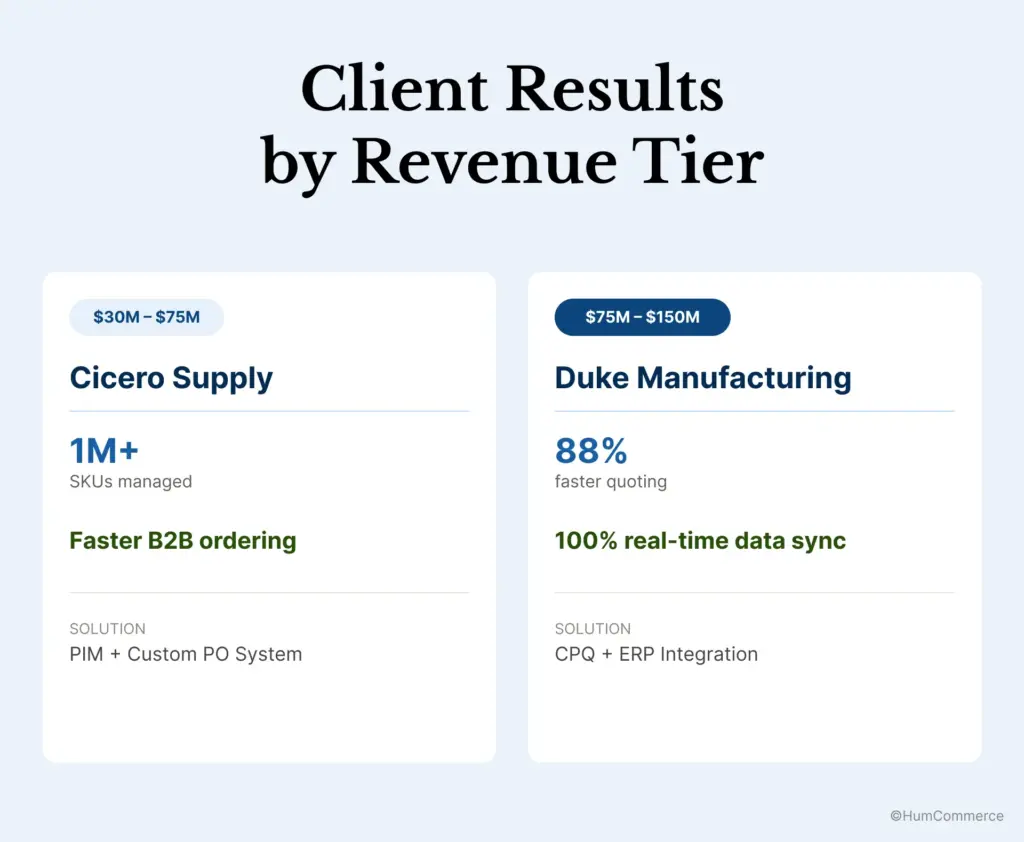
Benchmark outcome: Cicero Supply, with over one million SKUs and a complex B2B ordering workflow, achieved significantly faster B2B ordering after HumCommerce implemented Akeneo PIM and a custom PO system — without replacing their ERP or their sales team.
What Good Looks Like at $75M-$150M
At this revenue tier, the scale of manual operations creates structural cost problems that Stage 2 integration no longer resolves. A 5-rep team at $30M tolerates manual quoting. A 20-rep team at $120M cannot.
The typical current state: Stage 2. Customer login with contract pricing, some ERP integration, but still manual quoting, batch inventory sync, and rep-handled order entry for a majority of transactions. The portal exists, but it’s not driving the operational efficiency its scale demands.
What this tier actually needs:
Full real-time ERP sync across all data objects
At $75M-$150M, batch sync breaks down. Orders come in faster. Pricing changes more frequently. Inventory turns over between sync windows. Real-time API integration for pricing, inventory, and order sync is a baseline operational requirement at this scale, not an enhancement.
Automated quoting for standard orders
A 15-rep sales team processing 300 quotes per week at 60-90 minutes each spends roughly 450 hours per week on quoting. At a loaded rate of $75-85 per hour, that’s $1.7M-$2M annually in quoting labor. ERP-connected CPQ brings that down to 15-20 minutes per quote, or under 5 minutes for standard orders. Duke Manufacturing achieved 88 percent faster quoting after HumCommerce integrated their CPQ and ERP systems.
AI-assisted support for routine queries
At $75M-$150M, inbound support volume justifies an AI assistant connected to the ERP. Routine queries — order status, pricing checks, inventory availability, invoice history — represent 40-60% of contact volume at this scale. An AI assistant connected to live ERP data handles these without a human, at a cost of $0.10-$0.50 per interaction vs $8-$15 for a human-handled ticket.
Multi-location inventory visibility
Operations at this scale typically run multiple warehouses or distribution points. Buyers and reps need to see stock by location. This requires a WMS integration alongside the ERP connection, with the portal displaying location-specific availability at checkout.
Benchmark outcome: FHC, a manufacturing company, achieved 75 percent faster workflows and 100 percent real-time quoting accuracy after HumCommerce integrated their Epicor CPQ with Magento. Their operations team went from managing manual pricing exceptions to managing a system that handled them automatically.
The Three Questions That Tell You What Stage You Should Be At
Regardless of revenue, these three questions cut through the noise:
1. How many orders per week require rep involvement that don’t need to? If the answer is more than 20 percent of repeat orders, you’re leaving significant cost reduction on the table. Stage 3 gets this below 10 percent for standard orders.
2. How many hours per week do reps spend on non-selling tasks? Salesforce’s 2025 State of Sales report found that reps spend only 28-30 percent of their time actually selling. At $75M+, recapturing even 15 percent of that time through quoting automation and self-serve ordering is worth more than adding headcount.
3. What percentage of support contacts are answerable without a human? If more than 40 percent of your inbound contacts are order status, pricing, and inventory questions, your support team is working harder than the problem requires. A connected self-serve portal and an AI assistant handle these at a fraction of the cost.
What Moving to the Next Stage Actually Requires
Moving from $30M-$75M Stage 2 to Stage 3 requires three things: a real-time API connection to the ERP for pricing and inventory, bidirectional order sync, and account data sync for order history visibility. That’s a 90-day project, not a multi-year transformation.
Moving from $75M-$150M Stage 2 to Stage 3 adds quoting automation, multi-location inventory, and AI-assisted support. The timeline extends to 90-120 days depending on the ERP’s API maturity and the quoting complexity of the product line.
Neither requires replacing the ERP. Neither requires replacing the platform. Both require a technical partner who understands the integration layer between the two.