Four stages. Five dimensions. One clear way to know where you stand and what staying there costs.
TL;DR
- B2B eCommerce maturity spans four stages from Stage 1 (catalog only) to Stage 4 (AI-augmented commerce). Most $30M-$150M manufacturers sit at Stage 1 or Stage 2.
- Maturity is measured across five dimensions: product data, ordering, quoting, ERP integration, and customer support. A company can be Stage 3 on ERP and Stage 1 on quoting — that’s common.
- The cost gap between Stage 1 and Stage 3 averages $200,000-$600,000 annually for a mid-size manufacturer or distributor, depending on scale.
- Moving one stage in any dimension typically requires a focused 60-90 day project, not a full platform replacement.
- Stage 4 is becoming the standard for operations handling 50,000+ SKUs and 500+ orders per week. It’s where competitive advantage in B2B distribution is being built right now.
Most B2B manufacturers and distributors have no external reference for their eCommerce operation. They know something isn’t working — too many orders still go through reps, quoting takes too long, customers still call for pricing. But they have no benchmark to measure against.
The model below is built from patterns across 70+ B2B eCommerce implementations at HumCommerce. The data behind it isn’t theoretical. It comes from real operational assessments, integration projects, and client outcomes across manufacturing and distribution.
How the Maturity Model Works
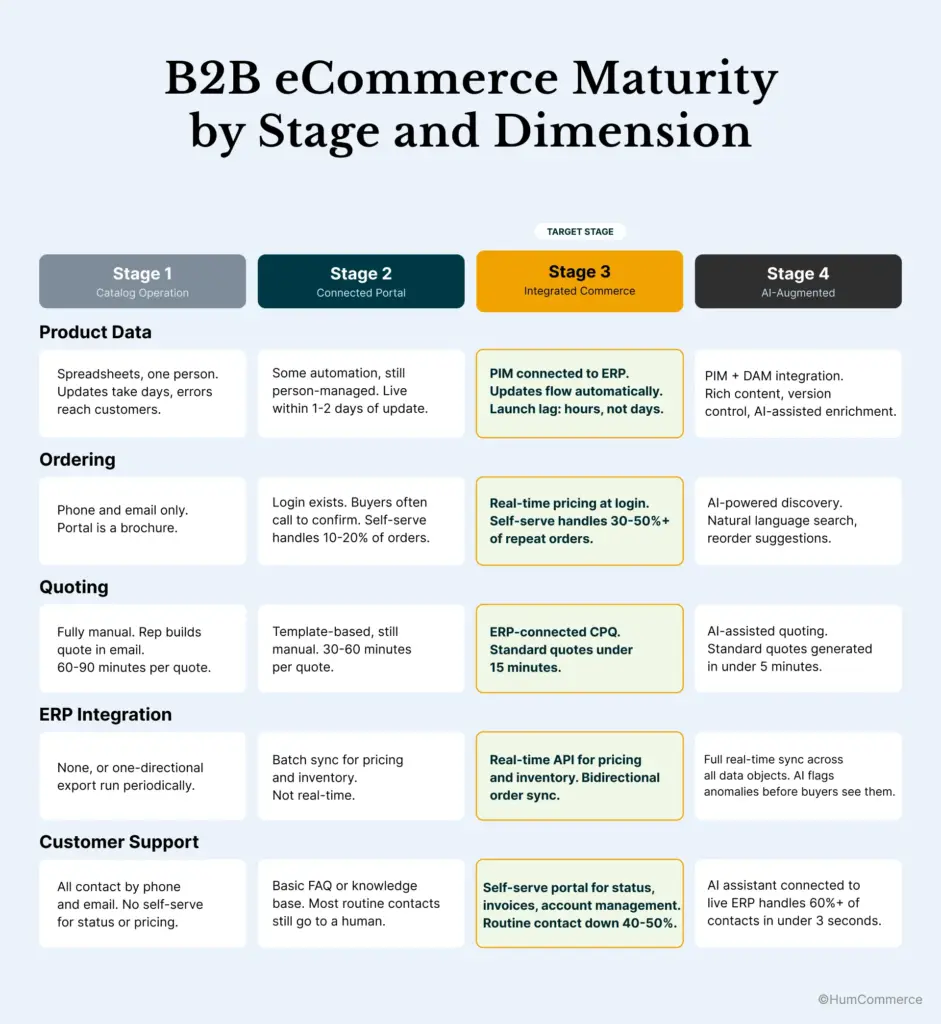
The model has two dimensions: stage (1-4) and assessment area (five dimensions). Your overall maturity score is an average across the five dimensions. But the score by dimension matters more than the average — a company can be Stage 3 on ERP integration and Stage 1 on quoting. Both gaps exist and both cost money, regardless of the average.
The five assessment dimensions:
- Product Data and Catalog
- Ordering and Self-Service
- Quoting and RFQ
- ERP and Systems Integration
- Customer Support and Service
The four stages:
Across every dimension, the same four-level framework applies. Level 1 is fully manual. Level 2 is partially automated with manual bridging. Level 3 is integrated and automated. Level 4 is AI-augmented.
Stage 1: The Catalog Operation
Who is here: Most manufacturers and distributors who built an eCommerce presence between 2015 and 2020 and haven’t significantly upgraded it. Also: companies who launched a portal primarily for marketing purposes rather than operational efficiency.
What Stage 1 looks like across the five dimensions:
- Product Data: Spreadsheets managed by one person. Product updates take days. Errors reach customers regularly.
- Ordering: Products are displayed online, but orders come through by phone or email. The portal is a brochure.
- Quoting: Fully manual. Rep opens ERP, checks pricing, builds quote in email, sends. 60-90 minutes per quote.
- ERP Integration: None, or a one-directional product export run periodically.
- Support: All inbound contact by phone and email. No self-serve for order status, pricing, or inventory.
Typical cost of the gap between Stage 1 and Stage 3:
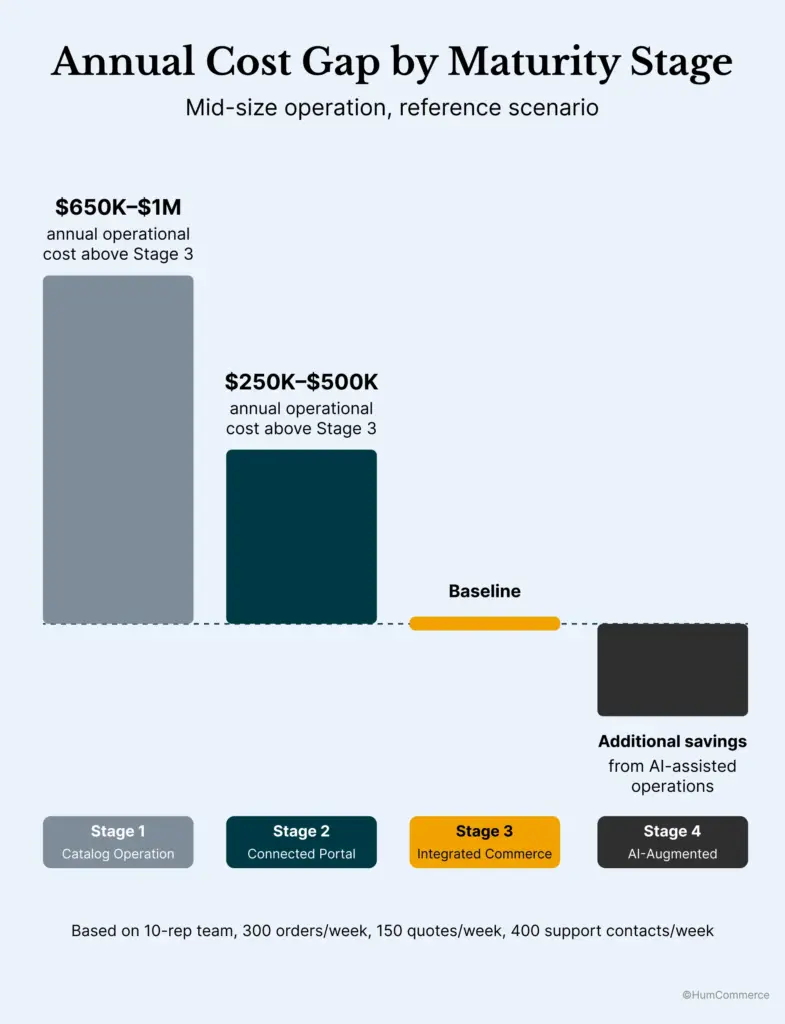
For a manufacturer or distributor with 10 reps, 300 orders per week, 150 quotes per week, and 5 support staff:
- Ordering gap: $150,000-$250,000 in annual rep labor handling self-serveable orders
- Quoting gap: $400,000-$600,000 in annual quoting labor (150 quotes x 75 min x $75/hr x 52)
- Support gap: $100,000-$150,000 in annual support labor on routine tickets
- Total: $650,000-$1,000,000 annually in operational cost that Stage 3 would eliminate or significantly reduce
Reality check: Most Stage 1 companies don’t have 150 quotes per week. The numbers above represent a mid-size operation. Scale these to your actual volumes.
Stage 2: The Connected Portal
Who is here: Manufacturers and distributors who’ve invested in Adobe Commerce, Magento, or Shopify Plus for B2B and done some integration work, but haven’t completed the architecture. This is the most populated stage among $30M-$150M companies.
What Stage 2 looks like across the five dimensions:
- Product Data: Some automation, but a person still manages catalog updates. May have a basic PIM or a structured data process. Products typically go live within 1-2 days of ERP update.
- Ordering: Customer login exists. Contract pricing is partially visible but may be stale or incomplete. Some self-serve ordering works, but buyers often call to confirm before placing. Self-serve handles 10-20% of orders.
- Quoting: Template-based. Still manual, but reps use a CPQ tool or structured process. 30-60 minutes per quote.
- ERP Integration: Batch sync for pricing and inventory. Orders may sync automatically or may require manual processing. Real-time isn’t live.
- Support: Basic FAQ or knowledge base. Most routine contacts still go to a human. Some buyers can check their own order status if the portal has a basic account section.
Typical cost of the gap between Stage 2 and Stage 3:
Stage 2 has closed some of the worst gaps. The remaining cost is primarily in quoting speed (batch sync pricing creates errors, quoting is still manual) and support (40-60% of contacts still require a human).
For the same operation above at Stage 2: $250,000-$500,000 in annual cost that Stage 3 would address, primarily in quoting labor and support ticket volume.
Stage 3: The Integrated Commerce Operation
Who is here: Manufacturers and distributors who’ve completed the ERP integration architecture and built a genuine self-serve capability. Less common than Stage 2, but where the operational ROI is highest. HumCommerce implementations target this stage as the 90-day outcome.
What Stage 3 looks like across the five dimensions:
- Product Data: PIM connected to ERP. Product updates flow automatically. Data quality is high. Launch lag is hours, not days.
- Ordering: Real-time contract pricing at login. PO workflow works online. Self-serve handles 30-50%+ of repeat orders. Buyers trust the portal.
- Quoting: ERP-connected CPQ. Pricing, inventory, and volume tiers auto-populate. Standard quotes take under 15 minutes. Complex quotes still go to reps.
- ERP Integration: Real-time API for pricing and inventory. Bidirectional order sync. Account data visible to buyers.
- Support: Self-serve portal handles order status, invoice history, and basic account management. Routine contact volume reduced by 40-50%. Complex contacts go to a human.
Key proof points from HumCommerce clients at Stage 3:
- Duke Manufacturing: 88% faster quoting, 100% real-time data sync after CPQ-ERP integration
- FHC: 75% faster workflows, 100% real-time quoting accuracy after Epicor CPQ + Magento integration
- Cicero Supply: 1M+ SKUs managed, faster B2B ordering after Akeneo PIM + custom PO system
Stage 3 is the realistic 90-day target for most Stage 2 operations. The core work — real-time pricing sync, bidirectional order sync, account data connection — is well-defined and executable in a single focused project.
Stage 4: AI-Augmented Commerce
Who is here: Early adopters and operations at the high end of the $75M-$150M range and above. This stage is becoming the competitive standard in industrial distribution and is where the efficiency gap between operators begins to compound.
What Stage 4 looks like across the five dimensions:
- Product Data: PIM with DAM integration. Rich content, version control, multi-channel publishing. AI-assisted product data enrichment.
- Ordering: AI-powered product discovery. Buyers describe what they need in natural language and the system returns exact matches from the catalog. Reorder suggestions based on purchase history.
- Quoting: AI-assisted quoting for standard orders — pricing, inventory, and delivery generated in under 5 minutes. Complex quotes still human-managed but pre-populated with AI data.
- ERP Integration: Full real-time sync across all data objects. AI monitors for anomalies — pricing errors, inventory discrepancies — and flags them before they reach buyers.
- Support: AI assistant connected to live ERP handles 60%+ of inbound contacts. Order status, pricing queries, inventory checks, invoice history — all answered in under 3 seconds. Human team handles complex and high-value interactions.
Who needs Stage 4 now: Operations handling 50,000+ SKUs, 500+ orders per week, or 400+ weekly support contacts. At that scale, the cost of human-handled routine interactions becomes a structural drag on the business.
Operations below those thresholds benefit from Stage 4 capabilities in sequence — AI-assisted product discovery first, AI support second, AI quoting third — rather than all at once.
How to Use These Benchmarks
Step 1: Score your operation on each dimension. Use the descriptions above. When you’re between levels, go lower — it’s better to understate your current state than to target the wrong next step.
Step 2: Identify your highest-cost gaps. Using the cost formulas from the assessment framework, attach a dollar figure to each dimension gap.
Step 3: Prioritize by effort-to-cost ratio. High-cost, lower-effort gaps first. For most Stage 2 operations, that’s real-time pricing sync (well-defined API work) and self-serve support access (portal account section plus order history sync).
Step 4: Build the internal case. Take the gap cost number to your CFO or COO. The conversation changes from “we need to invest in eCommerce” to “we’re currently losing $X annually in operational cost. Here’s how to close it.”
If you want someone to run this scoring for your specific operation and produce a written report with cost estimates, the HumCommerce free audit covers all five dimensions in a single 60-minute discovery call.
Sources
- HumCommerce B2B eCommerce implementation data — 70+ client engagements, 2026
- HumCommerce client case studies: Duke Manufacturing, FHC, Cicero Supply
- Salesforce, State of Sales, 6th Edition, 2025
- Industry B2B support ticket cost benchmarks: $8-$15 per human-handled ticket
- McKinsey, B2B Pulse Survey, 2025