The number isn’t a management problem. It’s an infrastructure problem.
TL;DR
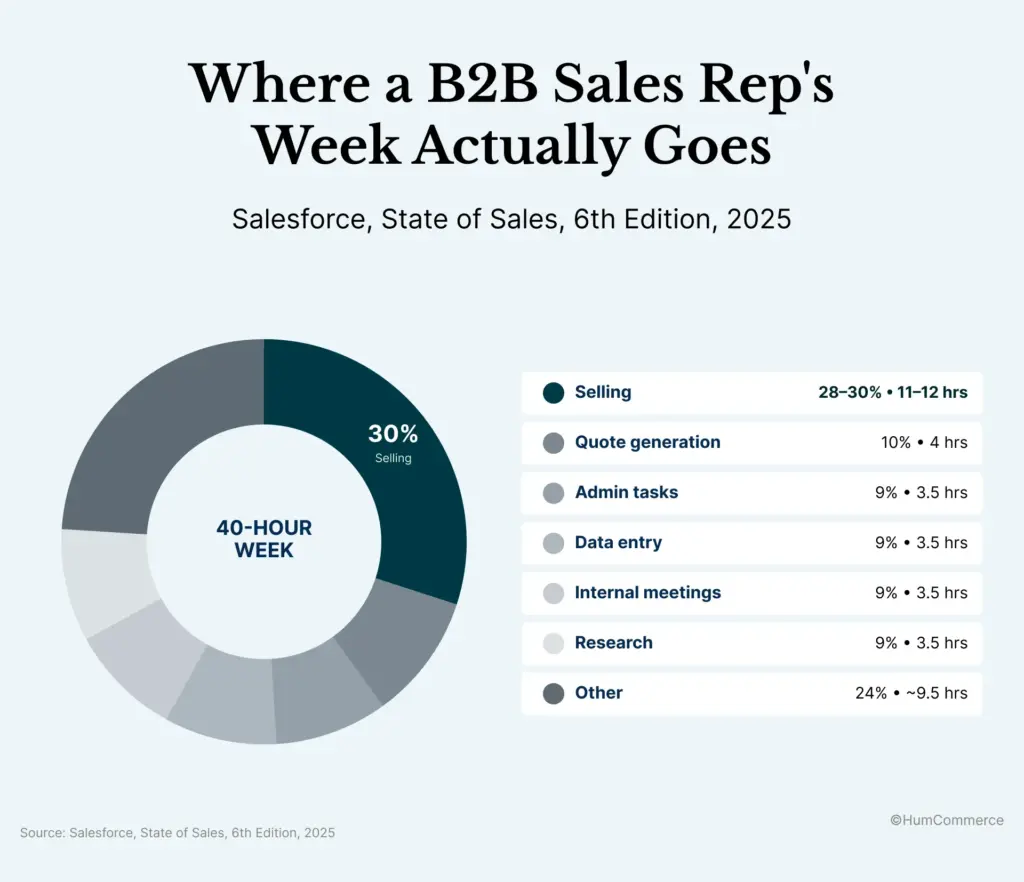
- According to Salesforce’s 2025 State of Sales report, B2B sales reps spend only 28-30% of their working week on actual selling activities. The other 70% goes to admin, data entry, internal meetings, and building quotes.
- For a 10-rep team at a fully loaded cost of $80,000 per rep per year, that’s $560,000-$590,000 in annual compensation generating admin output rather than revenue.
- Three tasks consume the largest share of non-selling time at B2B manufacturers and distributors: order entry, quoting, and order status inquiries — all of which can be handled without a rep.
- Quoting automation and self-serve ordering return 15-20% of weekly capacity to actual selling without changing headcount.
- At a $2M quota per rep, reclaiming 15% of a 10-rep team’s week in selling time produces an estimated $4.5M-$6M in additional annual revenue capacity.
If your best rep closes $2M per year and spends 40% of their week on order admin and pricing checks, you’re paying full rep compensation for 40% admin output. The revenue that admin time displaces never shows up in a forecast. It just doesn’t get generated.
That’s the actual cost of the problem. And it compounds across your entire sales team.
Where the 70% Goes
Salesforce’s 2025 State of Sales report draws on data from thousands of sales professionals and finds that reps spend only 28-30% of their working week on direct selling activities — calls, demos, negotiations, relationship conversations. The remaining 70% breaks down roughly as follows:
- Data entry and CRM updates: 9%
- Administrative tasks: 9%
- Internal meetings: 9%
- Research and prospect preparation: 9%
- Generating quotes and proposals: 10%
- Other non-selling work: 24%
For B2B manufacturers and distributors specifically, the biggest three buckets are slightly different from the broader sales population. They’re order entry, quoting, and responding to order status inquiries — tasks created directly by gaps in the eCommerce and ERP infrastructure.
The Three Tasks That Kill Selling Time at B2B Manufacturers
Order Entry
When a buyer calls or emails because they don’t trust the pricing on the portal, the rep takes the order manually and enters it into the ERP. That takes 10 to 20 minutes per order. For a rep handling 30 customer-initiated contacts per week, 40% of which could have gone through the portal with real-time contract pricing, that’s 12 orders per week — two to four hours that produced no selling activity.
This happens for one reason: the portal shows list price, not the buyer’s contract rate. A live API connection to the ERP’s customer pricing tables is the fix. Once buyers see their actual rate at login, a meaningful share of those phone orders shift to self-serve without any sales involvement.
Quoting
Manual quoting is the single largest block of non-selling time at most B2B manufacturers. A rep processing a standard quote manually opens the ERP, cross-references the customer’s pricing tier, checks stock across locations, calculates volume discounts, and builds the quote document. That takes 45 to 90 minutes for a standard order at most mid-size operations.
At 15 quotes per week per rep, that’s 11 to 22 hours of weekly quoting labor — the equivalent of 1.5 to 2.5 full workdays. An ERP-connected CPQ or AI-assisted quoting system collapses that to 5 to 15 minutes per quote. The same 15 quotes take 1.25 to 3.75 hours instead of a full week’s portion.
Order Status Inquiries
Customers want to know where their order is. Without self-serve order tracking, they call. Without self-serve invoice access, they call. Without self-serve inventory visibility, they call before placing the next order.
Each of these calls takes 5 to 10 minutes of rep time. At a distributor with 300 active accounts, weekly order status contacts can run 30 to 60 per week — 2.5 to 10 hours of rep time on questions the ERP can answer in 2 seconds through a self-serve portal.
The Annual Cost of Rep Admin Time
The cost calculation is straightforward. For a 10-rep team at a fully loaded cost of $80,000 per rep per year:
Total annual team cost: $800,000
If reps spend 70% of their time on non-selling work, and 25% of their total week goes to the three tasks above (order entry, quoting, order status), that’s $200,000 per year in rep compensation spent on work that infrastructure can handle.
For a 20-rep team at the same rate: $400,000.
This number never appears in a budget line. It sits inside salaries, marked as “sales operations.” But it’s real, and it’s addressable.
What Automation Returns to the Rep
The goal is not to eliminate the rep. It’s to return their time to work that actually requires them.
When quoting automation handles standard quote generation, reps spend their quoting hours on complex negotiations, non-standard configurations, and high-value accounts where their judgment creates value. When self-serve ordering handles repeat orders, reps focus on acquiring new accounts and expanding existing ones.
Duke Manufacturing achieved 88% faster quoting after HumCommerce integrated their CPQ and ERP systems. Their sales team went from spending most of a workday on quote processing to handling quotes in under 15 minutes each.
If a 10-rep team recaptures 15% of their week for actual selling, at a current close rate and average deal value, the revenue capacity expansion is typically $4M-$6M annually — not incremental revenue guaranteed, but potential that currently doesn’t exist because the time doesn’t exist.
The Infrastructure Fixes That Change the Numbers
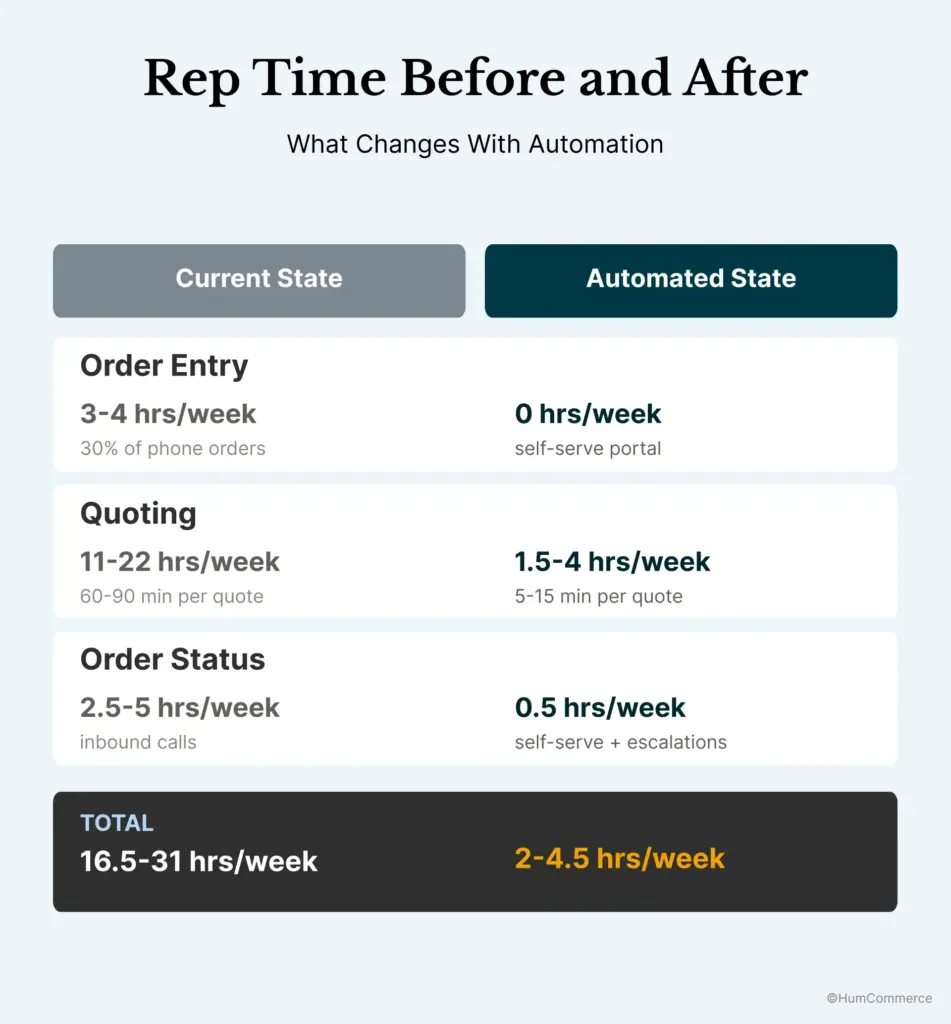
Three specific changes return the most time to your sales team:
Real-time contract pricing at portal login. Eliminates the order confirmation calls and rep-assisted order entry for accounts that use the portal. Requires a live API connection between your portal and your ERP’s customer pricing tables.
ERP-connected quoting. Pricing, inventory, and volume discounts auto-populate in the quote. Rep reviews and sends. Standard quotes drop from 60-90 minutes to 10-15 minutes. Requires CPQ integration with your ERP, or an AI assistant that queries the ERP directly.
Self-serve order status and account access. Customers check their own order status, invoice history, and delivery tracking through the portal. Routine inbound contacts drop by 40-60%. Requires bidirectional ERP integration and an account section with order history sync.
None of these require a new ERP. None require replacing your platform. They require building the integration architecture that connects your existing systems to your buyers.
Sources
- Salesforce, State of Sales, 6th Edition, 2025 — reps spend 28-30% of time selling: https://www.everstage.com/sales-productivity/sales-productivity-statistics
- McKinsey & Company, B2B Pulse Survey, 2025
- Duke Manufacturing case study, HumCommerce — 88% faster quoting after CPQ and ERP integration
- Kondo, The State of B2B Sales in 2025 — non-selling time breakdown: https://www.trykondo.com/blog/b2b-sales-2025-report