“Does this part fit a 2019 F-150 3.5L EcoBoost?” is the most common question your buyers ask. It should take 3 seconds to answer, not 3 minutes.
TL;DR
- Fitment search is the defining technical challenge in automotive parts distribution: year/make/model lookup across 500,000+ SKUs.
- Standard keyword search fails for fitment because buyers search by vehicle, not by part. The search engine can’t resolve “does this part fit this vehicle” from text matching alone.
- HumCommerce AI Assistant connects to your fitment database (ACES/PIES formatted or equivalent) and queries it before answering. It cannot guess at fitment — it returns what’s in the cross-reference or escalates.
- Account-specific pricing is pulled from your ERP simultaneously with the fitment answer.
- Multi-location inventory returns in the same response. The buyer gets fitment confirmation, their price, and stock availability at their nearest branch in one interaction.
Every automotive parts distributor handles the same call dozens of times a day.
A shop owner is at the counter with a customer whose 2019 F-150 needs a water pump. They call you: “Do you have a water pump for a 2019 F-150 3.5L EcoBoost? I’ve got account pricing — what’s my cost, and can your Denver branch have it ready in two hours?”
Your counter staff pulls up your catalog system, enters the year, make, model, and engine. Finds the part. Looks up the account. Gets the price. Checks Denver inventory. Delivers the answer in about 4 minutes.
That’s a four-minute interaction that happens 60 times a day across your branch network. An AI assistant connected to your fitment database, ERP, and inventory system returns the same answer in under 5 seconds.
Why Fitment Search Fails in Standard eCommerce
Standard B2B eCommerce platforms are built for product-first navigation: the buyer knows what they want, searches for it by name or part number, and adds it to cart.
Automotive parts buyers don’t navigate this way. They know the vehicle. They need the part. The mapping from vehicle to compatible part is the fitment database, and it’s a structured data problem, not a search problem.
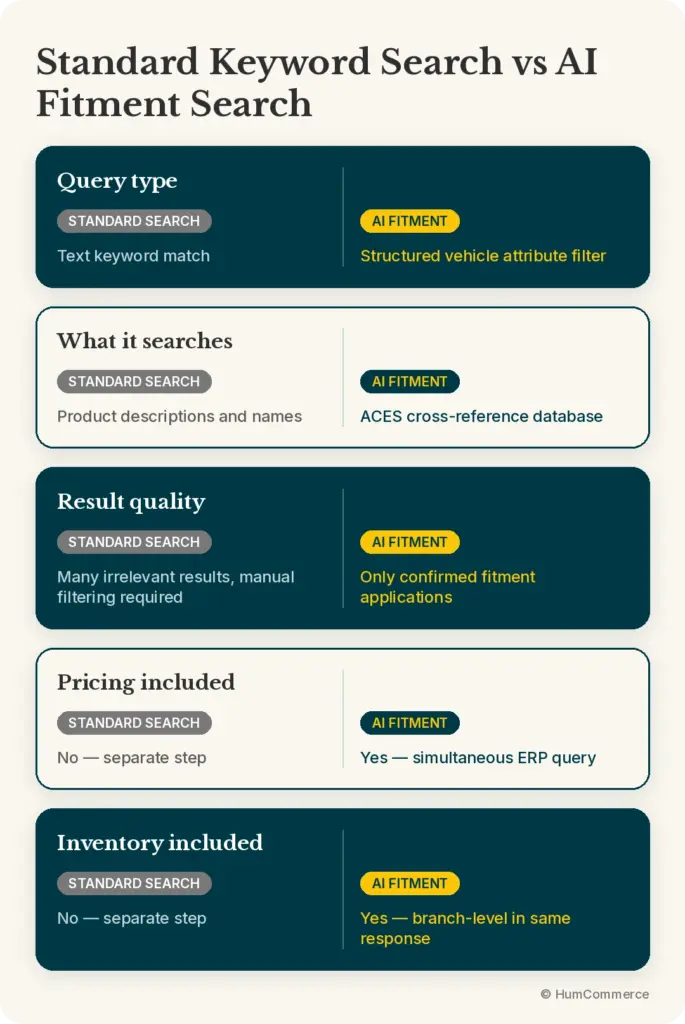
When a buyer types “2019 F-150 3.5L EcoBoost water pump” into a standard keyword search, the search engine returns every product that contains those words somewhere in its data. That might be the right part. It might also return general accessories, fluid additives, or parts for the 2.7L engine where the description mentions the 3.5L as incompatible. The buyer has to filter manually.
For a catalog with 500,000+ SKUs and multiple fitment variations per vehicle (different trims, engine variants, drivetrain configurations), manual filtering is not a realistic self-serve workflow. Buyers call. Counter staff spend 4 minutes per call. The self-serve portal is used for order placement by buyers who already know the exact part number — a small fraction of the total catalog interaction.
How Database-First AI Solves Fitment
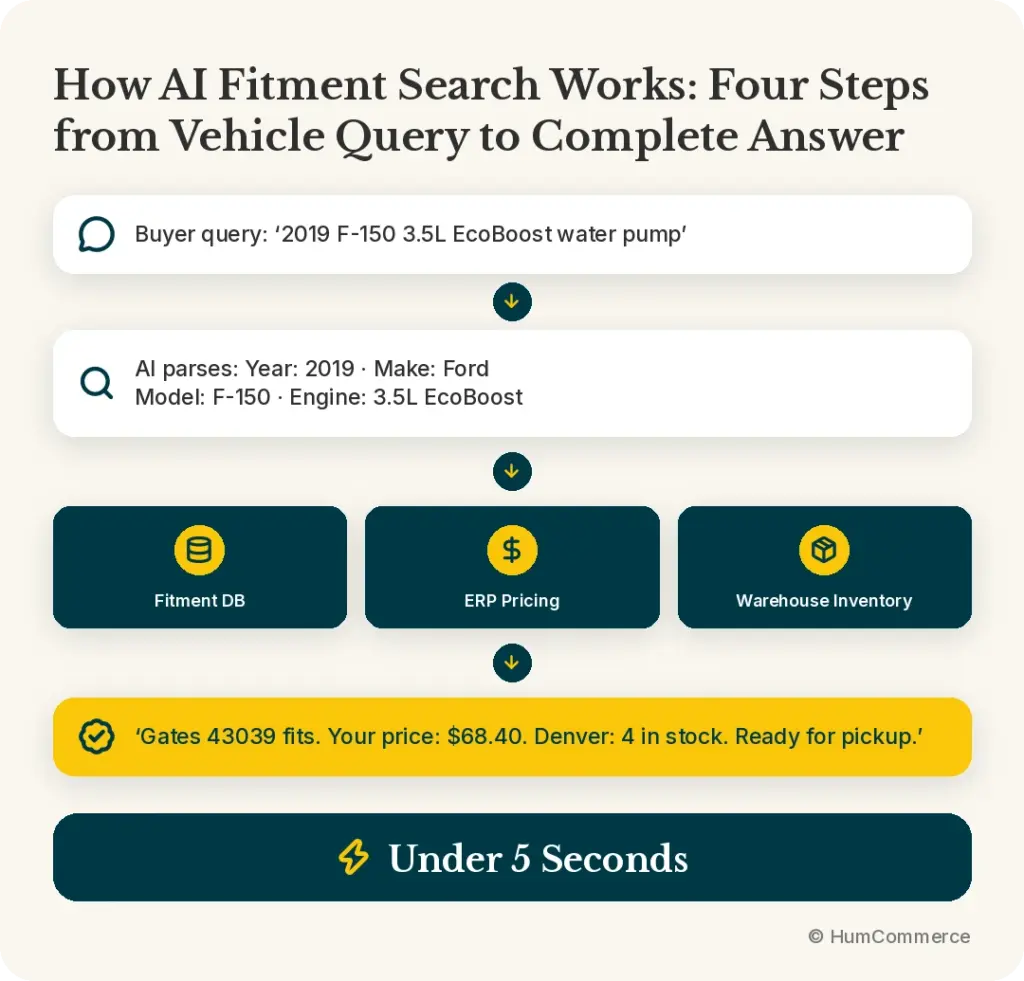
A database-first AI assistant handles fitment queries by querying your fitment data before constructing a response. The flow:
Step 1: Parse the vehicle query “2019 F-150 3.5L EcoBoost” is parsed into structured attributes: Year: 2019, Make: Ford, Model: F-150, Engine: 3.5L EcoBoost.
Step 2: Query the fitment database The AI queries your fitment cross-reference with the parsed vehicle attributes and the requested part category. It does not apply general automotive knowledge to determine whether something might fit. It queries the database.
Step 3: Return confirmed fitments The query returns parts confirmed to fit that specific vehicle configuration. The response lists those parts with part numbers, descriptions, and any fitment notes (OE replacement, performance, etc.).
Step 4: Simultaneously query pricing and inventory Using the buyer’s authenticated account and the matching part numbers, the AI queries the ERP pricing tables and warehouse inventory in parallel. The combined response includes fitment confirmation, account pricing, and stock at the relevant location.
What happens if the fitment database doesn’t have the cross-reference: The AI returns: “I don’t have fitment data for that exact configuration in our system. Let me connect you with our parts team.” It does not reason through whether the part might fit based on general automotive knowledge. Fitment is binary: confirmed or escalated.
ACES/PIES: The Fitment Data Standard
Most automotive parts distributors who stock branded product receive fitment data from suppliers in ACES format (Aftermarket Catalog Exchange Standard). ACES is a standardized XML schema for vehicle fitment data — it defines vehicle attributes (year, make, model, engine, transmission, drivetrain) and maps them to part numbers.
For an AI assistant to resolve fitment queries, your fitment data needs to be:
Machine-readable: ACES-formatted data that has been indexed into a queryable database. PDFs and printed catalogs cannot be queried programmatically.
Current: Fitment data updates when suppliers add new vehicles or applications to their catalogs. Outdated fitment data produces missed matches — buyers ask for a part that fits their vehicle, the AI says it doesn’t have data, and counter staff have to look it up anyway.
Complete for your catalog scope: If you stock 500,000 SKUs but only 300,000 have ACES fitment data, the AI assistant produces accurate results for the 300,000 and escalates for the remaining 200,000. Prioritize getting fitment data complete for your highest-volume part categories first.
For distributors who don’t have their fitment data in ACES format, HumCommerce works with the supplier-provided formats available and structures them for querying during the deployment process.
Multi-Location Inventory in the Fitment Response
Automotive parts distributors operate multi-branch networks. A buyer in Denver wants to know if Denver has the part — not whether Phoenix does. Delivery from Phoenix when the job is today isn’t useful information.
The AI assistant handles this by including branch-level inventory in the fitment response. When the buyer’s authenticated account has a primary branch, that branch’s inventory displays first. All branches with stock display for buyers who can accept shipment from multiple locations.
Example response: “Confirmed fitment: Gates 43039 fits 2019 F-150 3.5L EcoBoost. Your account price: $68.40. Denver branch: 4 in stock. Aurora branch: 2 in stock. Ready for same-day pickup or delivery within 3 hours.”
The buyer has everything they need to close the transaction. They don’t call back to confirm availability. They don’t wait for a callback on pricing. They place the order.
Account-Specific Pricing in Automotive Distribution
Automotive parts wholesale pricing is highly account-specific. Shop owners have negotiated rates on specific part categories. Fleet accounts have volume pricing structures. Independent shops have different rates from national chain accounts.
The AI assistant handles this through the same ERP pricing query architecture used across all HumCommerce deployments: the buyer’s account ID, authenticated at login, is the key that retrieves their specific pricing from the ERP. Every price the AI returns reflects that account’s actual rate.
This is particularly important for automotive wholesale. A shop owner who asks for a price and gets the list price — or a price that doesn’t reflect their negotiated tier — loses trust in the platform immediately. They call to confirm. They stop using the platform for pricing queries. The portal reverts to order placement only.
Real-time ERP pricing in the AI response is what makes the platform trustworthy for wholesale accounts.
What Implementation Requires for an Automotive Parts Distributor
Fitment database: ACES-formatted fitment data or equivalent structured cross-reference, indexed and queryable. The deployment process includes mapping your fitment data to the query format the AI assistant uses.
Product catalog in Adobe Commerce: SKUs with part numbers, descriptions, and attribute fields populated. The fitment database maps vehicle queries to part numbers; the product catalog maps part numbers to the full product record.
ERP API connection: Real-time pricing and inventory queries through your existing ERP (Epicor, NetSuite, SAP B1, or similar). Same architecture as any HumCommerce ERP integration.
Account authentication: Buyers authenticate with their account credentials. The account ID drives pricing and determines which branch displays first for inventory.
Timeline: For a distributor with current ACES fitment data and an ERP with accessible API, 10-12 weeks is a realistic deployment timeline. Significant fitment data cleanup or format conversion extends this by 4-6 weeks.
Sources
- HumCommerce B2B AI Assistant architecture documentation, 2026
- HumCommerce AI Assistant automotive industry page: https://humcommerce.com/b2b-ai-assistant/industries/ai-chatbot-for-automotive-parts-sales/
- Auto Care Association, ACES standard documentation (autocare.org)
- HumCommerce implementation data for automotive parts distributors, 2026