“Let me get back to you” is a five-word phrase that hands momentum to your competitor.
TL;DR
- The three most common questions that stall B2B sales calls: “What’s my price for 500 units?”, “Do you have 200 available in Atlanta?”, “Can you deliver by the 15th?”
- Each requires an ERP lookup the rep doesn’t have on the call without leaving the conversation.
- Research consistently shows that deals receiving responses within 4 hours close at a 35% higher rate than deals taking more than 24 hours (Proposify, ~2 million proposals).
- HumCommerce AI Assistant returns pricing, inventory, and delivery answers in under 3 seconds — on the call, while the buyer is still engaged.
- One distributor saw 25-35% of orders shift to self-service within 90 days of AI assistant deployment, freeing reps for higher-value conversations.
The call is going well. The prospect is engaged. They have a real requirement, a real budget, and they’re comparing you against one other supplier.
Then they ask: “We’d need 500 units of your #PD-440 at our Houston account pricing. What does that look like?”
Your rep knows the product. They know the account. They don’t have the Houston account’s pricing tier memorized at 500 units. They say: “Let me check on that and get back to you this afternoon.”
The buyer says: “Great, thanks.” They hang up and send the same question to your competitor.
What Happens in the Hours After “Let Me Get Back to You”
B2B buyers evaluating suppliers don’t wait passively. They continue their evaluation. Research from Proposify across nearly 2 million proposals found that deals receiving responses within 4 hours close at a 35% higher rate than deals waiting more than 24 hours.
The mechanism is simple. A buyer who asks a pricing question is ready to make a decision. If your competitor answers within the hour and you answer in four, the competitor’s price has already become the reference point. Your price is being compared against a number the buyer has been sitting with. The evaluation is no longer equal.
“Let me get back to you” doesn’t lose every deal. But across a 15-rep team running 200 active opportunities, the compounding effect of information gaps — every pricing question that couldn’t be answered on the call, every inventory check that required a callback — produces a measurable reduction in win rate that never shows up labeled as an information problem.
The Three Questions That Kill Sales Call Momentum
These three questions appear in some form on nearly every B2B sales call. All three require live ERP data. All three can be answered in under 3 seconds with a connected AI assistant.
“What’s my price for X units?”
This requires: the buyer’s account ID, the product ID, the requested quantity, and the ERP pricing hierarchy query that returns the applicable rate.
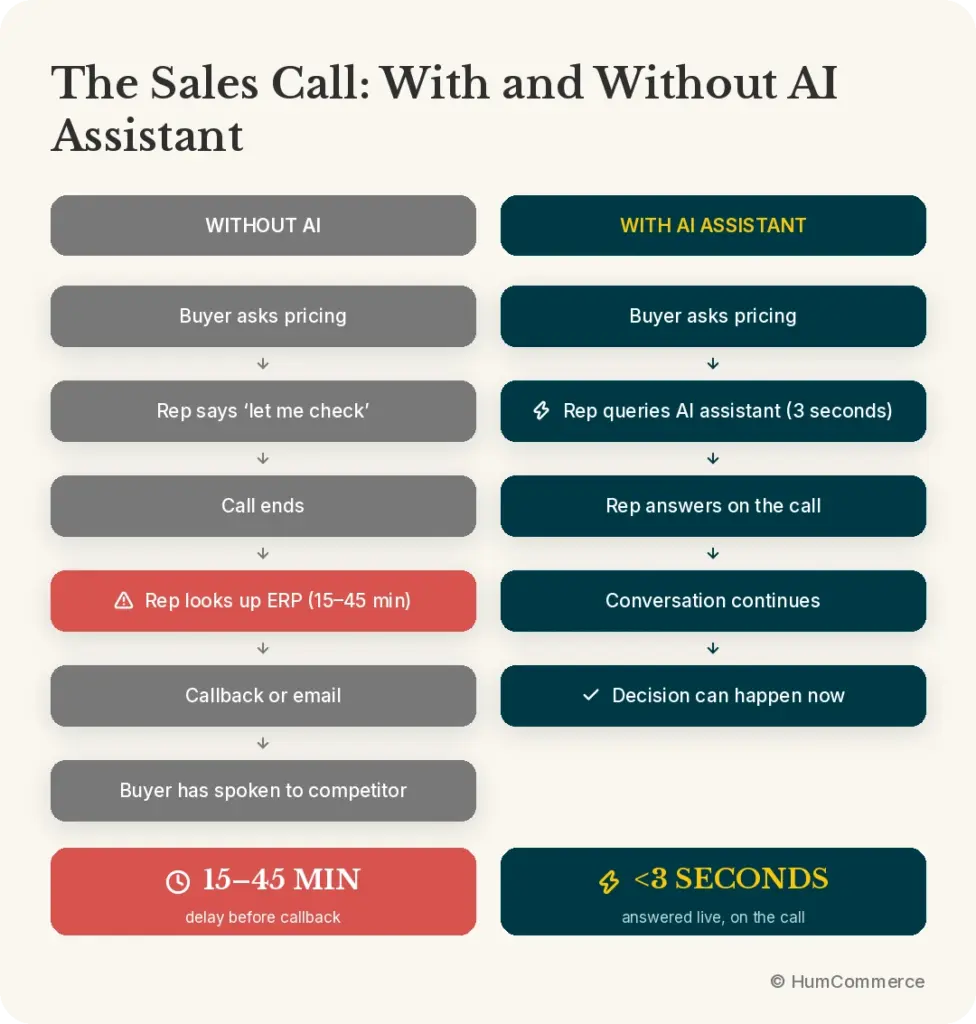
Without the AI assistant: the rep says “let me check on that,” puts the buyer on hold or promises a callback, opens the ERP, navigates to the account, finds the pricing tier, calculates the volume break, and either returns to the call or sends an email. Elapsed time: 15-45 minutes if they call back, or the following day if they email.
With the AI assistant: the rep asks the assistant (via desktop interface or voice command), the assistant queries the ERP pricing API, returns the contract rate for 500 units in under 3 seconds. The rep reads the answer to the buyer without leaving the conversation.
“Do you have X units in stock at [location]?”
This requires: the product ID, the requested quantity, and the warehouse location query that returns available stock.
Without the AI assistant: same sequence. ERP lookup, delay, callback or email.
With the AI assistant: live inventory query by warehouse, returned in under 3 seconds. “We have 312 units available in our Atlanta warehouse and 180 in Dallas.”
“Can you deliver by [date]?”
This requires: available stock at the nearest location, standard lead time from that location to the buyer’s address, and an estimated delivery date calculation.
Without the AI assistant: the rep estimates, hedges, or promises to confirm. Hedged estimates create uncertainty. Estimates that turn out to be wrong create credibility problems.
With the AI assistant: the system queries inventory and lead time data, calculates the estimated delivery date, returns it with specificity. “Standard delivery from Atlanta to Houston is 2 business days. If the order places by end of day today, delivery would be Thursday the 14th.”
What the Rep Does With 3 Seconds
The change an AI assistant creates in a live sales call isn’t just information speed. It’s conversational position.
A rep who can answer pricing and availability questions in real time stays in control of the call. The conversation moves forward. The buyer doesn’t lose confidence in the rep’s knowledge of their own products and pricing. There’s no awkward hold period, no callback that interrupts the buyer’s day, no gap in which the competitor can fill the space.
The rep’s role in the call changes. Instead of information retrieval — pulling up ERP screens, cross-referencing price lists — the rep focuses on what requires judgment: understanding the buyer’s full requirement, identifying upsell opportunities, handling objections, moving toward a decision.
That’s the conversation a good rep is built for. The AI assistant removes the part that isn’t.
What This Looks Like in Practice
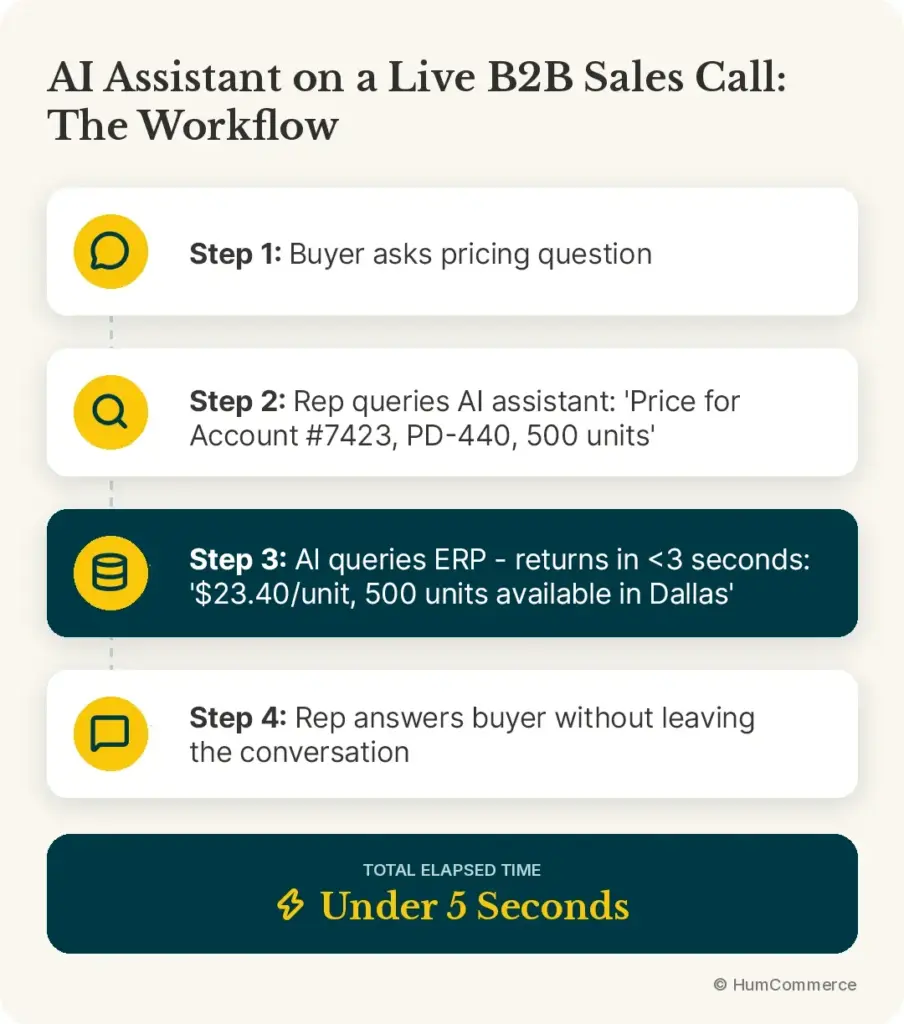
Here’s the actual workflow for a rep using HumCommerce AI Assistant on a live call:
Buyer: “We’re looking at 500 units of the PD-440 for our Houston distribution center. What does that look like on our account?”
Rep (types or voices to the assistant): “Price for Account #7423, PD-440, 500 units, Houston”
AI Assistant (returns in under 3 seconds): “Account #7423 contract rate at 500 units: $23.40/unit (standard price: $26.00). Your Houston DC qualifies for the Gulf Coast volume tier. 500 units available in Dallas, estimated delivery 1 business day.”
Rep (to buyer): “At 500 units, your Houston account pricing comes to $23.40 per unit. We have the inventory in Dallas — if you place by end of day, you’re looking at tomorrow delivery.”
The buyer has a complete answer. The rep never left the conversation. The decision can happen now.
The Broader Impact on Rep Time
The value of the AI assistant extends beyond the live call. Reps spend significant portions of their week on callbacks and email responses to questions they couldn’t answer in the moment. Every pricing callback, every inventory email, every delivery estimate that required a follow-up adds to a rep’s administrative backlog.
According to Salesforce’s 2025 State of Sales data, B2B reps spend only 28-30% of their week on actual selling. A substantial portion of the remainder goes to exactly these kinds of information retrieval tasks — questions that the rep handles after the call because they didn’t have the data during it.
Customers who deployed HumCommerce AI Assistant saw 25-35% of standard orders shift to self-service within 90 days of deployment, as buyers gained confidence that the portal held accurate data. The rep team’s time allocation shifted: less inbound inquiry handling, more outbound relationship and development work.
Sources
- Proposify, State of Proposals 2025 — 35% higher close rate for sub-4-hour responses: https://www.cobl.ai/blog/sales-proposal-statistics-what-actually-closes-deals
- Salesforce, State of Sales, 6th Edition, 2025 — reps spend 28-30% of time actually selling
- HumCommerce AI Assistant deployment data — 25-35% self-serve order shift within 90 days
- goautonomous.io, B2B Quote Response Time Benchmark 2026: https://goautonomous.io/blogs/b2b-quote-response-time-benchmark-2026-how-long-manufacturers-take-to-quote/