
The VP of Digital at a B2B distributor watches three dashboards on the screen.
One shows a traditional chatbot proudly reporting 3,000 conversations, but 70% ended with “talk to an agent.” Another shows the B2B portal, where RFQs still arrive as spreadsheets attached to emails.
The third is a pilot of a conversational AI chatbot for B2B ecommerce that parses a 40‑line RFQ, pulls specs from PIM, pricing from ERP, and pushes a draft quote into the pipeline.
The question in the room is which of these actually understands how your buyers think and buy.
How your B2B eCommerce buyers show up
If you own B2B ecommerce outcomes, you already know your buyers are not dropping in to ask random questions. They arrive with messy, high‑stakes requests like “Same valves as last time, but for plant B, 500 units, need delivery before shutdown,” or a CSV RFQ covering dozens of SKUs with contract‑specific pricing.
At the same time, research shows 77% of adults report chatbot frustration, and a majority of sessions end with a handoff to a human. Traditional AI chatbots for ecommerce are often part of that problem.
You are not choosing between AI and no AI. You are choosing between three ways your stack can understand B2B buyers:
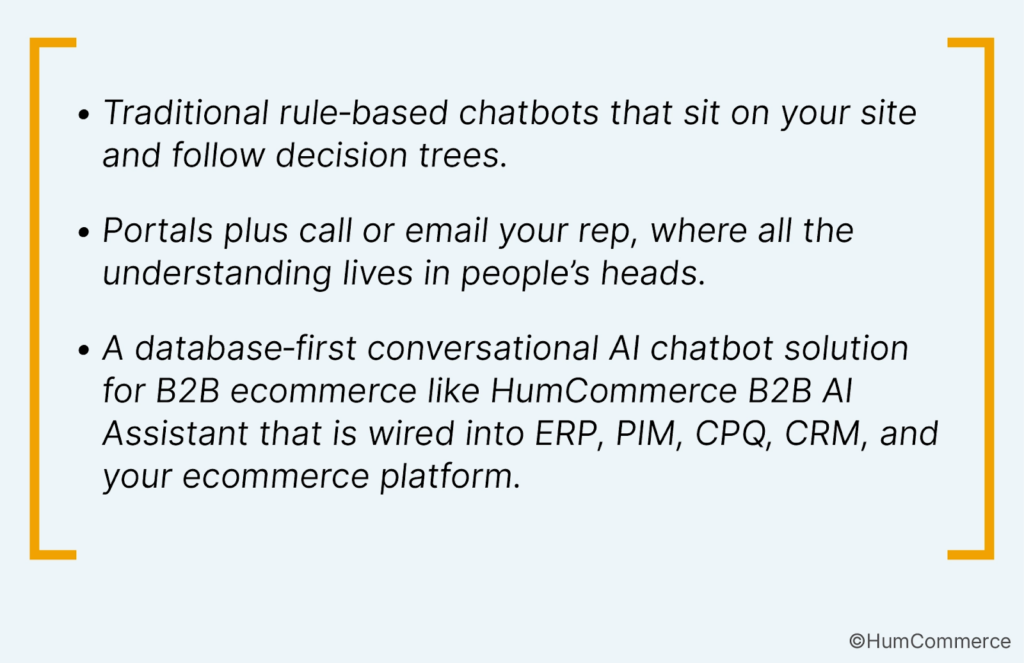
On paper they all promise better customer experience. In practice, only one of them behaves like a true conversational AI chatbot platform for B2B ecommerce that can hear “same as last time, but with stainless steel” and know exactly what to do.
This blog compares conversational AI for B2B ecommerce vs traditional chatbots using buyer understanding as the lens: how well they interpret intent, use context across systems, respect contracts and constraints, and decide when to pull a human in.
We will ground it in real workflows such as RFQs, quotes, and reorders, and in what research says about chatbot failures and conversational AI in B2B ecommerce, so you can decide which architecture belongs in front of your buyers.
What Exactly is Conversational AI for B2B Ecommerce Vs Traditional Chatbots
When someone says “we need an AI chatbot for ecommerce” in a B2B context, they usually mean “we need a way for buyers to ask questions and get answers online without waiting for email.” Under that vague goal, you are really choosing between three very different options for conversational AI for B2B ecommerce vs traditional chatbots.
HumCommerce B2B AI Assistant
HumCommerce B2B AI Assistant is a database‑first conversational AI chatbot solution for B2B ecommerce that sits on top of your core systems: Adobe Commerce or Magento, ERP such as SAP, Epicor, or NetSuite, PIM such as Akeneo, Salsify, or Pimcore, plus CPQ, CRM, and WMS.
It uses NLU and LLMs with retrieval to understand natural‑language RFQs and questions, then pulls live product attributes, stock by warehouse, contract pricing, and account data to handle RFQs, quotes, and reorders in a structured way. Its mental model is that this is a known account making complex, repeat purchases inside a system landscape it can see, which is what you want from a conversational AI chatbot platform for B2B ecommerce.
Traditional chatbots on the website
Traditional chatbots are rules‑based or intent‑slot bots embedded on the site. They match buyer utterances to predefined flows, answer FAQs, check basic order status, and open tickets.
They typically integrate with your ecommerce platform and helpdesk, but not with ERP, PIM, or CPQ, so they cannot reliably validate SKUs, check multi‑warehouse stock, or apply contract‑specific pricing.
Their mental model is that this is an anonymous site visitor asking one short question at a time, which is very different from a conversational AI chatbot for B2B ecommerce that understands RFQs.
Portals plus call or email your rep
Portals plus reps rely on a B2B portal for browsing and simple orders, and on human reps for everything else. Buyers log in, but when they need a real RFQ or complex configuration, they email a spreadsheet or call the rep.
Reps then interpret the request, jump between ERP, CPQ, and PIM, and manually craft quotes and orders. The mental model here is that the rep is the real assistant and the portal is only a catalog and order entry screen.
The rest of this article uses B2B‑specific criteria to judge which of these architectures actually understands your buyers well enough to change how they buy, not just how they ask for help, and to show where a conversational AI chatbot for B2B ecommerce truly outperforms traditional chatbots.
The Criteria to Compare Conversational AI for B2B Ecommerce with Traditional Chatbots
Feature lists such as “has chat,” “uses AI,” or “integrates with Shopify or Magento” do not tell you whether a solution will fix RFQ and quoting problems in B2B ecommerce. What matters for a conversational AI chatbot for B2B ecommerce is how deeply it understands four kinds of context: buyer intent, your systems, your catalog and constraints, and your relationships.
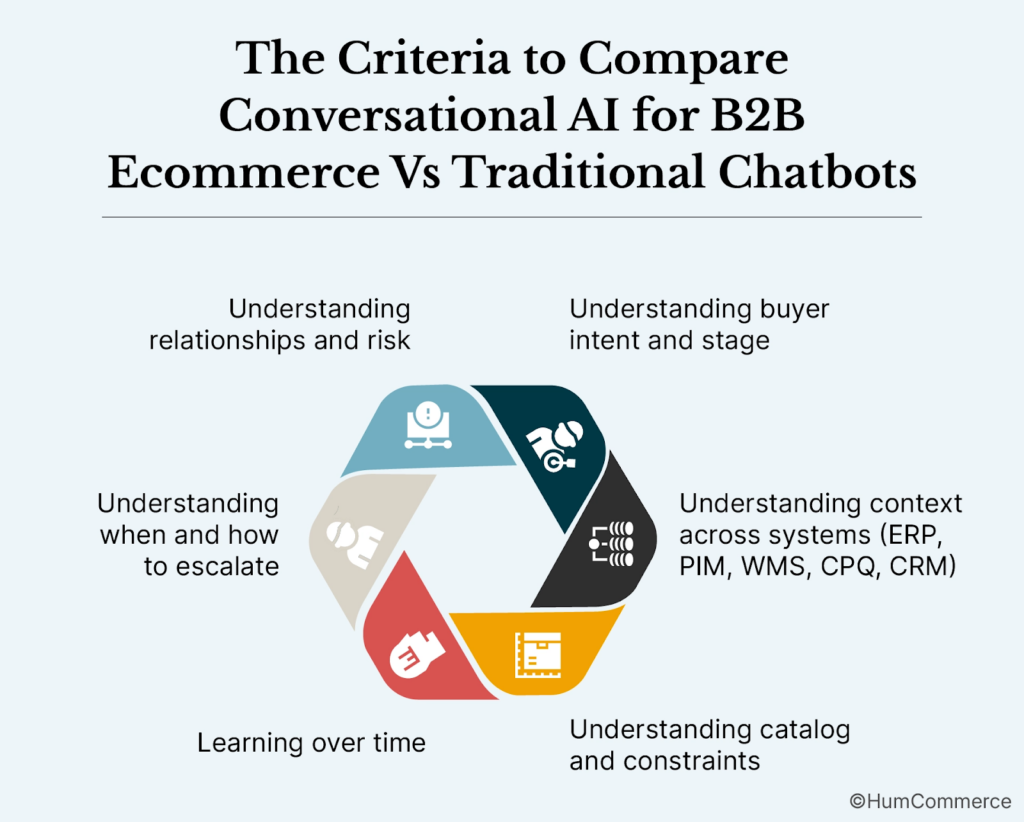
These are the key criteria we will use to compare a conversational AI chatbot platform for B2B ecommerce like HumCommerce B2B AI Assistant with traditional chatbots and portals.
Understanding buyer intent and stage
Can the assistant tell the difference between a casual pricing check, a true RFQ that should enter your quote pipeline, a reorder, and a troubleshooting request? Misclassifying these is why many traditional chatbots either escalate too often or never escalate when they should.
Understanding context across systems (ERP, PIM, WMS, CPQ, CRM)
Does it pull and reconcile data from ERP for inventory and pricing, PIM for attributes and compliance, WMS for fulfillment status, CPQ for complex rules, and CRM for account history? Without this cross‑system context, an AI chatbot for ecommerce can talk, but it does not really know your world.
Understanding catalog and constraints
Can it navigate high‑SKU catalogs, spec‑driven selection, and multi‑warehouse constraints, suggesting valid products and substitutes that respect capacity, regions, and regulations? Or is it just doing keyword search plus canned answers?
Understanding relationships and risk
Does it know which accounts are strategic, which contracts or SLAs apply, and which signals such as silence, negative sentiment, or repeated issues indicate churn risk or margin sensitivity? That understanding determines when you automate and when you pull a human in.
Understanding when and how to escalate
A good conversational AI chatbot for B2B eCommerce does not try to automate everything. It recognizes high deal value, ambiguity, or frustration and routes to the right human with full context. Traditional chatbots often fail here, trapping buyers in loops or dumping them into generic queues.
Learning over time
Can the system learn from repeated questions and edge cases to refine its understanding, or does every improvement require rewriting scripts and flows?
We will use these understanding dimensions, alongside classic measures such as productivity and time‑to‑value, to compare a database‑first conversational AI chatbot solution for B2B ecommerce like HumCommerce B2B AI Assistant, traditional chatbots, and portals plus reps.
HumCommerce B2B AI Assistant vs Traditional Chatbots vs Portals for Your B2B eCommerce Buyers
This section compares the same three approaches through the lens of buyer understanding, not just features.
Understanding buyer language and intent in RFQs and reorders
- HumCommerce B2B AI Assistant
Interprets multi‑line RFQs, “same as last order but for plant B,” and spec‑heavy questions by combining NLU with PIM and ERP context. - Traditional chatbots
Handle short, simple questions; often misclassify long or mixed RFQ messages and push them into generic flows. - Portals + reps
Reps usually understand intent well after reading emails or talking to buyers, but only at human speed.
Remembering context across sessions and channels
- HumCommerce B2B AI Assistant
Can tie web chat, portal sessions, and future conversations to the same account and opportunity via CRM and login. - Traditional chatbots
Have session‑limited memory; context is often lost if a buyer returns later or switches to email or phone. - Portals + reps
Context lives in rep notes and personal memory; continuity depends on individual reps and handovers.
Understanding your rules (contracts, pricing, approvals)
- HumCommerce B2B AI Assistant
Reads pricing and approval logic from ERP and CPQ and applies the correct contracts, tiers, and thresholds automatically. - Traditional chatbots
Rarely touch pricing logic and are usually restricted to general information to avoid errors. - Portals + reps
Reps know the rules but apply them manually, which is slow and error‑prone at scale.
Understanding catalog and constraints
- HumCommerce B2B AI Assistant
Uses PIM and inventory data to propose valid products, substitutes, and fulfillment options that match specs and capacity. - Traditional chatbots
Are limited to simple search and scripted replies and struggle with compatibility and multi‑warehouse stock logic. - Portals + reps
Reps understand constraints but spend time hunting across systems and teams to confirm details.
Understanding when to pull a human in
- HumCommerce B2B AI Assistant
Detects high value, confusion, or negative sentiment and escalates with full context to the right team member. - Traditional chatbots
Often fail to escalate gracefully; many sessions end in loops or abrupt transfers, which fuels frustration. - Portals + reps
Escalation is entirely manual; buyers escalate themselves by calling or emailing if unhappy.
HumCommerce B2B AI Assistant builds systematic understanding through data and workflows, not just chat transcripts. Traditional chatbots and portals rely on humans to supply context, which works for low volume or simple catalogs but breaks down as RFQs, SKUs, and expectations increase.
How Conversational AI for B2B Ecommerce Handles the Workflow Vs Traditional Chatbots
Consider a returning buyer sending a complex RFQ. Here is how each option interprets and acts on the same request.
With HumCommerce B2B AI Assistant
The buyer logs into your Adobe Commerce storefront, opens chat, and pastes a CSV RFQ with 40 line items, references to a previous order, and a note about delivery constraints.
HumCommerce B2B AI Assistant classifies this as a formal RFQ and links it to the right account and prior orders via CRM, not as a casual question.
It validates SKUs and specs against PIM, checks stock and lead times by warehouse in ERP and WMS, and reads contract rules from ERP and CPQ. It flags lines that cannot be fulfilled as requested, suggests substitutes or schedule changes, and explains the trade‑offs so buyers understand the options.
For a high‑value RFQ, it routes the AI‑prepared draft quote to a human approver, then syncs the approved quote back into ecommerce and CRM for one‑click conversion. In this flow, the conversational AI chatbot for B2B ecommerce has understood intent, context, and risk, and executed accordingly.
With traditional chatbots
The buyer opens the chatbot, picks a generic option such as “Ask a question,” and pastes the same RFQ details into a text field.
The bot can parse parts of the message but cannot reliably classify it as a formal RFQ or map all lines to SKUs without access to PIM and ERP data.
Since it lacks ERP and CPQ access, it cannot calculate pricing or confirm availability, so it opens a ticket labeled “pricing question” or “sales request.” A human rep or coordinator reads the ticket, re‑interprets the RFQ, and repeats the same validation steps manually in ERP and PIM.
The buyer experiences the traditional AI chatbot for ecommerce as a slightly nicer form. It did not really “understand” what they were trying to do, and it did not shorten the RFQ cycle in a meaningful way.
With portals and reps
The buyer logs in, finds building the RFQ inside the portal too cumbersome, and emails the CSV directly to their rep. The rep understands the request well, thanks to account and order history, but must manually open ERP, CPQ, and PIM, and sometimes email operations to confirm stock or feasibility.
They re‑enter the RFQ lines into systems, interpret pricing rules, assemble the quote, and often keep local spreadsheets along the way. After back‑and‑forth emails to clarify specs or timing, a quote reaches the buyer days later.
Understanding is strong, but it is trapped in human workflows and cannot scale easily without a conversational AI chatbot platform for B2B ecommerce acting as the front layer.
All three paths can technically handle the workflow. Only a database‑first conversational AI chatbot solution for B2B ecommerce like HumCommerce B2B AI Assistant combines human‑level understanding with system‑level execution at scale.
How Conversational AI for B2B Ecommerce Vs Traditional Chatbots Impact the Numbers
Understanding only matters if it moves the metrics that actually drive your B2B ecommerce outcomes.
RFQ turnaround time
- HumCommerce B2B AI Assistant
Automates validation and pricing off ERP and PIM data, cutting RFQ cycle times from days to hours or even minutes for well‑structured requests. - Traditional chatbots
Mostly neutral. They speed up intake, but the heavy lifting still happens manually in the back office. - Portals + reps
Entirely dependent on rep capacity; delays are common and very visible to buyers.
Quote‑to‑order conversion
- HumCommerce B2B AI Assistant
Faster, more accurate quotes that respect constraints and contracts improve win rates and reduce deal leakage. - Traditional chatbots
Limited impact. They rarely touch quote quality and can reduce trust when they misread intent or escalate poorly. - Portals + reps
Strong relationships can preserve conversion for key accounts, but slowness and inconsistency push opportunistic buyers elsewhere.
Sales and customer service time per RFQ or reorder
- HumCommerce B2B AI Assistant
Reduces manual re‑entry and cross‑system checking so teams review and adjust instead of building every RFQ from scratch. - Traditional chatbots
Add triage and another intake channel; core manual effort stays the same. - Portals + reps
Highest manual effort. Every complex RFQ is fully human‑handled across multiple systems.
Buyer satisfaction and retention
- HumCommerce B2B AI Assistant
Matches B2B buyers’ expectations for digital self‑service and speed; slow response is a known driver of supplier switching. - Traditional chatbots
High frustration when bots do not understand or cannot act. Around 77% of adults report negative experiences with basic chatbots. - Portals + reps
Satisfaction hinges on individual reps. Good for relationships, weaker on consistency and scalability.
Conversational AI for B2B Ecommerce Vs Traditional Chatbots: Which Fits Your Company Profile?
The right choice between conversational AI for B2B ecommerce vs traditional chatbots depends on your catalog, data quality, and digital maturity, not just on features.
Profile A: Simple catalog, early digital stage
You have limited SKUs, straightforward pricing, low RFQ volume, and buyers who still mainly email or call. A rep‑led portal model or basic AI chatbot for ecommerce that handles FAQs and tracking may be enough while you build ecommerce foundations and get your data into shape.
Profile B: Growing B2B, moderate complexity
Your catalog is expanding, ERP integration is in progress, RFQs are more frequent, but pricing rules and processes are still maturing. A more capable traditional chatbot can improve support and simple orders, buying you time to clean up PIM and ERP data and prepare for a conversational AI chatbot for B2B ecommerce later.
Profile C: High‑SKU, ERP‑heavy, RFQ‑driven
You manage hundreds or thousands of SKUs, contract pricing, multi‑warehouse inventory, and RFQs are a major revenue driver. In this environment, a database‑first conversational AI chatbot solution for B2B ecommerce such as HumCommerce B2B AI Assistant is one of the few practical ways to scale buyer understanding and execution without exploding headcount.
Profile D: Advanced digital teams
You already have a modern stack, strong data governance, and leadership buy‑in for automation. Here, a conversational AI chatbot platform for B2B ecommerce can act as a unified experience layer across search, RFQs, reorders, and support, and support advanced use cases such as churn prediction and proactive outreach.
Being honest about your profile prevents over‑investing in conversational AI before your data is ready and under‑investing when your buyers are already signalling that traditional chatbots and portals are too slow.
Implementation Considerations for Conversational AI for B2B Ecommerce Vs Traditional Chatbots
Many teams assume traditional chatbots and portals are simple to run while a conversational AI chatbot for B2B ecommerce is heavyweight to implement. The reality is more nuanced.
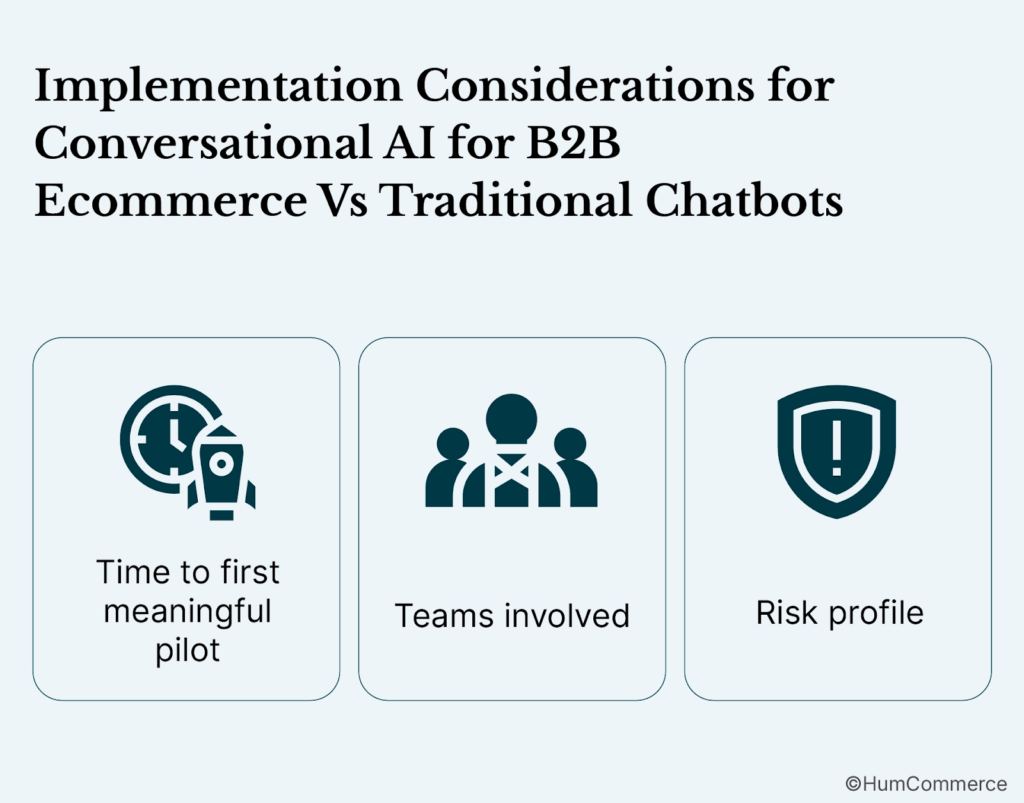
Time to first meaningful pilot
- HumCommerce B2B AI Assistant
Requires APIs into your ecommerce platform and ERP or PIM, but can start with one targeted workflow such as RFQs for a specific product line and build from there. - Traditional chatbots
Quick to launch for FAQs and basic support. Extending into pricing and inventory integration takes more time and separate projects than teams usually expect. - Portals + reps
Already live in most firms. Optimizing them still demands process changes, rep training, and data cleanup, with no structural improvement to RFQ speed.
Teams involved
- HumCommerce B2B AI Assistant
Ecommerce, IT, operations, and sales collaborate on integrations, workflow design, and approval guardrails. - Traditional chatbots
Mainly owned by ecommerce or CX. IT joins when deeper integrations are needed. - Portals + reps
Sales and customer service own buyer interactions. IT focuses on keeping systems running.
Risk profile
- HumCommerce B2B AI Assistant
Misconfigurations can affect quoting, but approval workflows, audit logs, and strong testing keep issues contained before quotes go out. - Traditional chatbots
Lower systemic risk, but high risk of buyer frustration and lost trust when they misread intent or fail to escalate gracefully. - Portals + reps
Risk concentrates in human error, inconsistency, and slow response times that push buyers toward competitors with faster, more automated workflows.
The practical path for a conversational AI chatbot solution for B2B ecommerce is to treat it as a targeted layer, not a replatform. Start where misunderstanding hurts you most, whether RFQs or complex reorders, wire into the minimum set of systems, and expand as you prove the impact.
Conversational AI for B2B Ecommerce Vs Traditional Chatbots
Traditional chatbots and rep‑led portals still have their place. For simple catalogs, early‑stage digital teams, or organizations whose main pain is basic support, they remain cost‑effective and familiar options. Once your growth depends on how well your stack understands complex B2B buyers, what they mean, what constraints they operate under, and which contracts and systems they live in, the limits of those models show up directly as RFQ delays, quote errors, and churn.
A database‑first conversational AI assistant like HumCommerce B2B AI Assistant is justified when buyers are already sending you signals that they expect to be understood, not triaged. HumCommerce B2B AI Assistant is a conversational AI chatbot for B2B ecommerce that sits on top of Adobe Commerce or Magento and connects directly to ERP, PIM, CPQ, CRM, and WMS.
This means that when a buyer pastes a multi‑line RFQ or asks a spec‑heavy question, the assistant can validate SKUs against PIM, check live stock and lead times in ERP, apply contract pricing rules, propose substitutes, and generate system‑ready quotes or reorders instead of just creating tickets.
Because HumCommerce also implements and optimizes the underlying B2B ecommerce stack, including ERP and PIM integrations, CPQ flows, and high‑SKU search and discovery, the conversational AI chatbot platform for B2B ecommerce is grounded in clean, reliable data rather than brittle scripts.
In practice, teams often start with one high‑impact workflow, such as RFQs on a Magento storefront, reorders for a key segment, or AI‑powered product discovery, and then scale HumCommerce B2B AI Assistant across more journeys as they see improvements in RFQ turnaround, quote win rate, and buyer satisfaction.