
TL;DR
- Selecting a B2B ecommerce platform requires more than comparing feature lists.
- You need a structured approach that accounts for your existing operations, integration requirements, and growth trajectory.
- This framework walks you through six stages: mapping current processes, assessing organizational readiness, preparing systems and data, designing improved workflows, implementing changes, and piloting with measurement.
- The goal isn’t finding the “best” platform – it’s finding the right platform for your specific business complexity.
Why This Matters for B2B Manufacturing & Distributions
The B2B ecommerce landscape has shifted dramatically. Grand View Research reports the global B2B ecommerce market reached $32.8 trillion in 2025. For manufacturers and distributors, this represents both opportunity and pressure. Your buyers expect self-service capabilities, real-time inventory visibility, and customer-specific pricing – all delivered through a platform that integrates with your existing ERP and operations stack.
Platform selection mistakes are expensive. A wrong choice means months of implementation, integration headaches, and operational disruption – followed by the painful realization that you need to start over. Distributors can achieve up to 30% improved efficiency in order processing by adopting the right B2B ecommerce solutions, according to Virtocommerce. But that efficiency gain only materializes when the platform actually matches your business complexity.
The stakes are higher for B2B than B2C. You’re not just selling products – you’re managing contract pricing, multi-level approval workflows, credit terms, and complex fulfillment requirements. Your platform needs to handle these realities from day one.
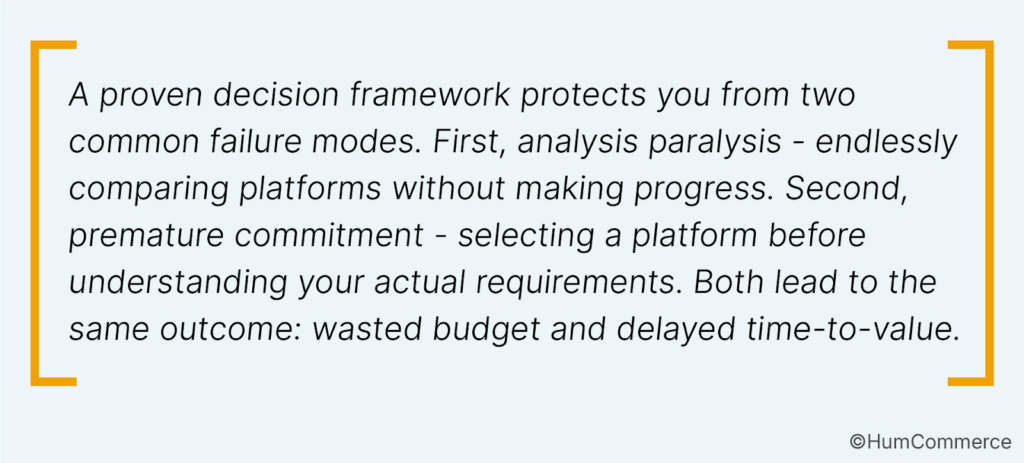
Why Choosing the Right B2B Ecommerce Platform Using a Proven Decision Framework Is a Priority Now
Buyer expectations have permanently changed. Gartner predicts that by the end of 2025, 80% of all B2B sales interactions will occur through digital channels, according to KiboCommerce. Your customers aren’t comparing you to other manufacturers – they’re comparing you to every digital experience they encounter.
The competitive window is narrowing. B2B firms with ecommerce storefronts expect 42% revenue growth, per Sana Commerce. Companies that delay platform decisions risk losing accounts to competitors who can offer online ordering, real-time inventory checks, and self-service account management.
What ‘Done’ Looks Like When You Choose the Right B2B Ecommerce Platform Using a Proven Decision Framework
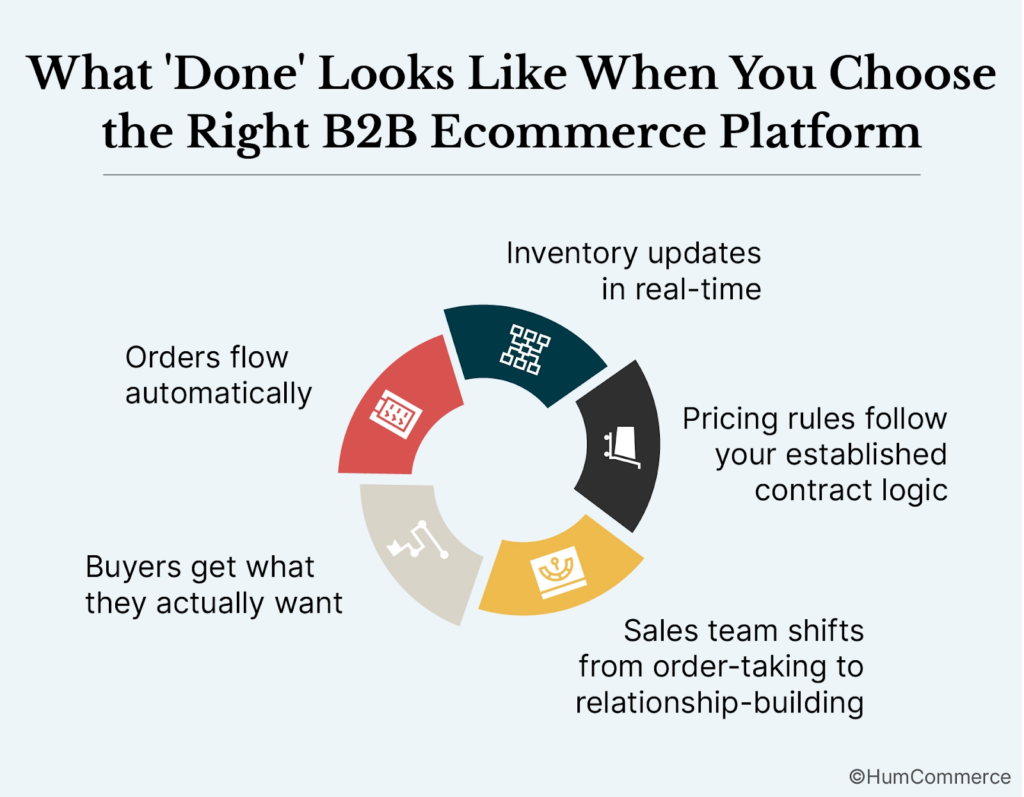
Success isn’t just launching a website. It’s achieving operational integration where your ecommerce platform functions as an extension of your ERP and operations. Orders flow automatically. Inventory updates in real-time. Pricing rules follow your established contract logic without manual intervention.
Your sales team shifts from order-taking to relationship-building. Instead of fielding calls about stock levels and pricing, they focus on complex deals and new account development. Customer service tickets about basic order status drop significantly.
Buyers get what they actually want: the ability to check pricing, place orders, review history, and track shipments without waiting for a callback. Research shows 83% of B2B buyers prefer managing orders and accounts entirely online. When you’ve chosen correctly, you’re meeting that expectation.
Step 1: Map How You Choose the Right B2B Ecommerce Platform Using a Proven Decision Framework Today
Before evaluating any platform, document your current state. This means understanding every touchpoint in your existing order-to-cash process – not how it’s supposed to work, but how it actually works.
Start with order intake. How do orders currently arrive? Phone calls, emailed spreadsheets, faxed purchase orders, EDI transactions? What percentage comes through each channel? Who handles them, and how long does processing take?
Next, map your pricing complexity. Do you have customer-specific contracts? Volume-based tiers? Regional variations? How many pricing rules exist, and where do they live – in your ERP, in spreadsheets, in someone’s head? This mapping reveals requirements that feature checklists miss.
Document your approval workflows. Which orders require credit checks? Who approves exceptions? What’s the current turnaround time, and where do bottlenecks occur? A platform that can’t replicate your necessary approval logic will create more problems than it solves.
Finally, inventory your integration points. ERP system and version. PIM or product data source. Warehouse management. Shipping carriers. Payment processors. Each integration adds complexity and narrows your platform options.
Step 2: Check If You’re Ready to Choose the Right B2B Ecommerce Platform Using a Proven Decision Framework
Organizational readiness determines implementation success more than platform features. You need honest answers to uncomfortable questions.
Does leadership understand this is an operations project, not a marketing project? Ecommerce platforms that integrate with ERP require involvement from IT, operations, and finance – not just the digital team. Without executive sponsorship that spans departments, projects stall.
Is your product data clean and structured? Most implementations hit delays because product information exists in multiple formats across different systems. If you can’t export a complete, accurate product catalog today, you’re not ready to start platform selection.
Do you have realistic expectations about timeline and investment? A properly integrated B2B ecommerce implementation for a manufacturer or distributor typically takes 6-12 months. Faster timelines usually mean cutting corners on integration – which creates technical debt you’ll pay later.
Consider your team’s capacity. Who will own this project day-to-day? Do they have bandwidth, or are they already stretched across other initiatives? Platform selection requires focused attention, not spare-time effort.
Step 3: Prepare Your Systems and Data
Data preparation is where most projects succeed or fail. Your platform is only as good as the information flowing into it.
Product data needs standardization. Every SKU requires consistent attributes: descriptions, specifications, images, categorization, and unit of measure. If you’re managing thousands of SKUs – common in manufacturing and distribution – this cleanup takes months, not weeks.
Pricing data requires extraction and validation. Pull your contract pricing, tier structures, and customer-class rules from wherever they currently live. Test them against recent orders to confirm accuracy. Errors in pricing logic damage customer trust quickly.
Customer data needs consolidation. Account hierarchies, shipping addresses, credit terms, payment methods, and user permissions all need documentation. For B2B, this includes understanding which contacts can place orders, which can only view, and which can approve purchases above certain thresholds.
Integration architecture deserves early attention. How will your ERP communicate with the ecommerce platform? Real-time API calls or batch synchronization? Which system is the source of truth for inventory, pricing, and customer data? These decisions affect everything downstream.
HumCommerce’s approach treats ERP as the operational backbone – designing Adobe Commerce to behave like part of your ERP rather than a separate storefront. This philosophy shapes data preparation significantly.
Step 4: Design the Improved Process
With current state mapped and data prepared, you can design target-state workflows. This is where you define how the platform should actually work for your business.
Start with the buyer journey. Map every touchpoint from initial product search through order placement and post-purchase support. Where do buyers currently experience friction? Where do they abandon the process and call your sales team instead?
Design for your actual complexity. B2B buying involves contract pricing, volume breaks, credit checks, and approval chains. Your platform must handle these in-flow with clear visibility into what happens next. Large orders shouldn’t stall in opaque internal processes.
Consider the handoff points between self-service and human assistance. The best implementations let buyers start self-serve, then invite a sales rep into the same cart or quote context when needed – no re-keying required. This hybrid model works better than forcing purely digital or purely human interactions.
Document specific requirements for each workflow. Quick order functionality for experienced buyers who know their part numbers. Requisition lists for repeat purchasing. Quote management with negotiation capabilities. Purchase order workflows with configurable approval chains.
Step 5: Implement Changes in Your Stack
Implementation is where your preparation pays off – or where shortcuts create ongoing headaches.
Platform configuration comes first. Company accounts with hierarchical structures. Role-based permissions. Customer-specific pricing rules. Catalog visibility controls. These settings determine whether your platform actually supports B2B complexity or forces workarounds.
Integration development follows. ERP connections for inventory, pricing, and order flow. PIM integration for product data. Payment processing for credit terms and account-based purchasing. Each integration requires testing against real data scenarios, not just happy-path transactions.
Quote turnaround time can drop from 3-5 days to just hours when you automate quote capture, approvals, and ERP checks in an end-to-end workflow. This efficiency gain requires tight integration between your ecommerce platform and backend systems.
User acceptance testing must involve actual users – not just IT. Have your sales team test the rep dashboard. Have a customer test the ordering flow. Have operations verify that orders sync correctly to fulfillment. Real users find problems that technical testing misses.
Training happens before launch, not after. Your team needs confidence in the new system before customers start using it. Role-specific training works better than generic overviews.
Step 6: Pilot, Measure, Improve
Launch to a controlled group first. Select customers who represent your typical complexity – not your simplest accounts. Their feedback reveals issues that affect broader rollout.
Define success metrics before you start. Order processing time. Customer service ticket volume. Self-service adoption rate. Average order value. Cart abandonment at checkout. These metrics tell you whether the implementation is working.
Measure continuously, not just at launch. Week-one metrics look different from month-three metrics. Early issues often resolve as users gain familiarity. Persistent problems require intervention.
Iterate based on data, not assumptions. If customers abandon carts at a specific step, investigate why. If certain product categories have low online adoption, understand the barriers. Continuous improvement separates successful implementations from expensive failures.
Common Mistakes to Avoid When You Choose the Right B2B Ecommerce Platform Using a Proven Decision Framework
Selecting based on feature lists rather than fit. Every platform has an impressive feature list. What matters is whether those features work for your specific pricing complexity, integration requirements, and buyer workflows.
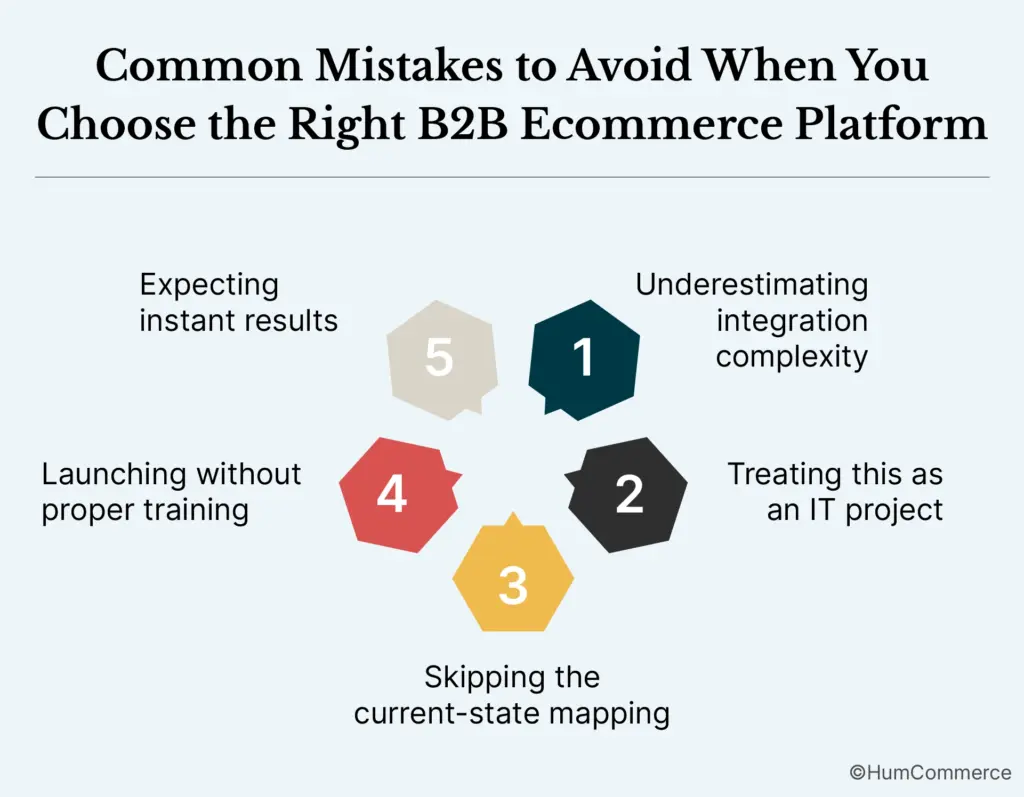
Underestimating integration complexity. The platform itself might be straightforward. Connecting it to your ERP, PIM, and fulfillment systems is where projects run over budget and timeline. KiboCommerce notes that 72% of B2B brands say composability is a top tech priority in 2025 – but composable architecture requires careful integration planning.
Treating this as an IT project. Technology matters, but this is fundamentally a business transformation. Without involvement from sales, operations, and customer service, you’ll build something that doesn’t match how your company actually works.
Skipping the current-state mapping. You can’t design a better process without understanding the existing one. Assumptions about how things work are usually wrong in important details.
Launching without proper training. Even the best platform fails if users don’t know how to use it. Invest in role-specific training and ongoing support.
Expecting instant results. B2B ecommerce adoption takes time. Customers need to learn new workflows. Your team needs to adjust processes. Plan for a ramp-up period, not an overnight transformation.
Need Help Putting This Into Practice?
Platform selection is only the beginning. The real work happens in implementation – connecting your ecommerce platform to ERP, configuring complex pricing rules, and building workflows that match your actual business operations.
HumCommerce specializes in Adobe Commerce implementations for manufacturers, distributors, and wholesalers. We’ve helped companies reduce quote turnaround from days to hours by integrating CPQ systems directly with their ecommerce platform. Our approach starts with your operations and ERP, not with a generic storefront template.
If you’re evaluating B2B ecommerce platforms and want to discuss your specific requirements, reach out for a conversation. We’ll help you understand whether Adobe Commerce fits your complexity – and what implementation actually looks like for your business.