
Key Takeaways
• Choose integration approach wisely: DCKAP Integrator offers flexible pricing starting at $999/month, while Epicor Commerce Connect provides native functionality but requires higher investment and customization.
• Real-time sync drives results: Manufacturers report 75% faster quoting workflows and 95%+ pricing accuracy when implementing proper real-time synchronization between systems.
• Architecture determines success: Effective data flow design with automated order-to-cash processes and inventory sync prevents overselling while enabling multi-warehouse fulfillment accuracy.
• Proven ROI from case studies: Leading firms achieved zero pricing errors, 50% reduced lead times, and ability to handle 200+ simultaneous product configurations.
• Future-proof with CI/CD pipelines: Implement monitoring systems and multi-region support to scale operations without introducing friction points as your business grows.
Wrong items get picked. Critical parts show out of stock when they’re sitting in the warehouse. Sales quotes prices that haven’t been accurate since last quarter.
When product data lives in too many places, mistakes happen. Your ERP says one thing. Magento shows another. And somewhere between those systems, your margins start bleeding.
Epicor CPQ integration with Magento fixes this disconnect at the source by creating a single source of truth that actually stays true.
Here’s what that looks like in practice:
Your sales team quotes from live pricing. Every time. No more “let me check on that” or pricing that’s three weeks stale.
Inventory numbers match reality. When a part’s available in warehouse A but not B, everyone knows. Including your customers.
Product configurations flow from CPQ straight through to fulfillment. No re-entry. No translation errors. No delays while someone figures out what the customer actually ordered.
Manufacturing firms using this integration report measurable results: 75% faster quote generation. Zero pricing discrepancies between systems. Order accuracy that actually improves instead of getting worse as you scale.
This isn’t about connecting systems for the sake of connectivity. It’s about building operations that respond to reality instead of reacting to problems after they’ve already cost you deals.
We’ll break down exactly how top manufacturers make this work—the integration approaches that actually deliver, the architecture decisions that matter, and the tools that handle complex manufacturing workflows without breaking your existing processes.
Because in manufacturing, the difference between connected systems and truly integrated operations isn’t technical. It’s profit.
Choosing the Right Integration Path for Epicor CPQ and Magento
Most manufacturers approach integration like they’re buying software. They compare feature lists, run demos, and pick the option that checks the most boxes.
That’s backwards.
Your integration path should match how your business actually operates. Not how the vendor thinks it should operate.
If you’re configuring complex industrial equipment with 500+ variables, your integration needs are different from a distributor managing standard SKUs. If you’re quoting million-dollar projects with multi-month lead times, you need different data flows than someone processing thousands of small orders daily.
Let’s break down the real decision points.
DCKAP Integrator vs Epicor Commerce Connect (ECC)
DCKAP Integrator starts at $999/month and gives you what most manufacturers actually need—reliable data sync without the overhead.
The advantages are straightforward:
- Real-time inventory management that actually reflects warehouse reality
- Transparent pricing that won’t surprise you at renewal time
- Drag-and-drop interface that doesn’t require a developer to change basic workflows
- P21 API access included, not sold separately
Epicor Commerce Connect (ECC) is Epicor’s native solution. It’s been refined through years of implementations, but that refinement comes with baggage.
Here’s what ECC actually costs:
- License fees (obvious)
- Consultation overhead (not obvious until you’re in it)
- Additional IT staff because it’s not simple to maintain
- Training costs that compound with every new hire
ECC gives you source code and documentation, which sounds great until you realize it uses a heavily customized Magento that limits your flexibility. Retrofitting ECC to an existing Magento site? Plan for significant modifications.
The real question: Do you need native Epicor integration badly enough to accept the complexity and cost? For most manufacturers, the answer is no.
API-First vs Connector-Based Integration Approaches
API-first integration means building exactly what you need using Epicor and Magento APIs directly. Maximum control. Maximum complexity. Maximum cost.
This path makes sense if:
- Your configuration workflows are genuinely unique
- You have experienced developers who know both platforms
- You’re willing to own the maintenance burden forever
Connector-based approaches use pre-built solutions like DCKAP Integrator. Less control, but faster implementation and lower technical requirements.
The trade-offs:
- Faster deployment (weeks vs months)
- Lower skill requirements for your team
- Pre-built data mapping that handles common scenarios
- Both scheduled and real-time sync options
Most manufacturers pick API-first because it sounds more sophisticated. Most should pick connector-based because it actually works.
Need expert guidance on selecting the right integration approach for your manufacturing business? Schedule a free 30-minute consultation with our CEO to discuss your specific requirements and challenges.
Version Compatibility: Magento 2.4.x and Epicor CPQ (formerly KBMax)
Version compatibility isn’t exciting. It’s also not optional.
Epicor CPQ (formerly KBMax) works best with current Magento versions, but “works” and “works well” are different things. Before you start any integration project, verify these compatibility points:
- Hardware and software requirements for both systems
- API version alignment between platforms
- Authentication methods that both systems support
- Data transformation requirements
We’ve watched manufacturers spend months troubleshooting integration issues that could have been prevented with proper version assessment upfront. One manufacturing client achieved 75% faster quoting workflows only after we properly aligned their Epicor CPQ and Magento systems through our ERP integration services.
The integration task agent in Epicor honors your External Company settings and enables bidirectional data flow. That’s technical documentation speak for “it should work with your existing setup.” But “should” isn’t “will.”
For optimal results, your integration team needs specialists who understand both platforms deeply. These systems handle business processes differently, and those differences show up in ways that aren’t obvious until you’re already committed to a particular approach.
The manufacturers who get integration right don’t pick the most popular option. They pick the option that matches their actual operational requirements.
Integration Architecture and Data Flow Design
Your integration architecture determines whether your systems work together or just happen to talk occasionally.
Most manufacturers treat integration like plumbing—connect the pipes and hope the data flows. But effective data flow between Epicor CPQ and Magento requires more than connectivity. It needs architecture that anticipates how your business actually operates.
Let’s break down what that looks like in practice.
Real-Time Sync for Product Configurations and Pricing
Product data inconsistency isn’t just an IT problem. It’s a margin killer.
When your CPQ holds one price, Magento shows another, and your ERP calculates something entirely different, every quote becomes a gamble. The integration between Epicor CPQ and Magento eliminates this chaos by establishing a synchronized product data environment.
Here’s what real-time sync actually delivers:
Pricing That Reflects Reality
Real-time pricing synchronization means current prices, contract terms, and market conditions show up in every quote. No more “let me get back to you” conversations because someone’s working from last month’s pricing.
Customer-Specific Accuracy
Customer-specific pricing displays correctly once the claim process completes. Your biggest accounts see their negotiated rates. Your standard customers see standard pricing. Everyone sees the right numbers.
Dynamic Quoting
Dynamic terms and accurate estimates flow throughout the buying journey. Complex configurations get priced correctly the first time instead of requiring manual adjustments later.
Without real-time pricing, sales reps take significantly longer to generate quotes—delaying negotiations and losing deals to faster competitors.
Order-to-Cash Automation via Epicor CPQ
Manual data re-entry between quote and order kills deals. And margins.
Epicor CPQ eliminates this friction by automating your entire order-to-cash cycle. Finalized product configuration data flows from CPQ straight to your ERP, triggering invoice creation and auto-populating orders with line-item details, pricing, discounts, shipping, and taxes.
The CPQ platform maintains real-time integration with both CRM and ERP systems to exchange customer data, estimate information, inventory levels, and visual renderings of configured products.
One manufacturer we worked with saw 75% faster quoting workflows after implementing this architecture. The improvement came from eliminating manual handoffs that previously caused pricing discrepancies and order delays.
Inventory and Availability Sync Between ERP and Magento
Nothing frustrates customers like promising delivery on parts you don’t have.
Real-time inventory sync between Epicor and Magento prevents this by updating stock levels across your ERP, CPQ, and webstore simultaneously. Sales teams see live inventory availability within their quoting tools. Customers get accurate lead times based on current stock levels. Overselling stops happening.
For multi-warehouse operations, this synchronization becomes critical. Sales representatives gain instant access to live stock availability within their sales platform, empowering them to provide accurate lead times and avoid overselling.
The result? Customer confidence that builds throughout the sales cycle instead of eroding when promises can’t be kept.
Customer Account Mapping and Role-Based Access
Customer data scattered across systems creates admin nightmares and customer frustration.
Sophisticated customer data synchronization between Epicor and Magento fixes this. Customer information—accounts, complete history, billing details—updates automatically when customers change their profiles on either platform.
Your integration supports:
- Customer maintenance, customer SKUs, and customer lists
- Role-based or location-based access to company data
- Customer self-service account management capabilities
One manufacturing client reduced admin overhead by 30% while improving customer satisfaction after implementing our ERP integration services. The improvement came from eliminating duplicate data entry and conflicting customer records between systems.
Want to see if your current integration architecture measures up? Download our eBook ‘The Tariff-Resilient Enterprise‘ to benchmark your integration strategy against industry leaders.
Case Studies: Real Results from Top Manufacturing Firms
Numbers don’t lie. Neither do the manufacturers who’ve made this integration work.
Here’s what actually happens when you stop treating Epicor CPQ and Magento as separate tools and start running them as a unified system.
75% Faster Quoting Workflows with Epicor CPQ
An industrial storefront glass manufacturer was drowning in their own quoting process. Seven days to generate a single quote. Sometimes more when pricing needed verification or product specs got questioned.
Their problem wasn’t complicated—it was just expensive. Epicor CPQ had one set of pricing rules. Magento showed different prices. Sales reps spent most of their time reconciling the gap instead of closing deals.
The integration with Magento and Salesforce fixed this in a way that actually stuck. Quote generation dropped from 3-7 days to under 1 hour. Not through faster manual processes, but by eliminating the manual work entirely.
What changed:
- Quote generation moved from days to minutes
- Real-time pricing sync across all platforms—no more discrepancies
- Data flows from CPQ through ERP to eCommerce without human translation
Zero Pricing Errors in Configurable Product Sales
Quote accuracy used to hover around 75-85% for most manufacturers. That might sound acceptable until you calculate what the other 15-25% costs you in rework, lost deals, and frustrated customers.
Epicor CPQ integration pushes that accuracy rate above 95%. The difference comes from centralized pricing rules that actually get enforced across every sales channel.
Repligen faced this exact challenge with their ProConnex® Flow Paths system—hundreds of customizable bioprocessing components with complex pricing structures. Manual pricing updates meant constant errors and delayed quotes.
After implementing Epicor CPQ, pricing updates became automatic. Sales teams and customers get accurate pricing in real-time, which cuts the entire sales cycle. No more “let me verify that price” delays.
Multi-Warehouse Fulfillment That Actually Works
Most multi-warehouse strategies fail because systems can’t talk to each other fast enough. Orders get routed to the wrong location. Stock levels don’t sync. Customers wait while warehouses play inventory telephone.
Integrated Epicor CPQ and Magento systems solve this through real-time visibility across locations. Walmart’s approach with regional distribution centers shows how this works at scale—faster fulfillment times while maintaining consistent customer experience.
The system enables:
- Live inventory visibility across all warehouse locations
- Automatic routing to the optimal fulfillment point
- Prevention of stockout-related order errors before they happen
Want to audit your current fulfillment accuracy? Request our free audit to identify opportunities for improvement.
Scalability That Doesn’t Break Your Operations
Van Wijnen, a Dutch housing developer, needed to configure over 200 properties simultaneously for single projects while managing 2,400+ homes annually. Their existing process required specialized engineering knowledge for every iteration.
Epicor CPQ didn’t just automate their workflow—it transformed it. Lead times dropped by 50%. Projects that used to take months now complete in under two hours.
The real breakthrough came from automated file-to-factory workflows that eliminate the translation steps between digital design and physical production. Configure once, produce automatically.
Top Tools for Magento Epicor Integration in Manufacturing
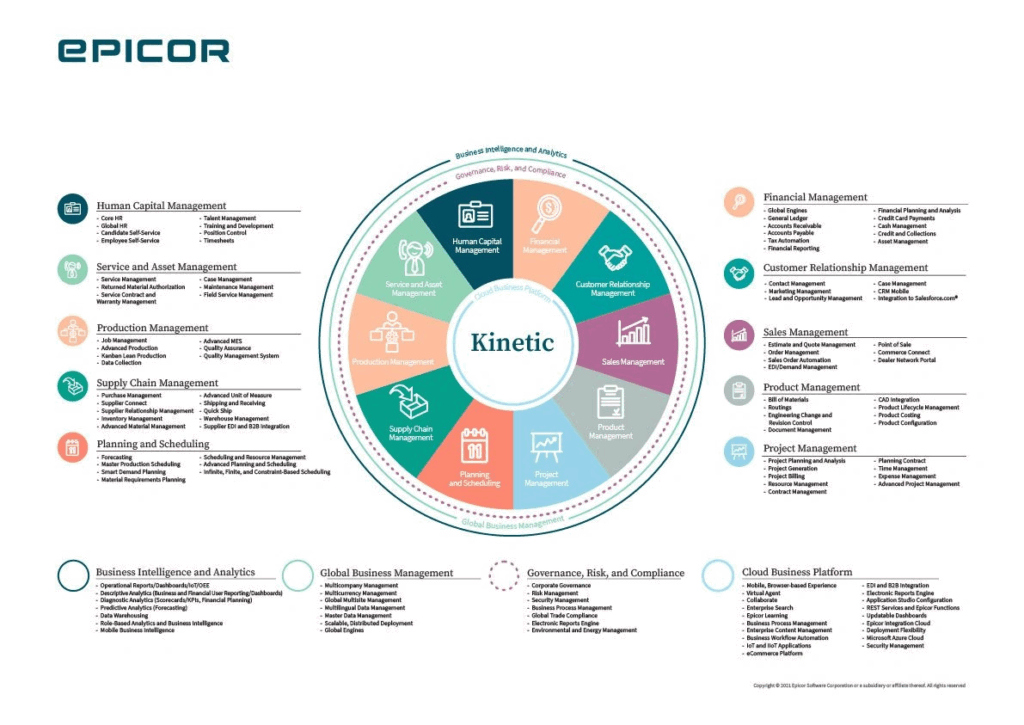
Image Source: Encompass Solutions
The integration platform you choose either works with manufacturing complexity or breaks under it.
Most platforms promise everything. Few deliver when you’re handling 50,000 SKUs, multi-plant pricing rules, and configurations that change based on customer specifications.
Here’s what actually matters when selecting your integration platform:
DCKAP Integrator: The Pragmatic Choice
DCKAP Integrator cuts through the noise with transparent pricing and manufacturing-focused features. Starting at $999 monthly for the Standard plan, it avoids the licensing maze that traps most manufacturers in expensive ERP vendor ecosystems.
Why it works for manufacturing:
The drag-and-drop interface means your ops team can modify workflows without calling developers. That matters when product lines shift or pricing rules change mid-quarter.
Real-time inventory sync handles the complexity most platforms struggle with—multi-location stock, reserved inventory, and the timing mismatches that create overselling. The Flow Designer eliminates custom coding for standard manufacturing workflows.
The trade-off: Less customization than API-first approaches, but faster deployment and lower maintenance overhead.
Celigo integrator.io: Built for Complex CPQ Workflows
Celigo makes sense when your quoting process involves multiple systems and conditional logic. The platform’s CPQ-specific workflows handle the complexity that breaks generic integration tools.
Where it excels:
Manufacturing firms with complex pricing matrices benefit from Celigo’s prebuilt automation that doesn’t require deep technical expertise. The platform manages conditional workflows—if customer A orders product B with modification C, then trigger pricing rule D and route to fulfillment location E.
NetSuite integration capabilities give you complete access to saved searches, dynamic lookups, and real-time triggers. That depth matters when your pricing depends on inventory levels, customer contracts, and market conditions.
The reality: More expensive than simpler connectors, but handles manufacturing complexity that would require custom development elsewhere.
MuleSoft: When Real-Time Actually Means Real-Time
MuleSoft’s event-driven architecture handles the demanding sync requirements that break standard integration platforms. When inventory changes in your ERP, pricing updates in Magento instantly. Not in the next sync cycle. Instantly.
Manufacturing firms utilizing our ERP integration services have achieved up to 75% faster quoting workflows with MuleSoft’s event-driven architecture, as demonstrated in our case study with FHC.
The engineering advantage: AsyncAPI support means your integration can evolve as your business grows without rebuilding from scratch.
The cost consideration: Enterprise pricing that reflects enterprise capabilities. Worth it for high-volume operations where sync delays cost deals.
Alumio: Scheduled Sync for Predictable Workflows
Some manufacturing operations don’t need real-time everything. Alumio’s scheduler-based approach works well when you can predict data flow patterns.
Set inventory updates for every hour, pricing refreshes overnight, and customer data sync twice daily. This controlled approach reduces system load and provides predictable processing windows.
Interested in optimizing your integration strategy? Download our eBook ‘The Tariff-Resilient Enterprise’ to benchmark against industry leaders.
The speed advantage: Completed within 2-4 weeks—75% faster than traditional integration timeframes. The platform’s broad connectivity supports REST API, GraphQL, SOAP, databases, and various file systems without custom development.
Best fit: Manufacturing operations with stable, predictable workflows where scheduling sync windows won’t disrupt business processes.
The Bottom Line on Tool Selection
Your integration platform needs to handle manufacturing reality, not just marketing promises. Complex pricing structures. Multi-location inventory. Product configurations that don’t fit standard eCommerce templates.
The right platform eliminates the manual workarounds that slow your operations. The wrong one creates new problems that cost more than the integration saves.
Scaling and Future-Proofing Your Integration
Your integration works. Sales quotes faster. Inventory syncs. Orders flow without manual handoffs.
But what happens when you double production volume? Add three new facilities? Launch in Europe where tax rules change everything?
Most manufacturers hit the scaling wall around month 18. The integration that solved their initial problems starts creating new ones. Data syncs slow down. Updates break workflows. Multi-region pricing becomes a manual nightmare.
The companies that scale successfully don’t rebuild. They architect for growth from day one.
CI/CD Pipelines for Continuous Integration Updates
Your integration isn’t static. Epicor releases updates. Magento evolves. Your business processes change.
Without CI/CD pipelines, every update becomes a potential disaster. Someone pushes a change at 3 PM on Friday. Your pricing engine breaks. Sales can’t quote until Monday morning while IT scrambles to fix whatever went wrong.
CI/CD pipelines eliminate that chaos. Changes get tested automatically before they touch your live systems. Updates deploy with zero downtime. Your integration stays current without the risk.
Manufacturing firms using our ERP integration services report 90% fewer integration failures after implementing proper CI/CD workflows. Not because the technology got better. Because the process got smarter.
Monitoring and Alerting for Data Sync Failures
Data sync failures don’t announce themselves. They hide.
Your inventory shows 500 units available. The warehouse has 50. A customer places a bulk order you can’t fulfill. By the time someone notices, you’ve got an angry customer and a credibility problem.
Automated monitoring catches these failures before they become customer problems. When pricing doesn’t sync between CPQ and Magento, your team knows immediately. When inventory counts drift between systems, alerts fire before the next sale.
The alternative? Finding out when a customer calls asking why their order shipped incomplete.
Want to identify potential integration weak points? Request our free audit to pinpoint vulnerability areas in your current setup.
Support for Multi-Region Pricing and Tax Rules
European customers expect VAT calculations. Canadian orders need GST. Your U.S. sales team thinks tax is simple until they try selling to a manufacturer in Quebec.
Most integrations handle single-region tax logic. Multi-region? That’s where things get messy. Different rates, exemption rules, compliance requirements. Your Epicor CPQ integration needs to handle all of it without custom scripts that break every time tax rules change.
The manufacturers expanding globally successfully build multi-region pricing and tax logic into their integration architecture. Not as an afterthought. As a core requirement.
Extending CPQ Logic to Mobile and Dealer Portals
Your sales team isn’t always at their desk. Your distributors need access to current pricing. Field engineers configure products on customer sites.
Epicor CPQ dealer portal integration extends your pricing logic beyond your internal systems. Authorized partners access real-time configurations. Mobile apps sync with your CPQ rules. Everyone quotes from the same data.
This isn’t about convenience. It’s about control. When your distribution network operates from consistent information, margins stay protected. When field teams configure from live data, orders come back correct the first time.
Calculate your B2B eCommerce revenue opportunity
Instantly discover how much additional revenue you could generate by optimizing your eCommerce store.
Conclusion
Wrong picks. Stale pricing. Order errors that compound.
These aren’t technical problems. They’re profit problems.
And the manufacturers fixing them aren’t doing it with bigger teams or better processes. They’re doing it with integration that actually works.
The path matters. DCKAP Integrator gets you there faster and cheaper than ECC. API-first gives you control but costs time. Connectors work when you need results more than customization.
Your architecture determines everything else. Real-time sync means quotes in minutes, not days. Order-to-cash automation means fewer manual touchpoints. Inventory that reflects reality means customers get what they ordered when they expected it.
The case studies make this clear: 75% faster workflows aren’t theoretical. Zero pricing errors aren’t wishful thinking. Companies handling 200+ simultaneous configurations aren’t outliers—they’re what’s possible when your systems actually talk to each other.
Tools like DCKAP, Celigo, MuleSoft, and Alumio handle the complexity. They bridge the gap between where you are and where you need to be. Without breaking what already works.
But here’s what matters most:
This isn’t a tech project. It’s a business decision.
The manufacturers winning aren’t the ones with the fanciest integration. They’re the ones who recognized that disconnected systems cost more than connected ones. That manual workarounds scale poorly. That customer experience starts with internal operations.