In a quarterly review, the B2B ecommerce team has three browser tabs open on the big screen.
One shows Intercom’s renewal quote with per‑resolution AI pricing and a promise to deflect more tickets.
Another shows a “Top 14 Intercom alternatives” article listing Zendesk, Freshdesk, Gorgias, Crisp, and LiveAgent, all pitching better ticketing and omnichannel support as the best Intercom alternatives.
The third tab is a demo of Klevu and HumCommerce B2B AI Assistant on their Adobe Commerce store, where a buyer describes an application in natural language and instantly sees compatible SKUs, stock, and contract pricing pulled from ERP and PIM.
The room realizes they have been treating Intercom and all the alternatives to Intercom live chat as the same kind of tool, when support‑first platforms, ecommerce‑native tools, and AI discovery assistants actually solve very different problems.
Why this choice matters now for B2B ecommerce
If you lead B2B ecommerce, you are usually not asking about Intercom alternatives because your chat icon feels outdated. You are asking because buyers still struggle to find the right products, your RFQs are messy and incomplete, and your team spends too much time answering “what should I buy?” questions even though you already pay for live chat.
At the same time, many Intercom deployments are turning into expensive support centers with AI add‑ons that mostly answer FAQs instead of solving product discovery and RFQ problems.
You are not choosing chat versus no chat. You are choosing which category of tools sits between buyers and your catalog when you look for the best Intercom alternatives or evaluate alternatives to Intercom:
- Support‑first platforms: Intercom itself and intercom chat alternatives like Zendesk, Freshdesk, Help Scout, HubSpot Service Hub, Comm100, Crisp, Zoho Desk, LiveAgent, and Tidio, which are excellent for tickets and messaging.
- Ecommerce‑native support tools like Gorgias, Ringly, and YourGPT for ecommerce that pull order data into support but still treat discovery as search’s job.
- AI product discovery and shopping assistants such as Klevu, Algolia, Vue.ai, Threekit, and B2B assistants like HumCommerce B2B AI Assistant that connect directly to your search indices, PIM, and ERP to guide buyers to the right SKUs and cleaner RFQs.
This blog does not just list Intercom alternatives. It compares these three categories using real B2B workflows as the lens: how well each helps buyers discover products and build RFQs, what they demand from your stack, and how they move conversion and RFQ metrics.
What are the Intercom Alternatives And What You’re Really Choosing Between
When most teams search for alternatives to Intercom, they land on blog posts that rank tools on number of channels, helpdesk features, pricing, and AI ticket bots. For B2B ecommerce, that is only part of the picture. You are actually choosing between three distinct tool categories rather than a single list of “best Intercom alternatives.”
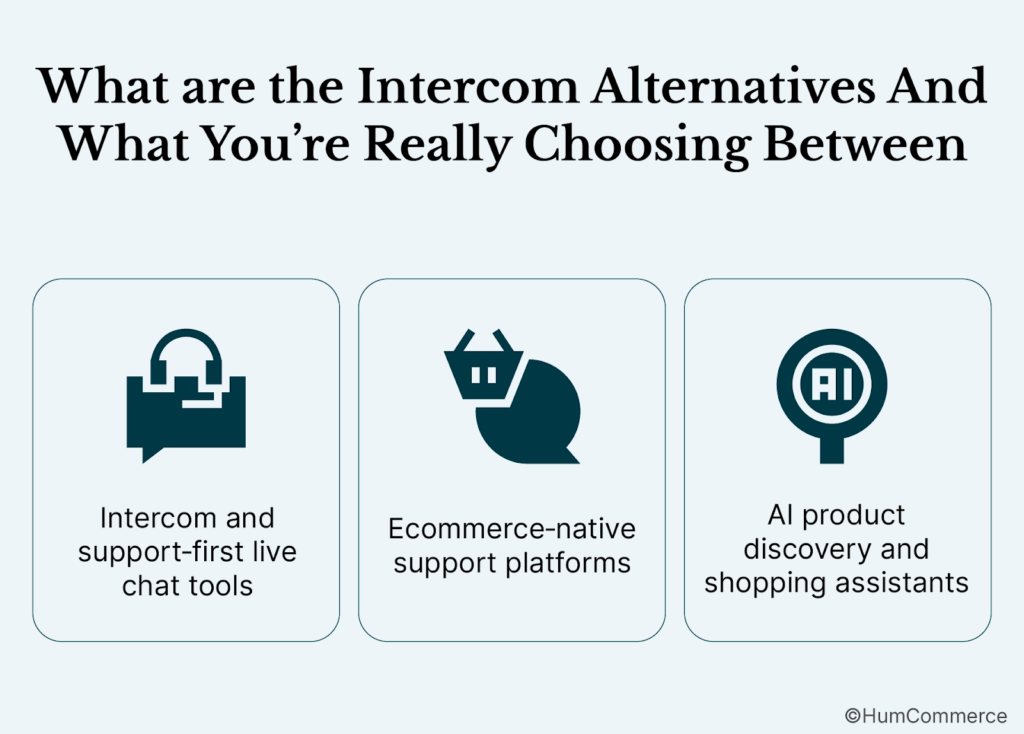
1. Intercom and support‑first live chat tools
This category includes Intercom itself and support‑first Intercom chat alternatives like Zendesk, Freshdesk, Help Scout, HubSpot Service Hub, Zoho Desk, Comm100, Crisp, LiveAgent, and Tidio. These tools are built to manage conversations across chat, email, and social, power ticket workflows, and provide strong support analytics.
Some offer AI bots that can answer common questions and deflect basic tickets. They integrate well with ecommerce platforms and CRM, but deep connections into ERP, PIM, or CPQ for product discovery are limited and usually custom.
2. Ecommerce‑native support platforms
Tools such as Gorgias, Ringly, and other ecommerce‑native platforms sit a step closer to the store. They pull in order history, shipping status, and some catalog context directly into support so agents can resolve ecommerce issues faster (cancellations, refunds, address changes) and automate macros.
They are a strong fit for DTC and B2C brands, and for B2B ecommerce as a post‑order support hub, but they still treat product discovery as something the storefront and search engine handle, not as part of alternatives to Intercom live chat that truly change how buyers find products.
3. AI product discovery and shopping assistants
The third category covers AI search and product discovery tools like Klevu (B2B search and discovery), Algolia, Vue.ai, Threekit, FindMine, and similar platforms highlighted in B2B AI discovery guides, as well as B2B‑specific assistants such as HumCommerce B2B AI Assistant for Adobe Commerce.
These tools plug into your catalog, PIM, and often ERP. They use AI to understand natural language queries, attributes, and compatibility relationships, and to guide buyers to the right SKUs, sometimes all the way into RFQs and configured products. For RFQ‑heavy B2B stores, this category often delivers more value than simply swapping one Intercom alternative for another support tool.
The rest of this article uses B2B‑specific criteria to compare how these three categories support product discovery and RFQs, not just live chat.
The Criteria That Decide Whether an Intercom Alternative Actually Helps B2B Product Discovery
A basic features table that says “has chat,” “has AI,” or “has a mobile app” does not tell you whether a tool will help buyers find the right products in a complex B2B catalog. To judge Intercom alternatives for B2B ecommerce, you need to evaluate them against discovery‑centric criteria, not just live chat features.
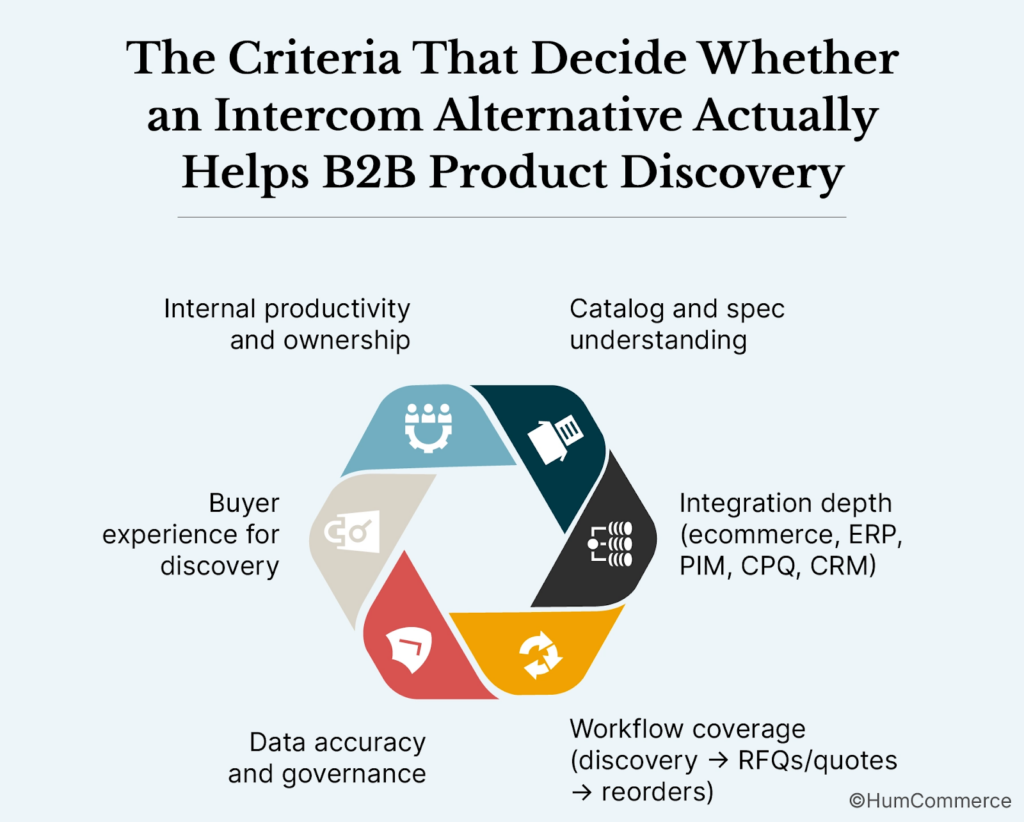
Catalog and spec understanding
Can the tool handle attribute‑rich catalogs (size, material, rating, certification), compatibility rules, and partial queries (“like this valve but stainless”) instead of just simple keywords? AI discovery tools like Klevu and Vue.AI are designed for this; most alternatives to Intercom in the support‑first category are not.
Integration depth (ecommerce, ERP, PIM, CPQ, CRM)
Does it only talk to your storefront and CRM, or can it also pull attributes from PIM and stock or pricing from ERP and CPQ? For any serious AI search or conversational layer in ecommerce, depth of ERP and PIM integration matters more than UI polish.
Workflow coverage (discovery → RFQs/quotes → reorders)
Can it help buyers go from “I have this requirement” to a shortlist of SKUs and a prepared cart or RFQ, or does it punt RFQs into email or tickets? AI discovery and B2B shopping assistants are built for this; most Intercom chat alternatives need heavy customization to cover the full discovery‑to‑RFQ flow.
Data accuracy and governance
Are product suggestions and related content grounded in source‑of‑truth systems and subject to clear rules (pricing tiers, compliance flags), or does the tool rely on a stale index or FAQ? In B2B, a wrong product recommendation can have safety, warranty, or regulatory consequences.
Buyer experience for discovery
Does the tool offer meaningful, guided discovery (faceted search, semantic search, conversational filters), or mainly serve as a way to “ask support”? Can buyers type in natural language, refine results, and see relevant upsell and cross‑sell suggestions, or do alternatives to Intercom live chat simply redirect them to category pages?
Internal productivity and ownership
Will it actually reduce manual pre‑sales work (helping buyers pick SKUs, cleaning RFQs), or just reroute that work into a new interface? Can ecommerce and product teams tune discovery behaviour themselves, or does every change require engineering or vendor services?
Intercom vs Ecommerce‑Native Support vs AI Product Discovery Tools
This section compares three categories that often show up as Intercom alternatives: support‑first chat tools, ecommerce‑native support platforms, and AI product discovery assistants.
Integration depth
- Intercom and support‑first chat tools
Strong integration with ecommerce platforms and CRM, but only limited, custom, or indirect access to ERP, PIM, or CPQ for discovery. - Ecommerce‑native support platforms
Deep integration with ecommerce and order data, partial catalog context, and usually no direct ERP, PIM, or CPQ integration for discovery. - AI product discovery and shopping assistants
Integrate directly with catalog indices, PIM, and often ERP or CPQ to drive search and discovery with live product, stock, and pricing data.
Discovery workflow coverage
- Intercom and support‑first chat tools
Primarily handle support conversations; product discovery still happens through your existing search and catalog, unless you heavily customize the bot. - Ecommerce‑native support platforms
Strong on order issues and simple questions. Complex discovery and RFQs are still delegated to search or humans. - AI product discovery and shopping assistants
Designed to turn natural language and spec‑heavy queries into results, suggestions, configurations, and even RFQ inputs.
Data and governance
- Intercom and support‑first chat tools
Bots typically rely on knowledge bases, not full product or pricing logic, so discovery data governance is weak. - Ecommerce‑native support platforms
Order and customer data are governed; product discovery governance depends on the underlying search engine, not the support tool. - AI product discovery and shopping assistants
Product, pricing, and recommendation logic are grounded in PIM and ERP and tuned by ecommerce and product teams.
Buyer discovery experience
- Intercom and support‑first chat tools
Good for “talk to support,” weak for “help me find the right product.” Discovery is often just a link to search or category pages. - Ecommerce‑native support platforms
Better than generic chat for order‑related help; discovery UX is still dominated by catalogs and filters. - AI product discovery and shopping assistants
Provide a rich discovery layer with semantic search, guided filters, visual recommendations, and conversational discovery, often tailored for B2B needs.
Internal productivity
- Intercom and support‑first chat tools
Improve ticket response and visibility but do little to reduce pre‑sales discovery workload. - Ecommerce‑native support platforms
Reduce effort on post‑order issues; “what should I buy?” questions still hit sales and customer service heavily. - AI product discovery and shopping assistants
Reduce repetitive discovery and RFQ clean‑up work, so sales can focus on higher‑value deals.
Time to value
- Intercom and support‑first chat tools
Fast to deploy for support use cases; meaningful discovery enhancements usually require separate tools such as Klevu or Algolia. - Ecommerce‑native support platforms
Similar story: quick support value, with discovery gains depending on the underlying search stack. - AI product discovery and shopping assistants
Require integration and tuning, but can start with targeted categories or queries and quickly show impact on discovery and RFQs.
Cost and change
- Intercom and support‑first chat tools
Offer predictable support ROI, with limited impact on discovery metrics unless paired with additional products. - Ecommerce‑native support platforms
Deliver good support ROI for ecommerce; you still need investment elsewhere for discovery and RFQ quality. - AI product discovery and shopping assistants
Higher integration cost, but impact is directly tied to revenue and RFQ KPIs from improved discovery.
If your main pain is support tickets, support‑first tools and ecommerce‑native platforms are natural alternatives to Intercom. If your main bottleneck is product discovery and RFQ quality, you will see the biggest lift from AI discovery and search tools; support platforms alone will not move those numbers in a meaningful way.
How Chatbots and Intercom Alternatives Handle B2B Product Discovery and RFQs
Let’s walk through a typical B2B scenario: a logged‑in buyer is trying to find the right product variant and submit an RFQ.
With Intercom & Support‑First Chat Tools
- The buyer opens the Intercom/Zendesk/Freshdesk chat widget and types: “Need 200 3-inch stainless valves, NSF‑61, same spec as last order but for our Ohio plant”
- The bot returns generic help articles or routes to a live agent, who must then open ERP, PIM, and previous orders to figure out SKUs and availability
- The agent may paste links to category pages or compile SKUs manually via email; the RFQ content is assembled outside the chat tool
- Discovery is essentially manual; chat is just the front door to a human
With Ecommerce‑Native Support Platforms (Gorgias, Ringly, etc.)
- The buyer opens Gorgias or a similar tool’s chat; the agent immediately sees order history and customer details
- For questions about previous orders or simple reorders, this works well: the agent can quickly repeat or tweak past line items
- For new discovery (“similar product but different spec/plant”), the agent must still use catalog search and ERP/PIM tools, and coordinate via email or phone
- The platform speeds up order‑related support, but discovery remains largely outside its scope
With AI Product Discovery & Shopping Assistants (Klevu, Vue.ai, HumCommerce B2B AI Assistant, etc.)
- The buyer types a natural language query into an AI‑powered search bar or assistant: “Need 200 3-inch stainless valves, NSF‑61, compatible with system X, available in Ohio.”
- The discovery tool parses the query, matches attributes and compatibility from PIM, and uses stock and lead‑time data from ERP/WMS to show suitable SKUs and alternatives
- The buyer can refine with filters or follow‑up questions and then add selected SKUs to a cart or RFQ list directly
- In some setups (e.g., HumCommerce B2B AI Assistant on Adobe Commerce), this happens in a conversational UI that can also prepare RFQ drafts grounded in real pricing and availability
All three paths can eventually get the buyer to a valid RFQ. Only the AI product discovery assistants are built to make that path fast, accurate, and repeatable without pulling a rep into every decision.
How Intercom Alternatives Impact the Numbers
The point of evaluating alternatives to Intercom live chat is to move key metrics, not just swap vendors.
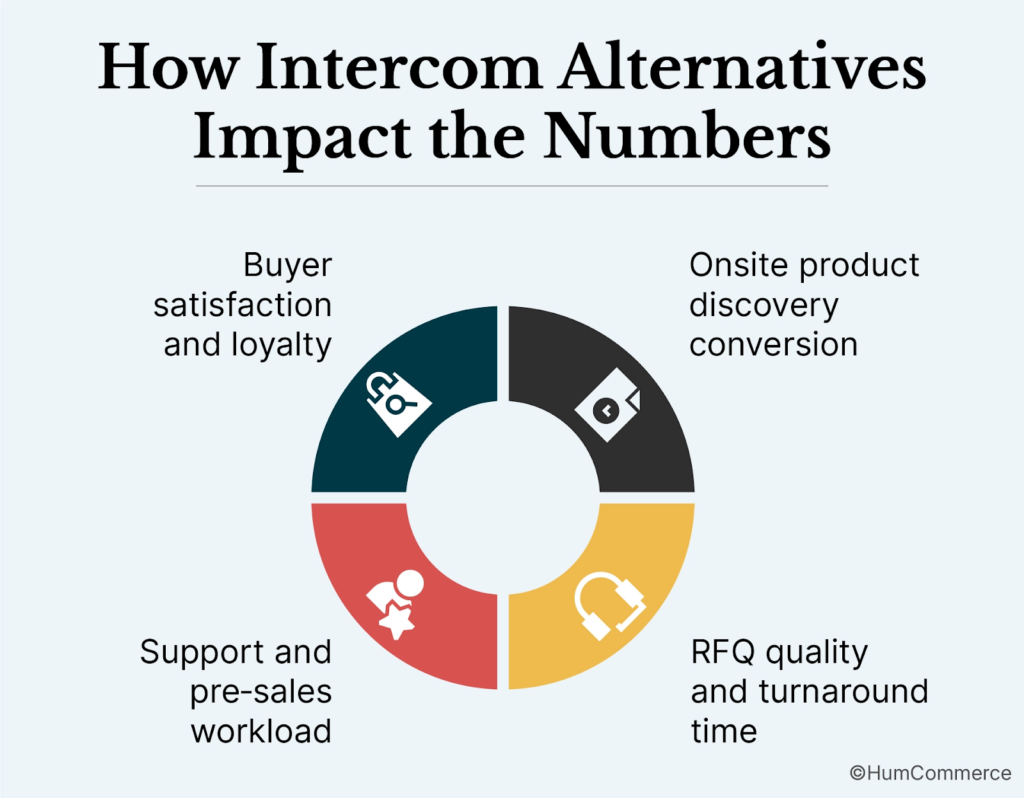
Onsite product discovery conversion (search/assist → product views / add‑to‑cart / RFQ)
- Intercom and support‑first chat tools
Limited direct influence; discovery remains primarily driven by your existing search and catalog implementation. - Ecommerce‑native support platforms
Help with post‑order and basic questions; little direct impact on discovery conversion. - AI discovery and search tools
Directly move this metric by reducing “no results,” understanding natural language, and suggesting relevant products and bundles.
RFQ quality and turnaround time
- Support‑first Intercom alternatives
RFQs arrive as tickets or email; quality and cycle time depend on manual interpretation. - Ecommerce‑native platforms
Similar story, although order context can help slightly. - AI discovery tools
Can enforce structured RFQ inputs (validated SKUs, quantities, specs) and push data directly into ERP or CRM, shrinking RFQ cycles.
Support and pre‑sales workload
- Support‑first tools
Improve efficiency and visibility but do not reduce the number of pre‑sales discovery questions. - Ecommerce‑native platforms
Reduce post‑order workload; pre‑sales discovery remains heavy. - AI discovery assistants
Offload a meaningful share of “what should I buy?” and “does X fit Y?” questions from reps.
Buyer satisfaction and loyalty
Good support experiences matter for any Intercom alternative, but in B2B ecommerce the bigger driver of repeat business is how quickly buyers can find the right products and submit clean RFQs. AI discovery and search tools hit this lever directly, while support‑first alternatives only influence it indirectly.
Best Intercom Alternatives: Which Path Fits Your Company Profile?
Your best Intercom alternative depends on catalog complexity, integrations, and RFQ volume, not on a generic “Top 10 tools” list.
Profile A: Simple catalog, support‑heavy pain
You have a small catalog, simple pricing, and your loudest issue is handling support across channels, not helping buyers choose products.
- Best category to prioritize first: support‑first tools.
- Typical stack move: Intercom → Zendesk, Freshdesk, Help Scout, HubSpot Service Hub, Comm100, Crisp, LiveAgent, or Zoho Desk.
- Goal: better ticketing, SLAs, and automation while keeping search and discovery simple.
Profile B: Growing B2B catalog, early digital maturity
Your catalog is expanding, ERP integration is in progress, and buyers are starting to feel discovery friction, but rising ticket volume is still the most visible symptom.
- Best categories to combine: support‑first or ecommerce‑native support plus an AI search upgrade.
- Typical stack move: Gorgias or Zendesk on the support side, paired with Klevu, Algolia, or Adobe Live Search for smarter search on key categories.
- Goal: stabilize support while quietly improving product discovery where it hurts most.
Profile C: High‑SKU, ERP‑heavy, discovery‑driven
You run large, attribute‑rich catalogs with complex pricing; RFQs drive a big share of revenue, and reps are swamped with “help me pick” questions.
- Best category to prioritize first: AI product discovery and shopping assistants.
- Typical stack move: make tools like Klevu, Vue.ai, Threekit, etc. a first‑class layer, with HumCommerce B2B AI Assistant as a strong fit if you are on Adobe Commerce and need conversational discovery tied directly to ERP/PIM.
- Goal: reduce manual “what should I buy?” work, improve RFQ quality, and ground suggestions in real stock and contract pricing.
Profile D: Advanced digital teams
You already invest in AI search and personalization (Adobe Sensei, Klevu), have PIM/ERP well integrated, and treat AI as a core advantage, not an experiment.
- Best category strategy: unify AI discovery and assistants across search, recommendations, and chat.
- Typical stack move: treat Intercom or any support‑first tool as a ticketing layer only, and extend AI‑driven discovery and RFQ flows across your key buyer journeys.
- Goal: orchestrate one coherent AI discovery layer that powers search, RFQs, and sales‑assist experiences, then plug any support tool into it.
Being honest about which profile you are in keeps you from over‑optimizing the chat widget when your real limiter is how fast buyers can discover the right products and build clean RFQs.
Implementation: The Real Effort Behind Intercom Alternatives
Teams often underestimate the integration effort behind “simple” chat tools and overestimate what is needed for AI discovery. The reality: support‑first tools are fast to launch but shallow for discovery; AI discovery takes more plumbing but can start narrow and show impact quickly.
Time to first meaningful impact
Support‑first chat tools
Quick to launch for support use cases. You can usually stand up basic chat, routing, and macros in a few weeks, but any real lift in product discovery still depends on separate search tools and additional projects.
Ecommerce‑native tools
You get fast wins on order‑related support (cancellations, shipping issues, invoice questions) because these tools sit close to ecommerce and order data. Discovery, however, still rides on your existing search and catalog; there is little native uplift without a separate discovery stack underneath.
AI discovery and search
These tools do require integration with catalog indices, PIM, and sometimes ERP—but you do not have to “boil the ocean” to see value. You can start with a narrow, high‑leverage pilot such as:
- Enabling AI‑powered search or conversational discovery on your top 2–3 RFQ‑heavy categories (for example, valves, bearings, safety equipment) and measuring RFQ turnaround time and win rate.
- Rolling out an AI assistant for logged‑in buyers in one region or key account segment, where buyers already submit complex RFQs and have access to contract pricing.
For a typical HumCommerce deployment on Adobe Commerce, that first pilot often looks like 6–8 weeks of work: wiring Adobe Commerce search to PIM and ERP for one category, turning on an AI assistant for a small buyer group, and tracking changes in search usage, add‑to‑cart, and RFQ quality.
Teams involved
Support‑first
Primarily CX and IT. The project is framed as “better support operations,” with ticketing and SLAs as the main success metrics.
Ecommerce‑native
CX, ecommerce, and IT collaborate. The focus is still support‑centric (post‑order issues, refunds, reorders), with ecommerce pulled in mainly for integrations and workflows.
AI discovery
Ecommerce, product, IT, and often operations for ERP/PIM are all involved. The work is closer to revenue and merchandising: improving how buyers discover products, assemble RFQs, and move into carts, not just deflecting tickets.
Changes to buyer experience
Support‑first
Buyers get a better “talk to us” experience: faster routing, clearer statuses, and sometimes FAQ bots. But discovery still feels like traditional search and filtering, and “what should I buy?” questions usually end up with a human.
Ecommerce‑native
The experience is smoother when buyers need help with orders. Agents can see order history, shipping status, and basic catalog context without jumping between systems. Discovery, however, remains catalog‑driven, and complex product selection still happens outside the tool.
AI discovery
The change is visible at the exact moment buyers are trying to decide what to buy. They can describe needs in natural language, see compatible SKUs with live stock and pricing, refine with filters or follow‑up questions, and assemble RFQs or carts without waiting on a rep. Over time, this becomes a first‑class discovery layer rather than just another chat box.
Risk profile and rollout pattern
Support‑first
Low systemic risk. The main failure mode is a clunky bot or poor routing that frustrates buyers but does not change what they can actually buy.
Ecommerce‑native
Similar risk profile. If response times are slow or macros are badly configured, customer satisfaction takes a hit, but product recommendations themselves are not changing.
AI discovery
Misconfigurations can affect suggestions and RFQs, so the rollout needs more thought—but it is also much more controllable than a full replatform. Common patterns include:
- Running AI discovery in “shadow mode” against your existing search, comparing results, clicks, and RFQ quality before exposing it to buyers.
- Starting with internal users or a small set of accounts, then expanding to all logged‑in buyers once governance rules (pricing tiers, exclusions, safety constraints) are tuned.
AI discovery does not require you to rip out your current stack. You can layer it onto Adobe Commerce or another modern platform, start with one or two high‑value journeys, and expand coverage as you see sustained impact on search usage, add‑to‑cart rates, and RFQ cycle time.
Your Next Best Step on Intercom Alternatives
If your main headache is support tickets across channels, focus on support first and ecommerce native tools such as Zendesk, Freshdesk, Help Scout, HubSpot Service Hub, Gorgias, Comm100, Crisp, Zoho Desk, and similar platforms. They improve case management, automation, and reporting, but they do not fix product discovery or RFQ quality on their own.
If buyers struggle more with finding the right products or building clean RFQs, put AI product discovery and search tools first and keep your current support stack in place. In that case, tools like Klevu, Algolia, Vue.ai, and Threekit should sit in front of your catalog, while your choice of chat or ticketing system becomes a secondary decision.
HumCommerce belongs in that AI discovery group for B2B ecommerce on Adobe Commerce and Magento, with AI Assist wired into your catalog, ERP, and PIM so buyers see real SKUs, stock, and contract pricing in one place. The assistant queries your Adobe Commerce database and ERP tables before answering, so RFQs and suggestions are grounded in actual product and pricing data.
To decide what to do next, share three inputs: your catalog size and complexity, your core systems (ecommerce platform, ERP, PIM), and your monthly RFQ or quote volume, and you can quickly see whether your next best step is a better support tool, an AI discovery pilot, or both.