
Key Takeaways
- Disconnected systems are costing you $2M–$5M annually in manual labor, lost revenue, and errors
- When ERP, PIM, and Magento actually sync, SKU onboarding drops from weeks to days
- Real-time data flow fixes pricing errors, inventory chaos, and broken RMA workflows
- Most wholesalers waste 25+ hours per week on manual data entry that could be automated
- Your team stops firefighting and starts forecasting when integration actually works
- Clear ownership, aligned teams, and the right middleware are what actually matter—not tool count
Your ERP says you have 2,400 units in stock. Your eCommerce site shows 1,850. Your warehouse manager swears it’s 2,100.
One angry customer just got an “out of stock” email after placing a $100K order.
Three systems. Three numbers. One problem: they’re not talking to each other.
If this sounds like Tuesday at your wholesale operation, you’re paying an integration tax and it’s costing you millions.
Four Catastrophes Destroying Your Margins
SKU Onboarding Takes 3 Weeks (And Still Has Errors)
Every new product launches late because your team manually re-enters data between ERP, PIM, and Magento. One mistake in attributes and the wrong size ships to your biggest customer.
Customer-Specific Pricing Is a Manual Spreadsheet Nightmare
Contract pricing lives in Excel. Volume discounts are a Frankenstein formula. Regional markups get out of sync. One pricing error on a $500K order costs more to fix than your ops manager earns in a month.
Multi-Warehouse Inventory Is a Guessing Game
Inventory syncs in batches, not real-time. You oversell. You create stockouts. Your fulfillment team spends half their day fixing orders that should have never been promised in the first place.
RMA Workflows Break Your Customer Service Team
Returns approvals happen through email threads. Credit notes are issued manually. Restocking decisions take days. Your CS team becomes a bottleneck instead of a growth lever.
The Wholesale Tech Stack Integration Maturity Model for Seamless Integration
Where Are You on the Wholesale Tech Stack Integration Maturity Curve?
Most wholesalers fall into one of five categories. Where does your operation land?
Stage 1: Siloed Systems (Reactive)
- Manual work everywhere.
- SKU data hiding in spreadsheets.
- Pricing managed offline… when it gets managed at all.
- IT is in patchwork mode, not in strategy mode.
You’ll feel it: order mistakes, shipping delays, and a customer experience that’s all over the place.
Stage 2: Basic Sync (Tactical)
- Systems talk, but only through point-to-point fixes (ERP ↔ Magento).
- Data still moves in slow, nightly batches.
- Teams manually clean up messes after the fact.
- Scaling feels more like adding chaos, not efficiency.
It’s a step forward, but it breaks easily under pressure.
Stage 3: Middleware-Led Integration (Coordinated)
- Middleware (like Celigo or Boomi) connects PIM, ERP, and eCommerce.
- Product data gets created once and published everywhere.
- Inventory and pricing updates are almost in real-time.
- Automation starts cutting out manual busywork.
Big shift: You stop putting out fires and start building real flow.
Stage 4: Composable Wholesale Architecture (Strategic)
- Systems are modular — picked for what they do best, not because they “kinda fit.”
- Clear rules: ERP owns pricing and inventory, PIM owns product info, and eCommerce owns experience.
- Custom APIs handle the weird edge cases.
- Data is finally managed like an asset, not an afterthought.
Efficiency meets flexibility, and you feel it.
Stage 5: Autonomous Commerce (Predictive)
- AI steps in, tweaking prices, predicting demand, and recommending products on the fly.
- Smart rules automatically trigger cross-system updates.
- Teams shift from fighting fires to fine-tuning growth.
From just integrated… to truly intelligent.
Most wholesalers are stuck between Stage 1 and Stage 2, losing millions in the gap.
Four Real-World Scenarios: Where Integration Actually Matters
Scenario 1: Pharma Distributors
You’re running a pharma distribution business. DSCSA regulations are breathing down your neck – serial numbers, batch tracking, expiration dates on every single product. Suppliers keep sending updates in different formats at random times. One missing serial number and you’ve got a compliance violation on your hands.
What’s actually happening right now: Your team sits around manually checking each supplier update. They’re cross-referencing against FDA databases. They’re praying nothing slips through. But something always does. It’s a constant stress.
Here’s what changes when you integrate: Your PIM automatically tells you when compliance data is missing. Your ERP handles the batch-level inventory stuff with real precision. Your eCommerce site only shows products that have actually cleared compliance. No scrambling. No panic mode.
What you actually get: Those quarterly compliance audits? Gone. Product launches stop taking three weeks, they’re now three days. Your legal team stops bracing for a disaster every time you scale a new product line.
Scenario 2: Global Distributors
You’re expanding into the US, UK, and Germany. Each market has different tax rules, different FX rates, different contract pricing. Your sales team is quoting off PDFs from six months ago because your systems haven’t kept up. Finance is holding their breath every time someone sends a quote.
What’s actually happening right now: Every pricing change means emails flying around between three departments. Finance says one thing, ops says another, sales is confused. By the time everyone agrees, the quote is old news. Contract pricing is scattered across random documents and spreadsheets that nobody fully trusts.
Here’s what changes when you integrate: Your ERP owns the rules—FX rates, tax calculations, contract discounts. Middleware syncs that into Magento every single day. Your storefronts automatically show the right price. For each customer. In each region. With their contract pricing built in. Sales pulls live data instead of making educated guesses.
What you actually get: Pricing errors drop from 15% down to less than 1%. Regional launches don’t blow up your Finance team. Sales, Operations, and Marketing finally agree on what things actually cost.
Scenario 3: High-SKU Wholesalers
You’re managing 10,000+ SKUs across your storefront, marketplaces, and custom portals. Every channel wants something different: CSVs for one, XMLs for another, localized descriptions for everything. Your team has basically become a data entry machine at this point.
What’s actually happening right now: You update a product once and re-enter it five times. Add a new marketplace? Time to hire someone. Scaling feels impossible because every channel needs manual work.
Here’s what changes when you integrate: Your PIM becomes the single source. Create a product once. It publishes everywhere automatically. Magento pulls localized content straight from PIM. Marketplaces get custom feeds tailored for their search. Sales tools auto-generate spec sheets. Adding a new channel doesn’t mean hiring new people.
What you actually get: One team manages it all. Updates that used to take weeks now take hours. Adding a new sales channel becomes a business decision, not a six-month project.
Scenario 4: Smarter RMA Workflows That Don’t Collapse Your Stack
Returns used to be chaos. Sales approved returns without checking inventory. CSRs issued random credit notes. Operations didn’t know when (or if) items would come back. Customers were left guessing.
The chaos: Without integration, return workflows are manual and disconnected. Finance and operations don’t talk. Customers get conflicting messages about refunds.
The fix: Magento triggers RMA requests with reason codes at intake. Your ERP cross-checks warranties and stock history before approvals. Your PIM flags anything that needs inspection before resale. All portals update automatically.
The payoff: Returns don’t clog your system anymore. Credit gets issued correctly the first time. CSRs have real answers when customers call. Finance reconciliation is clean.
ERP, PIM, and eCommerce: The Core Systems Behind Seamless Integration for Wholesale Distributors
In top-performing wholesale operations, it’s not just about connecting systems. It’s about each system knowing exactly what it owns and where it should stay out of the way.
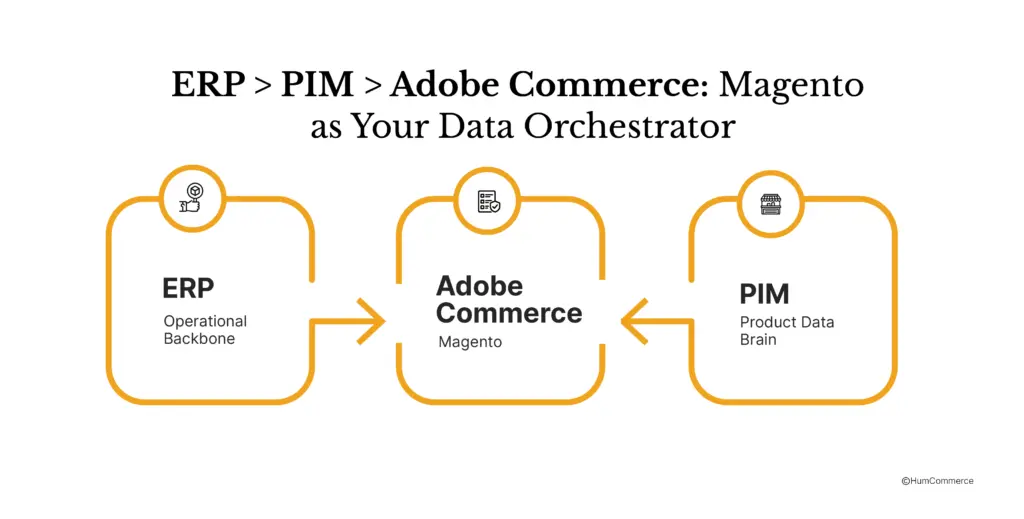
Rule 1: ERP Owns Inventory, Pricing, and Orders—Full Stop
Your ERP is the single source of truth for what you have, what it costs, and what you’ve promised to deliver. When multiple systems fight over ownership of pricing or inventory, you’re building chaos.
Let your ERP be authoritative. Let Magento distribute that information beautifully. Let your PIM organize the story around it. But don’t let them argue about the facts.
Rule 2: Middleware Is the Referee, Not the Star
Middleware (Celigo, Boomi, Zapier) syncs data between systems—but it shouldn’t make decisions. It should validate data, route it correctly, and catch errors before they ripple.
Common mistake: Letting middleware transform data on the fly instead of having the source system get it right the first time. That’s technical debt that compounds.
Rule 3: Data Is an Asset
Your product data and pricing rules change constantly. Without version control, approval workflows, and audit trails, you lose control.
Must-haves:
- Attribute-level permissions: Who can change what, and when?
- Approval workflows: Every significant data change needs sign-off.
- Full audit trails: When someone asks “who changed this?”, you have an answer.
- Automatic error handling: When syncs fail (and they will), the system catches it and alerts you, not your customer.
This Is What Strategic Integration Looks Like
At HumCommerce, we solve challenges like these every day.
Because in wholesale, growth gets blocked by disconnected systems, not so much by a lack of demand. And when you fix that? You leap ahead.
Your 90-Day Integration Roadmap
Days 1–14: Audit Your Stack
Map your current state: Where does inventory data live? Where does pricing? Where are the manual handoffs? Who owns what?
Deliverable: A one-page diagram showing your current tech stack and data flows (ERP to ??? to Magento to ???). Identify the three biggest bottlenecks.
Days 15–45: Pick Your Biggest Win
Don’t try to fix everything at once. Pick one high-impact bottleneck:
- SKU onboarding taking too long? Implement PIM-to-Magento automation.
- Inventory chaos? Get real-time ERP-to-Magento syncing live.
- Pricing errors? Move pricing authority to ERP with live Magento sync.
- RMA broken? Automate RMA initiation and status updates.
Deliverable: A scoped project plan with timeline, tools, and success metrics.
Days 46–90: Launch and Learn
Implement one quick win. Get it live. Measure the impact. Let your team adjust. Then repeat with the next bottleneck.
Deliverable: Quantified impact: “SKU onboarding: 18 days to 2 days” or “Pricing errors: 12% to 0.8%” or “RMA resolution time: 4 days to 8 hours.”
Before You Buy Another Tool, Get Clear on Ownership
Most integration disasters don’t start with bad technology. They start when nobody’s clear on who owns what.
Before you call a vendor or buy middleware, sit down with your teams:
Operations: How does fulfillment actually work? Where are you waiting for data?
IT and Security: What are your scalability limits? What compliance requirements can’t be compromised?
eCommerce and Marketing: What data do you need live? How quickly does it have to update?
Sales Leadership: What pricing accuracy do you need? Can you trust contract pricing to come from ERP in real-time?
Finance: Where are your reconciliation headaches? What’s a material control weakness?
Get alignment on answers. Then design your architecture. Not before.
What Actually Changes When Integration Works
When your systems finally sync cleanly, here’s what stops being a battle:
- SKU onboarding drops from weeks to days, no more triple-entry chaos
- Pricing accuracy stays real-time across regions, customer types, and promotions
- Fulfillment errors fade, and those painful “Where’s my inventory?” calls disappear
- Finance reconciliation becomes clean – duplicate payments vanish, auditor findings resolve
- RMA workflows stop collapsing your customer service team
- Teams shift from firefighting mode into forecasting and strategy
- Growth stops breaking your systems because architecture can handle it
In short: Integration moves from a behind-the-scenes tech project to a growth accelerator.
One Last Thing: The Real Cost of Waiting
Every month your systems stay fragmented, you’re paying the integration tax:
- $50K–$150K per month in manual labor (re-entry, data cleanup, order fixes)
- $30K–$100K per month in lost revenue (missed after-hours orders, slow SKU launches, pricing delays)
- $20K–$50K per month in error correction (duplicate payments, wrong shipments, compliance violations)
That’s $2M–$5M annually in real costs.
Your integration isn’t a cost center. It’s a revenue engine waiting to be built.
Ready to Finally Connect the Dots?
If you’re not sure where the disconnects lie, or how much they’re costing you, we’ll help you find out.
HumCommerce offers tailored system architecture audits for mid-market and enterprise wholesalers. We map your current stack, identify fragmentation points, and provide a clear, scalable integration roadmap, whether you’re just starting out or preparing for a composable future.
Let’s simplify complexity, eliminate duplication, and design a system that scales with you. Book Your Integration Architecture Review at HumCommerce today!
Author Note
HumCommerce helps B2B and wholesale companies turn their fragmented tech stacks into actual growth engines. We work across ERP, PIM, and eCommerce integration and we’ve done it in manufacturing, construction, pharma, and industrial supply. We know where integrations usually fall apart, and we know how to fix it.