TL;DR
- Zoovu guides buyers to a product, but stops at the results page
- B2B buyers need answers beyond filtered product selections
- HumCommerce connects Akeneo PIM and the catalog for live Q&A answers
- Bloomreach and Constructor.io cover search and merchandising well
- Choose based on where your buying journey actually breaks down
Think of a museum audio guide. It takes you through a carefully designed path, explains each exhibit in sequence, and makes sure you see the highlights without getting lost. For a first-time visitor, that structured experience is genuinely valuable. But the moment you stop in front of a piece and ask whether this technique appears in any item in the industrial collection on floor three, and whether you can see the cross-reference, the audio guide moves on to the next track. It was designed for the path, not the question.
That is the experience many B2B ecommerce teams encounter with Zoovu. As a guided selling and AI product discovery platform, Zoovu is strong at what it was built for: walking buyers through a structured advisor sequence from broad category to filtered result. For catalogs where buyer intent follows a predictable path, that model works.
For manufacturers on Adobe Commerce managing catalogs connected to Akeneo PIM, where buyers arrive with technical compatibility questions and sales reps need live product data during calls, guided selling alone leaves a gap. Your buyers need answers, not just paths. This guide covers the five best zoovu alternatives for B2B ecommerce teams in 2026, what each one handles well, and which situation each one fits best.
Why eCommerce Leaders Are Evaluating Guided Selling Alternatives
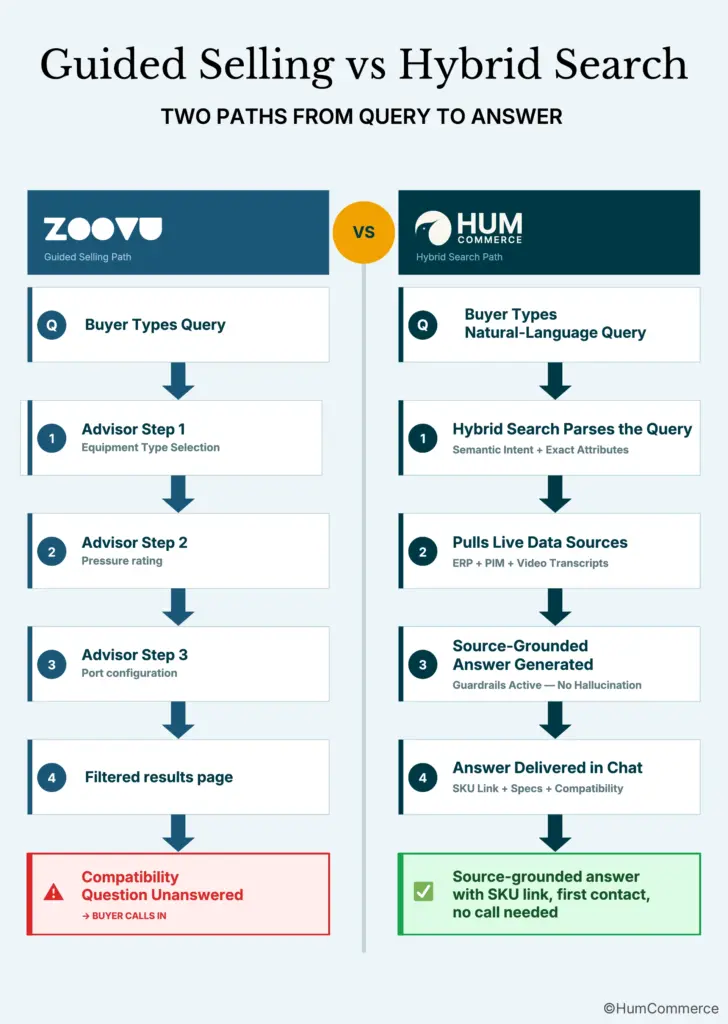
Zoovu’s design centers on the advisor model: a structured sequence of questions that narrows a product category down to a filtered shortlist through equipment type, pressure rating, port configuration, and similar attribute steps. For product discovery in categories where buyer intent follows a predictable sequence, that model performs well. Zoovu’s guided selling, AI search, and product-data-driven buying journeys make it a capable platform for enterprise discovery programs.
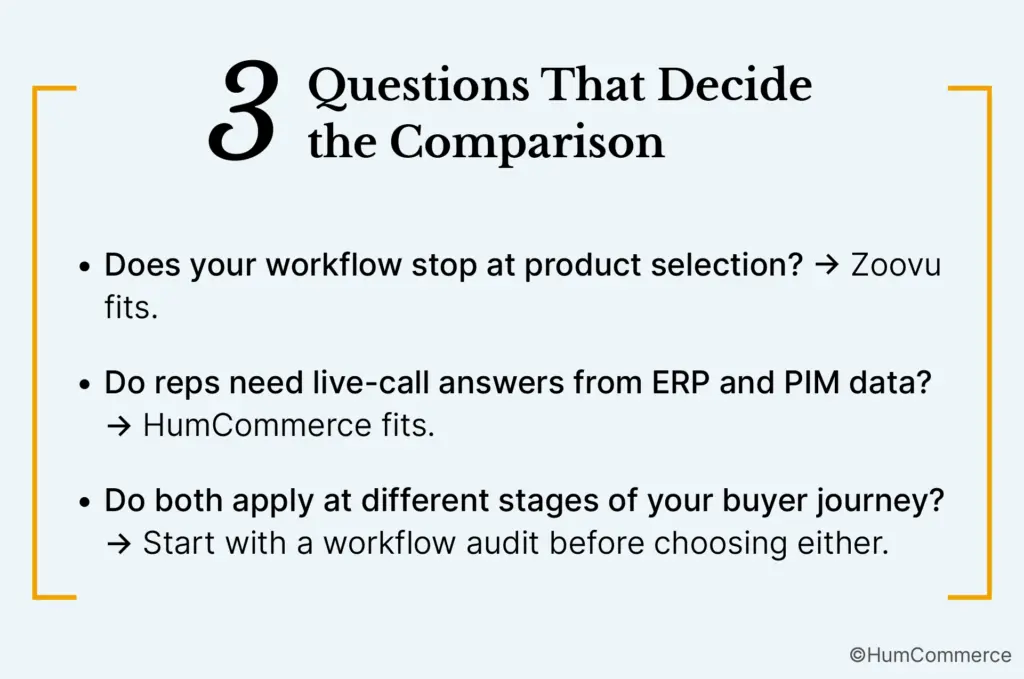
The friction surfaces when B2B buying journeys deviate from the advisor script. A procurement manager at a manufacturing plant rarely needs to be walked through a selection sequence step by step. They already know the spec. What they need is confirmation that the specific part number is in stock, what the account price is for a pallet quantity, and whether a compatible substitute ships faster from the nearest warehouse. None of those questions fit inside a guided selling flow.
This is why Head of eCommerce teams at manufacturers look for guided selling alternatives that go beyond advisor-style navigation. The buyer discovery problem in complex B2B catalogs is rarely about not knowing what category the buyer wants. It is about getting a precise, data-grounded answer to a technical question during an active buying session. Zoovu’s limitation here is a boundary in scope, and that boundary becomes a meaningful gap when your buyers and reps need more than a filtered results page at the end of a structured journey.
What Product Finder Alternatives for Ecommerce Actually Need to Handle
When you evaluate product finder alternatives for ecommerce in a B2B manufacturing context, the job description goes well beyond filtering. Your buyers, your sales reps, and your support team all interact with your product catalog differently, and the right platform has to serve all three. As a Head of eCommerce, these are the five capabilities worth testing for directly:
- Exact-match and semantic search in one layer: Buyers who type a part number and buyers who describe a product application in natural language should both reach the same accurate result without being routed through separate search experiences
- Live PIM connectivity: Product attributes, technical specifications, compatibility data, and cross-references should come from your live Akeneo PIM, not a cached export that goes stale between sync cycles
- Sales rep enablement during live calls: Your inside sales team needs the same product knowledge layer available to buyers on the website, so a rep answers a technical question in seconds rather than putting a customer on hold to search manually
- Support resolution beyond product discovery: Post-selection questions around order status, account pricing, and compatibility checks should be resolvable in the same interface where the buyer found the product
- Hallucination controls and data integrity: A wrong spec answer or an incorrect compatibility confirmation has real downstream consequences in B2B. Source-grounded responses and data inconsistency detection are requirements, not optional features
5 Best Zoovu Alternatives for B2B Ecommerce in 2026
1. HumCommerce AI Assistant
HumCommerce AI Assistant is a B2B-native buying assistant built for Adobe Commerce stores connected to Akeneo PIM and ERP systems. Where Zoovu builds a structured path from category to product, HumCommerce builds a connected knowledge layer that lets buyers and reps ask any question at any point in the buying journey and receive a grounded, data-accurate answer from your live systems.
The practical difference shows up in a real scenario. A buyer searching for a fitting on a Zoovu-powered store moves through advisor steps and lands on a filtered results page. If they then ask whether that fitting is compatible with a specific pump model already installed at their facility, the guided selling flow has nothing left to offer. HumCommerce handles that follow-up question directly, pulling from your PIM’s compatibility data and your catalog’s cross-reference tables to deliver a precise, source-grounded answer in the same conversation.
Four capabilities define HumCommerce as a B2B ecommerce AI assistant built for the complexity manufacturers deal with daily:
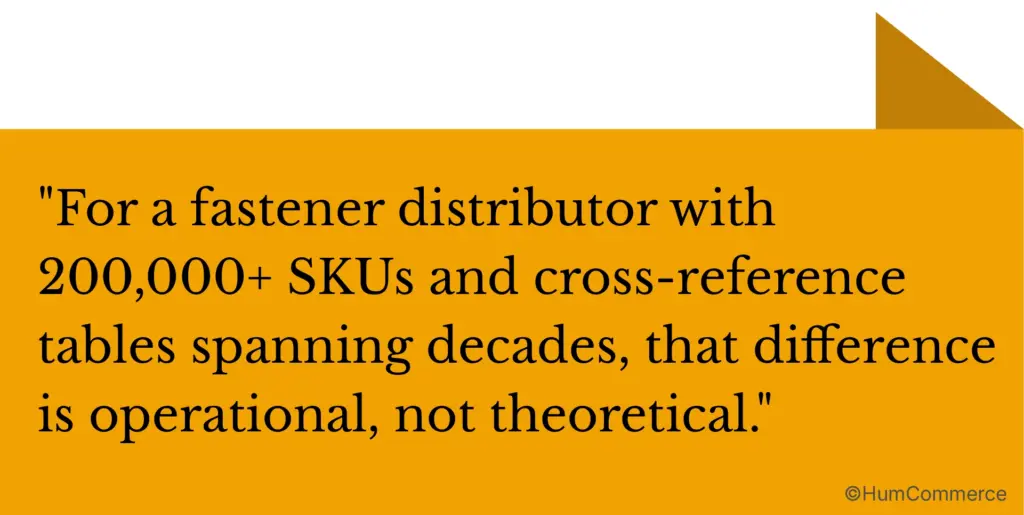
- Hybrid Search combines semantic AI understanding with exact attribute and keyword lookup, so a buyer typing a product description and a buyer entering a precise part number both return the same accurate result from a catalog of 150,000 or more SKUs
- Hallucination guardrails ground every response in verified source data from your Akeneo PIM and catalog, and surface a flag when information is missing, conflicting, or outdated, so neither buyers nor reps ever receive a confident but wrong answer
- Video transcript ingestion turns your product training videos, installation guides, and demo content into a fully queryable knowledge layer, giving buyers and reps access to answers that previously lived only inside video files
- Data inconsistency detection flags stale, conflicting, or outdated content across your connected Akeneo PIM and catalog sources before it reaches a buyer or a rep during an active conversation
Teams on Adobe Commerce have made 150,000 SKUs searchable with natural language through HumCommerce. Product page click-through has increased by 40 percent. Self-service orders have grown by 25 to 35 percent as buyers find the right product and get the technical confirmation they need without calling a rep.
Best for: Head of eCommerce at manufacturers on Adobe Commerce with Akeneo PIM, technically complex catalogs, and buyers who ask follow-up questions beyond a filtered results page
Verdict: Choose HumCommerce when discovery must extend into sales and support
2. Bloomreach
Bloomreach is an enterprise digital experience platform with a strong AI search and merchandising engine alongside content management and personalization capabilities. Its product discovery layer handles large catalogs well and includes semantic ranking, merchandising controls, and behavioral personalization that improve search relevance over time based on actual buyer actions.
For B2B ecommerce teams on Adobe Commerce, Bloomreach performs strongly on search and catalog-scale merchandising. It handles complex product taxonomies and gives merchandising teams significant control over how results surface for specific queries and categories. The limitation for manufacturers is consistent with other search-first platforms: Bloomreach addresses the discovery layer but does not extend into technical Q&A, rep enablement, or ERP-connected support resolution. Teams whose primary gap is search relevance and personalization rather than buying assistance will find it a capable platform.
Best for: eCommerce teams that need an enterprise-grade search and merchandising engine with behavioral personalization for large, complex product catalogs
3. Constructor.io
Constructor.io is an AI-powered product discovery platform built around search, browse, recommendations, and guided product quizzes. Its search engine trains on conversion data rather than keyword frequency, which means it surfaces products that buyers actually purchase rather than products that merely match query terms. For B2B catalogs where certain SKUs convert consistently, that behavioral signal improves results over time.
Constructor.io’s quiz and product finder features make it a viable product finder alternative for ecommerce teams that want guided discovery with stronger search integration than a traditional advisor flow. Like most discovery-first platforms, it does not address the post-discovery workflow: technical compatibility questions, rep enablement during live calls, and ERP-connected support resolution fall outside its scope. It is a strong option for teams moving away from keyword-frequency search toward conversion-optimized discovery.
Best for: B2B ecommerce teams focused on conversion-optimized search and guided product discovery without the rigid step-by-step structure of traditional guided selling platforms.
4. Klevu
Klevu is an AI search and product discovery platform with strong out-of-the-box semantic search capabilities, smart category pages, and AI-driven product recommendations. It integrates with several ecommerce platforms and requires minimal setup to improve search relevance compared to native platform search, making it one of the faster options to get into production.
For B2B ecommerce teams that need a quick, cost-effective upgrade to their catalog search experience, Klevu is a practical option. It handles natural language queries and improves category page performance through AI-driven ranking with relatively low implementation overhead. For manufacturers with technical catalogs requiring compatibility data, cross-references, and account-specific answers, Klevu’s strength is search relevance rather than the connected data layer that enables those deeper responses.
Best for: eCommerce teams that need a fast, affordable AI search upgrade with semantic capability and improved category page performance without a long implementation cycle
5. Searchspring
Searchspring is an ecommerce search, merchandising, and personalization platform designed for mid-market retailers and distributors. It gives merchandising teams strong manual control tools alongside AI-assisted search ranking, category management, and personalized product recommendations. Teams that want to actively curate what surfaces for specific queries will find its merchandising toolset practical and accessible.
For B2B distributors on Adobe Commerce that want more control over their search results and category pages alongside improved AI ranking, Searchspring covers that ground reliably. The boundary is clear: it is a merchandising and search platform rather than a buying assistant. Technical Q&A, ERP data connectivity, and junior rep enablement sit outside its feature set. Teams should choose it when the primary pain is search curation, not buying assistance depth.
Best for: B2B distributors that need hands-on merchandising control alongside AI search ranking and personalized product recommendations on Adobe Commerce
Zoovu Competitors for B2B Ecommerce: Side-by-Side
Here is how each zoovu competitor stacks up on the dimensions that matter most for a Head of eCommerce at a manufacturer running Adobe Commerce and Akeneo PIM:
- HumCommerce AI Assistant — Best for complex B2B catalogs needing discovery, sales rep enablement, and support in one layer. Native Akeneo PIM and ERP connectivity. Choose when discovery must extend into sales and support.
- Bloomreach — Best for enterprise search, merchandising, and behavioral personalization. Strong catalog-scale search performance. Choose for teams where search relevance is the primary gap.
- Constructor.io — Best for conversion-optimized search and guided product discovery. Conversion-data-trained ranking improves over time. Choose for teams moving away from keyword-frequency search.
- Klevu — Best for fast-to-deploy AI search upgrades with semantic capability and low implementation overhead. Choose for teams that need a quick, affordable search improvement.
- Searchspring — Best for mid-market distributors wanting merchandising control alongside AI search ranking. Choose when active curation of search results is the primary need.
Choosing the Right Zoovu Alternative for Your Discovery Workflow
The flow diagram above makes the structural difference visible. Traditional AI-guided selling walks a buyer through a predetermined advisor sequence and ends at a filtered results page. When a follow-up question falls outside that sequence, the platform has nothing left to offer and the buyer calls in. Search-led product discovery handles the initial query well but faces the same boundary: once a buyer moves from finding a product to needing a technical answer or account-specific data, a pure search platform has reached its limit.
A B2B ecommerce AI assistant built on Hybrid Search closes both gaps at once. It handles the buyer who types a part number, the buyer who describes an application, and then continues the conversation through the compatibility question, the account pricing check, and the RFQ without a handoff to a human. For manufacturers and distributors where those follow-up questions are everyday buying behaviors, that continuity is what determines whether your self-service channel actually converts or simply hands off to your sales team every time.
Your Catalog Has the Answers. Make Sure Your Buyers Can Access Them.
A buyer who finds the right product but cannot confirm compatibility, check account pricing, or get a technical spec without calling your team has not had a self-service experience. They have had a partial one. For manufacturers on Adobe Commerce with Akeneo PIM, the gap between product discovery and buying confidence is where revenue leaks out every day.
Explore how HumCommerce AI Assistant connects your catalog, your PIM, and your systems into a single buying intelligence layer so your buyers get a complete answer at the moment they need it, not just a filtered list of options.