
Key Takeaways
• Map core data flows first: Thoroughly document order sync, inventory updates, pricing logic, and returns processes before attempting any decoupling to avoid costly mistakes and system disruptions.
• Choose architecture based on business needs: Evaluate one-way vs two-way integration, middleware options (Celigo, MuleSoft, Boomi), and real-time vs batch processing to match your operational requirements.
• Plan for complex B2B scenarios: Design your integration to handle multi-warehouse inventory, customer-specific catalogs, approval workflows, and serialized items from the start.
• Avoid common integration pitfalls: Prevent data mismatches, performance issues with large SKU catalogs, over-customization, and inadequate error monitoring through proper planning and implementation.
• Implement MACH architecture principles: Adopt Microservices, API-first, Cloud-native, and Headless approaches to break free from monolithic systems while maintaining robust ERP connectivity.
Your Epicor system was supposed to make things easier.
Instead, every time you need to update pricing, add a new product line, or adjust inventory rules, you’re looking at weeks of development work. Your eCommerce site can’t keep up with customer demands because it’s shackled to ERP processes that were designed for a different era.
Sound familiar?
Most B2B distributors treat ERP integration like pouring concrete once it sets, you’re stuck with the shape forever. But here’s what the suppliers winning in today’s market figured out: your business doesn’t have to serve your technology.
B2B commerce isn’t catalog browsing. It’s negotiated contracts, customer-specific pricing, approval workflows, and supply chains that shift overnight. When your Epicor integration is bolted together like a monolith, every business change becomes a technical project.
The alternative? Decoupled architecture.
Instead of rebuilding everything from scratch, you can break the rigid connections between your ERP and eCommerce systems. This means gaining the flexibility to adapt without waiting for IT sprints or vendor roadmaps.
MACH architecture principles – Microservices, API-first, Cloud-native, Headless – let industrial suppliers keep their Epicor investment while building the agility that modern B2B buyers expect.
This guide shows you exactly how to implement that approach. Whether you’re battling inventory sync delays, struggling with customer-specific catalogs, or watching competitors move faster than your ERP integration allows, decoupling transforms your B2B eCommerce platform from a constraint into a competitive advantage for your industrial supply business.
Ready to stop serving your systems and make them serve you instead?
Why Decoupling Epicor Integration Matters for B2B Suppliers
Most B2B suppliers don’t wake up thinking about system architecture.
They think about missed deliveries. Pricing errors that cost deals. Inventory numbers that don’t match reality. Customers who can’t get the information they need when they need it.
Decoupling your Epicor ERP systems isn’t about following tech trends. It’s about solving the business problems that rigid integrations create every single day.
Operational bottlenecks in tightly coupled Epicor systems
When your ERP and eCommerce platform are welded together, changing anything becomes an engineering project.
Need to add a new product category? That’s a two-week development cycle. Want to adjust pricing rules for a key customer? Better hope your IT team isn’t busy with other priorities. Your competitor launches a promotion while you’re still waiting for system updates.
The usual mess looks like this:
- Teams manually entering the same data into multiple systems
- Inventory updates that lag hours or days behind reality
- IT budgets that consume up to 80% of resources just keeping things running
- Software versions locked in place because upgrades break everything
Headless commerce flips this dynamic. Your front-end and back-end systems operate independently, each with separate codebases that you can develop, deploy, and maintain without breaking the other. When market conditions shift, you respond in days instead of quarters.
Impact on customer experience and order accuracy
B2B buyers don’t care about your system architecture. They care about getting accurate information and placing orders without friction.
With an integrated ERP approach, your systems share real-time data, reducing order errors and preventing costly manual reconciliations.
Tightly coupled systems undermine that experience in predictable ways:
Your inventory shows 50 units available. The customer orders 30. Three days later, you’re explaining why you can only ship 15 because the “available” number didn’t account for existing commitments.
Your website crashes during peak ordering periods because traffic overloads the ERP connection. Customers can’t place orders. Sales teams scramble to take orders manually. Everyone stays late.
Product updates take weeks to appear online because they require coordinated changes across multiple systems.
The National Retail Federation tracks the damage: returns hit approximately $743 billion in merchandise, representing 14.5% of total sales. Much of this stems from order accuracy issues that better integration prevents.
Want to see how your current Epicor integration stacks up? Schedule a free 30-minute consultation with our CEO to identify potential optimization opportunities.
Scalability challenges in legacy ERP-eCommerce setups
Legacy Epicor integrations weren’t built for the demands industrial suppliers face today.
Peak traffic crashes your site. Adding new features requires months of development work. Compliance requirements change faster than your systems can adapt.
This isn’t a technology problem—it’s a business constraint. While you’re managing system limitations, competitors with flexible architectures are winning deals.
MACH architecture addresses these constraints systematically. You keep your Epicor core stable while adding capabilities that respond to market opportunities. New features deploy without touching critical business logic.
Looking to strengthen your B2B eCommerce infrastructure? Download our eBook ‘The Tariff-Resilient Enterprise‘ to learn how decoupled architectures create more resilient business systems.
The wins compound quickly. Orders flow automatically between systems. Inventory stays accurate across all channels. Customer data syncs without manual intervention. Your team focuses on growing the business instead of managing system workarounds.
The best part? These upgrades work with your existing ERP systems, so you don’t need a full replacement to gain agility
Mapping Core Data Flows Before Decoupling
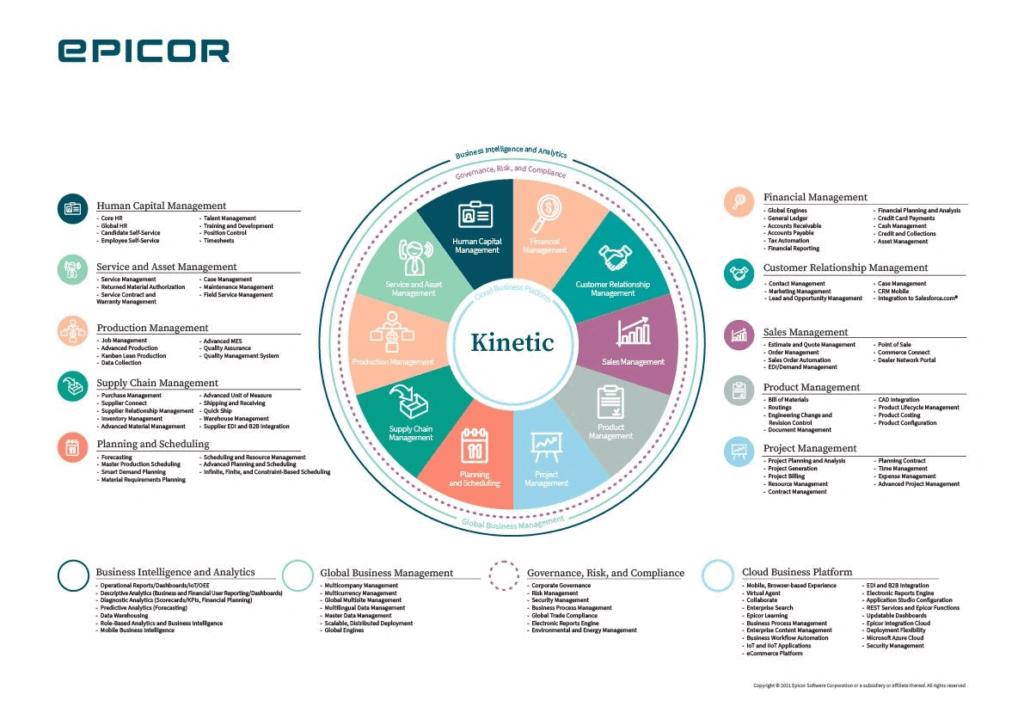
Image Source: Encompass Solutions
You can’t fix what you can’t see.
Before ripping apart any integration, you need to understand exactly how data moves between your storefront and Epicor today. Most suppliers skip this step and wonder why their “simple” decoupling project turns into a six-month debugging nightmare.
Smart mapping reveals the bottlenecks you didn’t know existed. And the opportunities you’ve been missing.
Let’s break down the five data flows that make or break B2B integration:
Order sync: From storefront to Epicor ERP
When customers hit “submit order” on your site, that transaction needs to land in Epicor as a clean sales order or quote. No manual re-entry. No SKU mismatches. No pricing errors that eat your margins.
This is about supporting the complex workflows that B2B buyers expect. Approvals for large purchases. Backorders when inventory shifts. Partial shipments across multiple delivery dates.
“We’ve seen b2b industrial suppliers reduce order processing times by 75% through automated Epicor ERP integration,” notes our integration team. “The key is designing the right architecture from the start.”
For industrial suppliers handling custom configurations or build-to-order scenarios, order sync becomes even more critical. A single miscommunication between systems can delay production schedules and frustrate customers who expect precise delivery timing.
Inventory updates: Real-time vs batch sync
Here’s where most integration strategies fall apart: inventory accuracy.
Real-time sync gives you immediate visibility across all sales channels. No overselling. No stockouts that could’ve been prevented. But it also demands more from your systems – higher processing loads, more complex error handling, tighter API rate limits.
Batch processing takes the pressure off your servers but introduces delays. Fine for slow-moving inventory. Problematic when you’re managing high-velocity SKUs or multiple warehouse locations.
The decision factors:
- Transaction volume and frequency
- System performance limitations
- Business requirements for inventory accuracy
- Multiple warehouse or inventory location needs
For industrial supply businesses with large or frequently moving stock, real-time inventory synchronization often delivers the most business value despite the additional technical complexity.
Customer-specific pricing and credit limits
B2B pricing isn’t catalog pricing. It’s contract rates, volume discounts, customer-specific terms, and credit limits that need real-time enforcement.
Your Epicor integration must surface these pricing structures directly in your eCommerce portal. This requires sophisticated data mapping between customer accounts in Epicor and your storefront—not the simple table joins that work for B2C catalogs.
Epicor P21’s credit management tools let you set and monitor credit limits for customers. Through proper integration, orders get automatically held when customers exceed their limits—protecting your cash flow while maintaining relationships.
The smart move? Automated credit limit alerts that notify your team when strategic customers approach their limits, allowing proactive management before issues arise.
Product catalog and SKU alignment
Product data synchronization gets complicated fast, especially for B2B eCommerce catalogs with thousands of SKUs. Your integration architecture must efficiently sync product attributes, categories, images, inventory levels, and technical specifications from Epicor to your storefront.
Industrial suppliers face unique product complexity:
- Variants and configurable products
- Kits and bundled items
- Bills of Materials (BOMs)
- Custom configurations
For Epicor Kinetic users, product configurators and job-based materials can also be synchronized to support build-to-order scenarios. This becomes a crucial consideration when mapping your data flows, miss it during planning, and you’ll be retrofitting functionality later.
Returns, refunds, and fulfillment logic
Returns management exposes the gaps in most integration strategies. Elite EXTRA’s Returns Automation solution for Epicor improves returns visibility and simplifies the process from receiving return requests to issuing credits. No manual return slips. Complete electronic chain of custody tracking.
A properly designed returns process includes:
- Customer return request submission via your eCommerce site
- Automated return authorization based on your policy rules
- Pickup order generation and routing
- Condition verification before credit issuance
- Status communication to customers
Request a free audit of your current Epicor returns process to identify optimization opportunities that could increase operational efficiency.
Map these five data flows thoroughly before attempting any decoupling. You’ll create a foundation for successful MACH architecture implementation ensuring your Epicor integration API strategy delivers maximum business value with minimal disruption.
Skip the mapping phase, and you’ll spend months fixing problems you could have prevented in the planning stage.
Choosing the Right Decoupling Architecture
You’ve mapped your data flows. Now comes the decision that determines whether your integration becomes a competitive advantage or just another technical project.
Architecture isn’t about picking the fanciest technology. It’s about matching your business reality to the right technical approach. Get this wrong, and you’ll spend months rebuilding what should have worked from day one.
One-way vs two-way Epicor API integration
The choice here is simpler than most consultants make it sound.
One-way integration sends data in a single direction—Epicor to your eCommerce platform, or vice versa. Perfect when you just need catalog displays or basic order capture. Simple. Reliable. Limited.
Two-way integration creates bidirectional data flow. Customer information, pricing changes, inventory updates, and order status all stay synchronized across both systems. More complex to implement, but essential for any serious B2B operation.
This is especially important for companies using P21 ERP, where inventory accuracy and contract pricing must always sync across channels.
Companies like Commercient built their SYNC product specifically for Epicor Prophet 21 users who need this bidirectional flow. Their approach uses cloud technology for security while supporting both file transfers and direct API connections.
Here’s the deciding factor: if your customers expect real-time inventory, personalized pricing, or order tracking, two-way integration isn’t optional.
Middleware options: Celigo, Boomi, MuleSoft
Middleware platforms act as traffic controllers between your B2B eCommerce system and Epicor. Each takes a different approach:
Celigo built their platform for small to medium businesses that don’t have enterprise IT teams. Drag-and-drop interface. Pre-built connectors for Salesforce and NetSuite. Non-technical users can handle most implementations.
MuleSoft operates on an entirely different philosophy—API-first architecture that creates flexible integration networks through their Anypoint Platform. Requires more technical expertise but delivers enterprise scalability for complex integrations.
Boomi and Workato fall somewhere between these approaches. Worth noting: Workato actually powers Epicor’s own Automation Studio, which tells you something about their enterprise capabilities.
The right choice depends on your team’s technical capacity and integration complexity. Simple catalog sync? Celigo works fine. Multi-warehouse, custom pricing, approval workflows? You’ll want MuleSoft’s power.
Middleware like Celigo or MuleSoft can bridge Magento and P21 software for businesses that need robust connectivity without rebuilding from scratch.
Using Epicor Integration API for modular sync
Epicor’s architecture philosophy centers on openness. Every function available in their user interface is equally accessible via API through OpenAPI and Swagger tools.
This matters for industrial supply businesses because it enables true modular integration. Instead of monolithic connections, you can build component-based systems that align with MACH architecture principles.
The Epicor Integration model connects industry solutions and services while maintaining consistent data flow across your entire system. Need to add a new pricing engine? Connect it through APIs without touching your core integration.
Data lake vs real-time API calls for pricing logic
Complex pricing logic forces another architectural decision: store data locally or query it on demand?
Data lake architecture means regularly pulling information from APIs and storing it in your own repository. You get historical data access, simplified migration paths, and powerful analysis through database views. Even if you discontinue a SaaS application, your historical data remains accessible for benchmarking.
Real-time API calls deliver immediate updates but face rate limitations and complex relationship modeling across multiple endpoints. Data stays fresh, but reporting and analytics require more developer involvement.
The practical difference: data lakes handle complex pricing calculations faster, while real-time calls ensure accuracy during rapid market changes.
Download our eBook ‘The Tariff Resistant’ to learn how flexible integration architectures create resilience against supply chain disruptions.
Most successful implementations combine both approaches—critical pricing data in real-time, historical analytics through data lakes.
Handling Custom Business Rules and Edge Cases
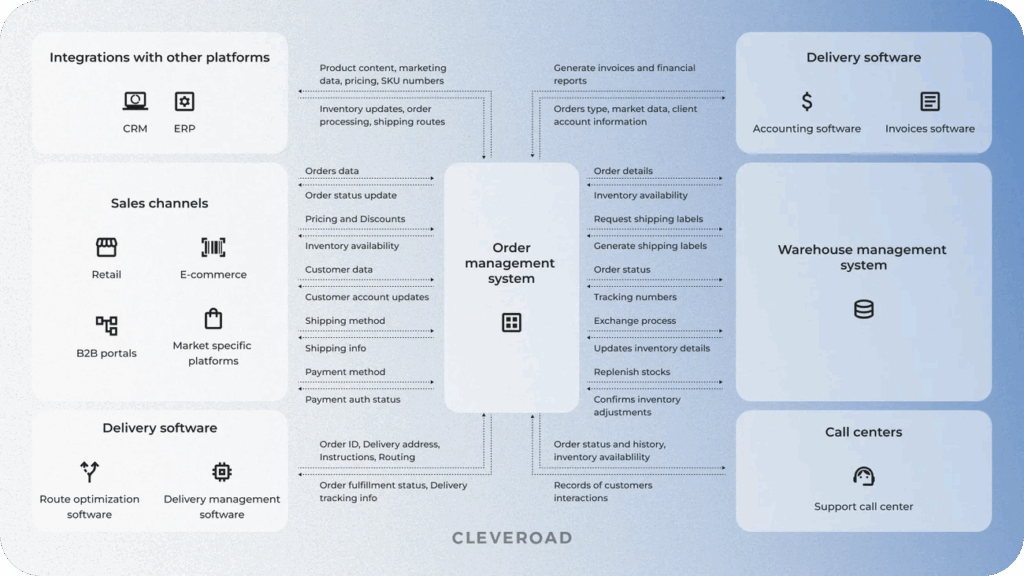
Image Source: Cleveroad
Standard data flows are the easy part.
It’s the edge cases that separate working integrations from ones that actually drive business value. Every B2B industrial supplier has unique requirements that don’t fit neatly into out-of-box epicor integration patterns.
These specialized scenarios often get pushed to “phase two” of implementation projects. But here’s what we’ve learned: the edge cases aren’t optional. They’re where your competitive advantage lives.
Multi-warehouse inventory and drop-shipping
Epicor P21’s multi-warehouse capabilities go beyond basic inventory tracking or suppliers operating with the P21 system, decoupling ensures multi-warehouse logic and drop-ship rules stay intact without creating bottlenecks.
You can configure location-specific rules, automate stock transfers between facilities, and maintain real-time visibility across your entire distribution network.
For drop-shipping operations, P21 eliminates the manual handoffs that kill margins. When a customer orders a product you don’t stock, the system automatically generates supplier purchase orders and routes shipments directly to your customer. No warehouse touch. No extra handling fees.
The integration challenge? Your eCommerce platform needs to understand which products can drop-ship, from which suppliers, with what lead times. That logic doesn’t live in standard product catalogs.
Customer-specific catalogs and payment terms
Industrial supply businesses don’t operate on one-size-fits-all pricing. Your integration needs to support catalog variations that go beyond simple customer groups.
Epicor’s electronic catalog system lets you create customer-specific product visibility, custom descriptions, and even different SKU naming conventions. But connecting these nuanced catalogs to your B2B commerce platform requires mapping that standard integrations don’t handle.
Payment terms add another layer of complexity. Standard net-30 is simple. But what about structures like “40% deposit, 40% on receipt of goods, and 20% after 30 days”? Your checkout process needs to reflect these terms accurately, not force customers into generic payment buckets.
When this ties into customer relationship management, your team gains complete visibility into accounts, credit limits, and quote histories in real time.
Approval workflows for large B2B orders
Email approval chains are where deals go to die.
Epicor’s BPM engine can automate complex approval logic—”if total exceeds $5000, send for manager approval“—but only if your integration architecture supports it. Most don’t.
The workflow logic needs to live in your ERP, not your eCommerce platform. But the customer experience needs to happen on your website. That means your integration must handle approval status updates, notification routing, and order modifications without breaking the customer journey.
These automated workflows shift your team from email tag to strategic decision-making. The difference shows in deal velocity.
Serialized items and kit configurations
Serialized inventory isn’t just about tracking—it’s about compliance, warranty management, and recall capabilities.
Epicor’s Serial Number Tracker maintains complete item histories, but your eCommerce integration needs to understand which products require serialization before orders ship. For regulated industries, missing this step creates compliance gaps that auditors love to find.
Kit configurations present a different challenge. When customers order a pump assembly that includes motor, controller, and mounting hardware, your integration needs to:
- Reserve all components simultaneously
- Handle partial availability scenarios
- Calculate accurate delivery dates based on the longest lead time
- Manage substitutions when alternate components are available
Companies handling large volumes of serialized items use Epicor’s Data Management Tool (DMT) for bulk receiving. But this only works if your integration architecture accommodates batch processing alongside real-time order flows.
The pattern across all these edge cases? Standard integrations treat them as exceptions. Decoupled architectures treat them as core requirements. That’s the difference between functional and strategic.
Avoiding Common Pitfalls in Epicor Decoupling
Most Epicor decoupling projects fail for predictable reasons.
Not because the technology is hard. Because the planning is rushed.
Teams get excited about the flexibility benefits and skip the groundwork. Then they hit the same walls that derailed the last three “modernization” initiatives.
Here’s where things usually break:
Data mismatches between Epicor and eCommerce
Your website shows 47 units in stock. Epicor says 12.
Customer places an order for 30. Now what?
Without proper sync architecture, this scenario plays out daily across B2B industrial suppliers. Inventory discrepancies frustrate customers and cost sales. The knee-jerk reaction? Manual data entry to “fix” the gaps.
But manual fixes create more problems than they solve. Every override introduces error potential. Every manual adjustment becomes a point of failure during peak order periods.
Near real-time synchronization solves this—but only if you design the error handling correctly from day one.
Performance issues with large SKU catalogs
Epicor users know the pain. Basic operations taking 10-20 seconds per window.
Now multiply that delay across 50,000 SKUs updating hourly.
Your integration architecture becomes the bottleneck. API calls stack up. Timeouts cascade. Your eCommerce site crawls while competitors’ sites fly.
Data throttling and intelligent queuing prevent these bottlenecks. But you need to implement them before your catalog grows, not after your site starts crashing.
Over-customization and vendor lock-in
Here’s the uncomfortable truth: 20-30% of ERP budgets get wasted on unnecessary modifications.
You customize Epicor to match “how we’ve always done things.” Then you discover those customizations make every upgrade a nightmare. Vendor updates break your modifications. Simple changes require consultant hours.
The path out? Start with out-of-box functionality. Document every customization decision. Ask “Does this serve our customers, or just our internal processes?”
Future you will thank present you for that discipline.
Lack of monitoring and error handling
Integration failures happen quietly.
Orders don’t sync. Inventory levels drift. Pricing updates get stuck. Your team finds out when customers call asking “Where’s my order?”
Many B2B eCommerce platforms for Industrial Supply businesses discover integration issues reactively. By then, customer trust is damaged and revenue is lost.
Proactive monitoring catches problems before they reach customers. Alert systems notify your team when sync processes fail. Automated retry logic handles temporary connectivity issues.
Calculate your B2B eCommerce revenue opportunity
Instantly discover how much additional revenue you could generate by optimizing your eCommerce store.
To Wrap Up
Most B2B suppliers know their Epicor integration isn’t working the way it should.
You’ve seen the bottlenecks. The delays when you need to update pricing. The manual workarounds when inventory doesn’t sync. The frustrated customers who can’t get accurate availability data.
But here’s what you’ve learned: this isn’t about replacing everything you’ve built.
Modern B2B eCommerce doesn’t require throwing away your Epicor investment. MACH architecture principles let you keep the ERP functionality that works while breaking free from the constraints that don’t. Your data connections stay robust. Your processes stay familiar. Your team doesn’t have to relearn everything.
The difference? Your business gets to move at market speed instead of IT project speed.
This is what a seamless ERP integration looks like, future-ready without disrupting your core operations
Companies implementing decoupled ERP integration report 75% faster response times when market conditions shift. No more waiting weeks to adjust pricing when suppliers change rates. No more losing deals because your catalog can’t reflect real inventory levels.
Your core data flows—orders, inventory, pricing, returns—become assets instead of obstacles. Multi-warehouse operations that used to require manual coordination start running automatically. Customer-specific catalogs that took months to implement now deploy in days.
The strategy isn’t complicated: map what you have, choose the right architecture for your business model, handle your edge cases upfront, and avoid the pitfalls that trap other suppliers in endless customization cycles.
Whether you go with middleware solutions like Celigo or MuleSoft, or build directly on Epicor’s API capabilities, the key is starting with a plan that balances immediate needs against long-term scalability.