Key Takeaways
- Why Traditional Fulfillment Systems Fail Urgent Auto Parts Orders (And How to Fix It)
- How to Automate VOR Order Escalation (Without Adding Headcount)
- How AI Helps You Prioritize and Fulfill Urgent Auto Parts Orders Faster
- How to Build a Scalable, Customer-Centric VOR Fulfillment Engine with AI?
- Key Takeaways & Next Steps
- FAQs
In Formula 1, a two-second delay in the pit lane can ruin an entire race.
Doesn’t matter if the engine is perfect, if a single bolt stalls, the car doesn’t move.
That’s exactly what happens in the automotive aftermarket when a $50,000 vehicle is stuck waiting on a $5 part. It’s not the price of the part that hurts, it’s the downtime.
And most fulfillment systems aren’t built to handle that kind of urgency. They treat all orders the same, whether it’s a routine restock or a Vehicle-Off-Road (VOR) emergency. That means critical parts get buried behind bulk orders, missed in manual queues, or delayed because no one flagged them in time.
But what if your system could do that for you?
What if your order flow could instantly recognize VOR orders, prioritize them, and ship them without waiting for someone to escalate?
In this blog, we’ll break down why traditional systems fail VOR customers, how automated order processing and purchase order automation can solve it, and how AI can bring real urgency into your fulfillment so you protect your customers, your margin, and your reputation.
Why Traditional Fulfillment Systems Fail Urgent Auto Parts Orders (And How to Fix It)
If you’re running a B2B parts operation, chances are your system treats a $5 oxygen sensor the same way it treats a 500-unit restock of coolant.
One is stopping a commercial truck from making deliveries. The other is going on a shelf.
But to your ERP or eCommerce platform, they’re just SKUs in a queue.
And that’s the problem.
Traditional fulfillment workflows follow a first-in, first-out logic unless someone manually escalates the order. That means Vehicle-Off-Road (VOR) parts where every hour off-road can cost a commercial fleet $500–$1,000 in lost revenue get processed with the same urgency as a routine replenishment.
This equal treatment has real consequences:
- VOR orders get delayed or missed entirely
- Field teams escalate by email or phone (often too late)
- Customers lose trust and sometimes the relationship
In the age of Amazon, automated order processing is a baseline but what separates a vendor from a strategic partner is how they handle urgency.
You can’t afford to treat downtime the same as a restock yet most systems do because they were built for volume, not business impact.
Let’s look at a typical VOR order in a legacy setup:
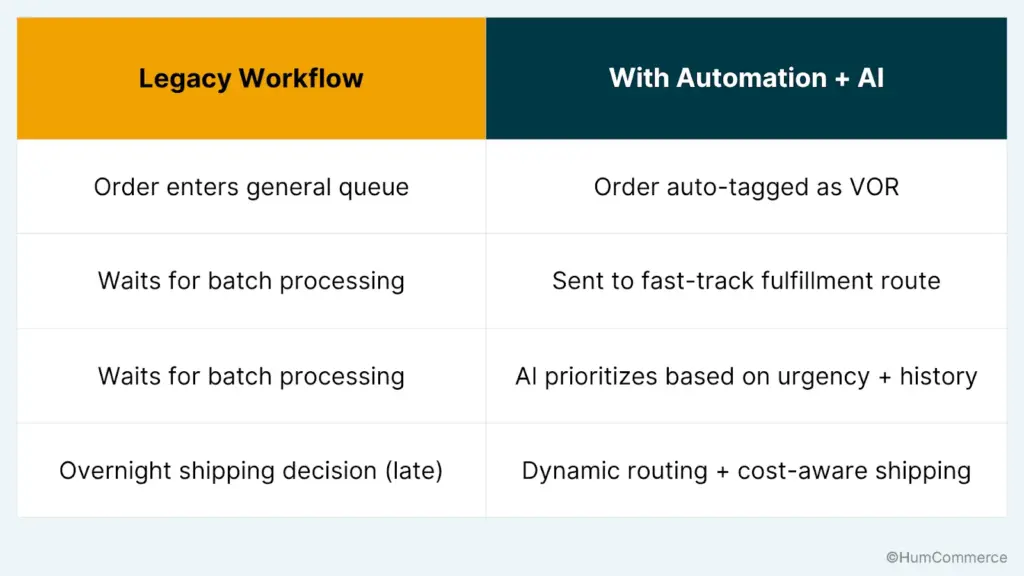
That’s why aftermarket leaders are turning to automated order fulfillment systems that identify VOR orders the moment they’re placed by connecting real-time data from your ERP and PIM. And by layering in smart rules or AI, these systems push critical parts to the front without anyone needing to chase it.
And when you do that? You protect margin, uptime, and retention.
If you’re not sure where your current system is leaking time or revenue, start with the math.
Our revenue calculator shows how much you could generate by optimizing your eCommerce store.
How to Automate VOR Order Escalation?
Modern B2B fulfillment operations can eliminate manual bottlenecks by automating the identification and escalation of urgent Vehicle-Off-Road (VOR) orders.
Here’s how an automation setup works step by step:
Step 1: The System Recognizes What’s Urgent
Automation enables your system to instantly identify VOR orders using a combination of real-time signals:
- SKU classification: Recognizes VOR-critical categories (e.g., brake sensors, engine relays)
- Customer profile: Flags commercial fleet or high-priority buyers in your ERP
- Order history: Detects SKUs previously marked urgent via PIM or CRM
- Order channel: Identifies orders placed through service desks or express portals
- Delivery timing: Flags orders with delivery requests inside business-critical SLA windows
These signals work together to ensure that urgent orders are automatically tagged as high priority, no manual intervention required.
Step 2: The System Automatically Escalates the Order
The second the order is flagged, your automated order fulfillment system kicks in:
- It pushes the order to the front of the fulfillment queue
- It selects the fastest shipping method using real-time routing logic
- It notifies account managers only if human action is needed
- It syncs the update across your order to cash automation flow so invoicing, shipment, and communication happen without delay
The result? The order leaves the warehouse within 90 minutes and no one on your team had to lift a finger.
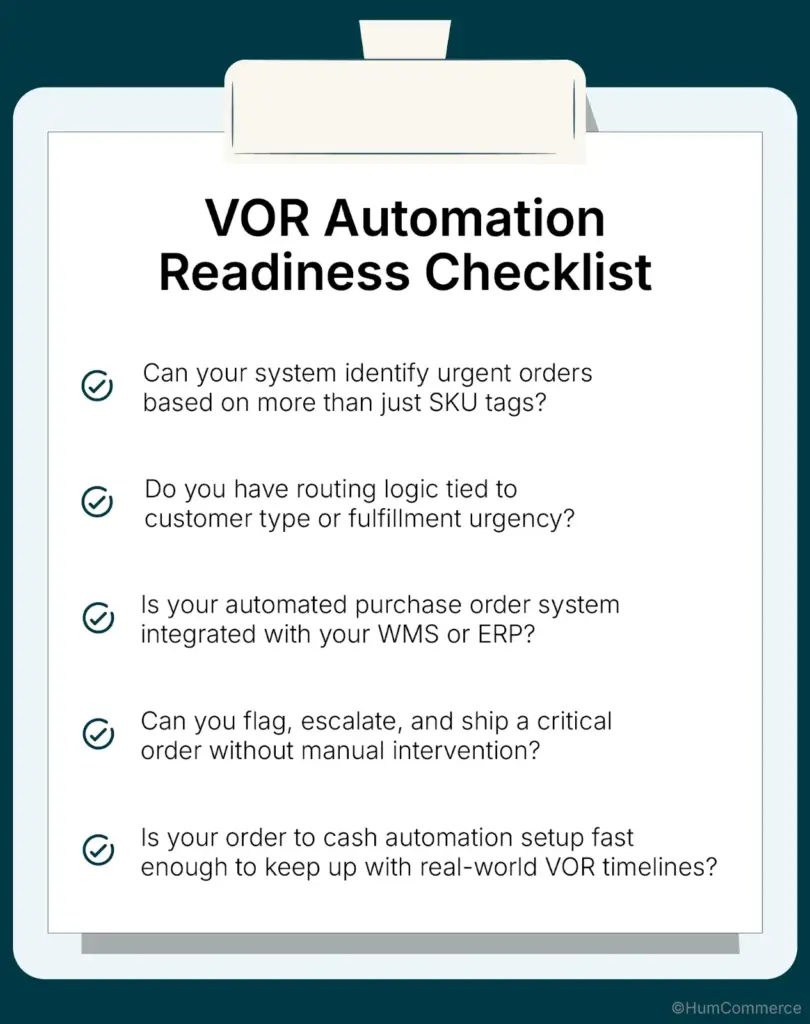
If you answered “no” to even two of these, your VOR process is costing you more than you think.
Want to see how leading B2B suppliers are automating VOR fulfillment?
Download our free eBook, “The Tariff-Resilient Enterprise,” for proven strategies and real-world playbooks to future-proof your quoting and fulfillment process.
How AI Helps You Prioritize and Fulfill Urgent Auto Parts Orders Faster
Automation is just the start. To truly accelerate VOR fulfillment and protect your margin, you need AI that understands context, not just rules.
How AI Knows Which Orders Need to Move First
AI looks at far more than what’s in the cart.
It evaluates:
- Customer history: Is this a high-value fleet account? How often do they escalate?
- Order timing: Is this part needed before 3 PM for same-day install?
- Part category: Is this a VOR-prone SKU (e.g., brake sensors, relays)?
- Location factors: How close is the customer to a fulfillment center with stock?
- Behavior patterns: Does this customer typically reorder when delayed?
It pulls this from:
- ERP: Order frequency, customer profiles, service levels
- PIM: Product urgency, compatibility, and criticality
- eCommerce: Order channel, notes, and delivery requests
Together, these signals help your automated order processing system determine urgency within seconds without human involvement.
How AI Optimizes Fulfillment and Shipping Automatically
Once a VOR order is identified, AI selects the best fulfillment route based on:
- Inventory availability and proximity
- Real-time shipping costs and cutoffs
- SLAs tied to the customer or vehicle type
- Warehouse workloads and pick-pack capacity
It may:
- Reroute stock from a different fulfillment center
- Split an order across two locations to save time
- Adjust shipping method based on cost-speed tradeoff
- Trigger next steps in your order to cash automation flow, including invoicing, tracking updates, and customer communication
All of this happens before your ops team even sees the order.
AI can’t do this alone. It needs the right data flowing at the right time from systems that rarely talk to each other natively.
But in most operations, these platforms sit in silos.
They’re patched together manually, or worse, updates happen on a delay that kills AI’s ability to act in real time.
That’s why ERP and PIM integration isn’t just a technical project. It’s the foundation for automated order processing, order to cash automation, and AI-driven fulfillment.
At HumCommerce, we help B2B teams connect these systems the right way:
- Real-time sync between ERP, PIM, and eCommerce
- Business logic that understands urgency, not just inventory
- A data layer AI can actually learn from
Because AI is only as smart as the systems behind it. We make sure yours are ready.
How to Build a Scalable, Customer-Centric VOR Fulfillment Engine with AI?
Most fulfillment teams can handle a handful of urgent orders a day.
But what happens when VOR requests spike during peak season? Or when your top fleet client expects “white-glove” handling on every order?
This is where automated order processing and AI stop being a nice-to-have and start becoming your competitive edge.
Once your system learns how to identify urgency, route efficiently, and fulfill at speed, every VOR order becomes a data point. The more you process, the smarter your system gets.
The 3 Stages of VOR Fulfillment Maturity
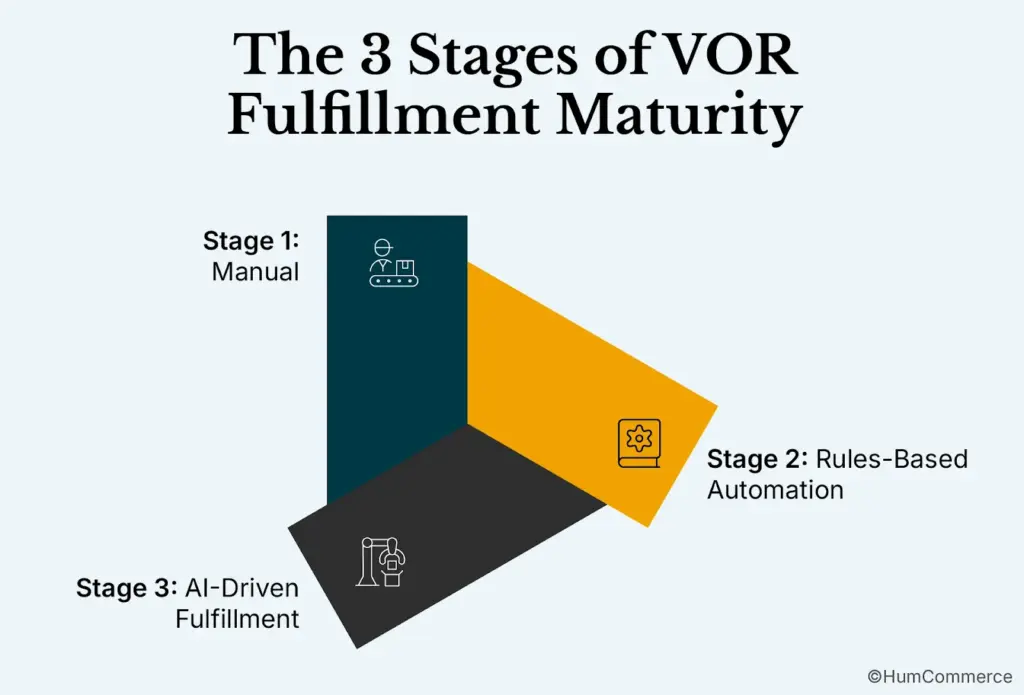
Stage 1: Manual
- Orders are escalated by phone or email
- Human judgment drives prioritization
- No visibility into patterns or urgency
Stage 2: Rules-Based Automation
- Certain SKUs or customers are auto-flagged
- Escalation logic is built into your automated purchase order system
- Still brittle, hard to scale or adapt
Stage 3: AI-Driven Fulfillment
- Context-aware logic uses customer history, inventory behavior, and demand patterns
- Orders are prioritized and fulfilled in real time
- AI evolves based on success rates, seasonality, and lead-time data
If you’re aiming for scale, AI-driven VOR automation is where meaningful gains begin.
How AI Improves Itself Over Time
With every VOR order, your system learns:
- Which customers are likely to escalate and how to pre-empt them
- Which SKUs are delay-prone and where they should be pre-stocked
- Which fulfillment centers are consistently fastest
- When seasonal patterns (like Q4 demand spikes) should trigger proactive reallocation
This is automated order fulfillment that doesn’t just move faster, it gets smarter the more you use it.
AI-driven routing and stocking may even led to upto 28% improvement in VOR lead times and a 2X increase in customer satisfaction scores without adding headcount.
White-Glove Service at Scale
Before automation, “white-glove” meant VIP queues, manual escalations, and ops burnout.
Now, with AI + workflow automation, you can deliver top-tier service across:
- Every customer tier
- Every SKU category
- Every warehouse location
And it all works without rewriting ERP rules or retraining your team every quarter.
Because your system is adaptive.
The Competitive Advantage No One Talks About
AI isn’t just about operational efficiency, it’s about perception.
Suppliers who master how to automate fulfillment orders don’t just ship faster.
They:
- Win more fleet and OEM contracts
- Reduce churn on high-margin accounts
- Command higher NPS scores and repeat business
This is what order to cash automation should look like: tight, intelligent, and customer-first.
And in the automotive aftermarket, where downtime destroys trust, being reliable at scale is the brand.
Next Steps
The biggest delays in VOR fulfillment aren’t caused by missing parts.
They’re caused by systems that don’t know which parts matter most.
And fixing that isn’t about hiring more staff or rewriting your entire tech stack.
It’s about using workflow automation and AI personalization to bring urgency, context, and intelligence into every step of the fulfillment process.
Here’s what to remember:
- Equal treatment = delayed fulfillment. If your system can’t tell a critical VOR order from a routine one, you’re gambling with customer trust.
- Automated order processing isn’t enough. You need smart prioritization and dynamic routing.
- AI helps scale white-glove service. The more you automate and learn from past orders, the better your system gets at protecting uptime and margin.
- Order-to-cash automation unlocks ROI. From picking and packing to routing and invoicing, automation reduces friction, manual effort, and risk.
Discover exactly where your urgent orders are getting stuck and how to fix it with automation and AI.