TL;DR
- What this is: AI-powered self-service tools for B2B ecommerce that connect to ERP and CPQ to answer product, pricing, and order queries without manual rep involvement
- Who it affects: Head of eCommerce at a mid-size manufacturer or distributor and CFO or VP Finance evaluating capital allocation at manufacturing and distribution companies
- The core problem: US manufacturers and distributors running Epicor, NetSuite, or SAP Business One with 500+ monthly customer support queries
- The cost of inaction: 75% of B2B buyers prefer a rep-free experience for routine purchases (Forrester 2025)
- What good looks like: HumCommerce B2B AI Assist – not generic AI chatbot platforms and manual customer support operations
- Proof it works: A US-based industrial distributor achieved a 60% reduction in routine support tickets within 90 days
Every support ticket your team fields for a routine question – “What’s my contract price on this SKU?” or “Is this part compatible with my existing setup?” – carries a fully loaded cost between $15 and $40. Multiply that across 500 or more monthly queries, and you’re looking at $90,000 to $240,000 a year in support labor that generates zero new revenue. For heads of ecommerce and operations directors at mid-size manufacturers and distributors running Epicor, NetSuite, or SAP Business One, this cost is often buried inside broader headcount budgets, invisible to the CFO until someone pulls it apart line by line.
This guide gives you the framework to do exactly that: quantify the real cost of manual B2B support, calculate the ROI of an AI assistant connected to your ERP and commerce platform, and present a business case that earns CFO approval. You’ll find specific formulas, benchmarks from real deployments, and a structure designed for the kind of capital allocation scrutiny your finance team demands. The goal isn’t to sell you on AI as a concept. It’s to hand you the numbers and the narrative you need to move a project from “interesting idea” to “approved budget line.”
Building the business case for AI in B2B ecommerce means confronting an uncomfortable truth: your buyers already expect self-service, your competitors are already deploying it, and AI investment now ranks among the top strategic priorities for CFOs across industries. The question isn’t whether to invest, but how to justify the spend with rigor.
What Is B2B AI Assistant ROI and CFO Business Case in B2B Ecommerce?
At its core, this concept refers to AI-powered self-service tools for B2B ecommerce that connect to ERP and CPQ systems to answer product, pricing, and order queries without manual rep involvement. These aren’t consumer-grade chatbots trained on generic FAQ pages. They’re purpose-built assistants that pull live data from your ERP, respect your contract pricing tiers, and handle the kind of technical product questions that would otherwise require a seasoned inside sales rep.
The ROI calculation and CFO business case component is what separates a technology experiment from a funded initiative. Your CFO doesn’t care that AI is “the future.” They care about payback period, cost per query reduction, and whether the investment displaces enough manual labor to justify itself within a fiscal year. A proper business case maps every dollar of AI spend against measurable reductions in support cost, improvements in quote turnaround, and gains in self-service order completion.
| Approach | What It Means |
| Generic AI chatbot platforms and manual customer support operations | Surface-level bots trained on static knowledge bases, disconnected from ERP, unable to answer pricing or inventory questions with real-time accuracy |
| HumCommerce B2B AI Assist | A conversational AI layer connected directly to your ERP, CPQ, and commerce platform, delivering contract-specific pricing, live inventory, and order status from a single source of truth |
The distinction matters because generic chatbots create a false sense of automation. They deflect questions rather than resolve them, pushing buyers back to phone and email and increasing frustration without reducing cost.
Why Most Manufacturing and Distribution Companies Underestimate This Problem
The operational consequences of ignoring AI-powered support are compounding. Every month your team spends answering questions that an ERP-connected assistant could handle, you’re burning inside sales capacity on admin instead of revenue-generating activity. A rep who spends 40% of their day answering “Where’s my order?” and “What’s my price on part number X?” is a rep who isn’t upselling, cross-selling, or closing new accounts. The revenue cost isn’t just the salary line item. It’s the opportunity cost of misallocated talent across your entire sales organization.
Generic chatbot platforms fail manufacturing and distribution businesses because they can’t access the data that matters. When a buyer asks, “Do you have M8 hex bolts in stainless, and what’s my contract rate for a case of 500?” – a generic bot trained on product descriptions has no answer. It doesn’t know the buyer’s account, their volume tier, or whether the item is in stock at the nearest warehouse. So the query escalates to a human, and you’ve spent money on a tool that adds a step without removing one. IBM’s research confirms that AI chatbots can handle up to 80% of routine inquiries when properly connected to live data, but the keyword is “properly connected.” Without ERP integration, that number drops to near zero for B2B use cases.
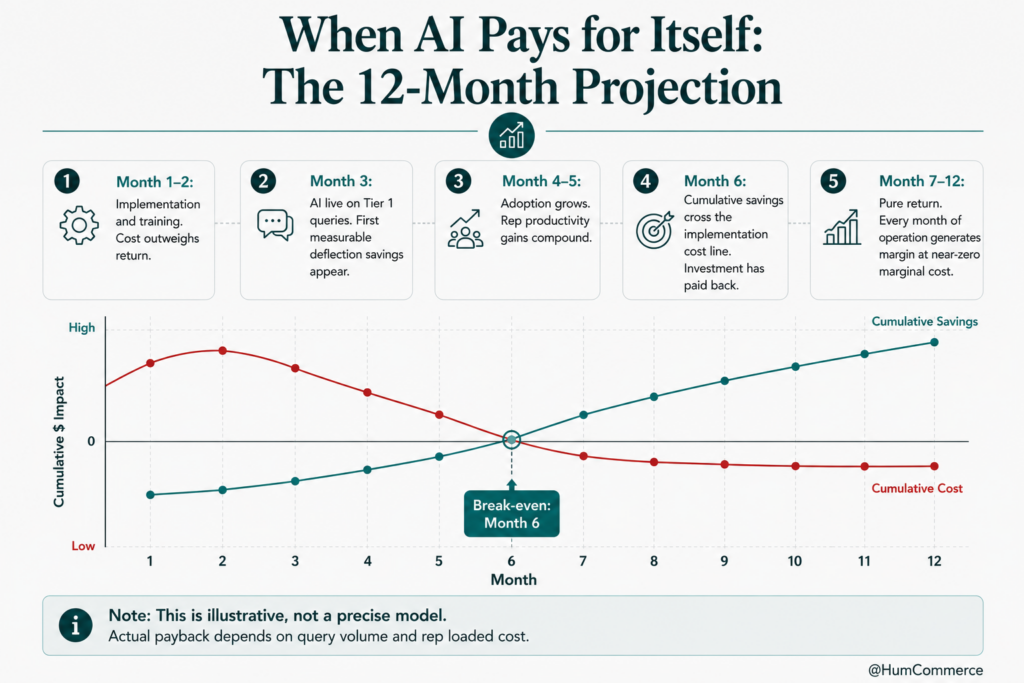
The pain concentrates in two roles. Heads of ecommerce feel it as a conversion problem: buyers abandon self-service because the site can’t answer their questions, and 75% of B2B buyers now prefer a rep-free experience for routine purchases (Forrester 2025). CFOs and VPs of finance feel it as a cost allocation problem: support headcount grows linearly with order volume, and there’s no clear path to scale without adding bodies. Teams that deploy AI for RFQ workflows typically achieve payback within 3 to 6 months, with ROI of several hundred percent over three years. Yet most mid-market companies haven’t modeled this because they haven’t isolated the per-query cost of their current operation. That’s where the business case starts, and the inability to measure AI ROI remains one of the top challenges facing CFOs heading into 2026.
The 5 Most Critical AI Support Failures in B2B – And How to Avoid Them
Customer support automation in B2B ecommerce fails more often than it succeeds, and the reasons are predictable. Here are the five issues that heads of ecommerce and operations leaders need to understand before investing.
1. Deploying a Generic Bot Without ERP Connectivity
A B2B AI assistant that can’t check live inventory, pull contract pricing, or confirm order status is a liability disguised as innovation. Your buyers need answers grounded in real-time ERP data. Without that connection, the bot becomes a glorified search bar.
2. Ignoring CPQ and Quote Workflow Integration
For manufacturers with configured products, an AI chatbot for sales that can’t interact with your CPQ system misses the highest-value use case. Quote turnaround is where B2B companies have reduced cycle times from days to hours by automating capture, approvals, and pricing checks.
3. Measuring the Wrong Metrics
Tracking chatbot “interactions” instead of ticket deflection rate, self-service order completion, or cost per resolved query leads to inflated success reports and no real savings.
4. Treating AI as a One-Time Implementation
A B2B AI assistant needs continuous training on new SKUs, superseded parts, cross-reference tables, and updated pricing rules. Set-and-forget deployments degrade within months.
5. Failing to Shadow Existing Support Workflows First
Before deploying any AI tool, shadow your customer service calls, interview inside sales teams, and audit failed site search logs. The discovery phase determines whether the AI addresses real friction or imagined problems.
| Failure Mode | Impact | Prevention |
| No ERP connection | Buyers get wrong prices/stock data | Require real-time, two-way ERP sync |
| No CPQ integration | Quotes still require manual processing | Connect AI to CPQ approval logic |
| Wrong metrics | ROI invisible to finance | Track cost per resolved query |
| No ongoing training | Accuracy degrades over time | Schedule monthly data refreshes |
| Skipping discovery | AI solves wrong problems | Audit support tickets before scoping |
Real Results: A US-Based Industrial Distributor
A US-based industrial distributor handling over 600 monthly support queries faced a familiar problem: their inside sales team spent the majority of each day answering routine questions about pricing, stock availability, and order status. Their ERP held all the answers, but buyers had no way to access that data without calling or emailing a rep.
What changed after implementation:
- 60% reduction in routine support tickets within 90 days
- 25-35% of orders completed via self-service after AI deployment
- Rep time on admin reduced by 40% in the first 6 months
- 48-hour average RFQ response time reduced to under 4 hours
The difference wasn’t the AI itself. It was the architecture behind it. HumCommerce B2B AI Assist connected directly to the distributor’s ERP, pulling contract rates, volume tiers, and real-time inventory into a conversational interface that buyers could use without training. Reps didn’t disappear from the process. They shifted from answering “What’s my price?” to focusing on complex quotes and relationship-building activities that actually grow accounts.
How HumCommerce Approaches B2B AI Assistant ROI and CFO Business Case Differently
Generic chatbot platforms treat B2B like a variant of B2C, bolting a conversation widget onto a storefront and hoping it deflects tickets. For mid-market manufacturers running Adobe Commerce with Epicor or SAP Business One as their ERP backbone, this approach fails immediately. B2B buyers don’t ask simple questions. They ask, “What’s my contract price on this assembly, and can you ship 200 units to my Dallas warehouse by Thursday?” Answering that requires live access to customer-specific pricing, warehouse-level inventory, and shipping logic, none of which a generic platform provides.
HumCommerce B2B AI Assist works differently because it treats your ERP as the single source of truth. The assistant connects to your commerce platform, ERP, and CPQ system to deliver answers that respect approval chains, purchase order requirements, and credit limits. For a head of ecommerce, this means buyers can self-serve on 60% or more of their routine queries without a single rep touch. For the CFO, it means support costs scale with technology investment, not headcount.
Implementation follows a structured discovery process. HumCommerce begins by auditing your existing support tickets, shadowing customer service calls, and mapping the most common query types against your ERP data model. This ensures the AI is trained on real buyer language and real product data, including alphanumeric SKUs, superseded parts, and cross-reference tables. The result is 75% faster quote workflows and a measurable reduction in cost per query from day one. If your team is fielding 500+ monthly support queries and you’re ready to model the ROI, HumCommerce B2B AI Assist is built for exactly this use case.
Take Action
The math on AI-powered B2B support is straightforward once you isolate three numbers: your per-query cost, your monthly query volume, and a realistic deflection rate. Most manufacturers and distributors running 500+ monthly support queries are sitting on six figures of annual savings they haven’t modeled yet. The companies winning CFO approval aren’t leading with technology hype; they’re presenting conservative financial projections grounded in their own operational data.
Your next step is specific: pull your last 90 days of support tickets, categorize them by type (pricing, order status, product specs, RFQ), and calculate the fully loaded cost of each category. That exercise alone will tell you whether an AI assistant investment clears your CFO’s hurdle rate. If the numbers work, and for most mid-market B2B operations they do, HumCommerce B2B AI Assist is purpose-built for exactly this kind of deployment.