TLDR
- Your rep just lost a $2.5M deal by saying “let me check” on one technical question. This happened 47 times across your team last quarter, each delay cost you 2-3 days and a faster competitor.
- AI knowledge assistants give instant 3-second answers instead of 48-hour follow-ups, keeping deal momentum alive and buyers confident in your expertise.
- Result: 25% faster cycles, 15-20% higher win rates, $4M additional revenue per 10-rep team, payback in 90 days.
Your VP of Sales just watched a deal die on a discovery call.
The prospect, a mid-market enterprise, asked your rep about API security compliance for EU data residency. Your rep said, “Let me circle back with engineering and get back to you.”
Three things happened next.
First, your rep scheduled a follow-up for Thursday. By Thursday, the prospect’s CTO had already talked to two other vendors.
Second, your competitor who answered the API security question in 30 seconds using an AI knowledge assistant was already in contract review.
Third, your deal moved from “closing this quarter” to “maybe next quarter.” That 30-second delay cost you 3 months and eventually the entire $2.5M deal.
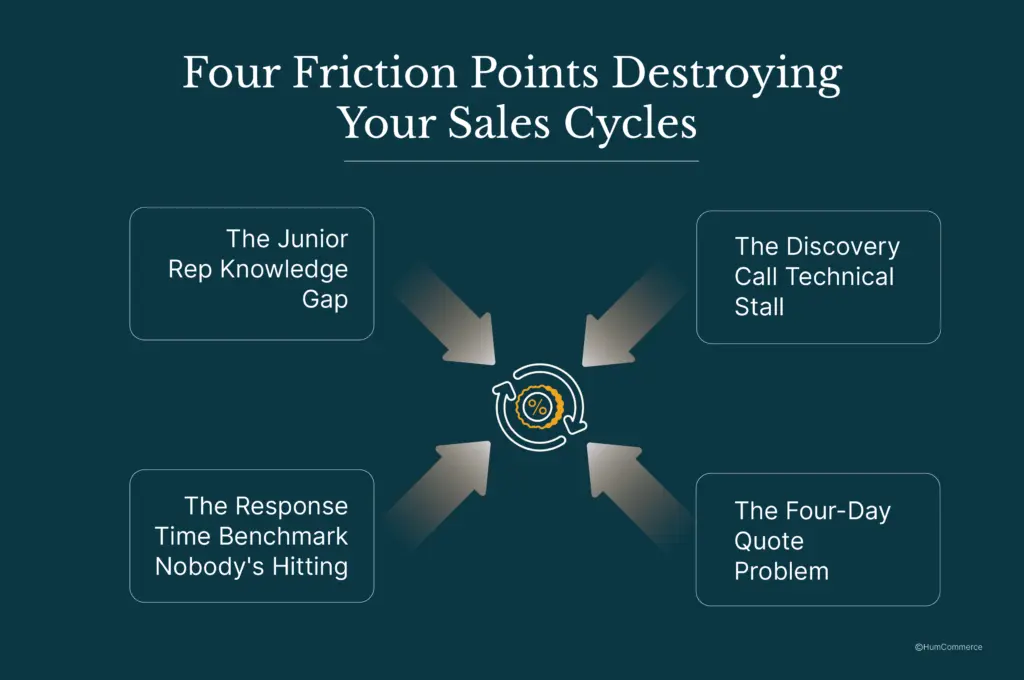
This pattern played out 47 times across your sales team last quarter. Each time, you added 2-3 days to the cycle. Each time, you eroded buyer confidence. Each time, a faster competitor captured the deal.
The core problem isn’t your product or your reps. It’s information latency.
When your rep can’t answer a technical question in real time, the deal stalls. Your competitor who can? They keep momentum alive and close faster.
This guide shows you exactly how to eliminate that gap.
What is This Costing You
Stop guessing at impact. Here’s what changing this looks like in real dollars.
The Deal Velocity Formula
Your revenue per rep = (Opportunities × Average Deal Size × Win Rate) ÷ Sales Cycle Length
Most companies try to improve this by adding more leads or hiring more reps. But the highest-leverage improvements come from two variables nobody optimizes: sales cycle length and win rate.
Reducing your sales cycle by 25% has the same revenue impact as increasing leads by 33%. But acquiring 33% more qualified leads is expensive and slow. Reducing cycle time is internal, controllable, and fast.
Impact #1: Cycle Time Reduction (25-30%)
Baseline Scenario (90-day cycle):
- 10 reps × 4 deals per rep per year × $250K ACV × 20% win rate = $20M revenue
With AI-Powered Speed (65-day cycle, 28% reduction):
- 10 reps × 5.6 deals per rep per year × $250K ACV × 20% win rate = $28M revenue
- Revenue increase: +$8M from cycle compression alone
Impact #2: Win Rate Improvement (15-20%)
Information latency kills deals in two ways:
- Directly: If you can’t answer questions quickly, buyers think you can’t handle their complexity. That’s 15-20% of deals lost to perception, not product fit.
- Indirectly: Your slow responses give competitors time to build relationships and close before your follow-up email lands.
Baseline (20% win rate on 100 qualified deals):
- 100 opportunities × $250K ACV × 20% win rate = $5M revenue
With Better Information Access (24% win rate, +4 points):
- 100 opportunities × $250K ACV × 24% win rate = $6M revenue
- Revenue increase: +$1M from win rate improvement
How AI Actually Works in Your B2B eCommerce
Most AI knowledge systems fail because they’re built wrong. Here’s what actually delivers results:
Semantic Understanding, Not Keyword Matching
Traditional search requires exact keywords. Search “data residency” and you get 47 documents. Which one answers your question? Your rep still reads through pages to find out.
AI-powered semantic search understands intent. When your rep asks “cross-border reporting with EU data residency,” the system knows this relates to:
- GDPR compliance requirements
- Regional data storage architecture
- Multi-national reporting capabilities
- Relevant case studies with international organizations
- How competitors position on this
The AI synthesizes an answer from compliance docs, product specs, implementation guides, legal requirements, and presents one coherent response with source citations. Your rep gets exactly what they need in three seconds—verified and ready to communicate.
Real-Time Synthesis Across Siloed Sources
Your knowledge isn’t in one place. Pricing lives in your ERP. Specs are in your PIM. Competitive intel is in a shared folder. Case studies are in your CRM. Implementation details are in Confluence.
A human searching all these sources on a live call? Impossible. An AI pulling from all integrated sources simultaneously? Three seconds.
When a rep asks “How does our API performance for high-volume transactions stack up against Competitor X?” the system:
- Gets your technical specs from product documentation
- Gets competitor benchmarks from your competitive intelligence database
- Finds relevant CRM case studies
- Surfaces customer complaints or support tickets about API performance
- Identifies which sales engineer can provide technical proof
Your rep gets a full, multi-faceted answer that would have taken 30 minutes of research and three internal conversations.
Source Citations Build Trust
The AI doesn’t just give answers—it shows its work.
“Your integration supports real-time inventory syncing with latency under 200ms” comes from:
- Technical documentation (updated last week)
- Load testing results (Q4 2025)
- Implementation specs from your three largest customers
Your rep isn’t blindly trusting AI. They’re seeing verified information from authoritative sources. When buyers ask follow-up questions, reps can dive deeper with confidence because they know where information originated.
By week three, skeptical reps are relying on this daily because it makes them smarter and more credible.
The Three AI Capabilities That Drive Results in Your B2B eCommerce
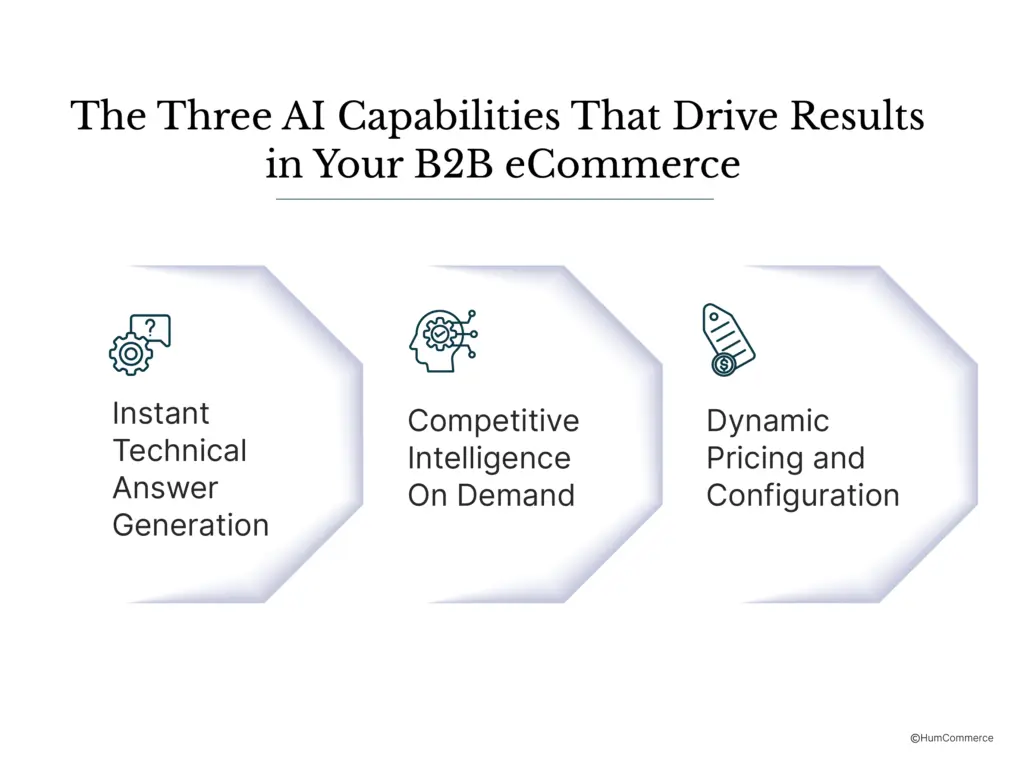
1. Instant Technical Answer Generation
Reps should get answers to any product, pricing, competitive, or implementation question in under 10 seconds. Not a chatbot saying “I found 12 documents.” A system that answers the question with source citations.
Benchmark: Companies implementing this see answer retrieval drop from 12 minutes to under 10 seconds. On a 45-minute call with six technical questions, that’s 70+ minutes of saved post-call research and follow-ups.
2. Dynamic Pricing and Configuration
AI-powered CPQ completely changes the game for complex B2B pricing (volume discounts, contract-specific terms, regional variations, product bundles).
Instead of reps manually building quotes in spreadsheets, the system generates accurate quotes in real time during the call. Change quantities? Prices update instantly. Add a product bundle? Discount rules apply automatically. Ship to three warehouses? Freight costs calculated and added.
Result: 88% faster quote generation. One company cut quote load time from 40 seconds to under 5 seconds, leading to immediate conversion rate lift because buyers stopped abandoning in frustration.
3. Competitive Intelligence On Demand
Scenario: Your prospect says they’re looking at Competitor X. Your rep knows you’re better but can’t explain why for this use case.
With AI-powered competitive intelligence:
- Rep: “For this manufacturing use case, how do we stack up against Competitor X?”
- AI: “Competitor X focuses on SMB deployments with limited customization. Your prospect needs multi-facility inventory sync and Epicor ERP customization. We have deep experience in both. See the automotive case study from Q3—we displaced Competitor X because they can’t handle complex procurement workflows. Key difference: we sync in real-time; they batch process with 12-24 hour delays.”
The rep now has situational positioning. Not vague claims—real differences based on what this prospect actually needs.
This is how junior reps talk like senior reps.
The 16-Week Path From Diagnosis to Full Deployment
Here’s the exact implementation plan businesses follow to go from diagnosis to measurable results.
Weeks 1–2: Audit Your Knowledge Gaps
Step 1: Pull CRM data from the last year. For each closed-lost deal, find exactly where it stalled. Look for patterns:
- Deals stuck because prospect wanted technical documents you couldn’t send immediately?
- Repeated delays because of questions about pricing or configuration?
- Deal stopped when you said “let me check” on competitive positioning?
Step 2: Survey your sales team. Ask:
- What information do you need most often during buyer calls?
- What questions make you say “let me check”?
- How long does it take to get answers right now?
Write down the top 20 questions. These are your first deployment priorities.
Step 3: Measure response times by question type:
- Pricing/configuration: currently 2-5 days
- Technical specs: currently 1-3 days
- Competitive positioning: currently 3-7 days
- Implementation requirements: currently 5-10 days
Put a dollar value on each delay. You’re losing revenue because of each gap.
Weeks 3–4: Centralize Your Knowledge Base
Step 1: Locate your most critical information:
- Product documentation (Confluence, SharePoint, PDFs)
- Pricing rules and configuration (ERP or spreadsheets)
- Competitive battlecards (hopefully organized, likely scattered)
- Case studies and customer stories (CRM + personal files)
- Implementation guides (engineering docs)
Don’t boil the ocean. Start with information that answers your top 20 questions.
Step 2: Tag content for AI retrieval:
- Use case (e.g., “international compliance,” “multi-location inventory”)
- Buyer persona (e.g., “CFO objections,” “IT technical validation”)
- Sales stage (discovery, technical evaluation, negotiation)
- Product area (API capabilities, reporting features, ERP integration)
Step 3: Assign ownership. For each knowledge domain, assign a subject matter expert responsible for accuracy and updates.
Weeks 5–8: Pilot Program (5-10 Reps)
Select a pilot cohort:
- 2-3 senior reps (to show even top performers benefit)
- 3-4 mid-level reps (your biggest group)
- 1-2 junior reps (to measure onboarding impact)
Choose reps who are both excited and critical. You want honest feedback, not cheerleaders.
Deploy AI knowledge assistant into:
- CRM (for deal review)
- Slack/Teams (for quick questions during calls)
- Sales call software (for real-time assistance during live calls)
Train reps on:
- How to ask good questions (natural language is fine, but context gets better answers)
- How to verify answers before sharing with buyers (check source citations, understand confidence levels)
Track these metrics weekly:
- Response time: Target <10 seconds
- “Let me check” frequency: Target 80% reduction
- Deal velocity: Target 15-20% reduction
- Win rate: Target 15-20% increase
- Rep satisfaction: Target 80%+ say “yes, this helped”
By week 6, you should see clear improvements. If you hit 50%+ answer time reduction, 15%+ win rate lift, and 80%+ rep satisfaction, you’re ready to scale.
Weeks 9–16: Staggered Rollout
Weeks 9-10: Deploy to second cohort (10-15 reps)
Weeks 11-12: Deploy to third cohort
Weeks 13-14: Deploy to remaining reps
Weeks 15-16: Optimize based on feedback
This step-by-step approach lets you improve training and fix problems before organization-wide deployment.
Continuous improvement:
- Weekly: Review questions that weren’t answered well. Add missing content.
- Monthly: Analyze usage patterns. Which knowledge areas get most questions? Which are underutilized? Reorder priorities.
- Quarterly: Update product information. Verify all sources are accurate. Add new competitive intelligence.
From “Let Me Check” to Instant Expertise
Here’s what we know with certainty.
Your B2B sales cycles are 25-30% longer than they should be. Every “let me check” adds 2-3 days. Ten delays per deal means 20-30 days of lost velocity. Your best deals are getting outpaced by competitors who answer faster.
The problem isn’t your product, your reps, or your pricing. It’s information latency. Your knowledge exists—in your PIM, your ERP, your technical docs, your CRM. But when your rep needs an answer in the middle of a live call, accessing that knowledge takes hours or days instead of seconds.
AI knowledge assistants solve this. Not with magic, but with practical, measurable improvements:
- 48-hour delays become 3-second answers
- Quote generation drops from days to hours
- Junior reps reach productivity 50% faster
- Win rates improve 15-20%
- Sales cycles compress 25-30%
The math is straightforward: Faster cycles + higher win rates = 70%+ revenue growth with the same team and marketing budget.
But this only works if you execute correctly. Audit your knowledge gaps. Fix your content quality before layering AI on top. Pilot with a group that proves value. Roll out systematically with proper change management. Measure obsessively and optimize continuously.
The companies that win in 2026-2027 won’t be the ones with the best products. They’ll be the ones who answer fastest, most accurately, and most confidently. The ones who turn “let me check” into instant expertise.
Your competitors are already moving. The question isn’t whether AI will transform B2B sales. It’s whether you’ll lead that transformation or get left behind.
Want to cut your sales cycle by 25% and raise your win rate by 15–20%?
We can map out your current B2B sales cycle, figure out how much money you’re losing because of response delays, and make an AI roadmap that fits your stack if you want a clear picture of how much money you’re losing.
Our AI consulting team will:
- Check for gaps in your current knowledge (Week 1–2)
- Set up your content so that AI can find it (Week 3–4)
- Plan and carry out your four-week pilot program (Weeks 5–8)
- Handle staggered rollout (Week 9–16)
Result: cycles that are 25–30% faster, win rates that are 15–20% higher, and 50–70% more revenue.