Key Takeaways:
- There are a lot of moving parts in the order management cycle for ecommerce, so it’s important to know where people often mess up.
- To make sure orders are right, you need a mix of clear SOPs, proactive staff training, automation, and technology like barcode scanning or integrated dashboards.
- The right automation and a step-by-step process audit can help you fix the most common order management problems, like having to enter data by hand, not being able to talk to each other, and having inventory that doesn’t match.
- Cutting down on order mistakes has many benefits, such as keeping customers’ trust, saving money, and letting your brand grow without making the same mistakes over and over again.
- If your business cares about getting things right and solving problems quickly, managing orders can go from being a problem to a way to grow.
Your eCommerce order management cycle is like a desk at work that is always busy.
There are papers everywhere, sticky notes for every job, and the phone rings just when you think you’ve finished that big report.
When things get busy, it’s easy to forget about small things, like an order that was missed, a double shipment, or an important email that never gets answered.
These B2B e-commerce mistakes cost money, slow down orders, and make everything more dangerous at every step.
This blog talks about the order management cycle in ecommerce, the most common problems with order management, and gives you step-by-step advice on how to make sure your orders are always right.
You will learn where mistakes happen when filling orders, how to avoid them, and the right mix of process and automation that makes managing orders easier and more reliable for your team and your business.
Let’s get going.
When you shop online, what is the order management cycle?
The order management cycle in ecommerce is the whole process that begins with placing an order and ends with delivering it (and sometimes bringing it back).
Getting each step right is the key to getting orders right and avoiding expensive mistakes.
This is how the cycle goes:
- Get Orders: When people order from your eCommerce site, over the phone, or even through EDI for B2B, the buying process starts. Not having all the information, having to type it out by hand, or a system that doesn’t sync right away are all things that can go wrong here.
- Reviewing orders: You look for things that might go wrong. Can you fill the order? Is the payment real? Is the address for shipping clear? A lot of problems with managing orders, like backorders or failed payments, go unnoticed if this step isn’t tight.
- Paying: Collect payments and confirm them safely. Customers can get angry if their payments don’t go through or are rejected, and you’ll have to follow up manually.
- Choosing: The warehouse finds the right items and pulls them out. When people have big or mixed B2B orders, they often make mistakes, like choosing the wrong SKU or quantity.
- Putting things in order: We put packages together, check them twice, and group them so that nothing is left behind or labeled incorrectly. People who are in a hurry, don’t double-check their work, or don’t fill out all the packing slips can make mistakes when they fulfill orders.
- Shipping: Labels are printed, carriers are chosen, and tracking starts. Any manual step here makes things more likely to go wrong, like entering the same address twice, entering a batch, or losing tracking numbers.
- Returns: An automated workflow that works well should keep track of, receive, and restock items that are sent back. If you don’t do this right, it could cause problems with your stock and make you lose sales.
Even if you have the best intentions, there can be problems with the order management cycle between these steps. This is especially true if you have to fix your systems or team by hand.
What are the most common problems with handling orders?
These are problems that happen way too often for most online stores:
- When you move orders from one spreadsheet to another or from eCommerce to ERP, you might end up with duplicate orders, numbers that are in the wrong order, or orders that are lost.
- Not talking to each other: If sales, fulfillment, finance, or the customer don’t work together, things will take longer or be wrong. An update from one team is a blind spot for another.
- Customers get upset when stock isn’t updated in real time, which can cause overselling and backorders. This is especially true when there are more than one warehouse or channel.
- “Fat finger” mistakes in fulfillment: Typos, sending things to the wrong address, and shipping to an old address are all common mistakes that can hurt both the customer experience and the bottom line.
These problems get worse because of common B2B problems:
- There are more line items, volume, and workflows in big, complicated orders, which makes it more likely that mistakes will happen.
- Changes to the product: When you have to deal with special requests and one-of-a-kind bundles by hand, it’s easy to make mistakes.
- A lot of channels are confusing: When you order from different stores, marketplaces, or direct reps, you have to deal with more systems. This means that there are more chances for things to go wrong.
B2B brands that want to grow quickly and keep their customers’ trust need to find ways to fix these order management issues.
How can you make fewer mistakes when you take orders?
Training that is proactive and clear standard operating procedures (SOPs) for each team member
- Make sure that everyone who works on the order management cycle in e-commerce, like warehouse workers, customer service reps, finance, and operations, can get to paperwork that is up-to-date and easy to understand.
- Add hands-on training and real-life situations to onboarding and upskilling so that team members can spot potential problems with order management before they cause a shipment to be late.
Automate tasks that you have to do over and over again when you can.
- Use technology to check payments, sync orders, and keep track of changes on its own.
- You are much less likely to make mistakes, enter the same information twice, or miss steps if you don’t have to hand off an order as often.
Use technology to help you make fewer mistakes when you fill orders.
- Use all three of these things at once to make picking and packing easier: barcode scanning, digital picklists, and automated batching.
- These tools make it much easier to get orders right by cutting down on “fat finger” mistakes with every scan and check.
Add checks, balances, and error flags.
- Set up rules for system-based validation, like flagging inventory mismatches, catching duplicate orders, and making sure that big or important orders are double-checked.
- Add audit trails and exception reporting so you can quickly find out what went wrong and fix it.
Give your team access to and use data in real time.
- Everyone can see the same up-to-date information on integrated dashboards that link all of the systems (storefront, ERP, warehouse, shipping).
- It’s less likely that there will be mistakes in orders when everyone can see the status of an order, the inventory, and any exceptions right away.
Making Accuracy a Part of the Culture
Let your employees talk to you about problems and give you ideas for how to fix them.
Let the warehouse, support, and operations teams know that they can talk about issues with managing orders and workflow without being blamed. Encourage people to talk to each other so that anyone can come up with a better way to find and fix mistakes in the process of managing orders for online shopping.
Encourage a “Catch It Early” Way of Thinking
Remind people how important it is to catch small mistakes before they turn into big problems with fulfilling orders. Make sure your team takes their time with important tasks like picking, packing, and validating to make sure everything is correct. It’s more important to fix a problem than to hurry through it.
As a team goal, celebrate making fewer mistakes.
Keep track of how often orders go wrong and use dashboards, meetings, and shifts to show how things are getting better. Give credit to people or departments that go the extra mile to make sure orders are correct. People feel like they own something and keep things going when they get little rewards or shoutouts.
One step at a time: Learning how to handle B2B order
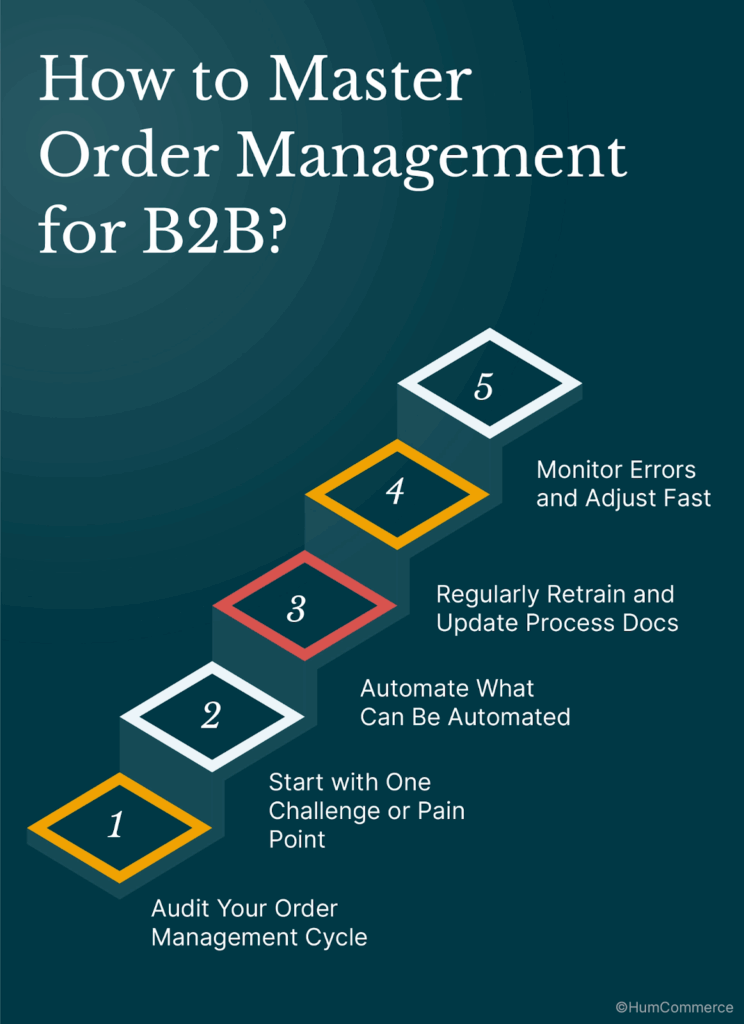
1. Look at the cycle for managing orders.
Check each step, from taking orders to returns, to see where things are stuck right now and where manual steps are most likely to go wrong. Talk to end users and staff who work on the front lines to find out where things go wrong or are always missed.
2. Start with one problem or issue
Pick the weakest link. If you have double entries between systems, missed picking slips, or tracking that isn’t always right, focus on fixing one thing that will help you the most.
3. Do things that can be done automatically.
Set up automation for things like checking payments, syncing orders, or sending updates on how orders are going. Tools like barcode scanning, digital picklists, and real-time dashboards are very helpful when things get complicated in B2B.
4. All the time Update and retrain the documents that explain how to do things.
As workflows and technology change, make sure your SOPs are up to date. Even when you hire new people, give your current employees short training sessions at work so they can learn new skills and stay up to date.
5. Watch out for mistakes and fix them as soon as you see them.
Use dashboards and exception reporting to find problems as they happen. Get together for short, regular meetings to talk about what went wrong, how to fix it, and what works again. The goal is to keep going, not to be perfect.
Lastly
when people in B2B order management make fewer mistakes, the systems get smarter, your team gets more power, and small changes add up quickly.
Your company can turn the order management cycle in ecommerce from a source of stress into a real competitive advantage by making accuracy a team value, adding the right technology, and fixing one problem at a time. HumCommerce helps B2B brands at every stage, starting with a targeted audit of your order flow to find mistakes and suggest specific, actionable fixes. We can help you with order workflows, automating steps that are done by hand, or training your team to be accurate over time. All of these things are made for complicated B2B settings.