For nearly a century, our strategy for forest fires was simple and wrong: total suppression. Smokey Bear pointed his finger and told us, “Only you can prevent forest fires.”
The result? We created monsters. By extinguishing every small fire, we allowed decades of dry underbrush and dead wood to accumulate. We prevented dozens of manageable fires, only to create the catastrophic infernos that now dominate the news cycle.
Fire ecologists now understand a counterintuitive truth that the most effective way to prevent a catastrophic wildfire is to strategically start a controlled one.
This framework validates what every seasoned supply chain leader knows: not all aging inventory is equal. A pallet of obsolete fasteners from three seasons ago is dry underbrush that needs burning now. A set of high-margin, specialized service components is valuable timber that must be protected. Treating them both with a blanket 50% discount is financial suicide.
What I have seen
In my conversations with supply chain leaders at major manufacturing and distribution firms, I see the same “Smokey Bear” thinking applied to aging inventory. There’s a lag in our strategy. And no, I don’t mean the technology.
We either suppress the problem, allowing dead stock to pile up in our warehouses, silently accumulating carrying costs. Or we react to financial pressure with panic, launching a “fire sale” that scorches our margins and brand reputation.
Both are losing strategies. It’s time to think like a fire ecologist and apply controlled burn principles to your balance sheet.
The 60/40 Liquidation Model: Your Controlled Burn Plan
A controlled burn isn’t chaos; it’s precise and disciplined. You don’t burn valuable old-growth timber; you strategically remove the low-lying fuel that poses the greatest risk. The 60/40 Model applies this logic to inventory.
It’s not a revolutionary app or buzzword-laden deck. It’s a simple shift in focus:
- 40% of your effort is the “controlled burn”: rapid liquidation of your highest-risk, lowest-value aging stock. The mission is speed and cash recovery.
- 60% of your effort is “selective thinning”: careful, margin-preserving sale of your strategic, high-value aging stock. The mission is profit protection.
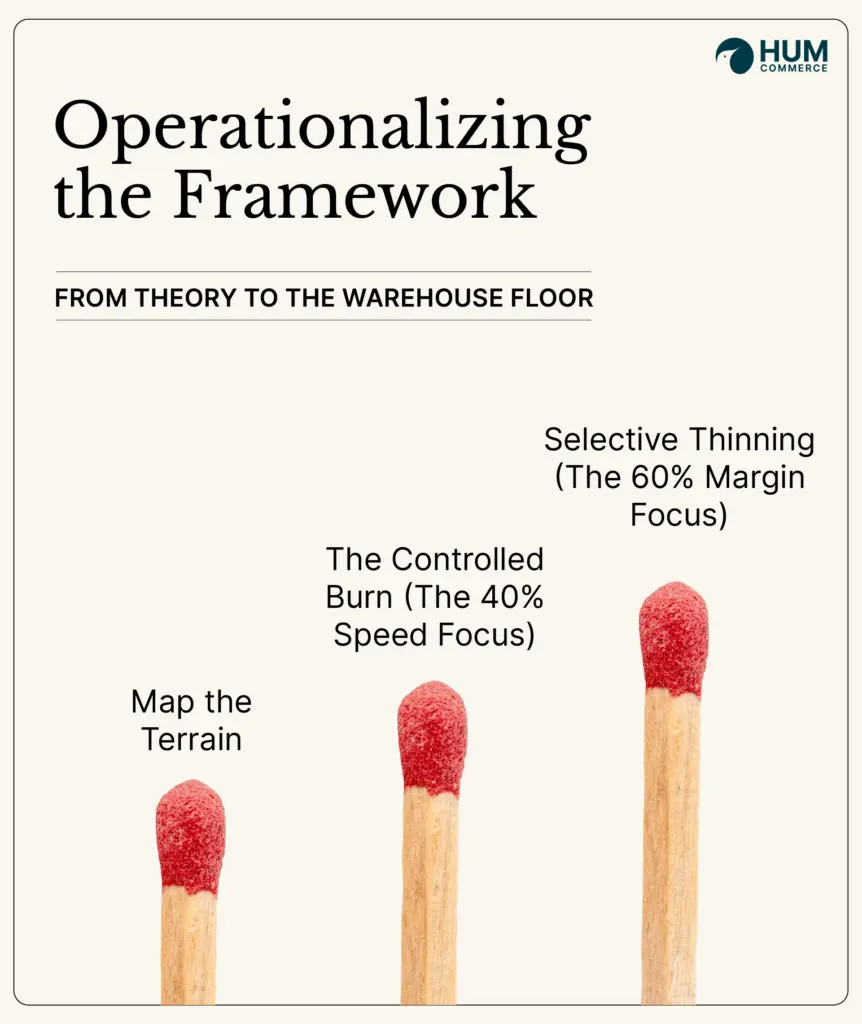
Operationalizing the Framework: From Theory to the Warehouse Floor
This model only works if it’s driven by data, not by who yells loudest in the quarterly planning meeting. It requires tight integration between your ERP and B2B commerce platform, turning operational data into actionable strategy.
Step 1: Map the Terrain
A fire ecologist starts with a map. Your ERP is that map. Segment every aging SKU (anything over 120 days) by more than age. Analyze through three lenses:
- Margin Class: A-class (high margin), B-class, or C-class (low margin)?
- Strategic Importance: Critical service part? Contractually tied to a key account?
- Customer Data: Who bought this before? Are they top-tier?
This analysis, automated in any modern system, separates your “dry underbrush” from “old-growth timber.”
Step 2: The Controlled Burn (The 40% Speed Focus)
For C-class, obsolete stock which is the fuel feeding your carrying costs:
Set the Perimeter: Never do this on your main website. Create a private, login-only “Outlet Portal.” This contains the burn and prevents brand damage. It frames the discount as a partner reward, not desperation.
Create Urgency with Automation: A static discount is lazy. Configure your portal to offer 30% for 15 days, then auto-shift to 40% for the next 15. This encourages action without manual intervention.
Leverage the Bulk Deal: B2B buyers think in pallets, not units. Offer an additional 10% for buyers who take the entire remaining lot. This clears warehouse space and generates cash in one transaction.
Step 3: Selective Thinning (The 60% Margin Focus)
For valuable timber, you don’t use fire. You use a scalpel.
No Public Discounts. Ever. These items never see the outlet portal. Their perceived value must be preserved.
Sales-Led Approach: This is a job for your best reps, armed with CRM data. Generate a list of customers who previously bought these items. The conversation isn’t a pitch; it’s a strategic consultation.
Frame as Value-Add: The script is not, “We have old stock.” It is, “I was reviewing your account and saw you’re still running the X-5000 series. I have access to limited stock of the original upgrade kits. I can secure them at your contract price to ensure your fleet’s longevity.” This is partnership, not clearance.
A Healthier Business
The outcome of a controlled burn is a rejuvenated forest floor, ready for new growth. The outcome of a disciplined 60/40 strategy is the same: stronger cash flow, protected margins, healthier balance sheet. In my experience, a 30-40% reduction in carrying costs is achievable within two quarters, while preserving over 85% of margin on strategic stock.
The choice is clear. You can continue the “Smokey Bear” policy, waiting for the inevitable wildfire of a market downturn to force a catastrophic fire sale. Or you can adopt the fire ecologist mindset, using small, strategic, data-driven interventions to ensure long-term business health.
This isn’t about revolutionary tools. It’s about applying a more intelligent framework to the tools you already have. After all, sometimes the biggest lag isn’t the technology, but the thinking.
What’s your approach to this challenge? I’m interested to hear from others in the trenches.