TL;DR
- When comparing akeneo vs salsify vs pimcore for your Adobe Commerce store, choosing the wrong PIM platform costs six figures.
- Akeneo is best for marketing teams managing 50K-500K SKUs who want fast implementation without paying enterprise prices. $25K-$75K annually
- Salsify is for retail syndication to Amazon, Walmart, and major channels. Overkill for pure B2B. $100K+ annually
- Pimcore if for maximum flexibility, lowest TCO for technical teams. Includes DAM + MDM in every edition. Free to $30K annually
- How to choose: Start with your technical reality, then look at your channel mix and finally, assess data complexity. Use our comparison sheet to score each platform against your requirements.
In 2024, a Midwest building materials supplier lost an entire weekend to a tariff change.
A Friday afternoon policy shift meant every quote they’d sent that week was suddenly wrong.
Their team scrambled to manually update thousands of SKUs, call back customers and redo calculations that should have taken minutes. By Monday, two major accounts had moved on.
The problem was the product data.
Their PIM couldn’t sync with their ERP, their pricing logic lived in spreadsheets and their Adobe Commerce store displayed numbers that were already obsolete.
This is what happens when product data management systems fail in B2B – just a slow, expensive bleed.
If you’re evaluating Akeneo vs Salsify vs Pimcore for your Adobe Commerce store, you’re probably already feeling the pain.
Maybe it’s the 30 hours your team spends every week on manual data entry.
Maybe it’s the pricing errors that cost you two accounts this quarter.
Maybe it’s the product launch that took three months when it should have taken three weeks.
This blog will walk through the three problems that actually matter for B2B catalog management and show you how each platform solves them differently.
By the end, you’ll know which PIM fits your reality.
Akeneo Alternatives for B2B Adobe Commerce Catalogs
If Akeneo does not fit, the realistic alternatives for a B2B catalog
are Salsify, Pimcore, and Inriver. Salsify costs more and is built for
retail syndication. Pimcore costs less and gives you full control over
data modeling, with DAM and MDM built in. Inriver sits closer to
Salsify in price and complexity but is built with manufacturers and
distributors in mind. See the head to head breakdowns below.
The Three Problems That Actually Matter
Before we compare platforms, let’s be clear about what we’re solving. Every B2B company evaluating product data management systems is fighting one of three battles.
Problem one: keeping product data accurate across every channel.
Your catalog lives in multiple places – Adobe Commerce, your ERP, your sales portal, maybe Amazon or a distributor network. When those systems don’t talk to each other, you get conflicting prices, wrong specs, and customers who stop trusting you.
Problem two: automating listings for marketplaces and B2B platforms.
Manual data entry doesn’t scale. When you’re managing 50,000 SKUs across five channels, every product update becomes a project. Every new marketplace becomes a six-month initiative.
Problem three: smarter media management with PIM and DAM sync.
Product images and documents are just as important as specifications. But when your digital assets live in a different system than your product data, you end up uploading the same image twelve times to twelve different places.
According to Akeneo’s 2024 B2B survey, 99% of business leaders said their organization faced at least one major product information challenge in the past year. Forty percent still rely on manual processes to ensure data consistency.
Let’s see how each platform addresses these challenges.
Akeneo’s Marketplace Story: Built for Retail, Adapted for B2B
Akeneo built its reputation on doing one thing well: product information management. It’s a dedicated PIM and it shows.
How Akeneo solves data accuracy
Akeneo’s entire architecture revolves around creating a single source of truth. Every product, attribute, translation flows through one system. When something changes, it changes everywhere.
The platform includes a data quality scoring dashboard that tells you exactly where your catalog has gaps. Missing descriptions, incomplete specifications, images that don’t meet your standards. You see everything at a glance.
For Adobe Commerce integration, Akeneo’s connector fetches data via API and inserts it directly into your database. This approach enables fast imports without site outages which is crucial when you’re managing large catalogs during business hours.
The only catch is that for catalogs exceeding 250,000 SKUs, you’ll need cron-based sync jobs with delta detection and fallback queues. The connector works well out of the box for mid-size catalogs. At enterprise scale, expect some custom middleware.
How Akeneo solves marketplace automation
Akeneo connects to over 200 apps and channels through its marketplace. You can push product data to Amazon, your distributor portal, and your print catalog from the same source.
Akeneo was originally built with consumer brands in mind. Its syndication capabilities are strong but they’re optimized for retail channels. If you’re syndicating primarily to B2B platforms and distributor networks, you may need additional connectors or custom integrations.
How Akeneo handles media management
This is where Akeneo shows its edges. The Asset Manager – available in Enterprise and Serenity editions – handles digital assets within the same platform as your product data. But in the Community and Growth editions, DAM capabilities are limited.
If rich media management is critical to your operation, make sure you’re budgeting for an enterprise-tier license or planning to integrate a separate DAM system.
Who should choose Akeneo
Akeneo makes sense when you need a pure PIM without the complexity of an all-in-one platform. If your marketing team will be the primary users, they’ll appreciate the intuitive interface. If you’re running 50,000 to 500,000 SKUs with moderate complexity, Akeneo hits the sweet spot.

Expect to pay $25,000 to $75,000 annually for Growth or Enterprise tiers plus implementation costs of $30,000 to $75,000 depending on complexity.
Who Needs Salsify (And Who Doesn’t)
Salsify doesn’t call itself a PIM, it calls itself a Product Experience Management platform and this distinction matters.
Where Akeneo focuses on managing product information, Salsify focuses on activating it – getting your products onto retail shelves, digital and physical, as quickly as possible.
How Salsify solves data accuracy
Salsify takes a different approach to the “single source of truth” problem. Instead of forcing everything into one model, it allows you to create what it calls “more than one source of truth” for different use cases.
In practice, it acknowledges a reality many B2B companies face that the product information your retail partners need isn’t identical to what your B2B buyers need. Salsify lets you maintain those variations without duplicating work.
The platform’s governance tools are sophisticated. Workflow automation ensures changes go through proper approval chains, real-time syndication means updates propagate to channels immediately.
How Salsify solves marketplace automation
This is Salsify’s core strength.
If you sell through Amazon, Walmart, Target, or other major retail channels, Salsify’s one-click syndication is unmatched. The platform has direct connections to over forty retail networks and can push product content changes automatically.
Salsify customers have uploaded 2.3 million SKUs via the Walmart API alone.
But (and this is important for B2B companies) Salsify was built for consumer packaged goods. Its retail syndication capabilities are designed for brands selling through major retailers which means if your primary channels are B2B platforms, distributor portals and direct sales, you’re paying for capabilities you may not use.
The Adobe Commerce connector, built through a partnership with Avionos, works well for D2C and hybrid models. It automatically syncs product content changes and supports both variant and simple product types.
How Salsify handles media management
Salsify includes native DAM capabilities within its PXM platform. Digital assets sync with product data seamlessly. For brands managing extensive image libraries across multiple channels, this integration reduces the manual effort significantly.
The Enhanced Content module goes further, enabling rich product pages with embedded video, comparison charts, and interactive elements, all managed centrally.
Who should choose Salsify
Salsify is the right choice when retail syndication is a primary requirement. If you’re a CPG brand or a company selling through major retail channels, Salsify’s direct connections justify the investment.
Be prepared for enterprise pricing. License costs typically start at $50,000 annually and can exceed $150,000 for complex implementations. Implementation often requires professional services, which adds to the total investment.
For pure B2B industrial or manufacturing companies, Salsify may be more platform than you need.
We’ve built a detailed comparison spreadsheet covering all three platforms across fifteen criteria.
Pimcore: When You Need to Build Your Own Data Universe
Pimcore takes a fundamentally different approach. It’s a digital experience platform that includes PIM, Master Data Management, Digital Asset Management, a CMS, and a CDP, all built on an open-source foundation.
It definitely is complex but for companies with sophisticated data needs and technical resources, Pimcore offers flexibility that proprietary platforms can’t match.
How Pimcore solves data accuracy
Pimcore’s data modeling capabilities are essentially unlimited, where Akeneo and Salsify impose structure, Pimcore lets you design your own.
Need to manage not just products but also suppliers, locations, customers, and the relationships between them? Pimcore’s MDM capabilities handle that.
Need custom attributes that don’t fit neatly into standard PIM taxonomies? Build them.
For Adobe Commerce integration, Pimcore supports real-time synchronization triggered on publish.
When a product changes in Pimcore, it can push to Adobe Commerce immediately.
The architecture supports millions of SKUs and complex data structures but this power comes with responsibility. Pimcore is “developer-heavy,” requiring PHP and Symfony expertise to implement and customize.
How Pimcore solves marketplace automation
Pimcore takes an API-first approach with over 700 endpoints available for integrating with external systems. You can connect to any marketplace or platform that offers an API.
What you won’t get is Salsify’s one-click syndication to retail networks, Pimcore expects you to build those connections or work with an implementation partner who can.
For B2B companies distributing primarily through their own channels, this isn’t a limitation. For companies that need plug-and-play retail connections, it’s a gap.
How Pimcore handles media management
Here’s where Pimcore stands apart. Digital Asset Management is included in every edition including the free Community Edition.
Product data and digital assets live in the same platform, managed by the same workflows, secured by the same permissions.
For B2B companies managing extensive product documentation – spec sheets, CAD files, compliance certificates, installation guides- this native integration eliminates a category of headaches.
Who should choose Pimcore
Pimcore fits when you need flexibility above all else.
If your data structures don’t fit neatly into standard PIM models, Pimcore lets you build what you need.
If your technical team has the capabilities to customize an open-source platform, Pimcore offers the lowest total cost of ownership.
The Community Edition is free for companies under €5 million in revenue. Professional licenses start at $9,900 annually. Enterprise licenses run $29,900 per year.
Implementation takes longer than Akeneo typically 17 to 34 weeks versus 10 to 20 weeks because you’re making more decisions about architecture and customization.
Akeneo vs Salsify vs Pimcore: Feature & Pricing Comparison
Feature / Criteria Akeneo Salsify Pimcore Primary Use Case Dedicated PIM for marketing teams Product Experience Management (PXM) & Retail Syndication Open-Source PIM + DAM + MDM + CDP Best For Catalogs with 50K–500K SKUs CPG & Brands selling via Amazon/Walmart Highly technical teams needing custom data models Adobe Commerce Fit Native API connector; fast onboarding Direct API connector (via Avionos partner) Real-time sync via API (PHP/Symfony expertise required) Annual License Cost $25,000 – $75,000 $100,000+ Free (Community) to $29,900 (Enterprise) Implementation Time 10 – 20 weeks 12 – 24 weeks 17 – 34 weeks
Akeneo vs Salsify: Quick Verdict
If your team needs a dedicated PIM without a big price tag, Akeneo wins.
Growth and Enterprise tiers run $25,000 to $75,000 a year, and marketing
teams can manage it without heavy technical support.
Salsify makes sense only if retail syndication is the priority. Selling
through Amazon, Walmart, or similar networks justifies the $100,000 plus
price tag. For a pure B2B catalog sold through your own store and
distributor portals, Salsify is more platform than most companies need.
Pimcore vs Salsify: Quick Verdict
Pimcore and Salsify solve different problems. Salsify is built to push
product content to retail channels fast. Pimcore is built to model
complex product, supplier, and customer data any way you need, with
DAM and MDM included in every edition, even the free Community tier.
If your business sells B2B through your own channels and your data
structures do not fit a standard PIM model, Pimcore gives you more
control at a fraction of Salsify’s cost. If you need one click
syndication to major retailers, Salsify still leads.
Akeneo vs Inriver: What B2B Teams Should Know
Inriver is an enterprise SaaS PIM built for syndication heavy brands,
often MACH certified, and aimed at manufacturers with a large retailer
network. It sits above Akeneo in price and implementation complexity.
Akeneo remains the better fit for catalogs between 50,000 and 500,000
SKUs where a marketing team needs to manage the platform directly.
Inriver makes sense when syndication to a wide retailer network matters
more than ease of use.
Salsify vs Inriver
Both are enterprise platforms built for brands syndicating to retail
networks. Salsify leans toward CPG and consumer brands with deep retail
integrations. Inriver leans toward manufacturers and distributors that
need MACH certified architecture and multichannel syndication without
Salsify’s consumer retail focus. Neither is built for a company that
sells primarily through its own Adobe Commerce store.
Akeneo Pricing in 2026
Growth and Enterprise tiers run $25,000 to $75,000 annually. Add
$30,000 to $75,000 for implementation depending on catalog complexity
and how much custom middleware your team needs for high volume syncs.
Making the Decision: A Framework
After guiding clients through Akeneo vs Salsify vs Pimcore evaluations for Adobe Commerce, here is how we approach the decision framework.
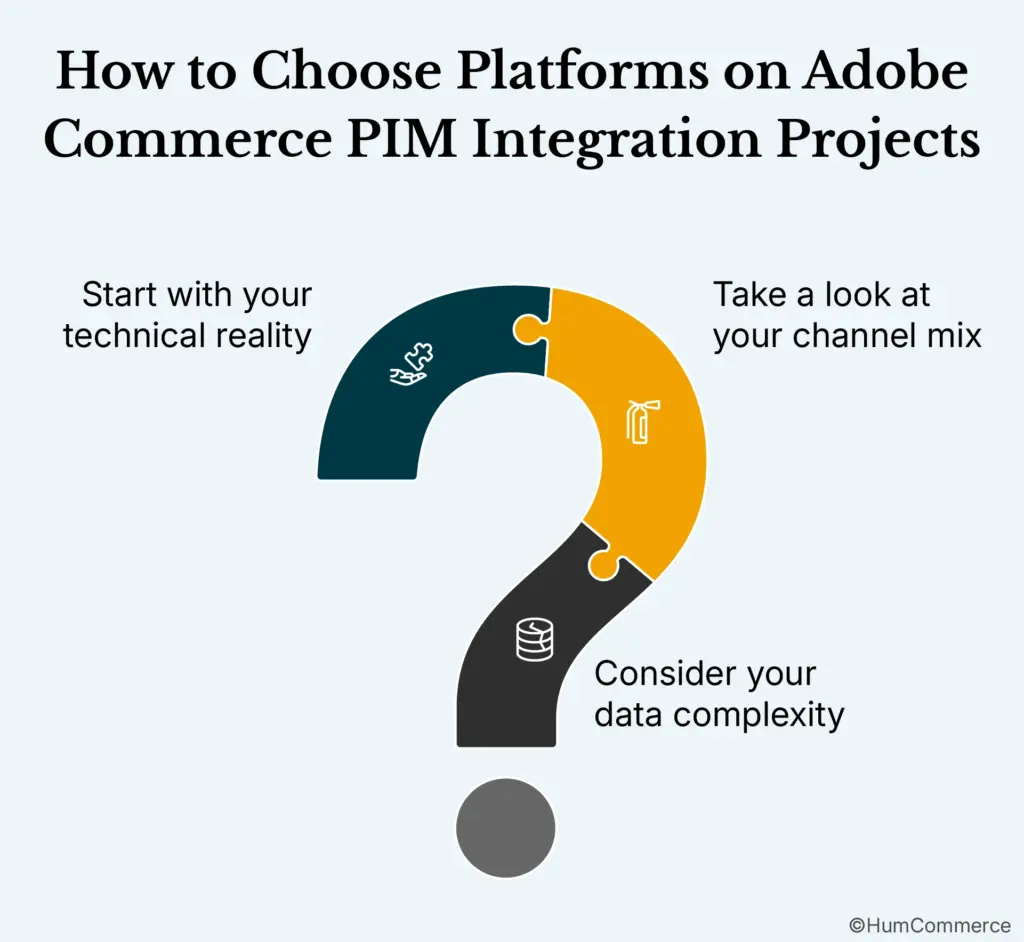
Start with your technical reality
Do you have developers who can work with PHP and Symfony? If not, Pimcore’s flexibility becomes a liability, you’ll need an implementation partner for everything which erodes the cost advantage.
Do you need something your team can manage without constant technical support? Akeneo’s user-friendly interface was built for marketing teams, Salsify’s workflow automation reduces the need for technical intervention.
Then look at your channel mix
Selling primarily through Amazon, Walmart, and major retail networks? Salsify’s syndication capabilities are worth the premium.
Selling primarily B2B through your own Adobe Commerce store and distributor portals? Akeneo or Pimcore will serve you better without paying for retail syndication you don’t need.
Selling through a mix of channels that require custom integration? Pimcore’s API-first architecture gives you more control.
Finally, consider your data complexity
Managing just products? Any of these platforms will work.
Managing products, suppliers, customer segments, and complex relationships between them? Pimcore’s MDM capabilities handle scenarios that would require workarounds in Akeneo or Salsify.
Need rich media management without paying enterprise prices? Pimcore includes DAM in every edition.
What the Research Shows and What It Means
The numbers paint a clear picture of why this decision matters.
According to Gartner, poor data quality costs organizations an average of $12.9 million annually. A Forrester study found that 66% of B2B companies have “poor” data quality, with 83% reporting that their data is incomplete, inconsistent, inaccurate, or outdated.
96% of companies surveyed by Forrester said they cannot make their entire product portfolio available online due to data limitations.
This is a business problem, every product that’s not online is a product that’s not selling.
The research also shows what happens when companies get PIM right. Implementation done well delivers ROI within 12 to 24 months, companies report 70% faster time-to-market for new products, manual data management tasks that took weeks compress into minutes.
But 70% of PIM implementations fail to meet their objectives because companies choose the wrong platform for their needs, underestimate implementation complexity, or fail to secure organizational commitment.
The Implementation Truth No One Talks About
Here’s something vendor demos won’t show you.
Akeneo: SaaS deployments enforce API rate limiting.
If you’re running high-volume syncs with hundreds of thousands of SKUs, you’ll need to design around those limits. The connector uses SQL insertion for speed, which means standard Magento observers won’t fire during import. Any custom logic that depends on those events needs to be handled differently.
Salsify: Implementation often requires professional services that aren’t included in the license price. Support response times can stretch to two to three days. The platform is powerful, but getting that power configured for your specific needs takes time and expertise usually from Salsify’s consulting team.
Pimcore: The learning curve is real.
Your team needs PHP and Symfony capabilities, or you need an implementation partner who does. Native reporting is basic; anything beyond standard metrics requires custom development. The flexibility that makes Pimcore powerful also means more decisions, more development, more time to production.
None of these are dealbreakers. All of them are realities you should plan for.
Evaluating Akeneo vs Salsify vs Pimcore: Which Path Fits Your Business
Choose Akeneo when you want a dedicated PIM that your marketing team can manage, you’re running 50,000 to 500,000 SKUs, and you prioritize speed to value over unlimited customization.
Choose Salsify when retail syndication is critical to your business, you sell through major retail channels, and you can invest at the enterprise level – $100,000 or more annually.
Choose Pimcore when you need PIM plus DAM plus MDM in one platform, your data structures require custom modeling, you have technical resources for development, and you want the lowest total cost of ownership.
The best PIM for Magento isn’t the one with the most features. It’s the one that matches your technical capabilities, fits your channel strategy, and solves the specific problems that are costing you money today.
Next Steps
We’ve built a detailed comparison spreadsheet covering all three platforms across fifteen criteria – connector capabilities, pricing tiers, implementation requirements, and more.
Use it to score each platform against your specific requirements, share it with your team and make a decision you can defend.
And if you want help evaluating which platform fits your Adobe Commerce deployment, that’s what we do. HumCommerce has implemented all three platforms across catalogs ranging from 10,000 to over 1 million SKUs. We’ll tell you what actually works, not what the vendor wants you to believe.Managing complex B2B catalogs on Adobe Commerce shouldn’t require spreadsheet heroics. The right PIM integration turns product data from a liability into a competitive advantage. Choose wisely.