Key Takeaways
- Implementing AI Demand Forecasting in B2B Supply Chains can push forecast accuracy from 65–70% to 85–90%, cutting inventory costs by 20–25%.
- But 40% of projects fail because five prerequisites are missing: 18+ months of clean SKU-level data, 90%+ data quality, forecastable demand patterns (CV <1.5), real-time API integration, and teams that trust the output.
- This guide shows you how to test your readiness before you sign anything.
Your team has demand planners. You’ve invested in forecasting software. You’ve got dashboards lighting up with more metrics than anyone can reasonably look at in a day.
And still, you’re sitting on roughly $4.2 million in slow‑moving inventory while your top A‑items stock out every week. Buyers are constantly expediting. Finance is frustrated about cash trapped in dead stock. Sales is sick of saying, “Sorry, we’re out again.” Sound familiar? Successfully navigating these complex distribution environments relies heavily on modern ai demand forecasting in b2b supply chains.
The vendors who sold you “AI forecasting” never mentioned that a large share of implementations fail, not because the algorithms are bad, but because five foundational prerequisites weren’t in place when you signed.
The issue usually isn’t effort or work ethic. It’s the underlying architecture of how forecasting is done. Traditional approaches – moving averages, simple regression, basic time‑series models – tend to stall out around 60–75% accuracy once you’re dealing with complex B2B demand. Modern machine learning can push that into the 80–92% range, but here’s the catch most vendors gloss over: a big share of AI forecasting programs never make it to real ROI because the foundations aren’t ready.
Research from firms like McKinsey and APICS points to what “good” looks like: 20–30% lower inventory and double‑digit improvements in fill rates when machine learning is implemented well. The same research also shows the dark side when data quality drops below about 85%, failure rates jump dramatically, and projects stall out before the business ever sees value. One industrial distributor quantified the impact: at roughly 68% forecast accuracy, they were tying up about $4.2 million in inventory they couldn’t turn fast enough.
That’s why the real question isn’t “Should we use AI for demand forecasting?” It’s “Are we actually ready for it?” The answer comes down to five concrete prerequisites that largely determine whether you get that 20–25% inventory reduction or end up with an expensive lesson in what doesn’t work.
AI Demand Forecasting in B2B Supply Chains: Why It Fails Where Retail Succeeds
Most AI forecasting content focuses on retail and e-commerce. Target optimizing seasonal apparel inventory. Amazon predicting consumer electronics demand. Walmart managing 50,000 SKUs with relatively smooth, predictable patterns.
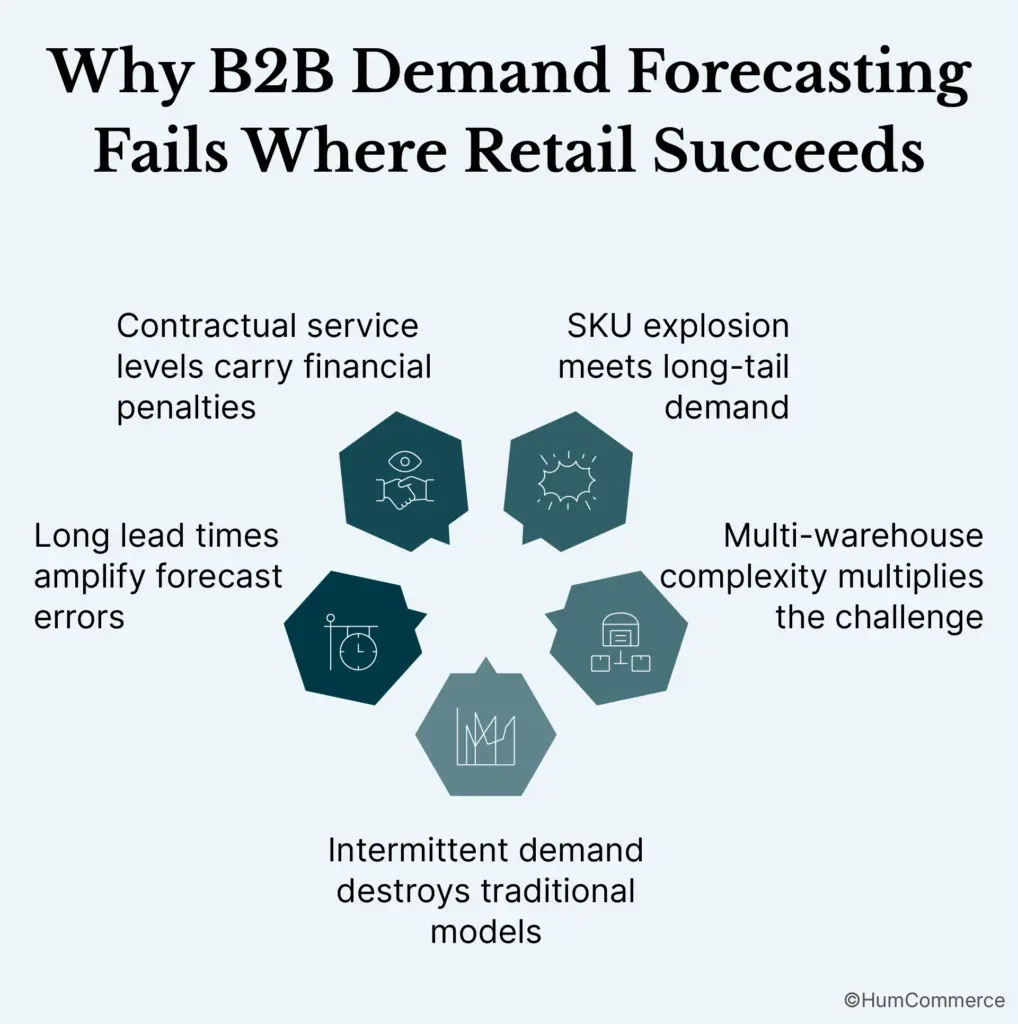
B2B operates in an entirely different dimension of complexity.
SKU explosion meets long-tail demand.
Retail manages 5,000-50,000 SKUs with concentrated demand (80/20 rule applies cleanly). B2B industrial distributors manage 100,000 to over 1 million SKUs, where 40-60% exhibit intermittent or lumpy demand patterns – weeks of zero orders followed by sudden spikes. HumCommerce clients routinely handle 1M+ SKUs via integrated PIM systems, where traditional forecasting simply breaks down.
Multi-warehouse complexity multiplies the challenge.
Forecasting aggregate demand is hard. Forecasting where that demand materializes across six regional warehouses is exponentially harder. One automotive distributor discovered their aggregate forecast hit 72% accuracy, but per-location forecasting improved accuracy to 87% – the difference between efficient regional stocking and constant emergency transfers.
Intermittent demand destroys traditional models.
Research shows B2B SKUs split roughly into three categories: 40% smooth demand (regular, predictable), 35% intermittent (sparse, irregular intervals), and 25% lumpy (high variability plus irregular timing). Standard ARIMA or exponential smoothing models trained on retail data fail catastrophically on intermittent patterns. You need specialized algorithms – Croston’s method, Syntetos-Boylan Approximation, that most “AI forecasting” vendors don’t even support.
Long lead times amplify forecast errors.
Building materials arrive in 4-12 weeks. Heavy equipment components take 8-16 weeks. In these scenarios, lead time variability often contributes 2x more forecast error than demand variability itself. Consumer goods with 2-3 day lead times tolerate forecast mistakes. Industrial B2B cannot.
Contractual service levels carry financial penalties.
Fill rates aren’t convenience metrics, they’re tied to contract performance, relationship risk, and account retention. One manufacturer calculated that improving from 95% to 98% fill rate protected $800,000 in annual revenue by avoiding contract penalties and preventing key account defection. When procurement managers expect 98% availability and you deliver 92%, they switch suppliers.
Before AI can address this complexity, you need to pass five diagnostic tests. Most companies fail at least three of them.
5 Prerequisites that Determine Whether AI Demand Forecasting Delivers Inventory Reduction
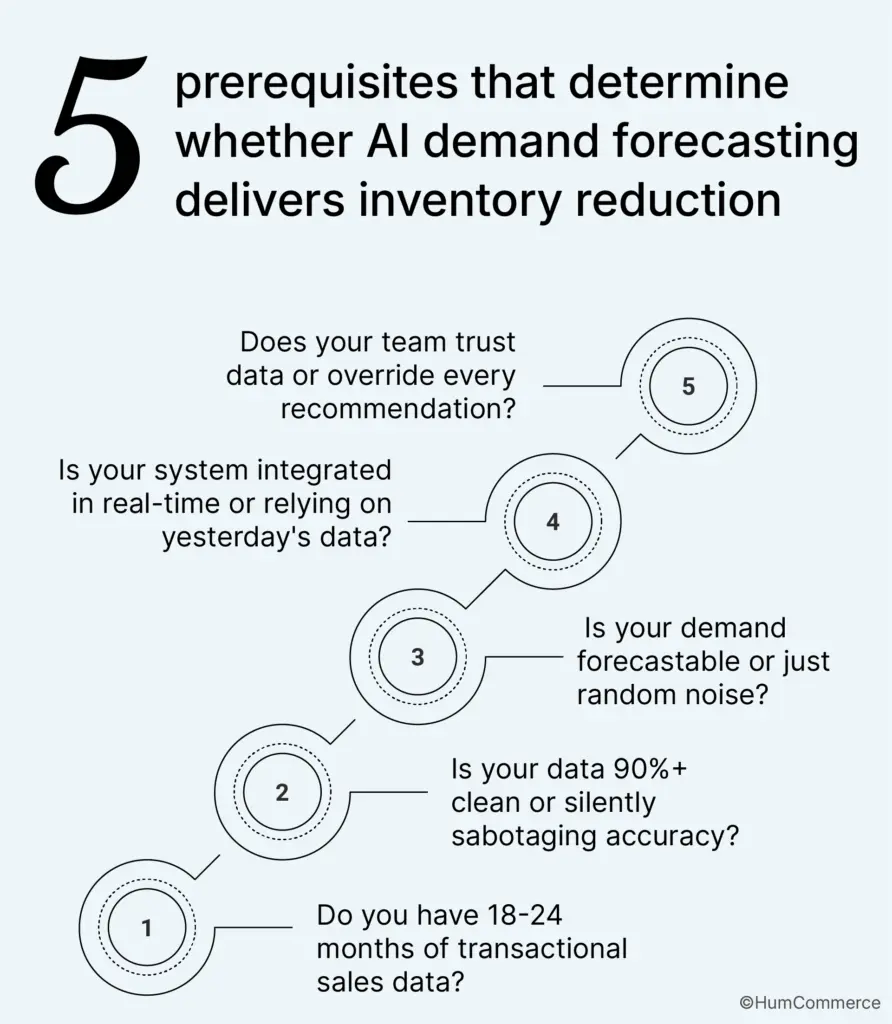
Prerequisite #1: Do You Have 18-24 Months of Transactional Sales Data?
Open your ERP or data warehouse right now. Filter by SKU-level transaction history. Can you see 18 months of granular, date-stamped records?
Transactional data: SKU identifier, quantity, transaction date, customer segment, price point, and for multi-warehouse operations, location code.
Machine learning algorithms require 18-24 months minimum to recognize seasonal patterns, with 36+ months ideal for capturing full business cycles. MIT research confirms time-series algorithms need at minimum 1.5x the seasonal cycle length to reliably detect patterns. If your business has annual seasonality, 12 months of data isn’t enough, the model can’t distinguish between trend, seasonality, and noise.
The data volume gap often hides in plain sight. Companies tell vendors, “We have five years of sales history,” pointing to annual or monthly reports in their business intelligence system. But when you drill down to SKU-level transactions with all required fields, suddenly only 8-12 months exist. The rest is aggregated, summarized, or missing critical dimensions like customer segment or location.
If you don’t have 18-24 months of clean, granular transactional data, stop here. Fix this first. Having clean records is the foundation for effective ai demand forecasting in b2b supply chains. No algorithm, no matter how sophisticated, can extract patterns that don’t exist in your dataset.
Prerequisite #2: Is Your Data 90%+ Clean Or Silently Sabotaging Accuracy?
Data volume means nothing if the data is garbage.
ML algorithms are pickier than traditional forecasting methods. When a human planner sees ‘VALVE-001’ in one system and ‘Valve001’ in another, they recognize it’s the same product. Machine learning treats them as two completely different SKUs, splitting the demand history, diluting the signal, and training separate models on fragmented data.
A chemical distributor ran a data quality audit before implementing AI forecasting. They discovered 34% of SKU records had inconsistencies: duplicate entries with slightly different naming, missing customer segment tags, incomplete price histories, transactions without location codes. They spent four months on data cleanup – standardizing SKU identifiers, enriching customer segments, filling price gaps – before training a single model.
The result? 24% inventory cost reduction within a year of implementation.
Gartner research shows companies with less than 85% data quality experience 3x higher ML project failure rates. That’s not “somewhat worse results”, that’s projects abandoned, budgets wasted, and credibility damaged.
The 90%+ clean data threshold requires:
Complete records. No missing dates, quantities, or SKU identifiers. Every transaction needs all fields populated.
Zero duplicate SKUs. Consistent naming conventions across all systems. ‘PART-12345’ doesn’t coexist with ‘Part 12345’ or ‘PART12345’.
Consistent customer segmentation. If you forecast by segment (commercial vs. industrial, new vs. repeat customers), tagging must be applied consistently across the entire history.
Complete price point history. Promotional pricing, volume discounts, contract-specific pricing all logged accurately. Gaps in price history break causal models that try to explain demand spikes from pricing changes.
Accurate location data for multi-warehouse operations. If 15% of your transactions are missing warehouse codes, per-location forecasting becomes impossible.
Run a data quality report. Calculate what percentage of your SKU records have complete, accurate data across all required fields. Poor data quality undermines any attempt at ai demand forecasting in b2b supply chains. If it’s below 90%, you’re not ready for ML forecasting. You’re ready for a data cleanup project.
Prerequisite #3: Is Your Demand Forecastable Or Just Random Noise?
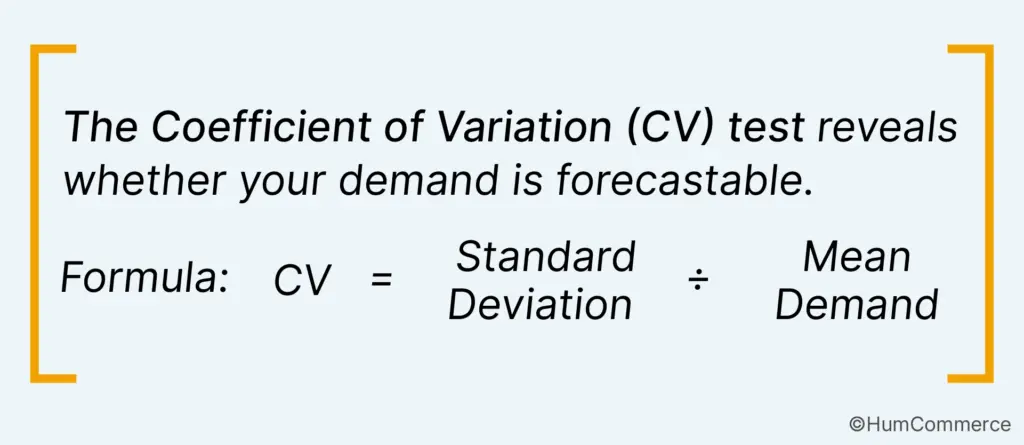
Not all demand is created equal. Machine learning requires repeating patterns – seasonal cycles, customer reorder rhythms, promotional effects. What ML cannot forecast is true randomness: project-based custom orders with zero historical precedent, one-off emergency purchases, disruptions with no pattern.
Interpretation:
- CV < 1.0: Low variability, highly forecastable (smooth demand)
- CV 1.0-1.5: Moderate variability, forecastable with advanced methods
- CV > 1.5: High volatility, challenging (requires specialized approaches or accept limitations)
But CV alone doesn’t tell the full story. The Syntetos-Boylan demand classification framework adds a second dimension: ADI (Average Demand Interval) – how often demand actually occurs.
Industries with naturally forecastable demand – industrial supply with recurring maintenance orders, automotive aftermarket driven by wear-and-tear patterns, building materials tied to construction seasonality – see the best ML results. Industries with project-driven, custom manufacturing or rapid product obsolescence struggle unless they segment carefully.humcommerce+2
Calculate CV for your top 100 SKUs by revenue. What percentage have CV below 1.5? That’s your forecastable base – Evaluating demand variability is a critical step in ai demand forecasting in b2b supply chains. the portion where ML will deliver results. Don’t waste effort applying AI to SKUs that are fundamentally unpredictable.
Prerequisite #4: Is Your System Integrated in Real-Time Or Relying on Yesterday’s Data?
AI demand forecasting isn’t standalone software. It’s a layer that requires real-time bidirectional integration across your ERP, PIM, and eCommerce systems.
Real-time matters more than most companies realize.
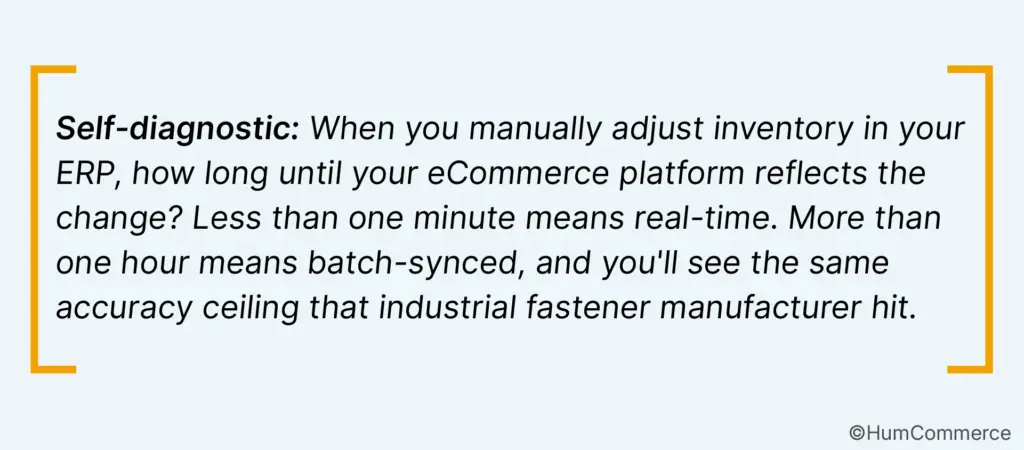
They upgraded to real-time API integration – sub-second queries pulling current inventory, open POs, and supplier lead times. The same ML models with the same historical data now achieved 89% accuracy.
Why? Because the model could react to same-day stockouts, adjust safety stock dynamically when supplier delays occurred, and incorporate intraday demand signals that batch-synced systems miss entirely. The accuracy improvement protected $480,000-$780,000 annually in margin by preventing overselling, expediting costs, and lost orders.
ML forecasting requires real-time data from:
ERP: Current inventory levels across all locations, supplier lead times, cost data, open purchase orders, inbound shipments in transit.
PIM: Product attributes, category hierarchies, substitution rules (which SKUs can replace out-of-stock items), product lifecycle status.
eCommerce platform: Customer search behavior, cart abandonment patterns, wish list adds, pricing viewed, all leading indicators of future demand.
The integration must be bidirectional. Forecasts generated by ML engines must flow back to ERP automatically, updating reorder points, triggering purchase requisitions, adjusting safety stock targets. If your “integration” means exporting a CSV file and emailing it to procurement, you don’t have integration, you have a manual process with extra steps. Real-time data feeds are essential for ai demand forecasting in b2b supply chains.
HumCommerce’s work with an automotive manufacturer illustrates the architecture: Adobe Commerce (frontend eCommerce) connects via real-time API to an AI forecasting engine, which simultaneously queries Epicor CPQ (for pricing and configuration rules) and SAP MM/SD (for inventory and order data) plus Akeneo PIM (for product hierarchies and substitution logic). All data flows are event-driven, sub-second response times, enabling 100% real-time quoting accuracy across six warehouses.
Prerequisite #5: Does Your Team Trust Data Or Override Every Recommendation?
An electrical distributor implemented technically sound ML forecasting. Models trained on clean data, real-time integration working perfectly, forecast accuracy validated at 85% in testing.
Six months post-launch, business results: zero inventory reduction. Fill rates unchanged. Working capital still tied up.
The problem wasn’t technology, it was trust. The procurement team, with 15-20 years of “gut feel” ordering experience, looked at ML recommendations and overrode nearly everything. “The model says order 500 units of SKU-12345, but we normally order 250. It must be wrong.” Click. Override. Order 250.
Without execution, forecasts are just interesting numbers in a dashboard.
The company invested in a six-month change management program. They ran A/B tests showing buyers where ML outperformed gut feel (spoiler: most of the time). Trained procurement teams to interpret confidence intervals and probabilistic forecasts. Created an exception workflow: overrides allowed, but buyers must log the reason capturing institutional knowledge the models can learn from. Overcoming planner bias is vital when rolling out ai demand forecasting in b2b supply chains.
Successful implementations require cross-functional buy-in:
Supply chain/demand planners tune model parameters, review exceptions, analyze forecast errors to improve accuracy over time.
Procurement teams must trust ML recommendations enough to execute, or at least follow a disciplined override process that feeds learning back to the models.
Finance approves inventory investment shifts. ML may recommend holding 30% more safety stock on high-value, fast-moving items while cutting 60% on slow movers. Finance needs to understand the working capital reallocation, not just see a budget increase request.
Sales provides promotional calendars, new product launch timelines, and market intelligence that external data can’t capture. When sales knows a major customer is launching a new facility in Q3, that context matters for forecasting their component orders.
If your ML system recommended increasing safety stock 30% on your top SKU tomorrow, would procurement execute the order, or override it and purchase the “normal” amount because “we’ve always ordered this much”? That answer tells you whether you have the organizational readiness for AI forecasting, or whether you need to invest in change management first.
The Question Is If You’re Ready
AI demand forecasting can deliver 20-25% inventory cost reduction and 15-18% fill rate improvements. Research across industries confirms these results are achievable and repeatable.
But 40% of implementations fail because companies skip the prerequisites.
The five diagnostic tests:
- 18-24 months of granular, transactional sales data
- 90%+ clean records with no duplicate SKUs
- Forecastable demand patterns (CV <1.5 for majority of revenue)
- Real-time ERP/PIM integration via API
- Cross-functional organizational buy-in (procurement trusts data)
If you passed 4-5 tests: Start a 90-day pilot with your top 20% SKUs by revenue. Prove value quickly, then scale.
If you passed 2-3 tests: Fix data quality and integration architecture first. Then pilot. Rushing into ML with missing prerequisites is how you join the 40% failure rate.
If you passed 0-1 tests: You’re not ready for AI forecasting yet. Focus on operational fundamentals – clean up your data, upgrade your integration, build cross-functional alignment. Revisit ML in 6-12 months.
The manufacturers, distributors, and wholesalers winning with AI demand forecasting didn’t start with better algorithms. They started with better foundations.
The question facing supply chain leaders isn’t “Should we use AI for demand forecasting?”
It’s “Do we have the prerequisites to make it work or are we about to become another expensive case study in what not to do?”
Mastering ai demand forecasting in b2b supply chains ultimately drives long-term profitability.
The 20-25% inventory reduction is real. The 15-18% fill rate improvement is achievable. But only if you build on the right foundation.
Your 90‑Day Pilot Plan: From Diagnostic to Deployment
This doesn’t need to be a two‑year IT saga. Treat it as a tight, 90‑day experiment designed to prove value on a small but meaningful slice of your business, typically 25–50 SKUs, before you scale.
Days 1–30: Foundation & Pilot Scoping
Week 1 – Run the five readiness checks
You start by answering a few hard questions:
- Do you have at least 18–24 months of transactional data for the SKUs you care about?
- Is your data roughly 90% clean (duplicate SKUs resolved, units consistent, key fields filled in)?
- Are your top SKUs actually forecastable based on CV and basic diagnostics?
- Can your systems talk in close to real time via APIs, or are you stuck with overnight file drops?
- Will procurement and planning teams trust and use a system‑generated recommendation?
You also define success up front: target lift in forecast accuracy (for example, +10–15 percentage points on MAPE), inventory reduction goals on the pilot set, and a service‑level or fill‑rate improvement target.
Week 2 – Get the data in shape
Pull 18–24 months of detailed transactions (orders, shipments, returns) at the SKU level. Run basic data‑quality checks to flag duplicates, missing fields, inconsistent units, and odd outliers. In parallel, map your ERP, PIM, and eCommerce systems and note where integrations are missing or brittle.
Week 3 – Understand your current reality
Segment your catalog using ABC/XYZ logic and calculate CV for your top revenue SKUs. Capture your baseline:
- Current forecast accuracy.
- On‑hand inventory and days of supply.
- Fill rates and backorder frequency.
- Weekly hours spent on manual forecasting, spreadsheet work, and fire drills.
This baseline becomes the “before” picture you’ll compare your pilot against.
Week 4 – Choose the right pilot SKUs
Pick 25–50 SKUs that together represent about 15–20% of revenue and a mix of behaviors:
- High‑velocity A‑items to prove quick, tangible value.
- Seasonal SKUs to test whether the system can handle complexity.
- Intermittent and lumpy items where Croston‑type methods shine.
- Promo‑heavy SKUs to test event and price sensitivity.
You want a pilot that feels meaningful to leadership but small enough that your team can actually pay attention to it.
Days 31–60: Model Deployment & Early Results
Week 5–6 – Deploy and validate the models
Apply the right model to each demand type: time‑series ML for smooth items, Croston‑SBA for intermittent SKUs, causal models for promo‑driven demand. Use out‑of‑sample testing: hold back the last 13 weeks, forecast them using only prior history, and compare to what actually happened. That gives you a fair, apples‑to‑apples comparison with your current process.
Week 7 – Connect to your operational systems
Hook the ML engine into your ERP and related systems with real‑time or near‑real‑time APIs where possible. Data should flow in both directions:
- Inbound: new orders, current inventory, current and promised lead times.
- Outbound: forecasts, recommended reorder points, safety stock targets, and alerts.
Set up exception rules so planners are notified when forecasts or actuals move outside a sensible band, for example, if demand jumps 50% above the previous pattern without an obvious reason.
Week 8 – Go live on the pilot SKUs
Let the system’s forecasts drive reorder suggestions for the pilot group, with planners still in the loop. Hold weekly reviews to look at forecast vs. actual performance, talk through overrides, and track early signals: fewer stockouts, fewer rush orders, and signs of inventory starting to come down on those SKUs.
Days 61–90: Validation, Scaling, and Proving ROI
Week 9–10 – Measure impact versus baseline
Now you quantify. Compare pilot results to the baseline you captured in Week 3:
- Forecast accuracy (are you up 10–15 points on the pilot set?).
- Inventory levels on those SKUs (have you knocked 15–20% off without hurting service?).
- Fill rates or service levels (are they up three to five points?).
- Manual effort (are planners spending less time wrestling spreadsheets and more time making decisions?).
Convert those deltas into dollars: working capital freed, emergency freight avoided, margin protected, and hours saved. That’s your initial ROI story.
Week 11 – Plan the next wave
Assuming the pilot met thresholds, decide which categories or SKUs to onboard next, typically the next 30% of revenue, focusing on high carrying costs or chronic stockout issues. Capture pilot wins and testimonials and use them in training sessions to build confidence with procurement and sales.
Week 12 – Industrialize and govern the process
Set up an automated retraining pipeline (basic MLOps) so models refresh on a schedule instead of only when someone remembers. Establish a simple governance rhythm:
- Monthly demand review meetings that include planners, supply chain, and finance.
- Quarterly model tuning and segmentation refresh.
Document lessons learned and present the combined business case, numbers plus stories, to the executive team as the argument for scaling beyond the pilot.
The leaders who see the best outcomes have a few things in common: they start small instead of trying to flip 10,000 SKUs at once, they aim for “90% clean and improving” instead of waiting for perfect data, and they treat the first 90 days as an iterative learning cycle, not a one‑and‑done implementation.
How ML Algorithms Turn Patterns Into Predictions
Modern ML forecasting pulls from multiple streams – internal transactions, external signals like weather and macro trends, and promotional calendars – then segments SKUs by behavior (smooth, intermittent, lumpy) and matches the right algorithm to each pattern.
Instead of a single-point forecast, you get a distribution (P50, P70, P90) that lets you set safety stock based on service-level targets, and the system retrains regularly using real outcomes and planner overrides so it gets more accurate over time.
See How AI Assist Transforms B2B Support and Sales
HumCommerce AI Assistant is an intelligent B2B chatbot that instantly answers customer questions with the right products, specs, pricing, and stock pulling real-time data from your ERP, PIM, and eCommerce systems.
We’ve helped automotive parts distributors, industrial supply companies, and building materials manufacturers implement the exact prerequisite framework outlined in this guide.
Schedule a 30-minute consultation. We’ll assess your data readiness, discuss integration architecture, and show you how HumCommerce AI Assistant combined with our Analytics services can transform your demand planning.