TLDR
- B2B buyers can’t find products in complex catalogs; keyword search returns hundreds of irrelevant results and they leave to buy from competitors.
- AI-powered discovery (semantic, conversational, and role-aware) gets buyers to the exact product with real-time price and stock in minutes, lifting conversions 20–40%.
- You don’t need a replatform. A focused 30-day sprint fixing zero-result searches and stock visibility can prove ROI and unlock budget for deeper AI.
Last month, 427 B2B buyers searched your eCommerce platform and bought from your competitor instead. Each spent around 11 minutes scrolling through irrelevant results, unable to confirm stock, pricing, or compatibility, and eventually gave up.
Based on a typical mid-market B2B deal size, that silent leakage adds up to roughly $5.4M in lost revenue in a single month without a single complaint logged.
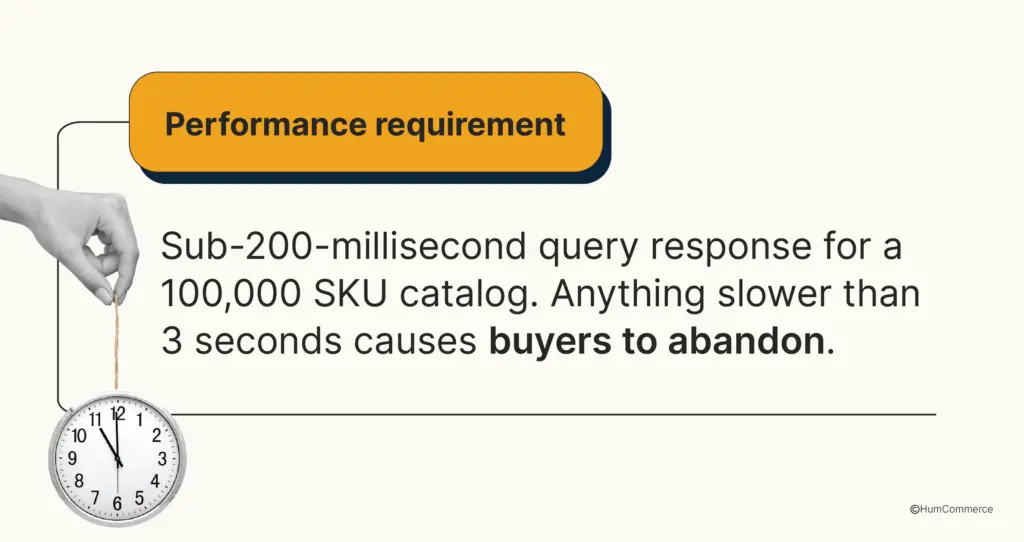
This isn’t a catalog problem. It’s a discovery friction problem: if buyers can’t find what they need in under 3 minutes, you’re not in the consideration set.
Discovery Friction Cost: How to Quantify the Leak
If you want leadership to care, you need a number they can’t ignore.
Discovery Friction Cost (DFC):
DFC = Avg. discovery time on failed sessions × monthly searchers × avg. deal value × historical conversion rate
Example for a typical distributor:
- 11 minutes average discovery time on sessions that don’t convert
- 2,400 buyers/month using search
- 15% zero- or low-relevance search rate
- 12,000 USD average order value
- 12% conversion rate when discovery works
Even with conservative assumptions, you quickly reach seven-figure monthly revenue leaks tied purely to product discovery friction.
Why Traditional Search Breaks Past 50K SKUs
There’s a point in every B2B company’s growth where keyword search stops working.
For most distributors with technical catalogs, that point is 50,000 SKUs.
Below 50K SKUs: Keyword search + good filters = acceptable. Buyers complain but can eventually find products.
At 50K-500K SKUs: Keyword matching becomes probabilistic noise. An industrial parts distributor with 250,000 SKUs saw a query for “bearing” return 43,000 results. Even after three filters, buyers saw 8,000 options. Average discovery time: 14 minutes. Cart abandonment: 30%. Their fix wasn’t “more filters.” It was semantic search that understood intent.
Above 500K SKUs: Browsing is impossible. Part numbers, cross-references, and compatibility tables are too complex for human navigation. AI isn’t optional here, it’s survival.
The 3 Buyers Using Your Search Bar (And What They Actually Need)
Every query in your logs comes from one of three personas, and a one-size-fits-all search experience fails all of them.
- The Engineer: Types “3000 PSI 316 stainless ASME certified.” They’re validating fit and safety, not browsing. They need specs, CAD files, certifications, and compatibility data up front.
- The Procurement Manager: Types “bulk hydraulic pumps, net 60 terms.” They’re optimizing cost and risk. They need contract pricing, volume discounts, payment terms, and total landed cost in one view.
- The Operations Lead: Types “reorder item 78432, check stock.” They’re executing under time pressure. They need real-time inventory, delivery options, and substitutes if stock is low.
A building materials distributor that implemented role-based discovery saw:
- Contractors getting project-ready bundles (materials + fasteners + sealants) and a 22% increase in average order value.
- Architects seeing spec sheets, sustainability certifications, and CAD files up front, cutting time-to-quote by 40%.
- Procurement teams viewing contract pricing, bulk discounts, and auto-routed approvals, driving a 35% lift in self-service orders.
Role-aware search is how you turn a generic search bar into a revenue engine.
What AI-Powered Discovery Actually Does
AI-powered product discovery doesn’t just return “better results.” It changes the entire path from “I think I need something” to “order placed.”
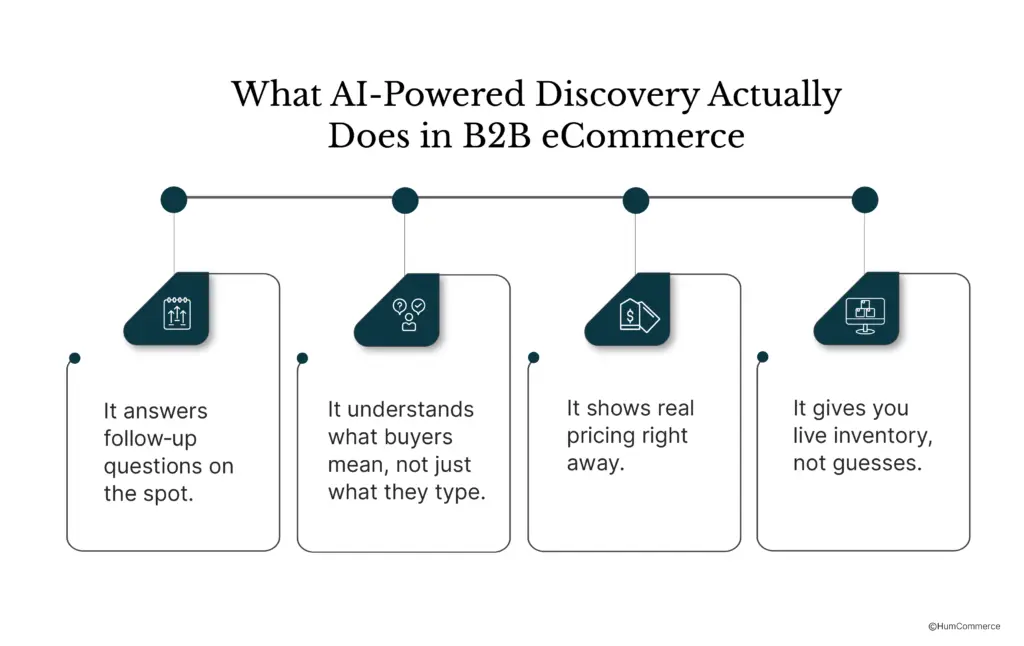
- It understands intent, not just keywords. “3000 PSI + 150 GPM” is parsed as pressure and flow specs, mapped to compatible pumps and fittings, even if the buyer types “3k psi” or “3,000psi.”
- It surfaces real contract pricing immediately, including volume breaks and customer-specific terms, instead of hiding everything behind “Request a quote.”
- It pulls live stock directly from ERP, so buyers see “12 units in Dallas, ships today” or “Backordered, in on March 3” instead of guessing.
- It handles follow-up questions in place (“is this compatible with 2-inch NPT?” “can you split ship to 2 sites?”) without forcing the buyer to call support.
The practical outcome: going from 11-minute, multi-filter, multi-page flailing to 3-minute, first-page resolution and a confident order.
Why Your AI Is Only as Smart as Your Data
You’ve deployed semantic search. You’ve added conversational interfaces. Your marketing deck promises “AI-powered discovery.”
Then a buyer searches. AI says: “12 units in stock, ships today.” Buyer orders. Two hours later, your warehouse says: “Actually backordered for three weeks.”
Your AI didn’t fail. Your data integration did.
The Integration Triad
ERP
What it provides: Real-time inventory, customer pricing, credit limits, lead times.
What breaks without it: Stale stock data, outdated pricing, wrong delivery promises.
PIM
What it provides: Structured specs, attributes, compatibility, digital assets.
What breaks without it: Incomplete product data, synonyms missing, search can’t parse specs.
CRM
What it provides: Purchase history, reorder patterns, approval hierarchies.
What breaks without it: No personalization, no intelligent substitution recommendations, lost context.
The 30-Day Sprint That Proves ROI (Without Rebuilding Your Stack)
You don’t need six months. You don’t need executive buy-in. You need 30 days and willingness to fix your top three friction points.
Week 1: Figure Out What’s Actually Costing You Money
- Pull 90 days of search analytics: zero-result queries, high-exit searches, time from search to add-to-cart.
- Review CRM and ticket data for “can’t find product” and “need pricing” complaints.
- Calculate your Discovery Friction Cost using the formula above and rank your top three friction points by revenue impact (e.g., zero-result searches, missing real-time stock, slow spec matching).
Week 2: Fix the Worst One First
- Export your top 500 queries; map synonyms and industry jargon to actual SKUs (“SS bolt” → stainless bolt, “316 fastener” → relevant SKUs).
- Enrich attributes on the top 20% of SKUs that drive 80% of revenue (add alternative names, cross-references, compatibility tags).
- Expose basic stock visibility quickly at minimum with a nightly ERP batch if live APIs aren’t ready yet.
Week 3: Measure What Changed
Track before vs. after on:
- Zero-result rate (target 30–50% reduction).
- Average discovery time (target 25–30% faster).
- Search-to-cart conversion rate (target +2–4 percentage points).
- Cart abandonment on search-driven sessions (target measurable drop).
Week 4: Show Leadership the ROI
- Build a simple dashboard: “Before 30-day sprint vs. after 30-day sprint.”
- Translate improvements into recovered monthly revenue using Discovery Friction Cost.
- Use those numbers to make a grounded case for a broader AI discovery rollout (semantic search, role-based UX, deeper ERP/PIM integration).
HumCommerce’s B2B audits regularly uncover dollars annual upside with exactly this style of discovery-first optimization.
When Autonomous Agents Start Ordering for You
Autonomous agents are already handling routine B2B tasks like reorders and basic supplier comparisons under defined rules and limits.
By the end of the decade, a significant share of repeat spend is expected to be mediated by these agents but they still need a product discovery layer that can map real-world needs to SKUs with confidence.
Fixing search and discovery now is how you prepare for that future without getting distracted from near-term ROI.
Read our guide to AI powered B2B search and discovery for more on this.
What Happens Monday Morning
Calculate your Discovery Friction Cost right now:
- Average discovery time when buyers don’t convert
- × Monthly buyer count attempting product search
- × Average deal value
- × Your historical conversion rate (÷ search refinements needed)
- = Your monthly revenue leak
If that number is above $1 million monthly, you have a board-level problem.
If it’s above $5 million monthly, discovery friction is your single largest revenue leak.
Then identify your top three friction points: Zero-result searches, missing real-time inventory, quote turnaround time, or complex spec matching.
Fix them in 30 days. You’ll see measurable uplift. Then scale what works.
The buyers searching your platform tomorrow are still reachable if you make discovery as seamless as checkout should be. But the window is closing. Your competitors aren’t waiting.
Ready to Fix Your Discovery Friction?
If you want a concrete diagnostic of how much revenue you’re leaving on the table, we can map your current product discovery experience, calculate your exact Discovery Friction Cost, and outline a 30-day roadmap.
What you’ll get:
- Discovery Friction Cost calculation (your exact revenue leak)
- Top 3 friction points ranked by impact
- 30-day sprint roadmap with week-by-week milestones
- ROI projection based on your traffic and deal value
HumCommerce has helped 40+ B2B distributors run this exact audit. Average result: $2.1M in monthly revenue recovery within 90 days.