TL;DR
- Architecture choice matters when business complexity outpaces current system flexibility capabilities.
- Inventory fragmentation costs the retail industry $1.77 trillion annually globally, 8% phantom inventory losses.
- Manual data entry consumes 10-25% of operations team time, automatable with proper integration.
- Composable ERP requires API architects, DevOps expertise, higher ongoing maintenance than monolithic systems.
- Monolithic ERP works well for stable operations, standardized processes, and limited integration needs today.
- Choose composable for rapid change, omnichannel commerce, volatile supply chains, real-time visibility requirements needed.
In 2024, Resilinc’s AI monitoring system detected 10,629 supply chain disruptions in manufacturing alone. That’s a 30% increase compared to 2023. Factory incidents, labor complications, regulatory changes, and competitive shifts are accelerating. Your business needs systems that can respond to these changes quickly.
The question isn’t whether monolithic or composable ERP is inherently better. Plenty of companies run SAP, Oracle, and NetSuite successfully. The real question is whether your current architecture can handle the pace of change your business faces.
Some businesses have stable processes, predictable supply chains, and standardized operations. For them, a well-integrated monolithic ERP works fine. Other businesses face constant channel expansion, volatile supply chains, and complex pricing structures. For them, the tight coupling of traditional ERP modules creates bottlenecks.
This isn’t a religious debate about architecture. It’s a practical assessment of what your business needs.
The Hidden Crisis: Why Your Current ERP Architecture Is Costing You Millions
Let’s be direct about what’s happening in most B2B operations.
Your ERP was designed around one fundamental assumption: business processes are stable. Upgrade the system once every 3 to 5 years. Train people. Run quarterly business reviews. Repeat.
That assumption is now false.
In 2025, almost 2026, the pace of change isn’t quarterly. It’s daily. Tariffs shift. Suppliers fail. Buyers demand new capabilities. Competitors launch new business models. Technology capabilities evolve faster than your vendor can ship updates.
The question isn’t whether you need to adapt. The question is whether your ERP can keep up.
Three specific pain points are crushing margins in B2B businesses right now. They’re interconnected. They’re expensive. And they’re almost entirely addressable with the right architecture.
Pain Point 1: Inventory and Order Management Fragmentation
The Problem: Information Asymmetry at Scale
Stop and ask your team this question: “Right now, do we know exactly how much inventory we have across all locations?”
Most will hesitate. Many will say “approximately.” Some will admit they’ll need to run a report or worse, call the warehouse.
In 2024, “approximately” costs you money.
Here’s what fragmented inventory management looks like in the real world. Your ERP holds one inventory number. Your warehouse management system has different counts. Your eCommerce platform shows yet another number to customers. Your sales reps are quoting from a spreadsheet they update manually. Somewhere in the system, there’s phantom inventory. Somewhere else, there’s unaccounted shrinkage.
When a customer places a high-value order through your eCommerce portal, the system confirms it’s in stock. But the real inventory sits in a bonded warehouse waiting for customs clearance – a fact that exists only in a shipping document, not in your system. Order fulfillment time slips. Customer satisfaction drops. You’re now managing exceptions instead of running operations.
The Financial Impact
Inventory distortion costs the global retail industry an estimated $1.77 trillion annually, according to IHL Group research. This breaks down into $1.2 trillion from out-of-stocks and $562 billion from overstocks. That’s equivalent to 7.2% of retail sales.
Phantom inventory accounts for approximately 8% of all inventory losses according to Zebra Technologies research. For every $100 in inventory, retailers lose roughly $8 to phantom inventory alone.
Retail shrinkage runs at approximately 1.6% of sales according to the National Retail Federation. Over 15% of retailers experience shrinkage above 3%.
These are industry-wide figures. Your specific situation will vary based on SKU count, warehouse complexity, and integration architecture.
Consider the math:
A mid-market distributor with $100 million in revenue and 50K SKUs experiences typical inventory-related challenges:
- Phantom inventory: 3-5% of recorded stock doesn’t physically exist
- Unaccounted shrinkage: 1-2% due to uncoded transactions
- Overstock in slow-moving SKUs: 8-12% of working capital tied up unnecessarily
- Stockouts on fast-moving items: Despite having “adequate” inventory overall
If your average SKU turns 4 times per year with 40% gross margin, that 12-15% inefficiency represents roughly $2.4-3.6 million in locked capital that could have been deployed to growth, debt reduction, or shareholder returns.
And that’s just the working capital story. The operational costs are separate.
Why Fragmentation Happens
Monolithic ERPs weren’t designed for multi-channel commerce. They were built for the era of centralized purchasing and single-warehouse operations.
Today, you’re managing:
- Multiple locations with regional pricing and inventory policies
- Multiple sales channels (direct sales, eCommerce, marketplaces, phone orders)
- Multiple fulfillment strategies (ship-from-warehouse, drop-ship, supplier-direct, customer-pick-up)
- Real-time visibility requirements that legacy systems can’t deliver
Each new channel or location gets bolted on. Each integration is incomplete. Data synchronization happens on a schedule (nightly batch updates) instead of in real time. By the time your ERP reflects reality, reality has already changed.
What Composable Architecture Changes
With a composable ERP approach, inventory becomes a shared data layer that everything feeds into and pulls from in real time.
Your WMS (Warehouse Management System) syncs inventory movements instantly via APIs. Your eCommerce platform queries real-time inventory before confirming orders. Your sales reps see live stock levels in the CRM. Your procurement system monitors inventory and triggers purchase orders automatically when thresholds are breached.
But here’s the critical part: this isn’t possible with a traditional monolithic ERP because each module can’t operate independently at the speed commerce demands.
Real-time inventory sync requires:
- Event-driven architecture that propagates changes instantly across systems
- API-first design where each module publishes and consumes data through well-defined contracts
- Distributed data management where inventory is a shared resource updated by all systems in real time
- Conflict resolution rules that handle edge cases (overselling during peak traffic, for example)
A monolithic ERP makes this technically possible but organizationally slow. Every change requires vendor approval and a release cycle. You’re locked into the vendor’s roadmap.
A composable ERP makes this the default. You can swap or upgrade the WMS without touching your finance module. You can add a new eCommerce channel without an ERP reconfiguration. You can pilot new fulfillment models without waiting for a quarterly release.
Pain Point 2: Pricing Complexity and the Source-of-Truth Crisis
The Problem: Multiple Realities
In a fragmented system, there’s no single source of truth for pricing.
Your ERP holds a base price. Your sales system applies customer-specific discounts. Your CPQ (Configure-Price-Quote) system adds configuration costs. Your eCommerce platform has promotional pricing. Your partner portal shows wholesale pricing. Your sales reps are using a quote template that hasn’t been updated in three months.
When a customer asks “What’s the price?” you’re not sure which price they should get.
This is more than a data management problem. It’s a revenue management problem.
The Business Impact
Inconsistent pricing has three immediate consequences.
First, it erodes margin through uncontrolled discounting. When your sales team doesn’t have real-time access to profitability data, they negotiate based on intuition. They might offer a 25% discount thinking it’s still margin-positive when the actual margin is only 18%. Multiply this across 100 sales reps making daily decisions, and you’re leaking 2-4% of gross margin without realizing it.
Second, it damages brand perception and customer trust. A customer who discovers they paid $500 more than another customer for the same product loses confidence. If pricing varies by channel (B2B direct vs. marketplace), it looks like price discrimination. If pricing differs on repeat orders, it feels arbitrary.
Third, it complicates financial forecasting and reporting. If pricing is inconsistent, so is the data. Your revenue forecast is only as good as your pricing data. Your cost-of-goods-sold calculations are suspect. Your profit margins look more volatile than they actually are.
Why Pricing Complexity Exists
Modern B2B pricing isn’t simple. It never was. But it’s gotten exponentially more complex:
- Customer segmentation: Different pricing for different customer tiers, industries, geographies
- Contract pricing: Multi-tier volume discounts, tiered quantity breaks, annual contracts with price adjustments
- Dynamic pricing: Time-based pricing, channel-based pricing, supplier-specific pricing
- Configurator pricing: Add-on components, customization costs, labor rates for installation
- Promotional pricing: Campaign-based pricing, clearance pricing, bundle pricing
- Cost-plus variations: Tariff adjustments, freight adjustments, landed cost calculations
A monolithic ERP can handle this complexity in its pricing module. But here’s the catch: the pricing lives inside the ERP. To get that pricing to your eCommerce platform, you need an integration. To get it to your CPQ, you need another integration. To sync it to your partner portal, another.
Each integration is a point of failure. Each sync is on a delay. Each system has its own logic for how to interpret pricing rules.
Result: fragmented pricing across channels.
Real Numbers on the Cost
High-volume selling periods expose integration weaknesses that otherwise remain hidden.
Consider a realistic scenario: An industrial distributor runs a Black Friday campaign across four channels simultaneously. Due to a sync delay between their ERP and marketplace systems, one marketplace shows a 20% discount that wasn’t applied to others. Within 30 minutes, volume shifts entirely to the discounted channel. If supplier pricing protection agreements require honoring returns on the margin difference, the single-day impact could reach six figures.
We’ve seen variations of this scenario play out across multiple clients. The specific dollar amounts vary, but the pattern is consistent: integration lag during peak volume creates margin exposure that’s difficult to recover.
The actual cost to your business depends on your transaction volume, margin structure, and how quickly you detect and respond to sync failures.
What Composable Architecture Changes
In a composable ERP, pricing becomes a microservice that all channels query in real time.
Your sales rep pulls up a customer in the CRM and sees the applicable contract pricing, tiered discounts, and real-time profitability data. The pricing service factors in customer history, current inventory levels, and promotional calendars. Your eCommerce platform calls the same pricing service for every SKU before checkout. Your CPQ pulls real-time pricing when generating a quote.
The critical difference: there’s one pricing engine. Multiple channels feed into it. Updates propagate instantly.
This requires:
- Centralized pricing logic as an independent service, not buried in the ERP module
- API access to pricing so every channel can query current rules in real time
- Version control and audit trails so you can see exactly why a price was calculated a certain way
- A/B testing capabilities to run pricing experiments without affecting production
A monolithic ERP can theoretically support this, but it requires heavy customization and strong middleware. A composable ERP bakes this in as a design principle.
Pain Point 3: Process Automation and the Manual Work Trap
The Problem: Humans Doing Machine Work
Here’s a statistic that should concern every operations leader: supply chain workers spend an average of 35% of their time manually handling data.
Let that sink in.
Over one-third of your payroll is spent moving data between systems instead of driving business value.
In a typical B2B operation, here’s what manual work looks like on any given day:
A customer order arrives through your eCommerce portal. Before it can be processed, someone verifies the pricing. Someone else checks inventory availability across locations. Someone reconciles the shipment address with your tax and compliance database. Someone enters the order into the WMS. Someone sends a fulfillment notification to the warehouse. Someone else matches the actual shipment to the order in the ERP.
A single order. Seven manual touchpoints. Multiply this across hundreds of orders daily.
That’s not operations. That’s data entry.
The Financial Bleed
Research on manual data entry costs reveals significant but varying impacts across industries.
A 2025 Parseur survey found that manual data entry costs American companies an average of $28,500 per employee annually. Employees reported spending an average of more than 9 hours per week transferring data between systems.
According to ProcessMaker research, the typical office worker spends approximately 10% of their time on manual data entry into business applications like ERP systems, CRM, or spreadsheets. In total, they spend over 50% of their work time creating or updating documents.
Smartsheet research found that over 40% of workers spend at least a quarter of their work week on manual, repetitive tasks.
A realistic calculation for your business:
If you have an operations team of 12 people at an average fully-loaded cost of $85,000 per person, that’s $1.02 million in annual payroll.
If 10-25% of their time goes to manual data handling (the range supported by research), that’s $102,000 to $255,000 annually in costs that automation could reduce.
The specific percentage for your business depends on your systems, integration quality, and process maturity. The right approach is to audit actual time spent on manual tasks rather than applying industry averages.
Why Manual Work Persists
It persists because systems don’t talk to each other.
Your eCommerce platform can’t automatically push orders to the ERP because the integration is batch-based. Your ERP can’t automatically update the WMS because they’re from different vendors and the middleware isn’t smart enough. Your order management system can’t automatically generate compliance documentation because fields are unstructured.
Each gap gets bridged by a person.
Monolithic ERPs actually make this worse. Because everything is in one system, companies often assume integration is “solved.” In reality, the integration between the ERP and external systems (eCommerce, WMS, CRM) is incomplete. The manual work gets hidden in different departments. Finance does reconciliation work that operations should have handled. Operations does order entry work that systems should have handled.
What Composable Architecture Changes
In a composable ERP, automation becomes the default instead of the exception.
An order arrives through your eCommerce portal. Rules-based logic automatically validates pricing, confirms inventory, and checks credit limits. If all checks pass, the order is automatically transmitted to the fulfillment system. When the shipment is processed, tracking data is automatically synced back to the customer account. Invoicing is automatic. The customer receives a digital receipt without human intervention.
The order-to-fulfillment process that previously required 7 manual touchpoints now requires zero.
This level of automation requires:
- Microservices architecture where each business function can execute independently
- Workflow orchestration that defines decision logic across systems
- Real-time API integration that propagates changes instantly
- Error handling and exception management that escalates problems to humans only when needed
A monolithic ERP makes this hard because everything is interconnected. Changing one workflow requires testing the entire system. A composable ERP makes this the default because services are loosely coupled.
These Three Pain Points Are Connected
Before we talk about solutions, understand this: these three problems don’t exist in isolation.
Inventory fragmentation causes pricing errors because pricing logic doesn’t have access to real-time cost data. Manual processes cause inventory discrepancies because data isn’t synchronized in real time. Pricing complexity causes manual work because pricing rules are too complicated for simple integrations.
Fix one without fixing the others and you’re rearranging deck chairs.
A composable ERP architecture addresses all three simultaneously because it’s built on a foundational principle: systems communicate, don’t conflict.
Enter Composable ERP: Architecture for an Uncertain World
Let’s cut through the vendor marketing.
Composable ERP is an architecture where business functions are broken into independent modules that communicate through APIs. Each module can be deployed, updated, scaled, or replaced independently without disrupting others.
Practically speaking:
Your finance module stays stable and compliant (vendors don’t mess with accounting logic). But your inventory module can be upgraded to handle new warehouse management complexity. Your pricing module can be replaced with a more advanced option without a system-wide implementation. Your commerce module can evolve with ecommerce trends without waiting for your ERP vendor’s quarterly release.
This is radically different from monolithic ERP where everything is integrated into a single application with a single upgrade cycle and a single vendor roadmap.
Why This Architecture Works for the Three Pain Points
Real-time inventory sync becomes possible because your WMS and ERP can communicate constantly without waiting for a nightly batch process.
Pricing consistency becomes possible because there’s a single pricing service that every channel queries in real time instead of each system maintaining its own pricing logic.
Automation becomes possible because orchestration layers can define business logic across services without needing to modify the services themselves.
What You Should Know About Implementation
A composable ERP implementation isn’t a rip-and-replace of your entire system. In fact, that’s the opposite of what you want.
The best approach is a “strangler fig” pattern. Keep your existing monolithic ERP running. Gradually replace specific modules with composable alternatives. Your commerce layer might move first because it generates revenue. Then inventory management. Then pricing. Over time, your ERP transforms from monolithic to modular without disrupting the business.
This approach:
- Reduces implementation risk
- Allows phased budget deployment
- Lets teams build skills gradually
- Enables continuous value realization instead of a “go-live crisis” scenario
A full transition typically takes 12-18 months for a mid-market business, with revenue-generating improvements visible within the first 3-4 months.
How to Know If Composable ERP Is Right for You
You Should Prioritize Composable If:
- Your business model changes more than once per year. You’re launching new channels, entering new geographies, or experimenting with new sales approaches.
- Your commerce operations are holding back growth. Order processing is slow. Pricing is inconsistent. Your team is overwhelmed with manual work.
- Your supply chain operates in a volatile environment. Tariffs, regulations, or supplier availability shift frequently.
- You have 100K+ SKUs or complex product configurations.
- Real-time visibility is critical to your business model.
You Can Probably Stick With Monolithic If:
- Your business model is stable and has been for years.
- Your processes are highly standardized (single product line, single warehouse, few customer types).
- Your IT team prefers “stable and predictable” over “fast and adaptable.”
- You have low transaction volume and limited integration needs.
The Reality Check: A Composable ERP Assessment
We’ve created a free Composable ERP Decision Scorecard that walks you through a 15-minute assessment to determine if composable architecture is right for your organization.
The scorecard evaluates:
- Your business volatility (how often you need to change)
- Your integration complexity (how many systems you need to connect)
- Your growth trajectory (are you scaling faster than your systems can handle?)
- Your IT maturity (can your team support a more complex architecture?)
- Your operational challenges (which of the three pain points are costing you the most?)
Download the Composable ERP Decision Scorecard (PDF)
A Realistic Implementation Framework
If you decide composable is right for you, here’s what a practical implementation looks like.
Phase 1: Assessment and Planning (Weeks 1-4)
Map your current systems and data flows. Identify which pain points are costing you the most. Establish your business case for change. Determine your budget and timeline.
This phase should answer one question: what’s the ROI of moving to composable ERP?
A typical mid-market B2B company sees ROI within 18 months through a combination of margin capture (pricing consistency, inventory accuracy) and cost reduction (automation, reduced manual work).
Phase 2: Foundation (Months 1-3)
Select your core ERP module and integration middleware. We typically recommend starting with finance (most vendors require this) or commerce (highest immediate ROI).
Implement master data governance. This is critical. If your customer, product, and vendor data is clean, everything downstream works better. If it’s messy, you’re automating garbage.
Set up your integration layer and API standards. Define how systems will communicate.
Phase 3: Commerce Integration (Months 4-7)
Connect your eCommerce platform to the ERP for real-time inventory, pricing, and order management. This is where most of your early wins come from.
Implement pricing service so all channels query the same logic in real time.
Set up order automation so orders flow from commerce to fulfillment without manual intervention.
Phase 4: Optimization (Months 8-12+)
Add advanced capabilities like AI-powered error correction, RFQ automation, or tariff compliance.
Scale to additional products, channels, or geographies.
Continuously optimize based on actual results.
The Timeline and Investment
Implementation cost varies significantly based on your systems and complexity. A typical mid-market implementation (starting from scratch) costs $500K-$1.5M and takes 12-18 months.
But here’s what’s important: you’re not paying all of that upfront. You’re spreading it across phases and seeing returns incrementally.
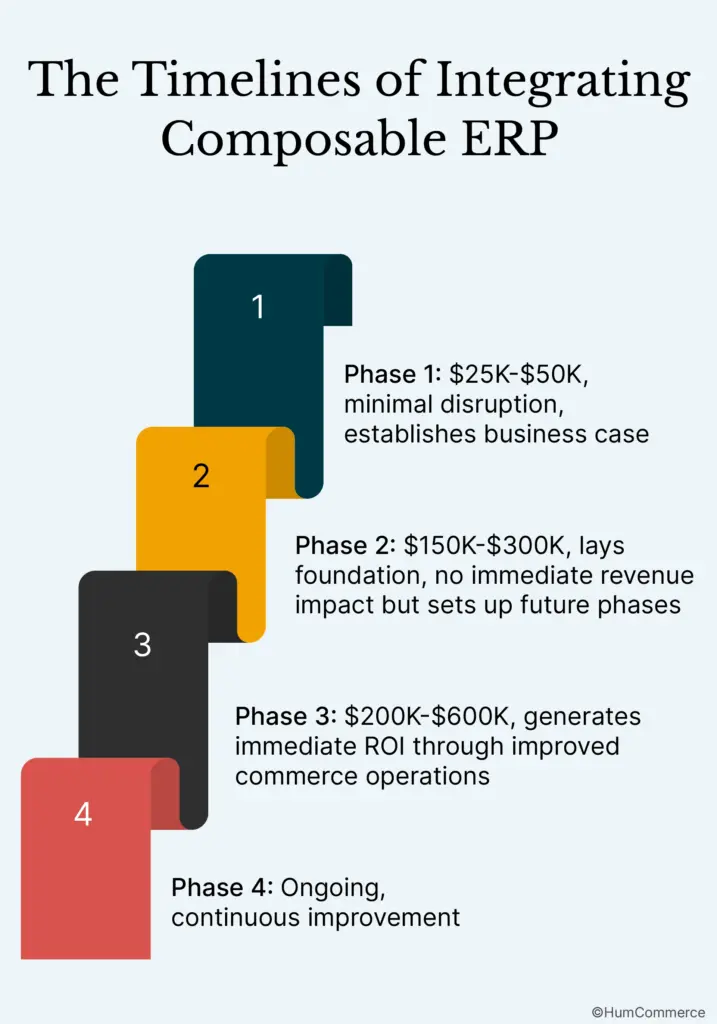
A well-planned implementation generates positive ROI by the end of Phase 3 and continues returning value for years.
The Real Risk: Doing Nothing
Here’s what happens if you stay with your current monolithic architecture:
Your competitors who move to composable ERP will respond faster to market changes. They’ll launch new products or enter new channels in weeks while you need months. They’ll maintain pricing consistency and inventory accuracy at higher levels. Their teams will spend less time on data entry and more on strategy.
Over time, you’ll lose margin. Not all at once, but incrementally. A percent here from pricing inconsistency. A percent there from inventory inefficiency. Half a percent from manual work that competitors have automated.
Margins compound. A 2-3% structural margin disadvantage is enormous over a few years.
And then something disrupts your supply chain like it did at TechMfg. Your monolithic ERP can’t respond fast enough. Your competitors already made the shifts you’re just starting to plan. You’re reactive instead of proactive.
Getting Started: Your Next Step
You probably don’t need to commit to a full composable ERP transformation next month.
But you should start understanding your current pain points more precisely.
That’s why we created the Composable ERP Decision Scorecard.
It takes about 15 minutes. It walks you through the factors that matter: how volatile your business is, how complex your integrations are, what your current operational challenges cost, what your team’s capabilities are.
At the end, you’ll know whether a composable ERP is a strategic imperative for your company, a nice-to-have optimization, or something to revisit in a few years.
Download the Composable ERP Decision Scorecard (PDF)
Or if you prefer to talk it through with someone who’s worked through these decisions with dozens of B2B companies, schedule a 30-minute strategy call.
We’ll assess your situation, identify the pain points that matter most, and give you a clear picture of what a realistic path forward looks like.
The Bottom Line
Your ERP architecture isn’t just a technical decision. It’s a business decision about how quickly you can adapt to change.
In 2024, the pace of change is accelerating. Disruptions come faster. Competitors move quicker. Customer expectations shift overnight.
Monolithic ERP architectures were built for an era where you could plan three years in advance. Composable ERP is built for today’s reality.
The three pain points we discussed – inventory fragmentation, pricing complexity, and manual process work – aren’t unique to your business. They’re structural to how monolithic ERPs operate. Thousands of B2B companies are experiencing them right now.
But those pain points become choices the moment you understand them.
You can choose to keep accepting them as “how business works.” Or you can choose to eliminate them.
That’s what a composable ERP architecture enables.
The choice is yours.
HumCommerce has helped dozens of B2B companies make that choice. We know the path. We know the obstacles. We know how to navigate to success.
The question is: are you ready to eliminate these pain points?
If so, let’s talk.