
Key Takeaways
- Most B2B teams waste around 480K dollars a year coordinating product content when launching 10,000+ SKUs.
- AI automates about 15% of the work (drafting), but 85% remains broken (data cleanup, approvals, channel rewrites).
- This guide shows a complete system: 5‑point readiness audit, structured prompts, 3‑layer validation (structure to data integrity to semantic risk), and automated syndication plus a 30‑day pilot and 12‑week rollout plan.
38 days to publish one product page. Because it sat in Legal’s inbox, bounced between Engineering and Marketing, and waited three weeks for photography.
By the time it went live, the team had burned about 186 dollars in coordination overhead on a product expected to generate roughly 4,000 dollars a year.
For companies launching around 10,000 SKUs a year, that pattern adds up to about 480,000 dollars in labor just moving content through inboxes and tools.
If you’ve already tried generative AI and got burned by hallucinated specs or legal blockages, this is why. If you’re about to start, these are the landmines that cause AI content pilots to stall or quietly die within six months.
You don’t have a content generation problem. You have a content system problem.
The Real Bottleneck Isn’t What You Think
On paper, the content process looks simple: get specs, write copy, publish.
In reality, the typical six‑week flow for one new SKU looks like this:
- Week 1 – Data archaeology: conflicting PDF spec sheets, BOMs, and supplier docs that must be reconciled into your PIM manually, often with multiple iterations.
- Week 2 – Approval labyrinth: Marketing writes in a couple of hours, then waits while Product, Legal, and Engineering review, comment, and send it back.
- Week 3 – Photography bottlenecks: scheduling shoots, waiting for samples, editing, renaming, uploading.
- Weeks 4–5 – Channel rewriting: one “master” description is re‑typed into 4–5 different formats for ecommerce, marketplaces, distributor portals, partner templates, and print.
- Week 6 – Error cascade: one spec change triggers manual edits across every channel.
Nine people may touch each SKU. Ten to fifteen hours of work get spread over 38 days. At a blended 50 dollars per hour, that’s around 48 dollars per SKU. For a 10,000‑SKU year, that’s the 480,000‑dollar “hidden tax” before you sell anything.
Writing itself is usually 10–15% of the effort. The other 85% is coordination, waiting, and rework. Dropping AI into that process automates the easy 15% and leaves the expensive 85% intact.
The System That Actually Works: Overview
The teams that succeed with generative AI in B2B ecommerce don’t start with “let’s generate 10,000 descriptions.” They start by making sure five foundations are in place and then layering AI onto that. Their system looks like this:
- A 5‑dimension readiness audit (data, brand guardrails, workflow, integration, metrics).
- Structured prompt templates tied to PIM fields, not ad‑hoc questions.
- A 3‑layer validation system: structural/policy checks to data integrity cross‑checks to semantic risk scoring.
- Automated multi‑channel syndication from one master description.
- A discovery layer (search/chat) that uses the same structured data to help buyers find the right product.
Once you think in those layers, AI becomes a force multiplier rather than a new source of chaos.
The Pre-Flight Checklist: Is Your System Ready?
Before you generate a single AI description, audit five dimensions. These determine whether AI becomes a force multiplier or an expensive distraction.
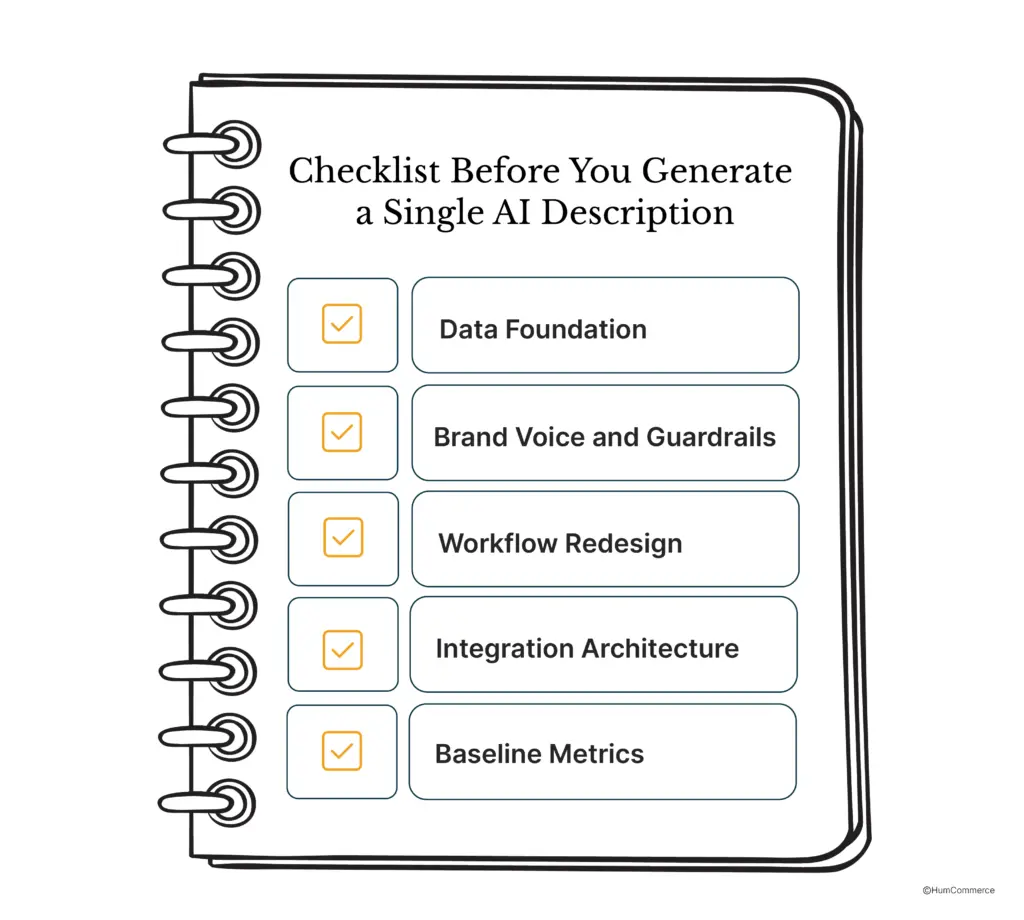
1. Data Foundation
What to check:
- Do you have a PIM or equivalent source of truth?
- Are mandatory fields (name, category, specs, dimensions, certifications) 90%+ complete?
- Are specs standardized? (Not “female” in one SKU and “female termination, male pin contact” in another)
- Is supplier data normalized before import?
Why it matters: AI models pattern-match. If your PIM has “connector type” spelled five different ways, the model picks one. It might pick wrong.
Common gap: 20%+ of SKUs are missing critical fields. One electronics distributor found that 18% of their catalog lacked voltage ratings, a deal-breaker for B2B buyers making compliance decisions.
Time investment: Four to six weeks to audit and clean core data.
2. Brand Voice and Guardrails
What to check:
- Do you have documented tone and style guidelines?
- Have you defined what AI must never say? (Unsubstantiated claims, performance guarantees without test data, compatibility statements without verification)
- Do you have 5–10 example descriptions that represent your ideal output?
Why it matters: Without guardrails, AI invents. One industrial supplier let AI describe a connector as “the most reliable on the market.” Legal caught it before publishing because they had no test data to substantiate “most reliable.” Close call.
Action item: Create a do/don’t list.
- DO: “Constructed from 316 stainless steel, suitable for corrosive environments per ASTM A240 standards.”
- DON’T: “Best fastener for harsh conditions” (vague, unsubstantiated).
3. Workflow Redesign
What to check:
- Have you mapped your current approval workflow? (Who reviews what, in what sequence?)
- Can you categorize SKUs by risk level? (Low/medium/high)
- Have you defined review SLAs for each tier?
Why it matters: If you keep your nine-person approval chain and add AI, you’ve just created a new bottleneck, slow reviewing instead of slow writing.
Better approach: Risk-based routing.
- Tier 1 (Low risk): Commodity items, stable specs, well-documented categories. Light review, 2–3 minutes. Covers 60–70% of SKUs.
- Tier 2 (Medium risk): Specialized products, newer categories. Standard review, 5–8 minutes. Covers 20–25% of SKUs.
- Tier 3 (High risk): Regulated products, safety-critical, first-time launches. Deep SME review, 15–20 minutes. Covers 5–10% of SKUs.
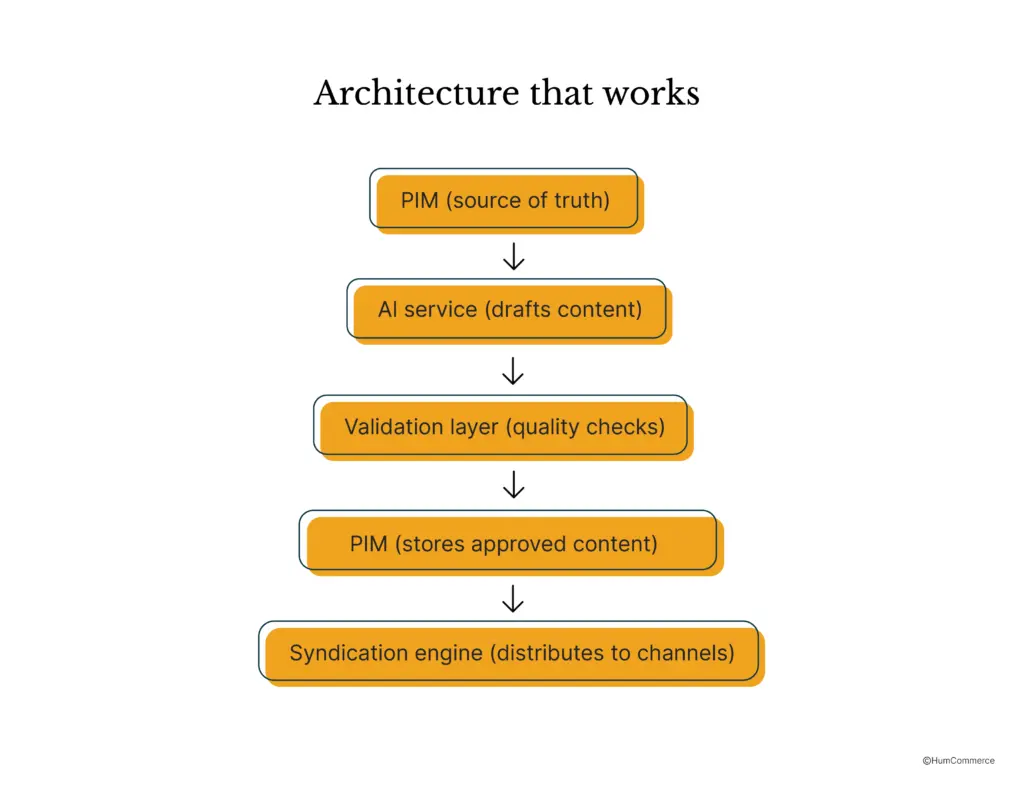
4. Integration Architecture
What to check:
- Can your PIM expose data via API?
- Can your AI service write back to the PIM, or does someone copy-paste?
- Are your commerce platforms (Adobe Commerce, Shopify, etc.) integrated with PIM?
- Can you auto-syndicate approved content to all sales channels?
Why it matters: If AI generates descriptions but someone manually copies them into five systems, you’ve only automated 20% of the workflow.
5. Baseline Metrics
What to measure now (before AI):
- Hours per SKU (current): _____
- Cost per SKU (current): $_____
- Spec error rate: _____%
- Time-to-publish: _____ days
- Content-related support tickets per month: _____
Why it matters: You can’t improve what you don’t measure. Without baselines, you won’t know if AI helped or hurt.
Prompt Engineering That Prevents Hallucination
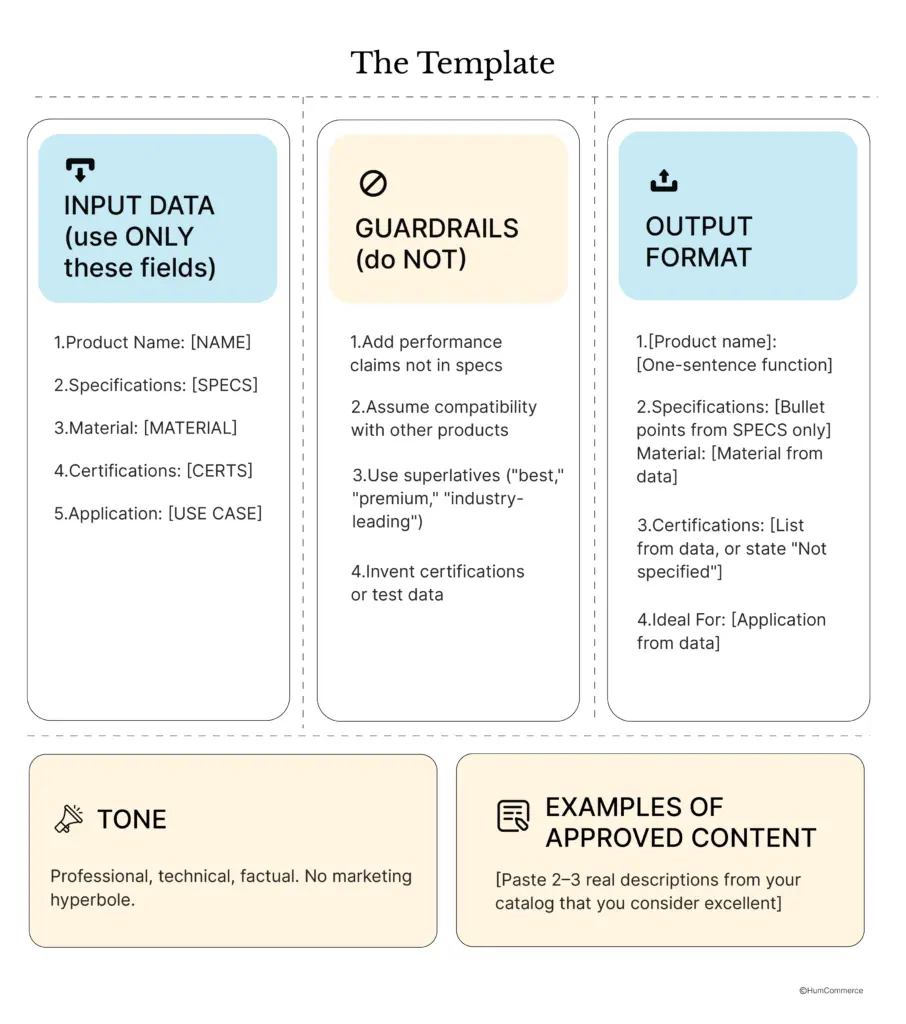
Most teams start with a vague prompt: “Write a product description for this connector.”
The AI guesses. Sometimes it guesses right. Sometimes it invents specs.
Here’s the anatomy of a safe prompt, one that grounds AI in your data and prevents hallucination.
The Three-Layer Validation System (The Part Everyone Skips)
This is the critical differentiator between teams that succeed with AI and teams that fail.
In B2C, a mistake means a product return. In B2B, a wrong spec can halt production lines and trigger contract penalties. The stakes are higher. Validation can’t be “hope for the best.”
Layer 1: Structural and Policy Checks
The first layer is about quick, automatic hygiene checks while content is being generated. You are asking, “Does this description look like something we would actually publish?”
Things to check include:
- Is the length in the right range for that channel, for example fifty to five hundred words.
- Are the required sections there, such as specs, materials, and certifications.
- Are banned words and risky claims missing, like “best,” “guaranteed,” or anything you cannot substantiate.
- Is the format consistent, including headings and bullet styles.
A simple rules engine or lightweight script can run these checks in real time as content is created. This alone tends to catch a large share of problems before a human ever sees the draft.
Layer 2: Data Integrity Cross‑Check
The second layer asks a different question: “Is everything this description says actually true according to our product data?”
Here you compare the text directly against your product information system. For example:
- If the description says “stainless steel,” the material field in your product data should also say stainless steel.
- If it mentions a six hundred volt rating, the voltage rating in your system should match.
- If it states a specific dimension, such as ten millimeters, it should line up with what is stored in the catalog, even if your internal data uses a different unit.
- If it claims compatibility with another part, there should be a defined relationship or compatibility mapping supporting that claim.
Technically, this means having the validator query the product information system for each SKU, read the ground truth fields, and flag any specs or compatibility statements that are not backed by those fields. This step catches a big portion of subtle hallucinations that slide past basic structure and policy checks.
Layer 3: Semantic Risk Scoring
The third layer looks beyond structure and raw data and asks, “Is this the right thing to say, in the right way, for this product and this brand?”
At this stage you want to check:
- Whether the tone fits the category and your brand voice.
- Whether the claims can be backed up by documentation or certifications you actually have.
- Whether any risky words are sneaking in, such as guaranteed, always, never, or best.
- Whether the description clearly belongs to this product and not something else.
A practical way to do this is to have a separate review model score each description for things like exaggeration risk, how likely it is that claims can be verified, and how closely the tone matches a set of approved examples.
You then route content based on that risk score. Low‑risk items can move straight through with a light sampling process. Medium‑risk items go into a batch review queue where humans spend a few minutes per SKU. High‑risk items, such as complex or safety‑critical products, get pushed to subject matter experts for a deeper look before anything goes live.
In real rollouts, most products land in the low‑risk bucket and rarely get rejected, a smaller slice sits in the middle, and only a handful of complex items need expert attention. This keeps quality high without burying your team in unnecessary manual review.
From One Master Description to Five Channels
In most B2B teams, one product turns into five different content jobs. The same connector or valve needs one version for your ecommerce site, another for Amazon Business, a stripped‑down version for distributor portals, yet another for partner templates, and a short blurb for the print catalog.
Done manually, that means someone is copying, pasting, and rewriting the same information again and again. It is slow, introduces inconsistencies, and almost guarantees that at least one channel drifts out of date.
A better way is to treat your detailed product write‑up as the master record and then apply a set of rules that automatically shape it for each channel.
First, you define what each channel expects. For your own site, that might be a five to eight hundred word, search friendly page written in a professional but detailed tone with clear calls to action and internal links. For Amazon Business, it might be a short title and exactly five tight bullets that focus on benefits and key specs. Distributors may want a hundred to one hundred fifty words focused almost entirely on technical details. Print might allow only a couple of short sentences and accept abbreviations.
Once those rules are clear, you can apply transformation logic. Take an industrial connector as an example. The master description might spell out voltage and current ratings, contact design, materials, certifications, and typical use cases. For Amazon, you pull out the five most important specs and benefits and turn them into compact bullets that lead with search terms and stay within character limits. For the print catalog, you compress that same information into a couple of factual lines that still tell an engineer what they need to know at a glance.
When your product information system feeds this master description into an AI service and then into your syndication tools, any time the master changes, all of the channel versions update on their own. Instead of chasing edits across five systems, your teams maintain one source of truth and let the rules do the rest.
What Happens After You Fix Content: Discovery
Even with perfect descriptions and clean syndication, there is a final hurdle. Most B2B buyers do not read every product page line by line. They search.
An engineer might type “six hundred volt connector for control panel” or “high amp connector for industrial machinery” without remembering the exact part number. If your site search cannot interpret that intent and connect it to your carefully maintained attributes, the buyer may never see the product that actually fits their need.
This is where a conversational layer like HumCommerce AI Assistant comes in. Instead of forcing buyers to speak in SKU codes or click through a dozen filters, it lets them describe what they are looking for in their own words and then maps that request to your structured data.
A few things this unlocks:
- A buyer can type “high amp connector for industrial machinery” and the assistant translates that into voltage, current, and application attributes, then returns the right connector and close substitutes.
- Instead of working through a long sidebar of filters, the buyer can simply say “show me connectors rated for six hundred volts or higher” and see the catalog update immediately.
- Because the assistant is tied into your ERP and quoting tools, it can show real stock levels, lead times, and contract pricing in the same conversation, without the “let me check and get back to you” delay.
- For bulk quotes, a buyer can upload a long list of requested products. The system can validate availability, pricing, and any compliance constraints, producing a ready‑to‑review quote in minutes rather than days.
The Bottom Line
Generative AI for B2B product content isn’t about the AI. It’s about the system around it.
Data quality determines AI quality. If your PIM is messy, your outputs will be too.
Validation prevents hallucination. Three layers – structural, data integrity, semantic – catch errors before they reach customers.
Workflow design determines speed. Risk-based routing eliminates approval bottlenecks without sacrificing quality.
Metrics determine ROI. Cost per SKU, time-to-publish, spec accuracy, conversion – these tell you if it’s working.
After analyzing implementations across manufacturing, distribution, and industrial supply, the pattern is clear: Winners fix the process first. Then they add AI.
The ones who skip straight to tools? They generate bad content faster.
Your next step: Audit your system. Score yourself across data foundation, brand guardrails, workflow design, integration architecture, and baseline metrics. Identify your top three gaps. Build a 30–90 day plan to close them.
Then, and only then, deploy AI. Because when your data is clean, your workflows are risk-tiered, your validation is automated, and your channels are synced, AI becomes what it’s supposed to be: a force multiplier.