TL;DR
- What this is: Manual order processing in B2B refers to the workflow where sales reps or operations staff receive, enter, verify, and route customer orders by hand – typically re-keying data from emails, phone calls, or PDFs into an ERP – instead of having orders flow automatically from a connected ecommerce portal.
- Who it affects: Director/VP of Operations and CEO/Owner at B2B Manufacturing & Distribution companies
- The core problem: US B2B manufacturers and distributors processing orders manually – via phone, email, fax, or spreadsheet – spend an average of $30-$80 per order compared to $1-$5 for orders placed through an integrated B2B ecommerce portal.
- The cost of inaction: The average cost of processing a manual B2B order is $30-$80 vs. $1-$5 for an automated online order (Institute of Financial Operations)
- What good looks like: ERP-First B2B Order Automation – not Order Management Add-On
- Proof it works: FHC Fastener Hardware Co-Op – Manual rework hours cut from 60/month to 8/month saving $10K/month in labor
Manual B2B order processing costs between $30 and $80 per order when staff re-key data from phone calls, emails, and faxes into an ERP. An integrated B2B ecommerce portal drops that cost to $1-$5 per order. This guide breaks down exactly where those costs accumulate, why they’re so often invisible on a P&L, and what an ERP-first approach to B2B order automation actually looks like in practice.
Every order that passes through a human hand before it reaches your ERP is an order carrying hidden cost. For US B2B manufacturers and distributors still processing orders via phone, email, fax, or spreadsheet, the math is stark: $30-$80 per order in labor, error correction, and cycle time compared to $1-$5 for orders placed through an integrated ecommerce portal. If your operations team handles 500 orders per month, that gap represents $12,500-$37,500 in avoidable monthly expense before you even account for the downstream consequences of keying errors, delayed shipments, and customer churn.
This isn’t a technology problem dressed up as an efficiency discussion. It’s an operational finance problem. The cost of manual order processing compounds silently across your organization: in the warehouse where incorrect picks get shipped, in customer service where reps field “where’s my order” calls, and in sales where reps spend 40% of their time on administrative tasks instead of building pipeline. For Directors and VPs of Operations, CEOs, and VP Sales leaders at mid-market manufacturing and distribution companies, understanding where these costs hide is the first step toward eliminating them.
The difference between companies that treat B2B ecommerce as a storefront add-on and those that treat it as an extension of their ERP determines whether automation actually delivers results. The rest of this guide maps the real costs, the common mistakes, and the specific approach that turns order processing from a cost center into a competitive advantage.
What Is Operational Efficiency & ROI in B2B Ecommerce?
Manual order processing in B2B refers to the workflow where sales reps or operations staff receive, enter, verify, and route customer orders by hand – typically re-keying data from emails, phone calls, or PDFs into an ERP – instead of having orders flow automatically from a connected ecommerce portal. This workflow touches multiple people, multiple systems, and multiple opportunities for error before a single item gets picked from a shelf. The inefficiency isn’t just the labor cost of data entry; it’s the ripple effect of every miskeyed SKU, wrong quantity, or outdated price that propagates through fulfillment.
Operational efficiency and ROI in B2B ecommerce measure how effectively your digital ordering channel reduces these manual touchpoints while maintaining data accuracy between your storefront and your ERP. A well-integrated portal doesn’t just accept orders online; it validates pricing against contract rates, checks real-time inventory, applies approval chains, and pushes clean order data directly into your ERP without human intervention.
Two fundamentally different approaches exist for achieving this.
Order Management Add-On treats ecommerce as a layer bolted onto existing systems. Orders, pricing, and inventory sync back to the ERP through middleware or manual reconciliation — which means more moving parts, more failure points, and more operational overhead just to keep both systems aligned.
ERP-First B2B Order Automation is built the other way around. The ecommerce portal is designed from the ground up to read and write directly to the ERP, treating it as the single source of truth for pricing, inventory, customer data, and order status, no middleware, no reconciliation, no lag.
The distinction matters because the add-on approach often recreates manual work in a different form: someone still reconciles data between systems, resolves sync conflicts, or manually updates pricing that the portal can’t pull from the ERP in real time.
Why Most B2B Manufacturing & Distribution Companies Underestimate This Problem
The financial impact of manual order processing is easy to underestimate because the costs don’t appear as a single line item. They’re distributed across payroll, returns processing, expedited shipping to correct errors, and customer retention efforts. A distributor processing 1,000 orders per month at $50 per manual order is spending $50,000 monthly on order processing alone. The average cost of processing a manual B2B order is $30-$80 vs. $1-$5 for an automated online order (Institute of Financial Operations). That’s not a rounding error; it’s a structural cost disadvantage against competitors who’ve already automated.
The Order Management Add-On approach fails because it treats the ecommerce portal as a separate system that happens to share some data with the ERP. In practice, this means pricing rules live in two places, inventory counts drift out of sync, and customer-specific contract rates require manual configuration in the portal instead of flowing automatically from ERP records. The result? Operations staff still spend hours reconciling discrepancies, and the “automated” system generates its own category of errors. B2B sales reps spend an average of 40% of their time on administrative tasks including manual order entry – time that could be spent selling (Salesforce State of Sales). When your ecommerce platform doesn’t eliminate that administrative burden, you’ve invested in technology without capturing the ROI.
The pain concentrates in two roles. Directors and VPs of Operations feel it as headcount pressure: they can’t scale order volume without adding staff, and every new hire introduces another source of human error. CEOs and owners feel it as margin compression: the gap between revenue growth and profit growth widens because operational costs scale linearly with order volume instead of flattening through automation. Companies that automate B2B order processing report a 60-80% reduction in order errors and a 70% decrease in order-to-ship cycle time (Aberdeen Group). Those aren’t incremental improvements; they represent a fundamentally different cost structure. Yet most mid-market manufacturers and distributors delay action because the current process “works” – meaning orders get filled, even if the cost per order is five to ten times higher than it needs to be.
The hidden cost extends beyond direct labor. Every order error triggers a correction cycle: customer service investigates, operations locates the discrepancy, warehouse pulls and re-ships, and accounting processes credits or adjustments. A single keying error on an alphanumeric SKU can cascade into a wrong shipment, a return, and a replacement order – tripling the cost of that transaction. When your error rate sits at 15-20% on manual orders, those correction cycles consume a significant portion of your operations team’s capacity.
The Five Costliest Manual Order Processing Failures and How to Eliminate Them
Eliminating manual B2B order entry costs starts with identifying exactly where money leaks out of the process. Here are the five most common failures that drive up the average cost of processing a manual B2B order versus an automated online order.
1. Re-Keying Order Data from Emails, Faxes, and Phone Calls
Every order that arrives as an email attachment, a faxed PO, or a phone call requires someone to manually transcribe line items, quantities, SKUs, and shipping details into the ERP. A single order with 15 line items takes 8-12 minutes to enter. Multiply that by hundreds of orders per week, and you’ve built a full-time job around data entry that a connected ecommerce portal handles in seconds.
2. Price Discrepancies Between Quotes and Orders
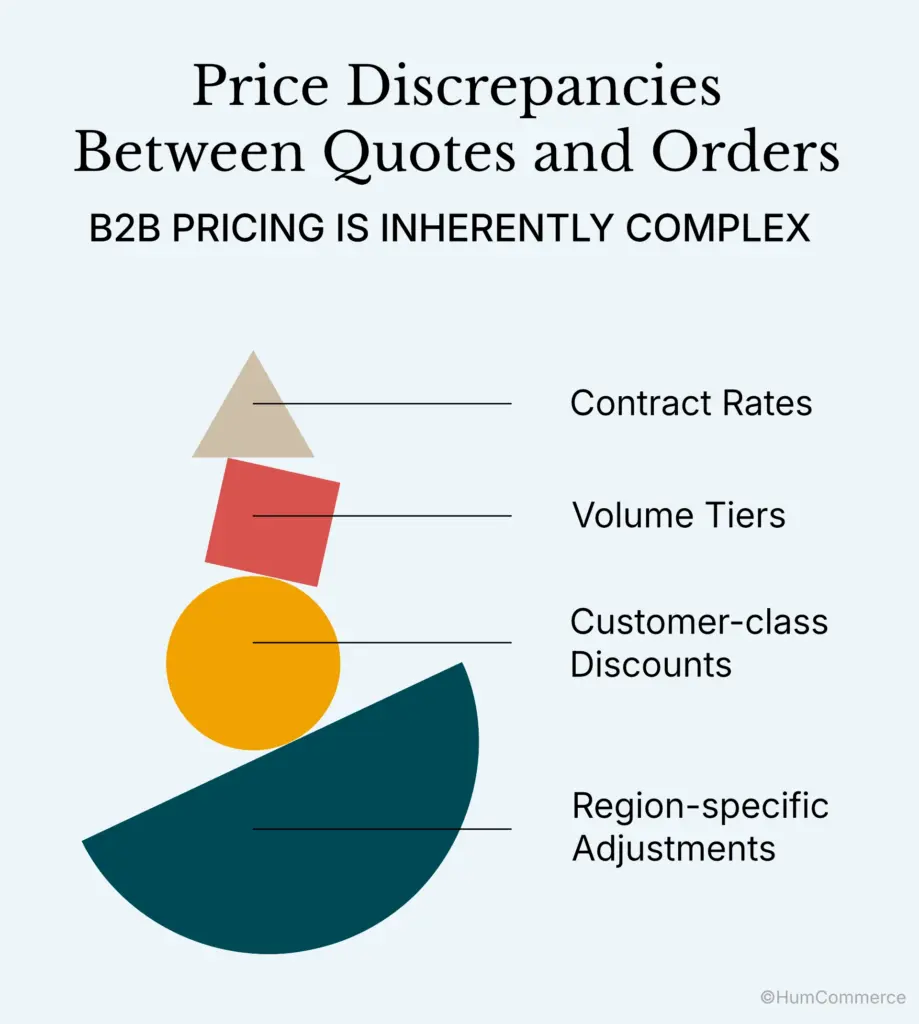
B2B pricing is inherently complex: contract rates, volume tiers, customer-class discounts, and region-specific adjustments. When a buyer places an order referencing a quote from three weeks ago, the operations team must verify that pricing is still valid, check whether volume thresholds have been met, and confirm that the correct customer-specific rate applies. Without ERP-driven pricing flowing directly into the ordering portal, this verification is manual and error-prone.
3. Inventory Inaccuracy at the Point of Order
Manual order processing creates a lag between when an order is placed and when inventory is actually checked. If your warehouse shows 200 units available but 180 have already been committed to orders sitting in someone’s email inbox, you’re overselling. Automated B2B ecommerce order systems query real-time ERP inventory at the moment of purchase, preventing oversells before they happen.
4. Approval Chain Bottlenecks
B2B orders frequently require internal approvals: credit checks, purchase order verification, manager sign-off for orders above a threshold. In a manual process, these approvals happen via email chains or physical routing slips, adding days to the order-to-ship cycle. An ERP-first portal automates approval routing based on predefined rules, moving orders through the pipeline without human bottlenecks.
5. Order Correction and Rework Loops
This is the most expensive failure because it compounds every other cost. When a manual entry error reaches the warehouse, the correction cycle involves customer service, operations, warehouse staff, and often accounting. B2B ecommerce order automation savings are most dramatic here: eliminating the error at the source eliminates the entire downstream correction workflow.
| Failure Point | Manual Cost Driver | Automated Solution |
| Data re-keying | 8-12 min per order, error-prone | Buyer enters order directly; data flows to ERP |
| Price discrepancies | Manual lookup and verification | ERP contract pricing displayed in real time |
| Inventory inaccuracy | Lag between order and stock check | Real-time ERP inventory query at checkout |
| Approval bottlenecks | Email chains, days of delay | Rules-based automated routing |
| Rework loops | Multi-department correction cycles | Errors prevented at point of entry |
Real Results: FHC Fastener Hardware Co-Op
FHC Fastener Hardware Co-Op, a mid-market fastener distributor, faced the exact operational efficiency challenge described above: a growing order volume processed almost entirely through manual channels, with rework consuming significant staff hours every month.
What changed after implementation:
- Manual rework hours cut from 60/month to 8/month saving $10K/month in labor
- Order correction rate dropped from 18% to 0.8% (95% improvement)
- Order-to-ship cycle reduced from 5-7 days to 24 hours
- Ops team handled 3x order volume (450 to 1,350/month) without new hires
The results weren’t driven by adding a portal on top of existing processes. They came from connecting the ecommerce platform directly to the ERP so that pricing, inventory, and order data flowed from a single source of truth. Customer-specific pricing displayed automatically based on authenticated buyer profiles. Orders entered the ERP clean, without requiring manual verification or correction.
The ERP-first approach meant the operations team stopped spending time fixing data and started spending time fulfilling orders. That’s the difference between an add-on and a system designed to behave like part of your operations.
How HumCommerce Approaches Operational Efficiency & ROI Differently
Most mid-market manufacturers and distributors who’ve tried B2B ecommerce have experienced the add-on problem firsthand. They launched a portal, connected it to their ERP through middleware, and discovered that the integration created as many problems as it solved. Pricing didn’t match. Inventory counts drifted. Orders still required manual review before they could be trusted. The add-on approach fails because it treats the ecommerce platform and the ERP as two separate systems that need to be kept in sync, rather than designing the portal to read and write directly from ERP data.
HumCommerce takes an ERP-first approach to B2B order automation on Adobe Commerce (Magento). That means contract pricing, tiered volume discounts, customer-specific catalogs, and real-time inventory all flow from the ERP as the authoritative source. Orders placed through the portal enter the ERP clean, following the same validation rules your operations team would apply manually. For a Director or VP of Operations, this translates to a portal that doesn’t generate its own category of exceptions and reconciliation tasks. Credit limits, approval chains, and purchase order requirements are enforced automatically based on ERP rules, not duplicated in a separate system.
Implementation starts with understanding your existing ERP workflows, not with configuring a generic storefront. HumCommerce’s team maps your order-to-fulfillment process, identifies where manual touchpoints exist, and designs the integration to eliminate those touchpoints rather than digitize them. This is the same approach that reduced quote turnaround time from 3-5 days to just hours for a complex B2B manufacturer by automating quote capture, approvals, and ERP/CPQ checks in the end-to-end flow. The goal isn’t to give your customers a website; it’s to give your operations team an order channel that behaves like part of the ERP. Learn more about how this works in practice at ERP Integration for B2B Ecommerce.
Take Action
Manual order processing is a structural cost problem, not an inevitable cost of doing business. The gap between $30-$80 per manual order and $1-$5 per automated order represents real margin that compounds with every order your team processes. The companies capturing that margin aren’t using ecommerce as a bolt-on storefront; they’re running ERP-first portals where pricing, inventory, and order data flow from a single source of truth.
If you’re a Director of Operations or CEO at a B2B manufacturer or distributor processing more than 300 orders per month manually, the math on automation is already in your favor. The question isn’t whether to automate; it’s whether your approach will actually eliminate manual touchpoints or just move them to a different system. HumCommerce builds Adobe Commerce portals that behave like part of your ERP, not beside it. Request a process audit at humcommerce.com to see exactly where your manual order costs are hiding and what it takes to eliminate them.