TL;DR
- The Problem: 67% of ERP integrations fail due to wrong architecture. Sports betting startup lost $7.4M when eCommerce to ERP sync broke silently (no error handling, no monitoring).
- Three Pain Points: (1) Inventory fragmentation leads to real-time sync saves 30-40% costs; (2) Pricing chaos prevents 1-5% margin loss in governance model; (3) Manual work to automation saves $1.5M-$2M annually.
- Governance Wins: Clear ownership of data, defined quality standards, and consistent monitoring strengthen every integration. Tracking accuracy, lag, and conflicts improves reliability.
- 12-Month Roadmap: Start with assessment and governance during the first two months. Integrate core systems in months three to five. Add PIM in months six and seven. Connect warehouse systems in months eight and nine. Sync CRM in months ten and eleven. Use month twelve for optimization.
- Your Next Move: Review your readiness checklist to evaluate your current level. Select an architecture that fits your needs. Establish governance early. Follow the roadmap. Keep monitoring throughout the process.
In 1999, Hershey tried to go live with three enterprise systems just before Halloween. Orders stopped flowing. Despite having Kisses and Jolly Ranchers sitting in warehouses, the company couldn’t ship them. By the time the dust settled, Hershey had missed over $100 million in orders, seen its stock drop 8%, and lost 19% of its quarterly profits.
The cause wasn’t bad software. It was bad integration.
This story gets told a lot in ERP circles, but the lesson usually gets simplified. “Don’t rush your implementation.” That’s true, but it misses the deeper point.
Hershey’s real problem was that three systems went live at once without proper testing, governance, or data handoff protocols. The systems couldn’t talk to each other. Orders entered in one place never made it to fulfillment. Inventory records didn’t match reality.
That’s what this handbook is about. Not ERP software selection. Not feature comparisons. Integration. The part that determines whether your systems work together or work against each other.
Why Integration Fails More Often Than Software
Here’s a statistic that should change how you think about your next ERP project: according to Gartner, somewhere between 55% and 75% of ERP projects fail to meet their objectives. Other research puts first-attempt failure rates at 50%.
What’s surprising is that most of these failures aren’t caused by choosing the wrong software. The system works fine in isolation. The problem shows up when data needs to move between systems. When your eCommerce platform needs to tell your ERP about a new order. When your WMS needs to update inventory counts. When your CRM needs to pull customer credit limits from your financial system.
Those handoffs are where things break.
A 2024 IDG survey found that 63% of organizations experienced ERP connectivity losses due to integration issues. For companies without a centralized integration platform, that number jumped to 76%.
The pattern is consistent: companies invest heavily in selecting the right ERP, then treat integration as an afterthought. They assign it to junior developers. They skip governance discussions. They assume the APIs will “just work.”
They end up like Hershey. Or like Nike, which lost $100 million in 2001 when its i2 supply chain software couldn’t properly communicate with existing systems, causing the company to overproduce unpopular sneakers while understocking the Air Jordans that customers actually wanted.
The Architecture Decision That Determines Everything Else
Before you write a single line of integration code, you need to make an architecture decision. This choice will shape every subsequent decision about how your systems connect.
You have three options.
Option 1: Point-to-point integration
- Each system connects directly to the others (System A to B, B to C, and so on).
- Works well for 2–3 systems with simple, one-way data flows.
- Advantages: cheap to build, easy to understand, fast to implement.
- Problem: does not scale. The number of connections grows quickly as you add systems:
- 4 systems → 6 connections
- 8 systems → 28 connections
- 12 systems → 66 connections
- 4 systems → 6 connections
- Each connection becomes a separate failure point that needs monitoring and updates when APIs change.
- Best fit:
- Fewer than 3 systems
- Simple, one-directional data flows
- Little or no near-term system growth
- Budget under roughly $50,000
- Fewer than 3 systems
Option 2: Hub-and-spoke integration
- You add a central hub and connect every system only to that hub.
- The hub routes and transforms data between systems.
- Connection math improves:
- 8 systems to 8 connections (instead of 28)
- 12 systems to 12 connections (instead of 66)
- 8 systems to 8 connections (instead of 28)
- Usually implemented with middleware such as Celigo, Boomi, or MuleSoft that offers:
- Pre-built connectors
- Centralized error handling
- Monitoring dashboards
- Pre-built connectors
- Example flow: an eCommerce order hits the hub, which validates the customer and inventory, sends the order to ERP, updates WMS, and notifies CRM.
- Cost profile:
- Build: about $50,000–$150,000
- Ongoing middleware: about $2,000–$15,000 per month, depending on volume and platform
- Maintenance is lower over time because you manage one hub, not dozens of custom connections. Over five years this often saves $100,000 or more.
- Build: about $50,000–$150,000
- Best fit:
- 5 or more systems
- Complex, multi-directional data flows
- Ongoing addition of new systems
- Need for centralized governance and monitoring
- 5 or more systems
Option 3: Event-driven architecture
- Systems publish events and other systems subscribe to the ones they care about.
- Example: WMS publishes “Inventory Updated,” and eCommerce, CRM, and analytics tools all react to that event.
- Communication is asynchronous:
- No blocking API calls or timeouts in the same way as synchronous REST calls
- Systems do not need to know about each other directly
- No blocking API calls or timeouts in the same way as synchronous REST calls
- Performance:
- Typical REST APIs handle about 100–500 requests per second
- Event-driven systems can handle 10,000 or more events per second
- Typical REST APIs handle about 100–500 requests per second
- Trade-offs:
- Harder to debug because events are processed at different times
- Data is eventually consistent, not always up-to-the-second identical in every system
- Requires a team that understands message queues and asynchronous design patterns
- Harder to debug because events are processed at different times
- Best fit:
- 10 or more systems with high transaction volumes
- Strong need for near real-time processing at scale
- Engineering team experienced with event-driven architectures
- 10 or more systems with high transaction volumes
Making the Decision
For most mid-market B2B companies with five to fifteen systems and moderate transaction volumes, hub-and-spoke is the right choice. It scales linearly, provides centralized governance, and doesn’t require specialized expertise to maintain.
Event-driven is typically overkill unless you’re running at the scale of a major retailer or financial services firm.
Point-to-point is fine for a startup with two or three systems and limited budget, but you should plan to migrate to hub-and-spoke as you grow.
Downloadable Tool:
If you’re still not sure about how to take the first step, download ERP Integration Readiness Checklist.
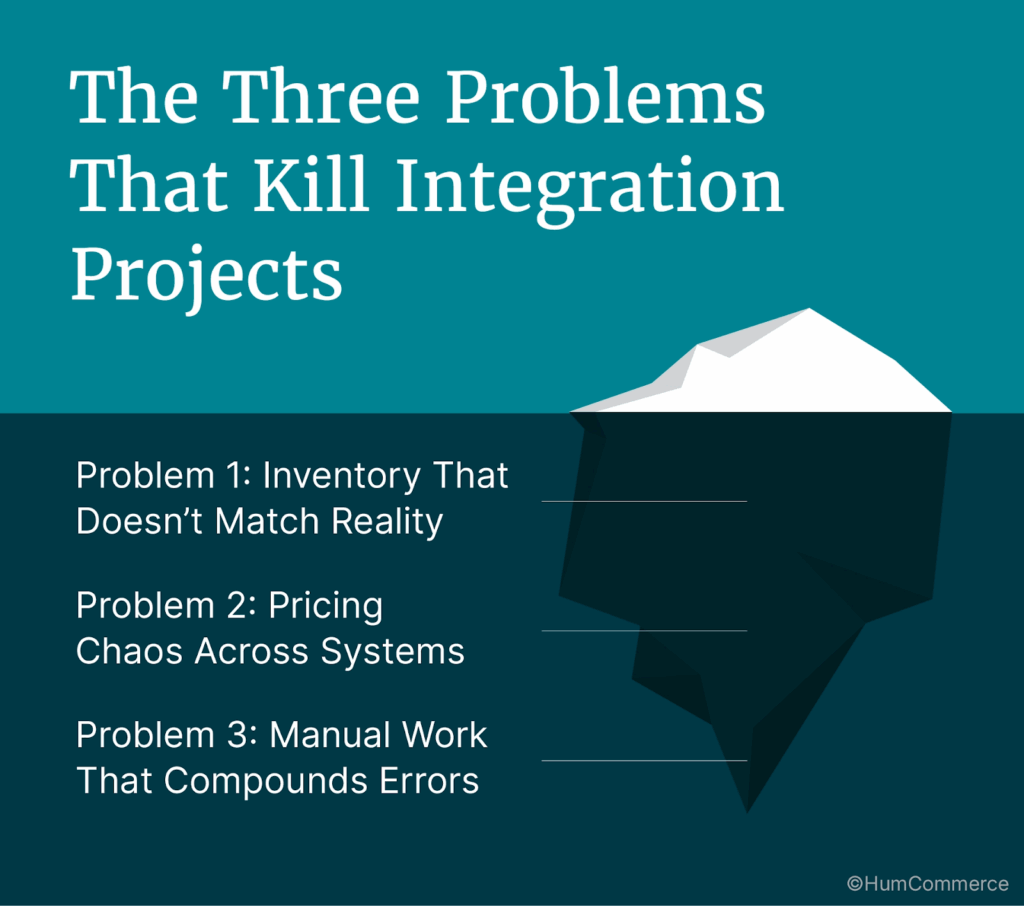
The Three Problems That Kill Integration Projects
Once you’ve chosen your architecture, you need to tackle three specific problems that cause most integration failures in the real world.
Problem 1: Inventory That Doesn’t Match Reality
What typically happens
- A customer places an order because your website shows the item in stock.
- Your warehouse checks physical inventory and discovers the item is unavailable.
- Your ERP still shows old perpetual inventory numbers from the last sync.
- You call the customer, cancel the order, and deal with the fallout.
Why it happens
- Inventory exists in multiple systems: ERP, WMS, and eCommerce.
- Each system updates on its own schedule.
- Each system is correct based on its last update, but they rarely match.
What a clean approach looks like
- Choose a single source of truth for inventory.
- Manufacturers often use the ERP.
- High-velocity operations may use the WMS because it reflects physical counts.
- Manufacturers often use the ERP.
- Set appropriate sync frequencies.
- High-demand SKUs: frequent syncs.
- Medium movement SKUs: hourly.
- Slow movement SKUs: daily.
- High-demand SKUs: frequent syncs.
- Add error handling.
- Alerts for failed syncs.
- Automatic retries.
- Conservative fallback behavior.
- If inventory cannot be confirmed, the website should show zero rather than risk overselling.
- Alerts for failed syncs.
What research supports
- Studies from supply chain and operations sources show that real-time tracking improves inventory accuracy and reduces carrying costs.
- These improvements translate into fewer stockouts, fewer cancellations, and better customer satisfaction.
Problem 2: Pricing Chaos Across Systems
What the customer sees
- The website displays one price.
- A sales rep quotes another.
- The invoice shows something different.
Why it happens
- Large B2B catalogs involve contract pricing, volume tiers, regional prices, and promotions.
- Pricing logic is often split among ERP, PIM, eCommerce, and CRM.
- Changes made in one system do not automatically appear in others.
- Ownership is unclear, so responsibility is scattered.
Models that work
- ERP-led model
- ERP owns list price and cost.
- PIM enriches product content but does not change price.
- eCommerce reads from PIM.
- CRM stores contract exceptions.
- ERP owns list price and cost.
- PIM-led model
- PIM manages channel and promotional pricing.
- ERP reads selling price for invoicing.
- Suitable for businesses with frequent price changes.
- PIM manages channel and promotional pricing.
- Hybrid model
- ERP owns cost and list price.
- PIM owns marketing attributes.
- A master data layer coordinates changes across systems.
- ERP owns cost and list price.
Governance required
- Clear ownership for each pricing type.
- Approval workflows for large pricing changes.
- Documented contract pricing and regional variations.
- Validation rules that prevent accidental overrides.
Problem 3: Manual Work That Compounds Errors
What a typical workflow looks like
- A buyer exports a purchase order from the ERP and emails it to the supplier.
- The supplier enters it manually into their system.
- The warehouse receives goods and updates the WMS.
- Someone reconciles the receipt against the PO in a spreadsheet.
- Accounts payable re-enters invoice data and matches everything again.
Why this is a problem
- Manual entry increases errors.
- Errors require rework, which increases cost.
- Teams spend hours on tasks that should take seconds.
- High volumes amplify both the workload and the risk of mistakes.
What the research shows
- Studies consistently report higher error rates in manual data entry compared with automated workflows.
- Companies that reduce manual work report fewer reconciliation issues and faster processing times.
What good automation looks like
- Orders automatically move from eCommerce or CRM into the ERP.
- Purchase orders are generated and sent to suppliers electronically.
- WMS updates inventory and sends accurate counts back to the ERP.
- Invoices pass through automated validation before human review.
- Teams focus on exceptions instead of every transaction.
The Governance Model Nobody Wants to Build
You’ve chosen your architecture. You’ve addressed the three big problems. Now comes the part that actually determines whether your integration succeeds long-term: governance.
Governance is boring. Nobody gets excited about documenting data ownership or defining quality standards. But governance is what prevents your integration from becoming a mess of conflicting data and finger-pointing about whose system is “right.”
Data Ownership
Data ownership answers a simple question: who is responsible for each piece of data?
Without clear ownership, conflicts multiply. Product master data changes in the ERP and the PIM doesn’t know. Customer records update in the CRM but the ERP has the old address. Pricing changes in eCommerce while the ERP still shows the old price.
For each major data domain, define one owner.
Product master data belongs to the ERP team. They create SKUs, maintain cost data, and manage GL coding. Product enrichment belongs to the PIM team. They add marketing content, images, and channel-specific attributes, but they cannot override cost or pricing without approval.
Customer master data is typically co-owned. CRM creates prospects and maintains contact information. ERP creates customers and manages accounts receivable. Daily sync keeps them aligned.
Order data is created in eCommerce but the ERP is the financial source of truth. eCommerce captures the order, ERP posts it to the general ledger.
Inventory is physical in the WMS and perpetual in the ERP. WMS maintains accurate physical counts, ERP maintains the perpetual balance, and they reconcile regularly.
The key principle: one owner per domain. Exceptions require documented approval.
Data Quality Standards
Define what “correct” means for each data type.
Every active SKU must have a name, category, unit of measure, cost, supplier, and GL account. Missing any required field means the record gets flagged and can’t sync.
Every customer must have a name, billing address, credit limit, and tax ID. Address format must match postal code patterns. Contact email is required.
Every order must have a valid customer ID, at least one valid SKU, quantity greater than zero, and delivery date. Missing required fields hold the order until someone reviews it.
Enforce these standards at the integration layer. When data fails validation, quarantine it in an error queue. Don’t delete it. Don’t silently accept it. Flag it for human review with a clear resolution deadline.
Organizations that implement data quality standards typically see data completeness improve from the mid-80s to 99% within a few months.
Monitoring and Reconciliation
You can’t manage what you don’t measure.
Daily, check your sync success rate. What percentage of orders synced without errors? Your target should be above 99.5%. Check data conflicts: how many SKU, customer, or order mismatches appeared? Keep this under 10 per day. Check sync lag time: how long from an event occurring to all systems being updated? Keep this under 30 minutes.
Weekly, run reconciliation checks. Compare ERP cost to PIM cost and investigate variances above 5%. Compare ERP perpetual inventory to WMS physical inventory and trigger cycle counts for variances above 2%. Compare CRM accounts to ERP customers and resolve any orphaned records. Compare eCommerce orders received to ERP orders posted and make sure they match.
Monthly, review all metrics with your steering committee. Look at trends. Address governance violations. Update standards if business needs have changed.
Build or buy a dashboard that shows sync status, data quality by domain, error queue depth, and reconciliation variances in real time.
The 12-Month Roadmap (How to Do This in Reality)
Now let’s talk about implementation. Because choosing the right architecture and governance is worthless if you can’t actually execute it.
Most companies quote 6-9 months for integration. They’re wrong. The real timeline is 12 months, and here’s why.
Month 1: Assessment & Alignment (The Month Most Projects Skip)
What happens if you skip this: You build the wrong architecture for your reality.
What to do instead:
Week 1-2: System Audit
- Map all systems: What are you running? How many? What does each do?
- Current integrations: What’s already connected? How? (manually? API? batch?)
- Data flows: Trace where data lives, how it moves, where it gets stuck
- Deliverable: Integration matrix showing all system dependencies
Week 2-3: Stakeholder Interviews
- Ops team: “What’s broken right now? What takes forever?”
- Finance: “Where do we spend time on reconciliation?”
- Sales: “Why do quotes take so long?”
- Procurement: “How do we get POs to suppliers?”
- Deliverable: Pain point analysis; prioritized list of “what hurts most”
Week 3-4: Architecture & Governance Workshop
- Steering committee (CTO, VP Finance, VP Operations, Head of Product): “Should we choose point-to-point, hub-and-spoke, or event-driven?”
- Walk through decision matrix: system count, data complexity, timeline, budget
- Decide governance model: Who owns product master? Who owns customer data? Who owns pricing?
- Deliverable: Architecture decision document; governance charter (draft)
Success criteria for Month 1:
- Everyone aligned on which architecture (no second-guessing later)
- Governance model documented and approved by steering committee
- 12-month roadmap approved with realistic resource needs
- Budget approved
Cost: Internal time only; no consultants yet ($0-$20K if you need external facilitation)
Typical mistake: Companies skip this and jump to “let’s pick middleware and start building.” They pick wrong architecture and regret it 3 months in.
Months 2-3: Architecture Design & Governance Foundation
Month 2: Technical Architecture Deep-Dive
If you chose hub-and-spoke: Evaluate middleware options
- Celigo (best for mid-market; pre-built connectors; $2-5K/month)
- Boomi (enterprise-grade; heavier; $5-15K/month)
- MuleSoft (robust; most complex; $10-30K/month)
- Custom (Kafka + microservices; only if $1M+ revenue in integration)
Evaluation criteria:
- Pre-built connectors: Do they have NetSuite? ERP? eCommerce? (saves weeks if yes)
- Error handling: Can it retry failed messages? Route to error queue?
- Monitoring: Dashboard showing sync health?
- Data transformation: Can it map field formats automatically?
- Cost per transaction: What’s the scale-up cost?
Decision: Select middleware; negotiate contract; procure licenses
Month 3: Governance Charter & Standards
- Finalize data ownership matrix: Who owns each domain? (draft from Month 1, finalize now)
- Define data quality standards: What must each record have? (product, customer, order)
- Set up governance team: Roles, cadence, escalation paths
- Create change management process: How do requests for data changes get approved?
- Build initial monitoring dashboard template
Success criteria for Months 2-3:
- Middleware selected and licensed
- Governance charter approved by all stakeholders
- Data quality standards documented
- Team trained on governance roles
Cost: Technology licensing ($2-5K/month); consulting if needed ($10-20K for architecture review)
Typical mistake: “We’ll figure out governance as we go.” No. Governance shapes everything. Get it right now.
Months 4-5: Core Integration (ERP ↔ eCommerce)
This is where real integration starts.
Month 4: Development & Testing in Sandbox
Build order sync (eCommerce to ERP):
- Map eCommerce order fields to ERP
- Build transformation logic (customer_id “123” in eCommerce exists as customer “C123” in ERP)
- Test scenarios:
- Valid order: Should post to ERP without error
- Order with new customer: Should create customer in ERP
- Order with invalid SKU: Should reject; log error
- Order with missing data: Should flag for manual review
- Error handling:
- If sync fails: Retry 3x, then escalate to error queue
- Manual override: Team can manually post order if needed
Build inventory sync (ERP to eCommerce):
- Hourly export from ERP inventory
- Transform to eCommerce format
- Update eCommerce catalog
- Test: Inventory change in ERP appears in eCommerce within 1 hour
Month 5: UAT & Go-Live
- User acceptance testing: Real users test order placement + inventory accuracy
- Load testing: Can system handle peak load? (test with 1000 orders in 1 hour)
- Data reconciliation: eCommerce orders is equal to ERP orders? (count and verify)
- Go-live: Deploy to production; run parallel (eCommerce + ERP running simultaneously) for 1 week
- Hypercare: 24/7 monitoring first 48 hours; daily check-ins for first week
Success criteria for Months 4-5:
- 100% order sync success (no dropped orders)
- <1 hour inventory sync lag
- 0 inventory mismatches after 48 hours
- All stakeholders trained on monitoring
Cost: Internal dev time; middleware transaction fees; no additional consulting (you’re self-sufficient now)
Typical problem: Orders sync, but 37% fail silently (like sports betting startup). Solution: Error queue alerting + auto-retry logic.
Months 6-7: PIM & Master Data Integration
Month 6: PIM Implementation & Data Migration
- Import product master from ERP to PIM: 10K-150K SKUs (depends on your portfolio)
- Data cleansing: Identify duplicates, missing fields, inconsistent formats
- Map attributes: ERP field to PIM field
- Channel setup: Define which attributes for website, which for marketplace
- Build sync logic:
- Daily: ERP cost to PIM (read-only; PIM team cannot override)
- Daily: PIM descriptions to eCommerce (catalog update)
- Weekly: Scheduled cost changes to ERP to PIM to eCommerce
Month 7: Enrichment & Publishing
- PIM team enriches products: Add descriptions, images, keywords for top 1000 SKUs
- Quality gates: Every product must have title, description, category, image
- Channel publishing: eCommerce catalog updated from PIM; Marketplace feeds created
- Testing: Search for product on website; verify correct price, stock, description
Success criteria for Months 6-7:
- 100% of active SKUs in PIM
- 95%+ products complete (title + description + category + image)
- Marketplace data errors <1%
- eCommerce catalogs in sync with PIM
Cost: PIM licensing ($1-3K/month); data cleansing (consultant or internal team)
Typical problem: PIM and ERP disagree on product hierarchy. Solution: Clear governance defining which system is authoritative for each attribute
Months 8-9: WMS/OMS & Order Orchestration
Month 8: OMS Integration (If Not Already in Place)
- Evaluate OMS: Extensiv, Brightpearl, NetSuite, or custom
- OMS connects to: ERP (get customer credit), WMS (check inventory), eCommerce (receive orders)
- Build order routing rules:
- Test: 100 test orders; verify optimal routing
Month 9: WMS Inventory Sync
- WMS ↔ ERP: Physical inventory scans update ERP
- Receiving: PO received in WMS to inventory posted to ERP
- Picking: Order picked in WMS to inventory decrement in ERP (real-time)
- Returns: Return processed in WMS to inventory increase + credit in ERP
- Reconciliation: Nightly batch checking (ERP qty vs. WMS qty); variance >2% is equal to flag for physical count
Success criteria for Months 8-9:
- 100% of orders routed correctly (to right warehouse)
- <1% inventory discrepancies (post-reconciliation)
- Order fulfillment time reduced 50% (was 48h, now 24h)
- 0 overselling incidents in past 30 days
Cost: OMS licensing ($0 if NetSuite; $1-5K/month if separate); no consulting (you’re experts now)
Typical problem: WMS and ERP inventory mismatch due to shrinkage/damage not being tracked. Solution: Cycle counting triggered by discrepancies
Months 10-11: CRM Synchronization
Month 10: Customer Master Sync
- Set up CRM ↔ ERP sync
- New customer created in CRM to posted to ERP with credit limit
- Customer address updated in ERP to CRM updated
- Test: Create customer in CRM; verify appears in ERP within 5 min
Month 11: Quote-to-Cash Sync
- Quote created in Salesforce
- Synced to ERP for pricing validation (does contract pricing apply?)
- ERP returns approved price
- Quote updated in Salesforce (showing approved price)
- Quote accepted to Order created in ERP
- Order synced back to Salesforce (sales rep visibility + commission tracking)
- Timeline for entire process: <30 min (was 24 hours manual)
Success criteria for Months 10-11:
- 100% of new customers synced from CRM to ERP
- <30-min quote approval time (was 24 hours)
- Quote accuracy 100% (no pricing mismatches)
- 90%+ quote-to-order conversion (was 60%)
Cost: CRM-ERP connector licensing ($1-3K/month); no consulting
Typical problem: Account hierarchy mismatches (CRM has parent company; ERP has regional divisions). Solution: Account mapping table
H2: Month 12: Optimization, Monitoring, & Handoff
- Tune performance: Identify bottlenecks; optimize queries/APIs
- Enable AI error correction: Auto-fix 88% of common errors; flag 12% for manual review
- Activate advanced reporting: Order-to-cash cycle, inventory accuracy, integration health trends
- Steering committee review: Did we achieve KPIs? What learned for next integration?
- Team enablement: Handoff from implementation team to operations team; ensure they can troubleshoot, monitor, maintain
Success criteria for Month 12:
- Integration uptime >99.9%
- All KPIs at or above targets
- Team confident in operations and troubleshooting
- Documented playbook for common issues
Cost: Minimal (no external consulting; internal team running it)
Your Action Plan
Before you commit to any integration project, you need clarity on where you actually stand.
The ERP Integration Readiness Checklist is a 50-point audit covering:
- Current system architecture (are you spaghetti or clean?)
- Integration gaps (what’s manual? What’s disconnected?)
- Governance readiness (do you have data ownership defined?)
- Team capability (can you execute? Or do you need partners?)
- Risk assessment (what could go wrong?)
Reality check: If you score <40/50, you’re not ready to start integration yet. You need Month 1-2 planning first.
If you score 40-60, you’re ready. Pick your architecture and go.
If you score >60, you’re ahead of most companies. You’re ready to scale to multiple systems.
Determine Your Integration Partner
You have three options:
Option 1: Build Yourself (If you have strong internal dev team)
- Pros: Full control; lowest cost; your team learns integration architecture
- Cons: Takes 18-24 months; requires deep technical expertise
- Risk: High likelihood of expensive mistakes
Option 2: Hire Implementation Consultant (If you have money; need fast execution)
- Pros: Accelerates timeline; leverage their expertise; de-risks execution
- Cons: Expensive ($100K-$500K depending on scope); team becomes dependent on vendor
- Reality: This is what the sports betting startup did after their first integration failed
Option 3: Hybrid (Recommended for most)
- Internal team + consulting for architecture/governance months
- Consulting for months 2-3 (governance + architecture review)
- Internal team execution for months 4-12 (they own build + operations)
- Consulting for month 12 review (lessons learned)
- Cost: $50K-$150K consulting; internal team learning + execution
- Outcome: Your team becomes integration experts; future projects are self-sufficient
Conclusion: From Chaos to Clarity
Remember the sports betting startup that lost $7.4M in revenue due to a failed integration?
They learned the hard way. You don’t have to.
Your integration isn’t a technical implementation detail. It’s a strategic decision that determines whether you can scale or whether you become paralyzed by disconnected systems.
Choose the right architecture (hub-and-spoke for most). Establish clear governance (data ownership prevents wars). Execute the 12-month roadmap (not the vendor’s fantasy 6-month timeline). Monitor relentlessly (catch issues before customers do).
The result: Systems that talk to each other. Data that means the same thing everywhere. Operations that run smoothly. Revenue that gets captured on day one, not day seven.
That’s the goal. This blog shows you how to get there.
HumCommerce specializes in exactly this: Building seamless ERP integrations for manufacturing and B2B distribution companies. We’ve guided 100+ mid-market companies through their integration journey from architecture decisions to post-go-live optimization.
We believe companies that understand integration architecture make better decisions, execute faster, and build lasting competitive advantage. That’s why we created this handbook.