
TL;DR
The Challenge: Most B2B manufacturers and distributors manage product data the same way
they did five years ago manually across multiple systems. This costs businesses up to 30% of revenue through inconsistencies, slow launches (16 days average), and wasted operational time (50% of team capacity).
The Core Problem: Without a centralized PIM system, you’re managing product information separately for your direct website, marketplace channels (Amazon, Walmart), and distributor networks each with completely different data requirements, formats, and technical constraints.
The Solution: A product information management system built on three core mechanics -master data in one place, intelligent transformation rules for each channel, and real-time syndication automatically keeps your data consistent, accelerates launches, prevents overselling, and maintains channel-specific pricing strategies without margin erosion.
You’re running a B2B business. You’re selling through your direct website, Amazon, Walmart, distributor networks, and maybe even print catalogs.
Each channel has different requirements, different expectations, and most importantly different consequences when data goes wrong.
The problem is that you’re probably managing product data like you did five years ago, when you had one channel.
Studies show that poor product information management costs businesses up to 30% of their revenue. That’s your margin, your growth, your competitive advantage slipping away because product data isn’t where it needs to be, when it needs to be there, in the format that each channel requires.
And here’s what makes it worse: this problem compounds. Every day you don’t fix it, more data inconsistencies pile up. More manual workarounds get created. More of your team’s time gets spent fixing problems instead of growing the business.
Three Critical Data Challenges That Are Costing You 30% of Revenue
Before we talk about solutions, let’s be honest about what’s actually broken.
Problem 1: When Buyers See Conflicting Product Information
Your Amazon listing says the product weighs 2 pounds, Walmart feed says 1.8 pounds, B2B portal shows “weight: 2 lbs (approx)” and your distributor portal is missing the weight entirely.
It’s the same product but your buyers see three different versions.
This creates confusion. Customers don’t know what they’re actually getting, returns go up, reviews mention inconsistencies. You lose trust.
And here’s the operational nightmare: when customers report inconsistencies, your team has to manually track down the right information, figure out which source is correct, and then update everything else. This takes time and people. And this keeps happening because you don’t have a single system of record.
The research is clear: 86% of shoppers will permanently abandon a brand after experiencing bad product data.
Problem 2: From 16-Day Launches to 24-Hour Rollouts: The Speed You’re Losing Without a PIM
You have a new product ready to go but before you can sell it anywhere, you need to gather information from multiple sources, clean it up, enrich it, create channel-specific versions for Amazon (with their title requirements), Walmart (with their Item Spec 5.0 format), your B2B portal (with technical specs and compliance docs), and your distributor network (with EDI-compliant data).
Studies show this process takes an average of 16 days just to gather and collate product information. Then you’re enriching it, managing approvals and manually uploading to each channel.
Meanwhile, your competitor launched the same product three days ago.
And that’s if everything goes right. When data is missing or wrong, you’re back to square one. You’re chasing down suppliers for spec sheets, redoing category assignments and rewriting descriptions because they don’t match what you uploaded to Amazon last month.
70% of companies report that manual processes are slowing their time-to-market.
Problem 3: You’re Wasting Incredible Amounts of Time on Tasks That Machines Should Handle
Your team spends time that should be strategic on work that’s purely operational.
Updating a price in your ERP? That should ripple to Amazon, Walmart, and your portal automatically. Instead, someone manually updates each one. Product description needs a small change? That should syndicate everywhere at once. Instead, multiple people touch it in multiple places.
And worst of all, when you do this manually, inconsistencies sneak in. Someone updates the description on Amazon but forgets the B2B portal. Someone changes the price for one channel but not another.
Employees spend up to 50% of their time correcting data errors instead of doing actual strategic work.
The PIM Strategy for Multi-Channel Success
Here’s what we know from working with successful manufacturers and distributors: the companies winning in this environment aren’t the ones working harder. They’re the ones with a strategy.
Each channel has different requirements, different audiences, and different technical constraints. What works is having one source of truth that intelligently adapts to what each channel needs.
Direct, Marketplace, Distributors: Why One-Size-Fits-All Data Management Fails
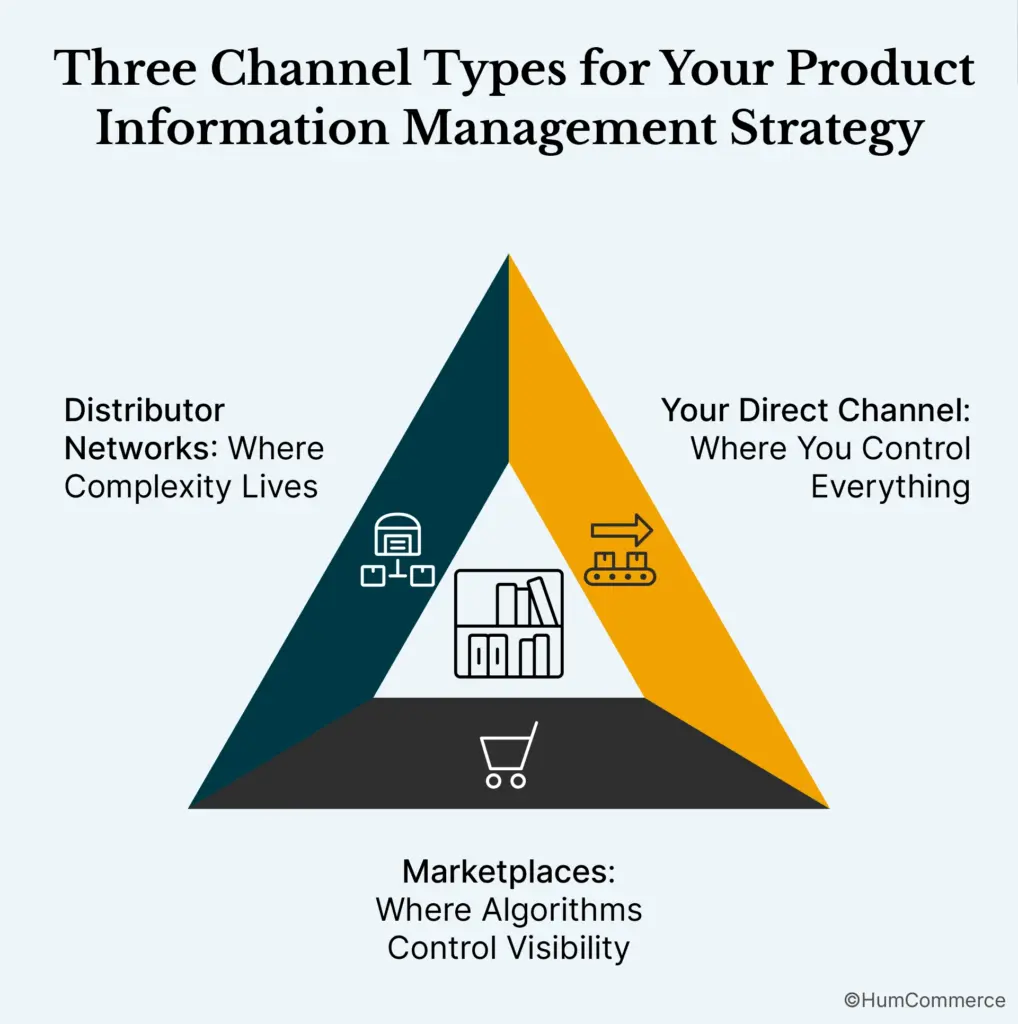
Most companies treat all their channels the same way. That’s the first mistake.
Your direct website, marketplace presence, and distributor network aren’t just different places to sell. They’re different business models with different requirements and different economics. Understanding this distinction changes how you think about product data.
Your Direct Channel Is Your Competitive Advantage
When someone lands on your website, you control what they see. You control the layout, the images, the descriptions, the experience. There’s no platform between you and your customer.
This is actually an advantage. It means you can be comprehensive. You can tell the full story of your product which includes rich descriptions, multiple images, technical specifications, compliance documentation, whatever helps your buyer make a decision.
On your direct channel, product data should be rich, detailed, and aligned with how your customers actually research and buy. You’re not limited by character counts or mandatory attributes that come from a platform. You’re limited only by what’s useful to your customer.
For B2B buyers especially, this is where they do serious research. They want technical details, compliance information, dimensional drawings, material specifications. Your direct channel should reflect that depth.
Marketplaces: Where Algorithms Control Visibility
Amazon, Walmart, and other marketplaces are different animals entirely. You don’t control the presentation. The platform does. Your job is to give the platform exactly what it needs to make your product discoverable and accurate.
This sounds simple. It’s not.
Amazon has specific requirements for product titles (200 characters, front-loaded keywords), bullet points (5 bullets, 500 characters each), descriptions (2,000 character limit), and browse node categorization that determines where your product appears in search. Get any of this wrong and your product either doesn’t show up or shows up in the wrong place.
Walmart’s requirements are different. They migrated to Item Spec 5.0 format, which requires Product Type Groups and Product Types instead of the old category structure. Miss this migration and your listings get rejected.
Each marketplace has different image requirements too. Amazon wants 1000x1000px minimum with pure white backgrounds. Walmart has different dimension specs per category. Both require specific image types and reject watermarks.
The critical insight: marketplaces don’t just have different requirements. They have different economics. Marketplace fees are typically 15-20% of the sale. Your direct channel has no fees. This changes your pricing strategy, your margin protection needs, and your approach to MAP (Minimum Advertised Price) policy enforcement.
On marketplaces, incomplete or misclassified data directly kills visibility. Research shows that 50% of product disapprovals and listing rejections stem from data errors. You can’t afford sloppy data here.
Distributor Networks: Where Complexity Lives
Your distributor partners operate in a completely different world. They’re integration partners who need machine-readable, standards-compliant product data.
This is where ACES/PIES comes in if you’re in automotive. This is where GS1 GTINs, EDI document standards, and compliance certifications become non-negotiable.
A distributor doesn’t want your marketing description. They want technical specifications in a specific format, unit of measure standardization, compliance documentation, pricing that reflects their contract terms and data they can integrate directly into their systems without manual intervention.
60% of distributors report product data inconsistencies as a major challenge. And when data is inconsistent, it flows through their entire operation. They can’t quote accurately. They can’t manage inventory. They can’t fulfill orders efficiently.
How Channel-Specific Attribute Requirements Works
This is where things get practical. Every channel needs different information, formatted differently, in different structures.
Amazon
- Title: Max 200 characters
- Five bullet points: 500 characters each
- Description: Up to 2,000 characters
- Images: Minimum 1000x1000px, white background
- Browse node IDs and ASIN mapping
- Optional A+ content
- Parent–child relationships for variations (variant-specific attributes required)
Walmart
- Mandatory: Product Title + Product Type (misclassification = rejection)
- Multiple images (dimensions vary by category)
- Pricing and inventory in Walmart-specific formats
- Compliance attributes (origin country, materials, etc.)
- Mandatory vs. conditional fields depend on category
B2B Portals
- Product name + part number
- Technical specs (weight, dimensions, materials, certifications)
- Images showing installation/use context
- PDF documentation: spec sheets, compliance certs, CAD files
- Customer-specific pricing and availability
- Bulk or custom configuration options
Distributors
- Master SKU + GTIN/GTIN-14
- Unit-of-measure standardization
- Compliance certifications (CE, FDA, UL, etc.)
- Detailed spec sheets
- Pricing in EDI format
- Compatibility data (e.g., Year/Make/Model using VCdb for automotive)
How Top Manufacturers Automate Product Data Transformation Across Every Channel
This is where a proper product information management system becomes essential. You can’t manually transform data for every product and every channel. You need architecture that does this intelligently.
Here’s how it works in practice:
Step 1: Master Data Lives in One Place
Your PIM system becomes the central source of truth. All product information – complete, accurate, and standardized – lives here. Specs, images, pricing, compliance docs, everything.
This is a dedicated system built specifically for managing product information across channels.
Step 2: Channel Mapping Rules Define Transformation
You define rules for how master data transforms for each channel. These rules are the intelligence that makes a true multi-channel strategy possible.
For example, a simple title transformation rule might look like: “For Amazon: Brand + Product Name + Key Differentiator (Size/Color) + Quantity, max 200 characters.”
Or: “For Walmart: Product Name + Key Attribute, following their mandatory format for this Product Type, max 150 characters.”
Or: “For distributors: Part Number – Product Name – Unit of Measure.”
These rules apply automatically. You update the master product once. The PIM applies the transformation rules and creates channel-specific versions.
Step 3: Real-Time Syndication
When master data changes, the system propagates that change to every channel automatically. Price changes? They sync to Amazon, Walmart, and your B2B portal simultaneously. Description update? It transforms for each channel and publishes everywhere.
This solves the consistency problem. Because data flows from one source through transformation rules, everything stays aligned.
Step 4: Error Detection and Handling
A good PIM system validates data before it’s syndicated. It checks that required fields are complete, that character limits are respected, that files are the right format. If something’s wrong, it flags it and stops publication until it’s fixed.
This prevents bad data from reaching marketplaces. You catch problems before Amazon or Walmart does. You avoid rejections, account warnings, and the nightmare of having to troubleshoot why your listings disappeared.
Stop Overselling Before It Starts: Real-Time Inventory Sync Across All Channels
Here’s a scenario that probably sounds familiar: You have 50 units of a product in stock. You list it on Amazon, Walmart, and your B2B portal. Amazon gets 30 orders. Walmart gets 25. Now you have 5 more orders than inventory.
Your customer service team is dealing with angry buyers. Your ops team is scrambling to figure out what to ship and what to cancel. Your marketplace account health is taking a hit because of the spike in cancellations.
This happens because your channels aren’t connected. Each one thinks it has access to the full inventory. There’s no real-time deduction across channels.
The solution is architecture. You need a unified inventory management system that connects your PIM, eCommerce platform, ERP, warehouse management system, and marketplace channels into one integrated view.
When an order comes in on any channel, that channel deducts from the unified inventory immediately. All other channels see the updated count in real-time. You never oversell because all channels are looking at the same, constantly updated number.
This requires real-time integration. Event-driven sync, not batch processes. When Amazon reports an order, your system immediately updates inventory. When your B2B portal processes a bulk order, that immediately reduces what’s available elsewhere.
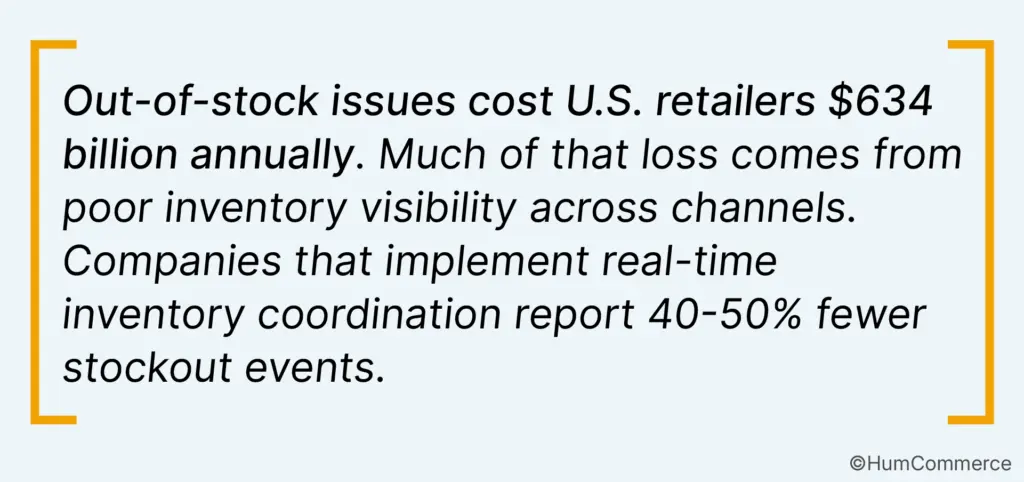
Out-of-stock issues cost U.S. retailers $634 billion annually. Much of that loss comes from poor inventory visibility across channels. Companies that implement real-time inventory coordination report 40-50% fewer stockout events.
Price Alignment Without Margin Erosion: The Channel-Specific Pricing Strategy That Works
You might think pricing is simple. Set a price, sell it everywhere but that’s where many companies go wrong.
Here’s the complexity: your margins are different by channel. Marketplace fees are 15-20%. Your direct site has no fees. EDI orders from distributors might have volume-based pricing. Contract customers might have negotiated rates.
If you charge the same price everywhere, you’re either eating margin on marketplaces or pricing yourself out of competitiveness on your direct channel.
But here’s the other problem: if prices are inconsistent, customers notice. A customer finds your product on Amazon at $100, then visits your website and finds it at $95. They feel manipulated. They question your authenticity. They leave negative reviews.
60% of shoppers lose trust in a brand when they see price differences across channels. That’s a permanent churn.
The solution is transparent, rule-based pricing. Your PIM system can apply pricing rules per channel that account for fees and still keep a margin guardrail in place.
For example:
- Base price: $100
- Amazon rule: Base + 20% (to cover fees and protect margin) = $120
- Direct channel rule: Base price = $100
- Distributor rule: Base – 10% (volume discount) = $90
These rules update automatically if base price changes. Everything stays aligned. Margins stay protected. Prices remain consistent with clear logic behind them.
The key is that this logic is transparent and applied systematically. You’re not gaming customers. You’re being smart about margin protection while keeping pricing fair.
The Media Management Problem And How PIM + DAM Integration Solves It
Product data isn’t just text. It also includes images, spec sheets, compliance documentation, CAD files, and video.
And here’s where most companies stumble: their images are scattered everywhere. Some in the ERP. Some in the eCommerce platform. Some in a shared drive. Some in marketing’s asset management system.
When you need to update an image, you have to hunt through multiple systems to find the right version. You update it in one place and forget it in another. You send the wrong image to a marketplace. Specs get out of date. Compliance docs expire.
This is the PIM + DAM (Digital Asset Management) integration problem.
A modern PIM doesn’t just manage metadata. It manages the media too. Or more precisely, it integrates with your DAM system so that when a product record in PIM references an image, that reference always points to the current, approved version.
When an image is updated in DAM, that update automatically flows to all products using that image. When a new spec sheet is uploaded, it’s immediately available to all channels that reference it.
More importantly, channel-specific transformations apply to media too. A product image for your B2B portal needs to be different from the image for Amazon (white background, specific dimensions, no lifestyle context). A PIM + DAM system manages these variations automatically.
You upload a master image once. The system automatically creates channel-specific versions: Amazon version (1000×1000 white background), Walmart version (specific dimensions per category), direct site version (high-resolution), B2B portal version (technical diagram).
This eliminates the worst part of the manual process: the hours spent recreating images for different platforms.
Building the Architecture: Real-Time Sync Without the Chaos
You can’t build this with spreadsheets. You can’t build this by manually uploading to each platform. You need an integrated system architecture.
Here’s what it looks like at the highest level:
Central PIM System receives product information from your ERP, from supplier feeds, from your internal teams enriching content. This is the hub.
Channel Transformation Layer takes master data and applies channel-specific rules. This happens automatically based on rules you’ve defined.
Real-Time Syndication pushes transformed data to marketplaces via their APIs (Amazon SP-API, Walmart API), to your eCommerce platform, and to your B2B portals.
Feedback Loop monitors whether syndication succeeded or failed. If a listing was rejected, the system flags it so your team can investigate. If inventory needs updating, that information flows back to your ERP.
This architecture only works if your systems are actually connected. Your PIM needs APIs to talk to marketplaces. Your eCommerce platform needs to sync inventory in real-time. Your ERP needs to feed product data to PIM.
The result: product information flows from one source through intelligent transformation into every place it’s needed, and feedback flows back to help you maintain quality.
Marketplace API Integration, Everything You Need to Know
If you’re selling on Amazon or Walmart programmatically (which you should be), you need to understand the APIs you’re working with.
Amazon uses the Selling Partner API (SP-API). This is a REST-based API that lets you submit products, get real-time inventory data, manage orders, and everything else programmatically. It replaces the old MWS (Marketplace Web Services). SP-API uses OAuth 2.0 authentication, which is more secure than the old signature-based approach.
When you syndicate to Amazon via SP-API, you’re sending structured product data with specific required fields. Get the format wrong and the API rejects your submission. Get the data wrong and the product gets listed incorrectly or rejected by their quality gates.
Walmart uses a different API structure. They’ve moved to Item Spec 5.0, which requires you to define Product Type Groups and Product Types precisely. Wrong Product Type? Your listing gets rejected hard. No negotiation.
Both marketplaces have rate limits. You can’t hammer their APIs. You need to respect throttling. Most modern PIM systems handle this for you, they queue submissions and respect marketplace rate limits.
The critical point: API integration isn’t a one-time setup. These platforms change their APIs, add new fields, deprecate old ones. You need monitoring to catch when something breaks.
EDI for Distributor Integration: The B2B Standard You Can’t Ignore
If you’re selling through distributors, they’re probably sending purchase orders via EDI (Electronic Data Interchange). This is an older but incredibly stable standard for B2B document exchange.
Common EDI documents include:
- EDI 850: Purchase Orders (distributor to you)
- EDI 855: Purchase Order Acknowledgments (you to distributor)
- EDI 856: Advance Shipping Notices (you to distributor, tells them what’s shipping)
- EDI 810: Invoices (you to distributor)
Distributors don’t just want to buy from you via EDI. Many also want product data via EDI feed. This means your PIM needs to export product information in EDI format that their systems can ingest directly.
This sounds technical, but the key requirement is standardization. Your product data needs to follow industry standards – GS1 for GTINs, ETIM for certain industries, ACES/PIES for automotive.
When you send non-standard or incomplete data to a distributor via EDI, they charge chargebacks. These can run 5% of order value.
Many companies work with EDI translation service providers who handle the technical conversion. But the fundamental requirement is that your PIM exports data in a standard format that distributors can actually use.
The Governance Question: Who Approves What, and When?
Better technology doesn’t solve bad governance. You can have the best PIM system in the world but if nobody knows who’s responsible for what, you’ll still have inconsistent data.
Effective product data governance means:
Clear ownership. Someone owns each product category. They’re responsible for ensuring that product data is complete and accurate.
Defined workflows. Before a product is published to any channel, it goes through approvals. Marketing approves the description. Compliance approves the certifications. Operations approves the inventory setup. Nobody can publish without sign-off.
Role-based access. Not everyone should be able to edit product data. Product managers can, but customer service reps shouldn’t be modifying specs.
Audit trails. Every change to a product record should be tracked. Who changed it? When? Why? This is essential for compliance and for understanding what went wrong when something does.
Data quality standards. Define what “complete” means for different product types. For a software product, completeness might mean: title, description, at least 3 images, spec sheet, pricing. For a distribution product, it might include compliance certifications.
When governance is clear, your team knows what’s expected. When it’s unclear, everyone guesses, and guesses conflict.
Measuring Success: How Do You Know This Is Working?
Implementation is one thing. Proving value is another.
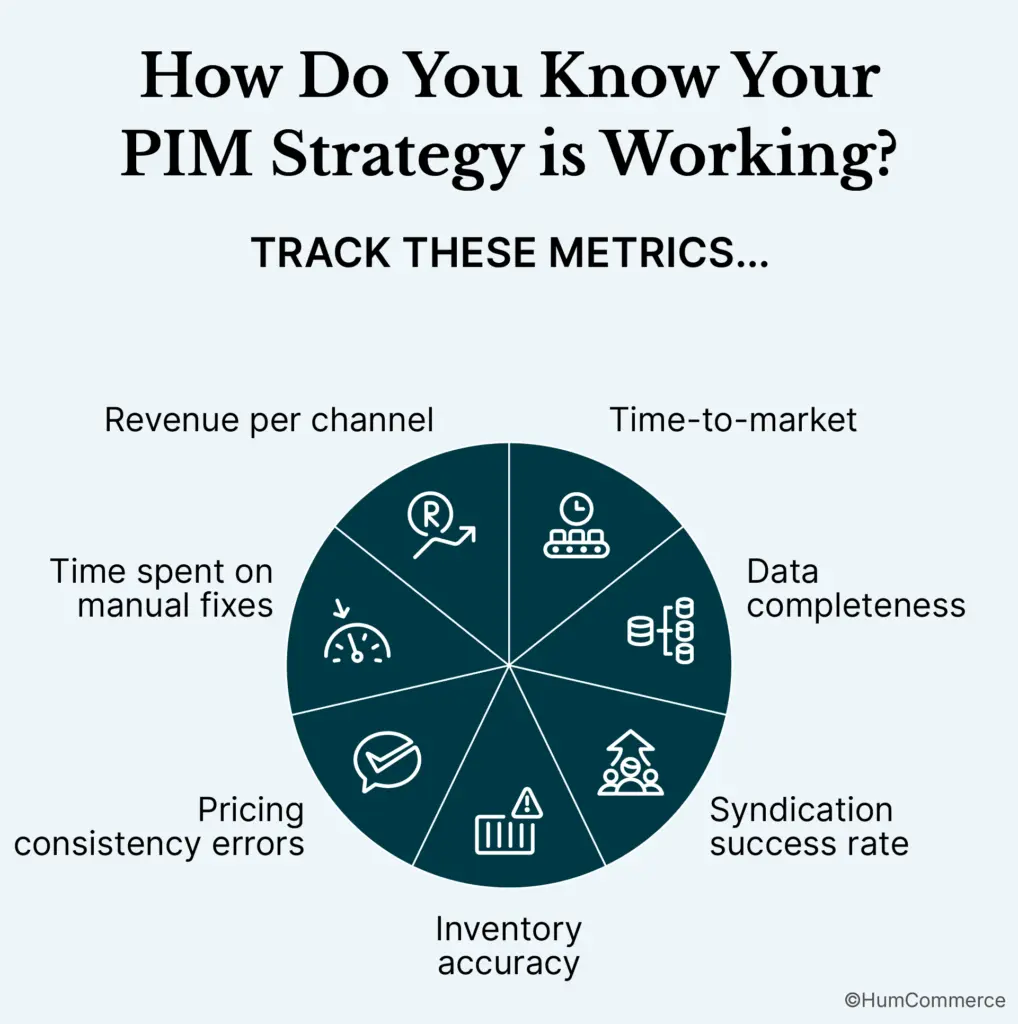
Track these metrics:
Time-to-market: How long does it take from “new product ready” to “live on all channels”? This should drop from weeks to days once you have a proper PIM strategy.
Data completeness: What percentage of your product information is complete and ready for each channel? This should be tracking toward 95%+.
Syndication success rate: What percentage of products published to marketplaces without rejection on first attempt? Aim for 98%+.
Inventory accuracy: How often do you oversell because of inventory sync problems? Track this monthly. It should trend toward zero.
Pricing consistency errors: How many times per month do you discover pricing inconsistencies across channels? This should drop to near zero.
Time spent on manual fixes: Track how many hours your team spends manually correcting data errors or reconciling information across systems. This should drop 40-60% with proper PIM implementation.
Revenue per channel: Track how your sales move on each channel before and after implementing a proper multi-channel strategy. Most companies see 10-20% improvement in channel revenue once data is consistent and complete.
The research is clear: companies implementing a proper PIM strategy see ROI of 96%, with most ROI coming from reduced manual labor, faster launches, and improved channel performance.
What You Need to Do Right Now
Implementing a multi-channel PIM strategy isn’t something that happens overnight. But it also doesn’t need to be a painful multi-year project.
First: Take inventory. Where does your product data live right now? How many systems do you manage it in? How often do inconsistencies happen? What’s the business impact?
Second: Prioritize. Not every product needs the same level of enrichment right away. Start with your highest-revenue SKUs. Get those working perfectly. Then expand.
Third: Define your governance. Before you implement technology, get clear on who’s responsible for what. What does “complete” mean for your products? Who approves changes? What’s the workflow?
Fourth: Choose your platform. A product information management system is only useful if it actually connects to where your data needs to go. Make sure whatever you choose integrates with your ERP, your eCommerce platform, and your marketplace APIs.
Fifth: Start with one channel. Get your direct website data consistent and complete. Then add Amazon. Then Walmart. Then distributors. Each layer you add is easier because the foundation is already solid.
Finally: Measure and iterate. Once you have the system in place, track those metrics we talked about. See what’s working. Double down on it. Fix what isn’t working.
Download Your Multi-Channel PIM Checklist
We’ve created a comprehensive checklist to help you assess your current state and map out your implementation plan. It includes:
- Channel-specific attribute requirements comparison
- Data transformation rule templates
- Real-time sync architecture overview
- Inventory coordination setup guide
- Governance workflow checklist
- ROI calculation worksheet
This checklist helps you and your team get aligned on what needs to happen next.
Download the Product Data Accuracy Audit Template
Time to Act: Transform Your Product Data Strategy Now
The companies dominating multi-channel B2B commerce aren’t doing it through brute force. They’re doing it through intelligence. They’ve invested in the infrastructure to manage product data systematically. They’ve built governance that ensures consistency. They’ve chosen technology that connects all the pieces.
And the result? They launch products faster. They have fewer errors. Their customers have better experiences. They capture more revenue from the channels they’re in.
You can have the same thing. It starts with recognizing that product data isn’t just a marketing problem. It’s an operational, strategic, and revenue problem. And when you treat it that way with the right system, the right governance, and the right approach everything changes.
Your next product launch doesn’t have to take three weeks of manual data wrangling. Your inventory doesn’t have to go out of sync across channels. Your team doesn’t have to spend half their time fixing data errors. Your customers don’t have to see inconsistent information.
All of that is fixable. It starts with a strategy. It continues with the right system. And it succeeds with disciplined execution.
HumCommerce specializes in exactly this.
We’ve helped manufacturers and distributors across automotive, building materials, industrial supply, and pharmaceutical industries build PIM strategies that work. We integrate product information management with your existing ERP, eCommerce platform, and marketplace channels creating a unified architecture that makes multi-channel selling predictable instead of chaotic. Our approach combines Adobe Commerce integration, real-time inventory coordination, and data governance frameworks that scale as your business grows.
The question isn’t whether you can implement a proper multi-channel PIM strategy. The question is: how much longer can you afford to wait?Ready to transform your product data strategy? Let’s talk about how HumCommerce can help you launch faster, eliminate data errors, and reclaim your team’s time. Contact us today to explore a PIM approach built for B2B commerce.