
TL;DR
- Orphan data (fields with no clear owner) costs B2B companies $200K-$500K+ annually in wasted labor, compliance fines, and lost marketplace revenue
- The solution: Break product data into four ownership domains (Technical/Commercial/Marketing/Compliance), assign clear owners, implement the 5-Gate workflow, and automate validation
- Companies using this model improve from 60% to 95%+ data quality in 12 weeks
- Download the PIM Data Ownership Matrix to get started
In the 2023 United States Grand Prix, Lewis Hamilton drove one of the best races of his life. He finished second, just seconds behind Max Verstappen. Then, two hours later, he was disqualified.
The reason? A wooden plank on the bottom of his car had worn down by less than 1 millimeter.
Mercedes failed because of a data governance error. In their pursuit of performance (lowering the ride height), they ignored a critical compliance constraint. The result was a total erasure of points. The effort was wasted because the data validation failed.
For B2B digital transformation leaders, this scenario is terrifyingly familiar. You are being asked to drive faster – automate more marketplaces, launch AI search, expand to new regions but your data “ride height” is unchecked.
You’re worried about the $500,000 FDA fine because a compliance attribute was left blank. You’re worried about Amazon Business rejecting 40% of your catalog because “Material Type” didn’t map correctly. You’re worried that your “AI Search” project will fail because it’s learning from orphan data.
Governance is not red tape. In Formula 1, brakes aren’t installed so the car can go slow; they are installed so the car can drive at 200mph without crashing.
This is your playbook for installing those brakes.
Nobody Owns This Field” And It’s Costing You $500K a Year
Most B2B organizations suffer from the “Orphan Data” Paradox.
Companies spend millions on ERPs (SAP, Epicor, NetSuite) and PIMs (Pimcore, Akeneo), yet the actual data inside them often has no legal guardian.
- The Symptom: Engineering assumes marketing owns the “technical specs” field. Marketing assumes ERP owns it. IT manages the database but doesn’t know a voltage rating from a viscosity index.
- The Result: A “blob” of 50,000 SKUs where critical fields are populated by guesswork, “TBDs,” or legacy copy-pastes from 2019.
The cost of this ambiguity is rarely measured, but it is massive.
- The Compliance Hit: In 2024, the U.S. food and manufacturing sectors saw a spike in recalls not due to product defects, but due to labeling errors, undeclared allergens or missing safety warnings caused by data disconnects.
- The Automation Tax: If you try to automate marketplace listings with dirty data, you are simply scaling your errors. Instead of one wrong listing on your website, you now have 10,000 wrong listings on Grainger, Zoro, and Amazon amplifying the risk of returns and account suspensions.
You cannot solve this with a “data cleanup sprint.” Product Data Accuracy Audit Template
The Hidden Architecture: The Four Data Tribes Inside Your PIM
If I walked into your office and pointed to the “Hazardous Material Class” field in your PIM, could you name the specific human being accountable for it? Not a department (“Logistics”). A role.
If you can’t, you don’t have a data problem. You have a people problem.
To fix this, you must break your product data into four distinct domains. Each domain operates under different rules, owned by different “Pit Crew” members.
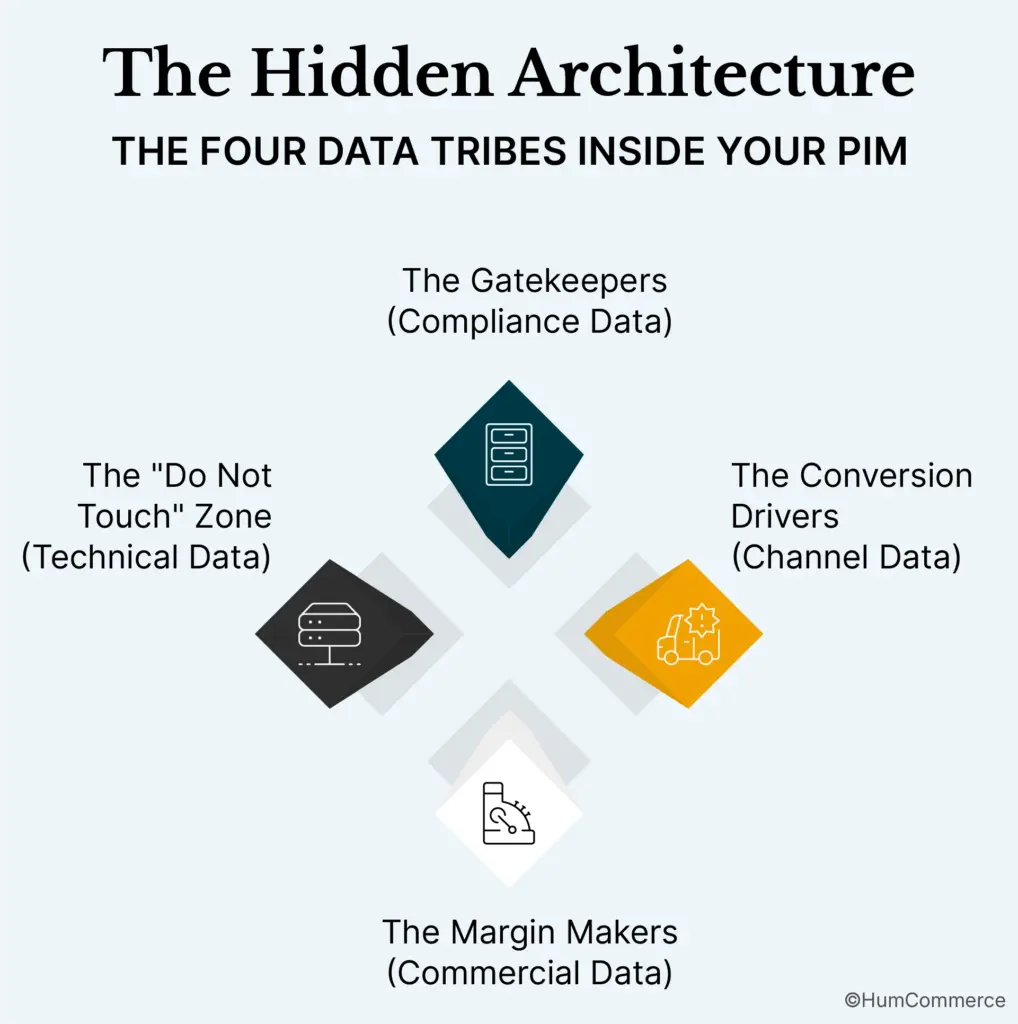
Domain 1: The “Do Not Touch” Zone (Technical Data)
This is the immutable truth of the product.
- Attributes: Dimensions, Tolerances, Voltage, CAD Drawings, Material Composition
- The Owner: Engineering / R&D
- The Rule: Read-Only for everyone else. Marketing cannot “tweak” a voltage rating to make it fit a customer request. If this data is wrong, people get hurt or lawsuits happen
- System of Record: PLM or ERP
Domain 2: The Margin Makers (Commercial Data)
This data is fluid and time-sensitive.
- Attributes: Pricing Tiers, MOQs (Minimum Order Quantities), Lead Times, HS Codes
- The Owner: Sales Ops & Logistics
- The Rule: Automated Expiration. A price from 2023 is not data; it is a liability. Governance rules must flag or expire commercial data that hasn’t been refreshed in X months
- System of Record: ERP
Domain 3: The Conversion Drivers (Channel Data)
This is subjective, persuasive, and optimized for algorithms.
- Attributes: SEO titles, romance copy, lifestyle images, and cross-sell relationships.
- The Owner: Digital Marketing and eCommerce
- The Rule: Accuracy is less important than optimization. This should change often based on A/B testing and search trends, unlike engineering data.
- System of Record: PIM
Domain 4: The Gatekeepers (Compliance Data)
The hard “No.”
- Attributes: Prop 65 warnings, CE certificates, FDA/DSCSA numbers, and the country of origin
- The Owner: Officer of Legal and Compliance
- The Rule: The Hard Lock. If a mandatory compliance field is blank, the product can’t be published. No exclusions. No “we’ll fix it later”
The Marketplace Mirage: Why 40% of Your Catalog Gets Rejected
In F1, teams rely on telemetry to predict failures before they happen. If a sensor detects a rise in tire temperature, the team adjusts strategy before the tire blows out.
In B2B commerce, your “blowout” is a marketplace suspension. Amazon Business, Grainger, and MSC Industrial have strict taxonomy rules. If you send them garbage data, they won’t just reject the product; they will penalize your account health.
How to Turn Your PIM Into a Telemetry Engine (Before It Blows)
You cannot have one “Description” field for every channel. That is a rookie move. You need Governance Rules that act as your telemetry.
- The Scenario: Your ERP description is “VLV-BALL-0.5-SS”.
- The Governance Rule:
- IF target channel is Amazon: Construct Title as [Brand] + [Series] + [Material] + [Size]
- IF Material is missing: STOP. Do not publish. Flag for “Commercial Owner” review
- IF target channel is Webstore: Use Marketing_Romance_Copy
- IF target channel is Amazon: Construct Title as [Brand] + [Series] + [Material] + [Size]
This logic turns your PIM from a storage bucket into an active decision engine. It ensures that you only publish “Golden Records” data that meets the specific regulatory and structural requirements of the destination.
When Your CAD Drawings Go Rogue: The Media Governance No One Talks About
Here is a scenario that kills margins:
Engineering updates a CAD drawing in the PLM system to “Version 3”. Marketing, unaware of the change, continues to display “Version 2” PDFs on the product page.
A customer downloads the old spec, machines a custom fitting based on it, and… it doesn’t fit. Return. Refund. Churn.
Build the “Self-Healing Loop”
Governance isn’t just about text; it’s about the relationship between files and data. A mature PIM/DAM setup creates a “Self-Healing” loop:
- The Trigger: Engineering approves “Drawing_V3” in the PLM.
- The Signal: The integration layer detects a new revision timestamp.
- The Action: The PIM automatically un-publishes the old asset and flags the SKU as “Review Required.”
- The Result: You never accidentally sell a new product with old instructions.
The 5-Gate Playbook: Installing Your Data Bouncer
You don’t need to hire a Chief Data Officer to fix this. You need to implement a workflow that enforces your Matrix. Think of it as installing a “Bouncer” at the door of your PIM.
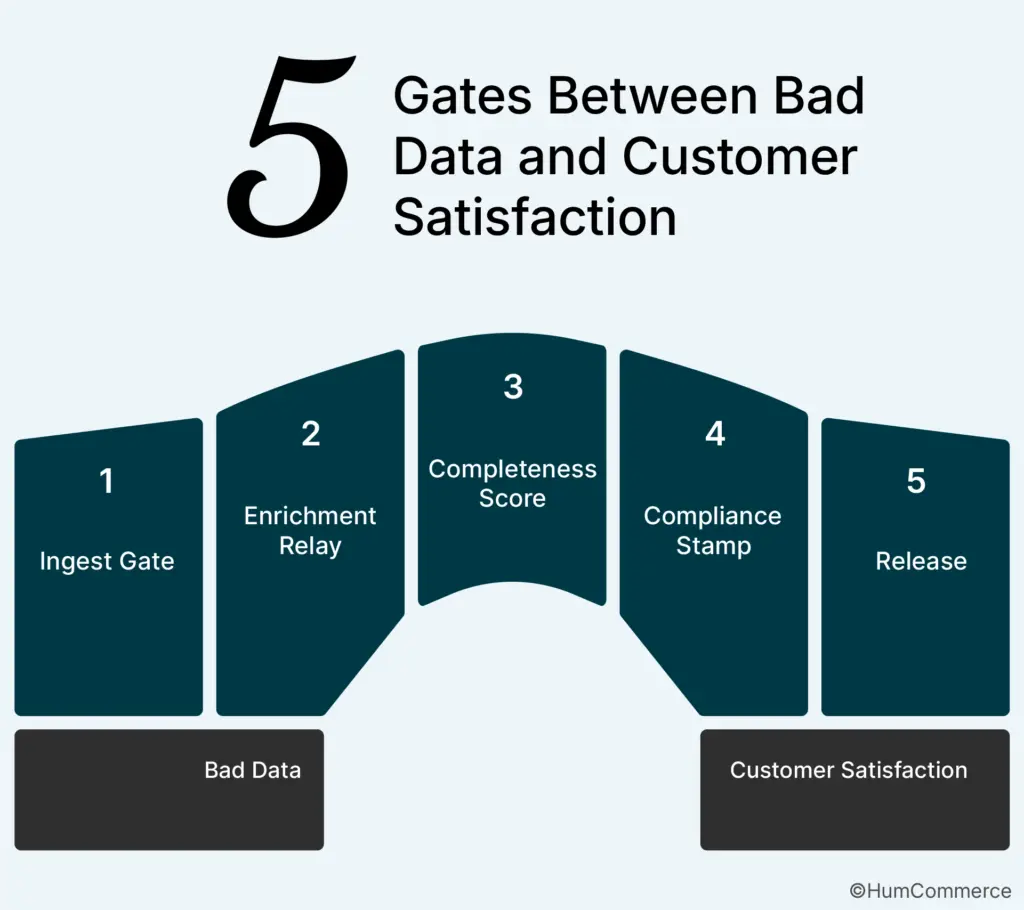
1. The Ingest Gate (The Bouncer):
Data arrives from the ERP. The PIM runs auto-validation scripts.
- Is the GTIN 14 digits?
- Is the Weight numeric?
- Does the HS Code match the current tariff schedule?
- Result: If it fails, it is rejected back to the ERP. It never enters the clean room.
2. The Enrichment Relay
Valid data moves to Marketing. They add images and copy. They cannot edit the Price or Voltage (those fields are locked by the Matrix).
3. The Completeness Score
The SKU sits at 80% complete. It cannot be published. Why? The “Safety Data Sheet (SDS)” is missing.
4. The Compliance Stamp
The system pings the Compliance Officer. They upload the PDF. The score hits 100%.
5. The Release
Only now does the API unlock the product for syndication to your webstore and distributors.
Speed Requires Structure: The Brake Pedal Before the Accelerator
Mercedes didn’t lose that race because they were slow. They lost because they ignored a constraint.
For B2B leaders, the lesson is clear: You cannot automate what you do not govern.
If you want to use AI, if you want to sell on 20 marketplaces, if you want to scale from $50M to $500M, you need a governance framework that serves as your brakes.
It stops the errors, so you can floor the accelerator.
At HumCommerce, we’ve watched hundreds of B2B manufacturers and distributors invest millions in PIMs, ERPs, and Adobe Commerce platforms only to realize the technology wasn’t the bottleneck. The people and process were.
We’ve built integrations for companies across Pimcore, Akeneo, SAP, Epicor, and multi-channel syndication.
Ready to Build Your Pit Crew?
Download the Product Data Accuracy Audit Template and get started today. It includes:
- The exact RACI model we use with enterprise clients
- A 40+ attribute dictionary mapped to owners
- Validation rule templates (copy-paste ready for Pimcore/Akeneo)
- A 90-day governance roadmap
Or book an assessment with our team. We’ll audit your current PIM setup, identify where orphan data is bleeding value, and give you a playbook to fix it in 12 weeks.
The accelerator is ready. Install the brakes first.