
Key Takeaways
- Slow RFQ responses are not “annoying,” they’re expensive. For a mid-sized manufacturer handling ~200 RFQs a month, 48‑hour turnaround can quietly cost 2-3M dollars in lost and delayed deals every year.
- Chatbots that just collect RFQ details and create tickets can’t fix that.
- Orchestrated commerce intelligence does by coordinating SAP/Epicor, contract pricing, compliance, and freight in parallel, cutting quote time from days to minutes and protecting both win rates and margins.
A procurement manager at a mid-sized automotive manufacturer submits an RFQ on Tuesday afternoon: 600 units across 40 different SKUs. The AI chatbot on your ecommerce site cheerfully confirms receipt and promises a quote “soon.”
By Thursday morning, the order was already placed with a competitor who responded in under 10 minutes with accurate stock, contract-specific pricing, and delivery options.
What went wrong?
Your chatbot couldn’t validate inventory across three warehouses in real time. It couldn’t apply customer-specific contract tiers. It couldn’t flag that twelve SKUs required updated tariff calculations. And it definitely couldn’t coordinate approvals from Operations, Finance, and Compliance.
So it did what most B2B chatbots do: collected information, created a ticket, and waited for humans to manually assemble the answer. Two days later.
Research shows that 80% of frequent B2B buyers have switched suppliers within 24 months because expectations weren’t met, and slow response times are a major driver. When RFQs are late‑stage, high-intent events, every extra hour in your quote cycle sends a silent message: “We’re slow. Expect this later too.”
What’s the Real Cost of Slow RFQ Response?
“Slow quotes” sounds like a minor annoyance until you put numbers to it.
The traditional, sequential RFQ dance looks like this:
- Sales receives the request.
- Pricing hunts down comparable deals.
- Procurement logs into SAP to confirm availability.
- Operations weighs in on lead times via email.
- Compliance reviews tax and legal terms.
- Someone finally pieces everything together into a quote.
If any person is traveling, in meetings, or out sick, the clock drifts from 24 hours to 48, or longer. In today’s market, that delay sends a silent message: “We’re slow. Expect this later too.” Research on lead response time shows the impact is brutal: waiting even tens of minutes instead of minutes can crush conversion rates, and many B2B teams still measure response in days.
With orchestration, the same RFQ runs very differently. As soon as the request comes in, the system:
- Checks inventory across plants and warehouses via live ERP APIs.
- Applies contract pricing and customer terms automatically.
- Pulls real‑time freight options.
- Runs compliance checks on tariffs and tax rules.
- Assembles a ready‑to‑send quote once all checks pass.
All of that happens in parallel, so a quote that used to take 24-48 hours can go out in under four minutes.
For a mid‑sized manufacturer with:
- Average deal size of around 85k dollars.
- Roughly 200 RFQs a month.
Lifting conversion from, say, 28% to 42% just by responding faster and more reliably translates into millions in incremental annual revenue, without adding reps or lowering price. And that doesn’t include the opportunities you never even see because buyers stop asking slow responders for quotes in the first place.
Why Your Current Chatbot Can’t Fix RFQ Delays
Most B2B chatbots were never designed to run your RFQ process. They were designed to answer FAQs, deflect basic tickets, and maybe collect some form data. That’s it.
Here’s why they break down the moment you ask them to handle serious revenue work.
1. Cached Data vs Live Systems
A typical setup looks like this:
- Your SAP/Epicor instance syncs inventory and pricing to a separate database once or twice a day.
- The chatbot reads from that cached data, not from ERP directly.
- At 2 PM, the bot shows “480 units available” because that’s what the 3 AM sync captured.
- The last 100 units were sold at 11 AM.
The chatbot confidently confirms availability that no longer exists. The order gets booked based on wrong assumptions. Fulfillment fails, and trust takes a hit.
Real-time pricing adds even more complexity. B2B prices aren’t static; they’re dynamic calculations that combine:
- Customer-specific contracts and tiers.
- Volume-based discounts and breaks.
- Current tariffs and duties.
- Regional taxes and surcharges.
- Freight and accessorials.
When any of those change, a static knowledge base or once-a-day sync doesn’t keep up. Your chatbot keeps quoting yesterday’s margins into today’s cost structure.
2. Stateless Conversations in a 5‑Day Negotiation
B2B sales is a rolling conversation, not a one‑and‑done chat.
- Monday: buyer sends over 40 SKUs.
- Tuesday: adds five more.
- Thursday: pricing wants delivery splits.
- Friday: quantities change again.
A generic, stateless chatbot treats each of those as a brand-new request. It forgets Monday’s 40 SKUs, doesn’t “remember” Tuesday’s additions, and has no sense that this is one negotiation. The buyer re‑explains the story; the bot keeps asking for details it already captured earlier.
Without a shared state across days and channels, your AI can’t act like a seasoned account rep. It behaves like a kiosk.
3. No Real Access to Systems That Matter
Buyers feel the limitations every time they ask a serious question:
- “What’s my contract price on Product X?”
- “Can you deliver 600 units split across two plants?”
- “Is this SKU compliant for shipment to Germany?”
Most chatbots sit outside your core stack. They can’t:
- Pull account history and contracts from CRM or CPQ.
- See live inventory across multiple warehouses.
- Check billing status, credit holds, or payment terms.
- Validate compliance and certifications.
Every “I don’t have access to that, let me transfer you” response quietly erodes trust and reinforces the idea that your systems don’t talk to each other.
Fixing this requires more than a smarter chat interface. It requires a unified data layer and orchestration that treat ERP, CRM, contracts, and compliance as connected parts of one system of record.
What Makes B2B Support Fundamentally Different From B2C?
B2C support is usually about quick answers to simple questions. “Where’s my package?” “What’s your return policy?” Those answers live in static knowledge bases or single systems.
B2B is a different game entirely. A single RFQ might trigger simultaneous checks across:
- Inventory systems validating stock across plants and warehouses.
- Pricing engines applying contract terms, volume discounts, and landed costs.
- Compliance databases verifying HS codes, origin rules, and tax clauses.
- Freight calculators modeling delivery options and total landed cost.
- Approval workflows coordinating sign-offs from Finance, Ops, Sales, and Compliance.
Generic chatbots typically touch those systems one at a time, if at all. By the time they’ve checked inventory, the buyer has already moved on.
B2B buyers now expect live stock validation, accurate contract pricing, and instant quantity-discount feedback as standard, expectations shaped by B2C experiences but multiplied by the complexity of industrial procurement.
When your support and sales workflows can’t keep up with that expectation, you don’t just create friction; you push deals toward competitors whose systems can.
What Happens When Your Chatbot Can’t Remember Context?
B2B sales isn’t a one‑and‑done chat. It’s a rolling conversation:
- Monday: buyer sends over 40 SKUs.
- Tuesday: adds five more.
- Thursday: pricing wants delivery splits.
- Friday: quantities change again.
A generic, stateless chatbot treats each of those as a brand‑new request. It forgets Monday’s 40 SKUs, doesn’t “remember” Tuesday’s additions, and has no sense that this is all part of one negotiation. The buyer ends up re‑explaining the story every time, while the bot keeps asking for details it should already know.
Source: Forbes
What works instead is a stateful setup that keeps track of:
- Conversation history across days and channels.
- Contract terms, pricing tiers, and approvals.
- Past orders and preferences.
- The current negotiation status (draft quote, pending review, revised version).
- Partial decisions and open questions.
When sales teams layer AI onto that kind of foundation, they stop re‑starting the conversation on every touch, which typically shortens sales cycles and improves win rates because each interaction adds information instead of repeating it.
Why Do Pricing Errors Create Margin Bleed?
Stale data doesn’t just slow you down, it actively destroys profitability.
When tariffs shift, raw material costs fluctuate, or supplier pricing changes, batch-synced systems lag behind reality. Your chatbot quotes based on information that was accurate three weeks ago but isn’t anymore.
The pattern plays out like this:
- Sales rep relies on chatbot-provided pricing
- Customer accepts quote
- Order processes
- Finance reviews actual costs
- Projected 18% margin is actually 6%
- Too late to renegotiate
The technical solution centers on dynamic pricing engines that calculate prices on-demand rather than retrieving pre-calculated values. These systems:
- Query ERP pricing rules in real-time
- Apply customer-specific contracts instantly
- Factor current tariff rates automatically
- Calculate freight based on live carrier APIs
- Incorporate compliance surcharges dynamically
Response times stay under one second while accuracy reaches effectively 100%, protecting both speed and margin.
How Does Poor Escalation Trigger Abandonment?
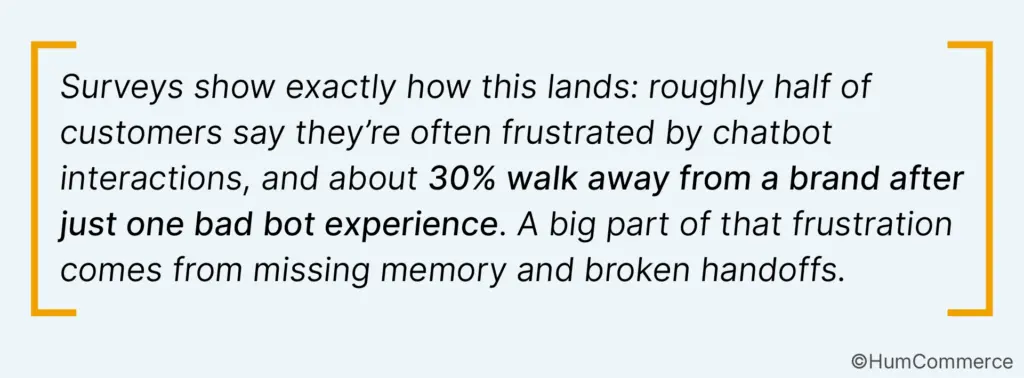
Most people don’t rage‑quit chatbots because the bot can’t help. They quit because the handoff to a human is terrible.
You’ve seen it play out:
- Buyer asks for pricing on 500 units of a specific SKU.
- Bot asks for the account number, “checks,” stalls, then gives up and transfers.
- Human joins with, “Hi, how can I help?” as if nothing happened.
The customer has to repeat everything. Trust evaporates, and many simply close the tab or abandon the quote altogether.
Smarter escalation looks very different. It should:
- Watch sentiment and escalate as soon as it detects rising frustration, no endless loops.
- Trigger a handoff after a couple of failed attempts instead of forcing the buyer to beg.
- Pass full context forward: conversation history, who the customer is, what systems were queried, and what the AI recommends next.
When that happens, the human agent doesn’t open with “How can I help?” They’re already caught up and can move straight to resolving the issue, which turns a potential abandonment into a “they actually get it” moment.
What Does Workflow Orchestration Actually Mean?
Under the hood, this is the real dividing line between basic chatbots and serious B2B commerce intelligence.
- Integration is just wiring one system to another: ERP to pricing, pricing to freight, one call at a time.
- Orchestration is where a central “brain” breaks a complex request into pieces, runs them in parallel against multiple systems, keeps track of shared context, and then recombines everything into a single, accurate response.
Take a 40‑SKU RFQ. With orchestration, the system can simultaneously:
- Check inventory across all warehouses through live ERP APIs.
- Apply contract pricing and customer‑specific terms.
- Calculate freight options from real‑time carrier rates.
- Validate compliance, tariffs, and country‑of‑origin rules.
- Confirm MOQs and, if needed, suggest alternates.
Because those checks run in parallel and share the same state, the buyer receives one unified quote that’s already validated across inventory, pricing, freight, and compliance, often in a few minutes instead of days.
Behind the scenes, this relies on:
- A workflow manager that breaks the RFQ into tasks.
- Dispatchers that send each task to the right system.
- Feedback loops that validate results and catch anomalies.
- A shared state store so context doesn’t get lost halfway through a long interaction.
That’s the difference between “a bot that talks” and an intelligence layer that can actually move a 40‑line B2B deal from request to ready‑to‑sign.
What Is Self-Healing ERP And Why Does It Matter?
Most teams think of “AI in ERP” as answering questions. Self‑healing ERP goes a step further: it catches and fixes bad data before it ever pollutes your systems.
In practice, a self‑healing architecture will:
- Watch data as it flows in, not weeks later.
- Flag entries that look wrong based on past patterns.
- Auto‑correct the routine stuff.
- Hand complex issues to humans with a suggested fix.
- Keep a clean audit trail of every change.
Common corrections include:
- Mapping the wrong vendor code to the right one based on previous POs.
- Fixing unit‑of‑measure mismatches using SKU master data.
- Reclassifying GL codes based on item type and history.
- Filling in missing compliance fields by pulling from your master data.
The result is fewer downstream headaches in finance, operations, and audit with almost no change to how users key in orders or update records day to day.
How Should You Implement This Without Disrupting Operations?
You don’t have to rip out your ERP or freeze the business for six months. The safest approach is to treat self‑healing as an add‑on layer you phase in.
Weeks 1-2: Discovery
- Map your stack: ERP, CRM, eCommerce, pricing, contract tools.
- Pinpoint the ugliest workflows (RFQs, inventory validation, pricing disputes, invoice mismatches).
- Define success in business terms: fewer errors, faster processing, lower manual effort.
Weeks 3-6: Pilot
Pick one high‑volume supplier or category and switch self‑healing on just there. Track:
- Manual reconciliation time (aim for 70%+ reduction).
- How accurately the system flags real errors (95%+).
- How much faster transactions clear (5x speedup is realistic).
Weeks 7-12: Scale Carefully
Extend to your top ~20 suppliers that drive most of your volume. Train teams on what’s changing (less cleanup, not fewer jobs) and show before/after examples so they see the benefit quickly.
Weeks 13-16: Go Beyond Cleanup
Once basic error‑fixing is stable, you can start layering on:
- Predictive procurement signals (which suppliers and SKUs are trending risky).
- Smarter contract and price‑break enforcement.
- Cross‑network supply orchestration tied into planning and logistics.
Crucially, you’re not replacing ERP, CRM, or eCommerce. You’re adding an orchestration layer that makes all three behave like a single, coordinated system for the first time.
What Really Separates This From Generic “AI Chatbots”?
A lot of vendors sell “AI chatbots” with big claims and very little detail. The key difference with B2B commerce intelligence isn’t the buzzwords, it’s how deeply it plugs into your systems and how much real work it can actually do.
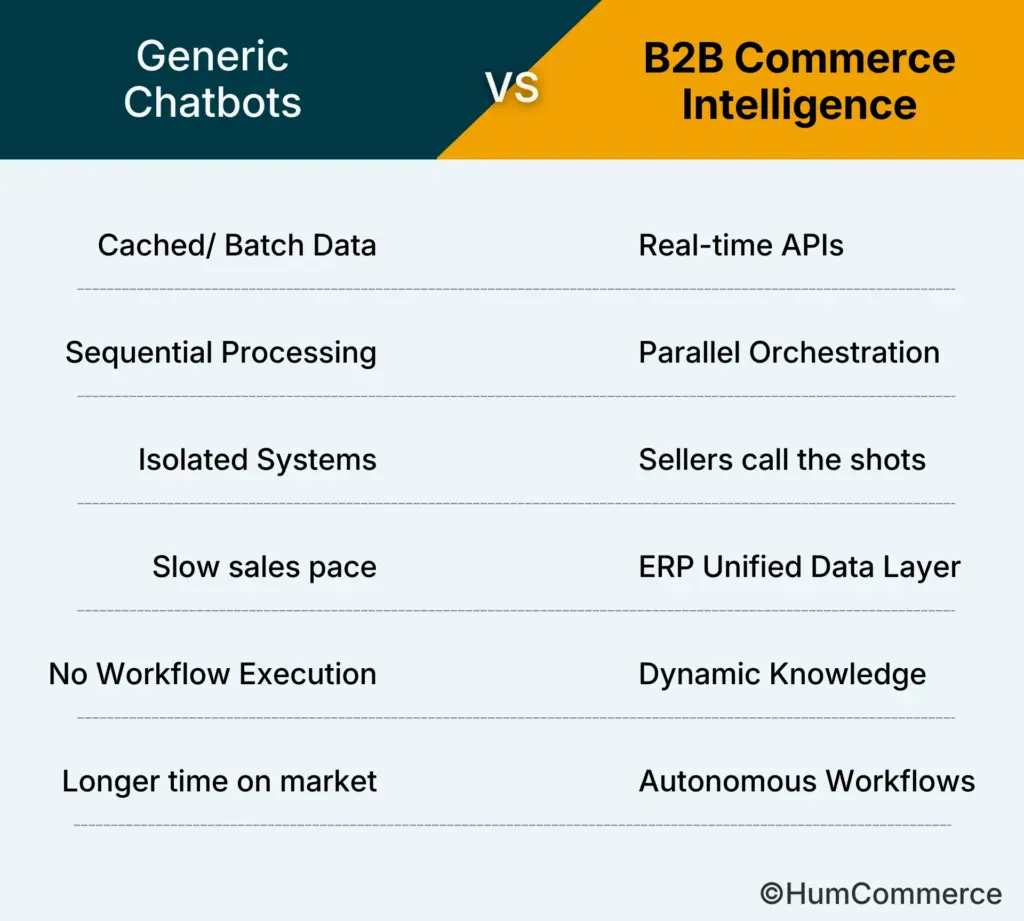
Generic chatbots usually:
- Read from cached or batch‑synced data, so answers lag reality.
- Query one system at a time instead of coordinating across many.
- Forget context once a session ends.
- Can’t kick off real workflows or route approvals.
- Sit at the edge of your stack rather than inside it.
- Depend on someone manually updating their knowledge base.
B2B commerce intelligence, by contrast, typically:
- Uses real‑time APIs into SAP, Epicor, Oracle, and other core systems so it can validate data in sub‑seconds.
- Orchestrates multiple systems in parallel and shares state between them.
- Maintains memory across sessions, channels, and days so it “remembers” each account.
- Executes workflows, approvals, RFQs, pricing checks, inside your governance rules.
- Sits on top of a unified data layer that ties ERP, CRM, contracts, compliance, and order management together.
- Updates its knowledge automatically from live feeds instead of waiting for manual refreshes.
That’s the difference between a chatbot that answers FAQs and an operations layer that quietly fixes errors, speeds up quotes, and keeps your core systems in sync.
What Does Success Actually Look Like?
The manufacturers, distributors, and wholesalers winning in B2B ecommerce aren’t deploying “smarter chatbots.” They’re building commerce intelligence stacks that orchestrate, validate, and execute, not just chat.
They respond to 40-SKU RFQs in 4 minutes instead of 48 hours, maintaining 80% buyer retention in an environment where competitors’ slow response triggers mass defection.
They protect margins through real-time pricing that adjusts instantly when tariffs shift, eliminating the $500,000-$800,000 annual margin bleed that stale data creates.
They free finance teams from 30-40 hours of weekly manual reconciliation, redirecting that capacity to strategic analysis that drives $5.7 million in supply chain optimization.
They achieve 70%+ first-contact resolution rates because their AI can actually access customer contracts, apply pricing rules, validate inventory, and coordinate approvals, not just apologize and escalate.
The architectural requirements aren’t mysterious: real-time system integration, parallel workflow orchestration, stateful memory, and self-healing validation. But the competitive advantage they create is unmistakable.
The question facing B2B commerce leaders isn’t whether to implement AI support.
It’s whether your AI can orchestrate complex workflows across SAP, Epicor, contract engines, and compliance systems in real-time or just collect information and wait for humans to manually assemble answers your buyers needed yesterday.
The 80% of B2B buyers who switch suppliers due to unmet expectations aren’t waiting for you to figure it out.
HumCommerce AI Assistant orchestrates your existing systems – SAP, Epicor, Salesforce,
contract engines, compliance databases without replacing anything. See your actual
workflows process in real-time during a personalized technical consultation.