The person placing your $40,000 industrial supply order on Monday placed a $200 order on Amazon on Sunday. They noticed the difference.
TL;DR
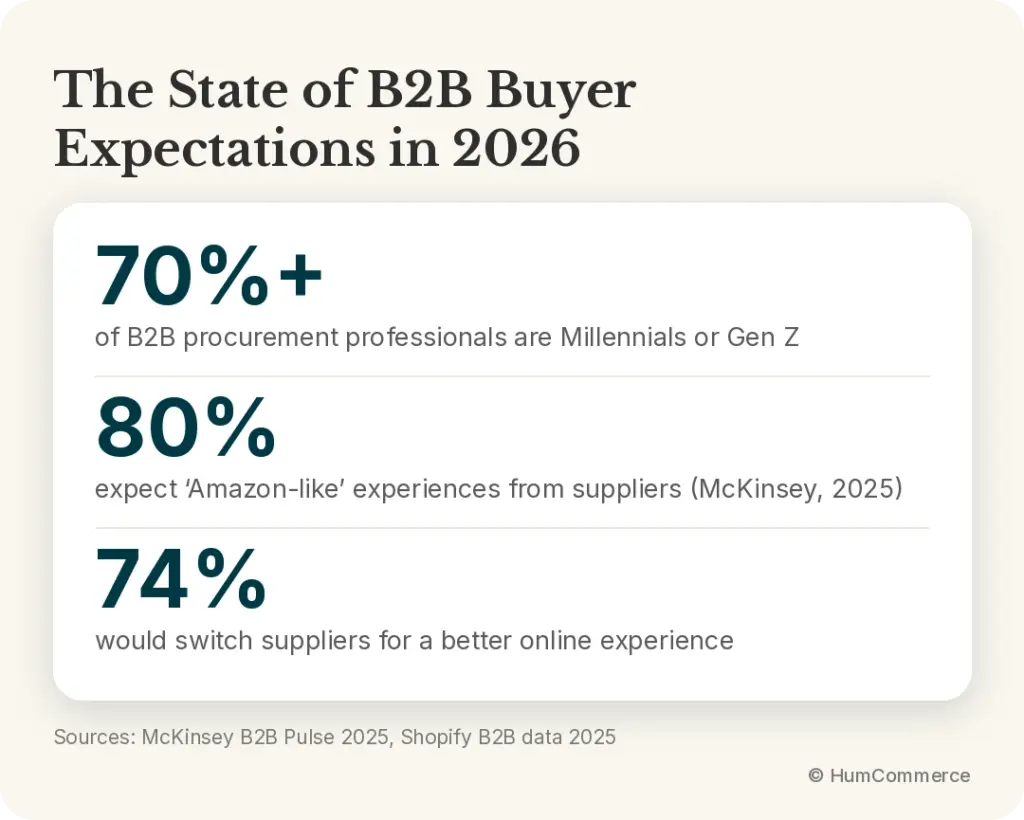
- Millennials and Gen Z now represent over 70% of B2B procurement professionals globally, according to multiple industry sources.
- 80% of B2B buyers expect “Amazon-like” experiences from their suppliers, based on McKinsey’s 2025 B2B Pulse research.
- 65% of B2B buyers prefer digital self-service over traditional sales calls (McKinsey, 2025).
- 74% say they would switch suppliers for a better online experience.
- The four specific expectations driving this shift: pricing transparency at login, real-time inventory visibility, order history access, and status tracking without calling.
- Meeting these expectations doesn’t require AI or advanced automation. It requires a portal that actually connects to your ERP.
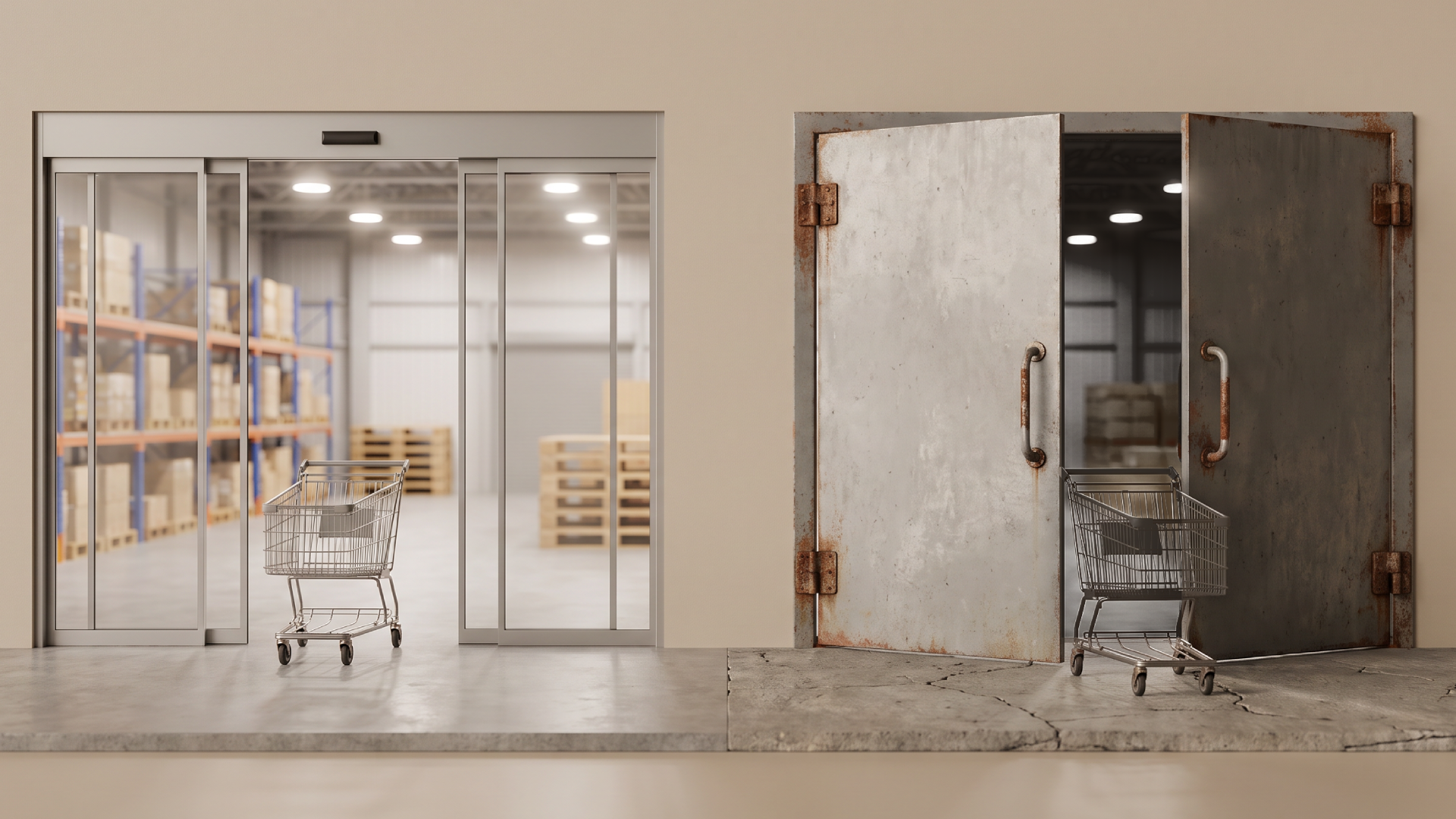
Here’s what a B2B buyer’s Sunday looks like in 2026. They search for a tool on Amazon, see the price, see it’s in stock, place the order, get a delivery confirmation, and receive a text when it ships. The entire interaction takes four minutes.
Monday morning they log into your B2B portal to place a supply order for their company. They can’t see their contract pricing. The inventory count looks off. There’s no order history from last month. To get answers to any of these questions, they need to call or email your team.
They don’t consciously compare the two experiences. They just make a note — somewhere in the back of their thinking — that doing business with you creates friction. And next year, when your competitor launches a portal that works, that note becomes a reason to evaluate switching.
Who Is Making Your B2B Purchasing Decisions Now
The demographic shift in B2B buying is no longer emerging. It’s current reality.
Millennials and Gen Z now represent over 70% of B2B procurement professionals globally. These are buyers who have never placed an order by fax, who expect digital self-service as the default, and who evaluate supplier portals against the consumer experiences they use every day.
According to McKinsey’s 2025 B2B Pulse survey, 80% of B2B buyers now expect an “Amazon-like” experience from their suppliers. The same research found that 65% prefer digital self-service over traditional sales calls for routine purchasing.
These are not aspirational numbers from a futurist report. They’re the buying preferences of the people placing orders with your company right now.
What B2B Buyers Specifically Expect
The expectation gap isn’t abstract. It’s four specific capabilities that B2B buyers check every time they log into a supplier portal:
Pricing visibility at login
A buyer who logs into your portal expects to see their price — their negotiated contract rate, not your list price. This is table stakes. A portal that shows list price to a contract account communicates one thing: the portal doesn’t know who I am.
McKinsey data consistently shows that pricing transparency is the single most impactful driver of B2B portal adoption. When buyers see their price immediately at login, self-serve order rates increase. When they see list price and have to call to confirm, they stop using the portal for anything other than product research.
Real-time inventory visibility
A buyer checking availability before placing a large order expects to see whether the product is in stock — and ideally, at which of your warehouses. If the portal shows “in stock” and the order can’t be fulfilled, the buyer’s trust in every subsequent data point on your portal declines.
Inventory visibility is especially important in industrial and manufacturing B2B, where buyers are often scheduling production runs or construction projects against your availability. A buyer who gets caught by an inaccurate inventory display doesn’t just lose trust in the portal. They build a workaround — calling before every order — that permanently reduces their portal adoption.
Order history and reorder functionality
One of the highest-adoption features in any B2B portal is the ability to reorder from history. A buyer who placed the same order last month wants to place it again in two clicks. They don’t want to search for the products, re-enter the quantities, or confirm the price.
Order history requires syncing the ERP’s order records to the portal’s account section. Without this sync, the portal has no history to display. The buyer either reconstructs the order from memory or calls your team to look it up.
Order status without calling
“Where is my order?” is the most common inbound B2B support contact for a reason. Buyers want to know what’s happening with their order without making a support call. They expect shipment tracking, estimated delivery dates, and invoice status visible in their portal account.
According to industry data, 74% of B2B buyers say they would switch suppliers for a better online experience. The friction of having to call for order status — something they can check in 10 seconds on Amazon — is exactly the kind of friction that drives supplier evaluation.
What Happens When You Don’t Deliver These Four Things
Low portal adoption despite portal investment
The most common outcome: the portal exists, marketing talks about it, and buyers visit it occasionally but don’t order through it. Self-serve order rates stay below 15%. Reps keep handling the same order volume they did before the portal launched.
The portal isn’t failing because of design or UX. It’s failing because the data isn’t there. Buyers learn quickly that the portal can’t be trusted for pricing or inventory, and they revert to calling.
Reps get busier as the business grows
Without self-serve adoption, every new account and every increase in order volume translates directly to more rep workload. The business scales, but the cost-to-serve doesn’t decrease. At some point the only solution appears to be headcount.
The actual solution is a portal that buyers trust. Buyers who trust the portal order through it. Reps focus on new accounts and complex relationships.
Competitive vulnerability
74% of B2B buyers will switch suppliers for a better digital experience. That number was 50% five years ago. It’s moving in one direction.
If you’re in a market with two or three competitors, and one of them launches a portal with contract pricing at login, real-time inventory, and order history, their portal adoption numbers go up. Their rep efficiency improves. Their customer retention improves. And some of your accounts start noticing the comparison.
What Closing the Gap Requires
The good news: meeting 2026 B2B buyer expectations doesn’t require AI, headless architecture, or a platform replacement for most operations.
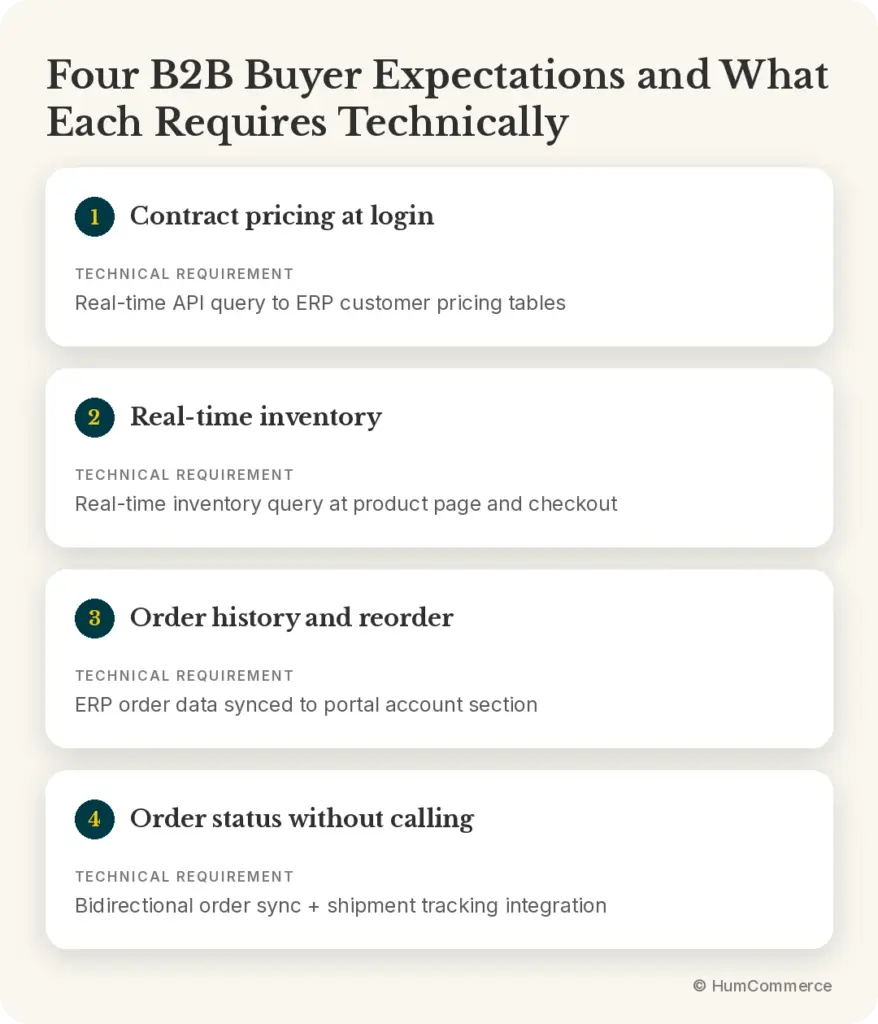
The four buyer expectations above map to four specific technical requirements:
- Pricing transparency: Real-time API connection between the portal and the ERP’s customer pricing tables
- Inventory visibility: Real-time inventory query at product page and checkout
- Order history: ERP order data synced to the portal’s account section
- Order status: Bidirectional order sync and shipment tracking integration
These are integration requirements, not design requirements. They can be implemented on your existing Adobe Commerce or Magento platform without a rebuild.
For most Stage 2 operations — portal exists, partial ERP integration, low self-serve adoption — closing these four gaps takes 60-90 days and delivers a measurable increase in self-serve order rate within the first quarter after go-live.
Sources
- McKinsey & Company, B2B Pulse Survey, 2025 — 65% prefer digital self-service, 80% expect Amazon-like experiences: https://www.repspark.com/b2b-ecommerce-transformation-in-2025
- Shopify / industry data — Millennials and Gen Z represent 71%+ of B2B procurement: https://www.shopify.com/enterprise/blog/cpq-for-b2b-ecommerce
- Centarro, Hidden Costs of Enterprise eCommerce Platforms, 2026 — 74% would switch suppliers for better online experience: https://www.centarro.io/blog/hidden-costs-enterprise-ecommerce-platforms
- HumCommerce portal adoption data, 2026