
TL;DR
- There are three paths: generic chatbots, portals, database‑first RFQ assistant
- Generic chatbots collect RFQs, still rely on manual quoting
- Portals digitize catalogs, keep RFQs in email and spreadsheets
- HumCommerce B2B AI Assistant automates RFQ intake and quoting
- Best choice depends on catalog complexity, ERP stack, RFQ volume
It is quarter‑end and the VP of Sales at an industrial distributor is stuck in a budget review, staring at RFQs that never turned into quotes.
One pilot used a “smart” website chatbot that politely collected requests and then dumped them into email queues. Another doubled down on “log in and call your rep,” but RFQ cycle times barely moved.
No one can see whether the drag is coming from ERP integration, pricing logic, or buyer friction; they only know deals are slipping to faster rivals. Walking out, the VP starts searching for the best AI chatbot for B2B ecommerce and realizes that what they really need is a clear way to compare these chatbot options against their actual RFQ workflow.
Why are AI chatbots important for B2B eCommerce in 2026?
If you run a B2B ecommerce website, your real problems are slow RFQs, error‑prone quotes, and clunky reorders. Teams that look for the best AI chatbot for B2B ecommerce website are usually trying to fix these problems, not just add another support widget.
You are measured on RFQ turnaround time, quote‑to‑order conversion, and how accurately your store reflects live stock and contract‑specific prices, not on raw chat engagement. With catalogs that run into thousands of SKUs and pricing tied to contracts, tariffs, and freight, your workflows look closer to industrial systems engineering than to simple customer support.
For this kind of environment, there are three main paths that people often group under “best B2B ecommerce shopping assistants” and “AI chatbots for selling ecommerce”:
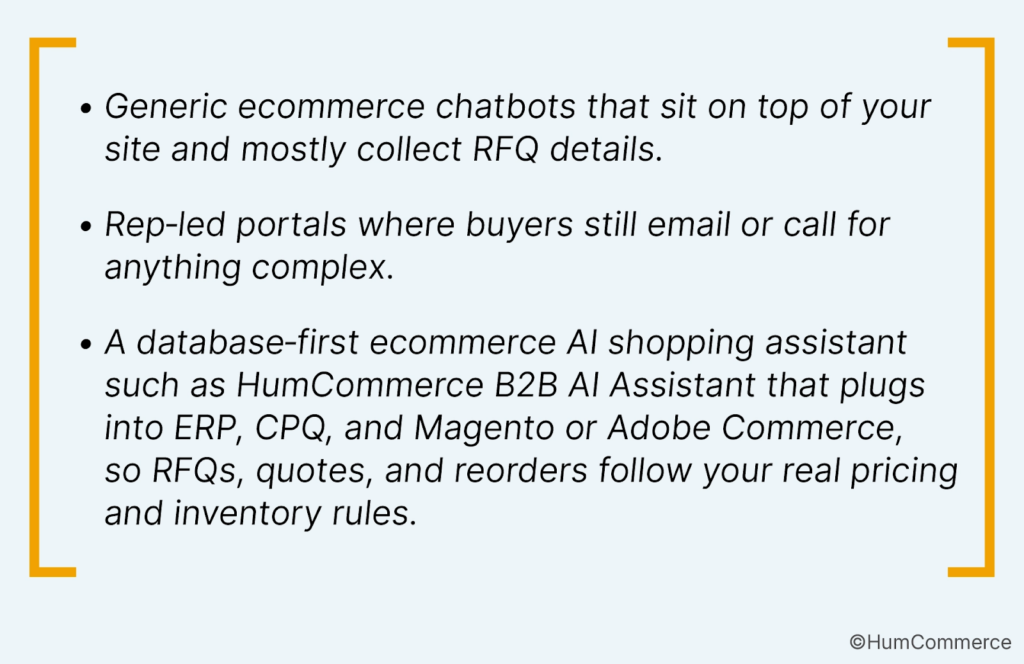
Each path changes how RFQs are captured, how quotes are generated, and how often people still have to re‑enter data across systems. This article compares those three approaches using real B2B workflows for RFQs, quoting, and reorders as the main lens.
You will see how each option integrates with your stack, how it affects daily work for sales and operations, and what it does to core numbers such as RFQ cycle time, quote‑to‑order rate, and revenue from AI chatbots for selling ecommerce, so you can select the right path for where you are today.
What people mean by AI chatbot for B2B ecommerce
When teams talk about AI chatbots for B2B ecommerce, they usually picture a widget on the store where buyers can ask questions and get quick answers, with some automation behind it. In practice, when you search for the best AI chatbot for B2B ecommerce or the best AI chatbot for a B2B ecommerce website, you are really choosing between three very different architectures, each with a different ceiling for RFQ and quote automation.
HumCommerce B2B AI Assistant
HumCommerce B2B AI Assistant is a database‑first assistant that sits on top of your Adobe Commerce or Magento store and the ERP tables that hold real pricing, contract, and inventory data. Instead of inventing answers, it queries your ecommerce and ERP data first and then formats the response, so buyers see accurate products, stock, and prices in chat.
For RFQ‑heavy B2B ecommerce, that means the assistant can read RFQs, match and validate SKUs, check availability using the same data your store relies on, and prepare structured RFQs or draft quotes for your team to review, rather than handing off unstructured notes to email. This is closer to a focused ecommerce AI shopping assistant for RFQs and reorders than to a generic chatbot, and it is the path that can actually move RFQ turnaround time and quote‑to‑order conversion for AI chatbots for selling ecommerce.
Generic chatbots on the website
Generic chatbots are scripted or LLM‑based tools that live in a widget on your B2B ecommerce website, often sold as the best B2B ecommerce shopping assistants or general AI chatbots for selling ecommerce. They usually connect to your ecommerce platform or helpdesk, but have limited or no direct access to ERP, CPQ, or PIM.
They can answer FAQs, route tickets, and sometimes trigger simple actions. In most RFQ and quote workflows, they stop at collecting details and forwarding them into email or a queue, instead of validating SKUs, applying contract pricing, or generating a quote your team can use immediately.
Portals and call or email your rep
Portals with rep support are traditional B2B ecommerce setups where buyers log in to view catalogs, place simple orders, and then email or call their sales rep for anything involving complex pricing, configuration, or large RFQs. Many vendors still pitch this combination of portal plus manual follow‑up as digital transformation: the catalog is online, but the heavy lifting for RFQs and quoting stays in spreadsheets, inboxes, and disconnected systems, with no B2B ecommerce chatbot or assistant in the loop.
The criteria that decide whether an AI chatbot for B2B ecommerce actually works
A feature checklist that says “has chat,” “uses AI,” or “supports FAQs” tells you almost nothing about whether a chatbot will fix your RFQ and quoting problems. In B2B ecommerce, success or failure comes from how deeply the assistant is wired into your systems and workflows, not from how friendly the widget looks.
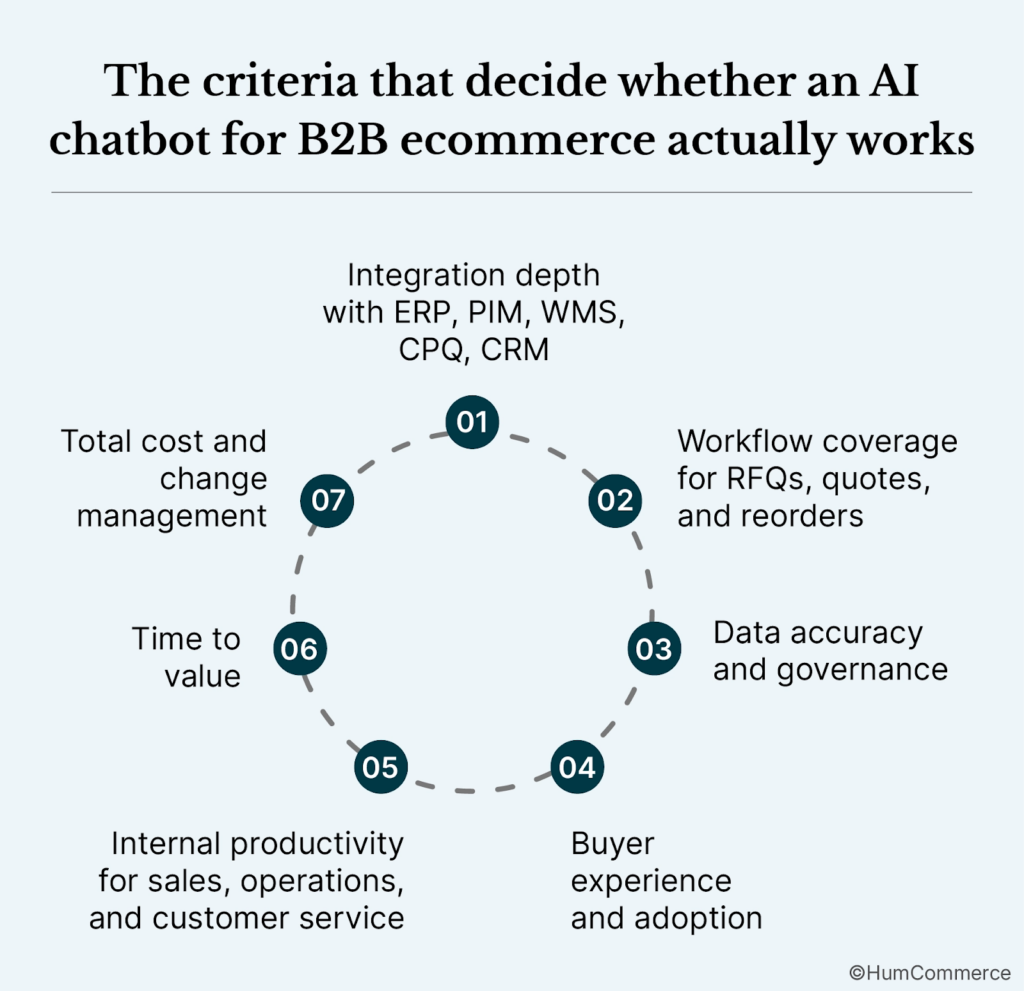
These are the criteria that separate the best AI chatbot for B2B ecommerce from generic tools.
Integration depth with ERP, PIM, WMS, CPQ, CRM
Does the assistant talk directly to the systems that hold the truth for inventory, pricing, and contracts, or does it only capture text and send an email? For serious conversational AI in ecommerce, real‑time ERP integration matters more than visual polish or small UX tricks.
Workflow coverage for RFQs, quotes, and reorders
Can it parse unstructured RFQs, validate SKUs, apply contract pricing, and generate quotes, or does it hand off halfway through the process? Does it support reorders based on past orders and current stock, not just new carts and simple one‑off questions?
Data accuracy and governance
How does it ensure that pricing, inventory, and contract terms stay correct and compliant, especially across regions, tariffs, and account types? Is there a clear audit trail and approval routing for high‑value quotes, so finance, sales, and operations can trust what the assistant generates?
Buyer experience and adoption
Can buyers upload RFQ files, paste lists, and ask follow‑up questions in natural language, while still getting precise answers grounded in your own data? Does the assistant reduce friction compared with long forms and back‑and‑forth email, or does it simply add another step before a human takes over?
Internal productivity for sales, operations, and customer service
Does the chatbot remove manual translation work such as retyping emails into ERP or CPQ, or does it just add another channel to monitor? How much human intervention is still required to clean data, complete quotes, and push orders into your systems?
Time to value
How quickly can you move from idea to a pilot that touches real RFQs in your stack, and how much custom build is required to reach that point? Are there proven patterns for RFQs, quoting, and reorders in your specific type of B2B business, or are you starting from a blank slate?
Total cost and change management
Beyond license fees, what is the integration cost, who needs to be involved across IT, sales, and operations, and how much behavior change is required from buyers and reps? The best B2B ecommerce shopping assistants and AI chatbots for selling ecommerce repay this investment with faster RFQs, cleaner data, and more repeat business.
These are the lenses this guide uses to compare HumCommerce B2B AI Assistant, generic chatbots, and portals with rep‑led workflows, so you can see which path functions as the best AI chatbot for a B2B ecommerce website in your situation.
HumCommerce B2B AI Assistant vs generic chatbots vs portals
This section compares the three approaches against the criteria above, with RFQs, quotes, and reorders as the main focus. It shows where a database‑first assistant such as HumCommerce B2B AI Assistant acts like the best AI chatbot for B2B ecommerce, and where generic tools or portals fall short for RFQ‑heavy teams.
Integration depth
- HumCommerce B2B AI Assistant
Uses direct integrations with Adobe Commerce or Magento and ERP, so it works from live stock, pricing, and contract data already in your stack. - Generic chatbots on site
Usually connect only to the ecommerce platform or helpdesk. ERP and CPQ access often needs custom work or is missing entirely. - Portals with rep‑led workflows
Strong back‑office integration in ERP and other systems, but no conversational layer. Buyers still rely on reps to bridge gaps between systems.
Workflow coverage for RFQs, quotes, and reorders
- HumCommerce B2B AI Assistant
Can read RFQs, match SKUs, check availability, and prepare structured RFQs or draft quotes and orders for review. - Generic chatbots on site
Can collect RFQ details and answer FAQs, but usually stop before pricing, validation, and approvals for complex RFQs. - Portals with rep‑led workflows
Handle full workflows through manual email, phone, and spreadsheet‑driven processes for every complex request.
Data and governance
- HumCommerce B2B AI Assistant
Uses ERP and ecommerce data as the source of truth, enforces pricing rules, logs actions, and supports clear review or approval steps. - Generic chatbots on site
Rely mainly on knowledge base content; pricing and compliance control is limited unless heavily customized. - Portals with rep‑led workflows
Governance exists in back‑office systems, but repeated manual re‑entry creates more error risk and gaps in audit trails.
Buyer experience
- HumCommerce B2B AI Assistant
Allows natural‑language questions, RFQ file uploads, and guided suggestions, with answers grounded in your own data. - Generic chatbots on site
Chat experience works for simple support, but often breaks down on complex quotes and multi‑line RFQs. - Portals with rep‑led workflows
Buyers must navigate portals and then switch to email or phone for anything non‑standard, which slows decisions.
Internal productivity
- HumCommerce B2B AI Assistant
Reduces manual translation work so sales and operations teams start from system‑ready RFQs and quotes instead of retyping data. - Generic chatbots on site
Create more tickets and handoffs; staff still re‑enter requests into ERP or CPQ after chat collects them. - Portals with rep‑led workflows
Highest manual load on sales and operations; every complex RFQ demands interpretation, data hunting, and re‑entry.
Time to value
- HumCommerce B2B AI Assistant
Starts with targeted workflows such as RFQs on Magento, using proven integration patterns that HumCommerce already applies on B2B projects. - Generic chatbots on site
Fastest to deploy for basic support, but needs significant extra work to reach deep B2B RFQ automation. - Portals with rep‑led workflows
Often already live, but do not change RFQ speed or accuracy in a structural way.
Cost and change
- HumCommerce B2B AI Assistant
Higher integration investment, but aligned with strategic automation and fewer manual steps over time. - Generic chatbots on site
Lower upfront software cost, with high hidden operational cost from manual work and rework. - Portals with rep‑led workflows
Minimal new tech spend, but high ongoing labor cost and slower revenue capture from delayed quotes
In practical terms, HumCommerce B2B AI Assistant stands out wherever RFQ complexity, contract pricing, and SKU volume are high, because it replaces the manual “interpret and re‑enter” step with a conversational layer tied directly to ERP and CPQ.
Generic chatbots and rep‑led portals still have a place for simple catalogs, early‑stage digital teams, or organizations where buyers strongly prefer human contact and RFQs are rare.
If your RFQs arrive as spreadsheets or PDFs with dozens of SKUs and your team is juggling SAP or other ERPs alongside Magento or another store, generic chatbots won’t close the gap, they’ll just move the inbox from Outlook into a widget. In that context, the only way to materially move RFQ speed and quote accuracy is to let an assistant that understands your data do more of the work.
How Each AI Chatbot in B2B ECommerce Handles RFQs and Quotes
RFQs and quotes are the clearest stress test for any AI chatbot for B2B ecommerce because they sit on top of catalog complexity, pricing rules, and approvals. Here is how the same RFQ behaves on each path and what that usually does to your numbers.
HumCommerce B2B AI Assistant
A buyer uploads a CSV or PDF RFQ or pastes SKUs and quantities into chat on your Adobe Commerce or Magento‑based storefront. The assistant reads the file, matches SKUs against your catalog, and checks stock using the same inventory and pricing data your store and ERP expose for ecommerce, then prepares a structured RFQ or draft quote that follows your existing rules.
- RFQ turnaround: often moves from days down to hours or minutes for well‑structured requests.
- Quote‑to‑order: improves because quotes go out faster and with fewer errors or clarifications.
- Team time: shifts from manual data entry to exception handling and relationship work.
- Buyer experience: faster, clearer answers grounded in real data, closer to what frequent B2B buyers expect.
Generic chatbots on the site
The buyer opens chat, types or pastes RFQ details, and gets basic answers and a confirmation that “someone will follow up.” Because the bot has little or no direct ERP or CPQ access, it cannot reliably validate inventory, apply contract pricing, or produce a quote, so it forwards the RFQ into email or a queue.
- RFQ turnaround: usually unchanged, because the same back‑office steps still happen manually.
- Quote‑to‑order: limited lift; perception of responsiveness improves, but quote quality and speed do not change much.
- Team time: more tickets and handoffs, with staff re‑entering requests into ERP or CPQ.
- Buyer experience: acceptable for simple questions, frustrating when buyers have to repeat details to a human to get a real quote.
Portals with rep‑led workflows
The buyer logs into the portal, sees the catalog, and quickly realises complex RFQs are still easier to email or call in. Reps then hunt through past orders, contracts, and ERP screens, check inventory, apply pricing logic, coordinate approvals, and re‑enter data into ERP, CPQ, and sometimes Magento.
- RFQ turnaround: highly variable and often slow, especially when multiple teams are involved.
- Quote‑to‑order: can be strong for strategic accounts, but limited by slow response and inconsistency.
- Team time: highest manual load; every complex RFQ demands hands‑on work and re‑entry.
- Buyer experience: relationships may be strong, but patience for slow quotes is shrinking as more competitors automate RFQs.
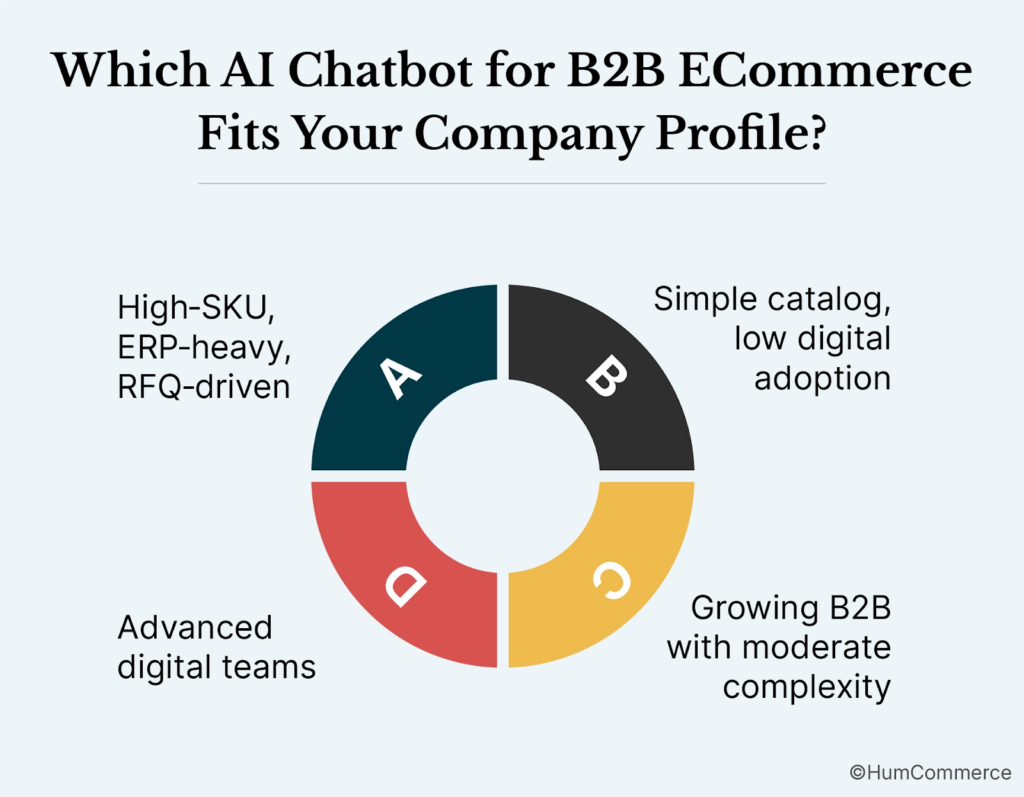
Which AI Chatbot for B2B ECommerce Fits Your Company Profile?
The best AI chatbot for B2B ecommerce depends on your catalog complexity, system landscape, and digital maturity, not on a single feature list.
Profile A: Simple catalog, low digital adoption
You have a limited product range, straightforward pricing, and buyers who still prefer phone and email. Rep‑led portals or a basic chatbot on your B2B ecommerce website may be enough for now, because they keep spending low and help your team learn before deeper automation.
In this stage, chasing the best AI chatbot for a B2B ecommerce website is less important than getting clean data, a usable portal, and basic self‑service in place.
Profile B: Growing B2B with moderate complexity
You are adding SKUs, integrating an ERP, and starting to see more RFQs, but pricing rules and workflows are still evolving. A more capable generic chatbot can act as a bridge, handling FAQs and simple orders while you prepare data and integrations for a deeper assistant.
Used this way, generic AI chatbots for selling ecommerce help you respond faster without forcing a full ERP‑level project before you are ready.
Profile C: High‑SKU, ERP‑heavy, RFQ‑driven
You run thousands of SKUs, contract‑based pricing, multiple warehouses, and RFQ and reorder volumes are already straining teams. In this environment, a database‑first assistant such as HumCommerce B2B AI Assistant, working on top of Adobe Commerce or Magento and your ERP data, is one of the few practical ways to scale RFQ and quote workflows without exploding headcount or risk.
For this profile, treating that assistant as your primary ecommerce AI shopping assistant for RFQs, quotes, and reorders is usually where the best B2B ecommerce shopping assistants deliver real ROI.
Profile D: Advanced digital teams
You already have good data governance, a modern ecommerce stack, and strong internal buy‑in for automation. In this case, you are ready to treat HumCommerce B2B AI Assistant as a proper layer across RFQs, reorders, and even VOR or complex service workflows, not just as a support bot.
The key is to place yourself honestly. If RFQs and quotes are already a bottleneck at your current catalog size, waiting rarely makes them easier to automate later.
Implementation: The Effort Required Behind AI Chatbots in B2B ECommerce
Many teams underestimate how much work it takes to make “simple” chatbots or portals useful, and overestimate the effort required for an assistant that actually talks to ERP and quoting systems.
These are the practical factors to compare before you pick what you call the best AI chatbot for B2B ecommerce in your roadmap.
Time to first pilot
- HumCommerce B2B AI Assistant
Needs up‑front integration with a limited set of systems, for example Adobe Commerce or Magento plus ERP for RFQs, but can be piloted on a narrow, high‑value workflow. - Generic chatbots
Quick to launch for FAQs and simple support. Extending into reliable pricing and inventory use cases usually takes more effort than expected. - Portals with reps
Often already in place, so there is no new pilot, but there is also no structural improvement in RFQ speed.
Teams involved
- HumCommerce B2B AI Assistant
Ecommerce, IT, and operations collaborate to expose APIs, map data, and define workflows. Sales is involved to set approval rules and guardrails. - Generic chatbots
Usually owned by ecommerce or marketing. IT may be lightly involved for basic integrations or authentication. - Portals with reps
Sales and customer service carry most of the workload. IT focuses on keeping the portal running.
Changes to buyer experience
- HumCommerce B2B AI Assistant
Introduces a conversational path on your B2B ecommerce website that can resolve complex RFQs and reorders using your own data, not just answer generic FAQs. - Generic chatbots
Add a support‑style chat experience that often hands off to humans for anything beyond simple questions. - Portals with reps
Keep the experience fragmented between an online catalog and offline email or phone for non‑standard requests.
Changes to internal workflow
- HumCommerce B2B AI Assistant
Replaces manual data translation with review and approval of AI‑prepared RFQs, quotes, and orders, which aligns with how B2B ecommerce AI agents are being used in practice. - Generic chatbots
Add another intake channel. Core manual processes for RFQs and quotes generally stay the same. - Portals with reps
Keep current manual workflows and their bottlenecks intact.
Risk if something breaks
- HumCommerce B2B AI Assistant
Integration issues can affect quoting, but governance, audit trails, and human review help teams catch problems before quotes go out. - Generic chatbots
Low system risk but high risk of buyer frustration if bots promise too much and cannot deliver accurate pricing or availability. - Portals with reps
Risk concentrates in human error and delays, especially on large RFQs with many stakeholders.
You can start with one flagship workflow, such as RFQs on your Magento‑based B2B storefront and one or two core systems, then expand as you prove value and move closer to a full ecommerce AI shopping assistant for quotes, pricing, and reorders.
Your Next Step on AI Chatbots for B2B Ecommerce
Portals with rep‑led workflows still make sense if your catalog is simple, digital adoption is low, and RFQs are infrequent. In that situation, your main priority is getting basic ecommerce and data foundations in place, not choosing the best AI chatbot for B2B ecommerce. Generic chatbots are a reasonable interim step when you want faster responses and better triage, but you know you are not ready yet to expose ERP and CPQ data to an assistant.
Once you are dealing with hundreds or thousands of SKUs, contract‑based pricing, and a steady flow of RFQs and reorders, a database‑first assistant such as HumCommerce B2B AI Assistant moves from “nice to have” to core infrastructure. It is one of the few credible ways to improve RFQ turnaround and quote‑to‑order conversion at scale while protecting margins and compliance, because it works directly on the ERP and pricing rules your teams already trust.
Your decision should anchor on RFQ cycle time and quote win rate, not on whether you can tick an “AI chatbot” box on a roadmap slide. If you share your current RFQ volume, tech stack, and catalog size, we can walk through whether a rep‑led model, a generic chatbot, or HumCommerce B2B AI Assistant is the best fit for your B2B ecommerce website right now and where to pilot a high‑leverage workflow first.