
TL;DR
- What this guide covers: A step-by-step framework for aligning IT, Sales, Operations, and Marketing on a single B2B ecommerce roadmap so every department pulls in the same direction.
- Who it’s for: VP Sales, Ops Directors, and IT Directors at B2B manufacturing and distribution companies.
- Platform covered: Adobe Commerce, integrated with Epicor, NetSuite, SAP Business One, and Dynamics 365.
- What you’ll be able to do: Build and maintain a unified ecommerce roadmap using a repeatable, step-by-step process that keeps all four departments accountable.
- Proof it works: Duke Industrial Equipment reduced their sales cycle from 90 to 52 days (42% faster) after aligning stakeholders on a shared roadmap.
Most B2B ecommerce projects don’t fail because of bad technology. They fail because IT, Sales, Operations, and Marketing each build their own version of “what we need,” and nobody reconciles those versions into a single plan. If you’re a VP of Sales, an Ops Director, or an IT lead at a manufacturing or distribution company, this guide gives you a cross-functional B2B ecommerce strategy for getting every department aligned on one roadmap – and keeping them there. The framework applies specifically to companies running Adobe Commerce with ERP systems like Epicor, NetSuite, SAP Business One, or Dynamics 365, where the integration complexity makes alignment even more critical.
Why VP Sales / Ops Director / IT Directors Get This Wrong
The most common failure pattern looks like this: Sales wants a self-service portal with customer-specific pricing and quick reorder capabilities. Operations wants real-time inventory sync and automated order routing. IT wants a stable platform with clean integrations and minimal technical debt. Marketing wants better product content, SEO performance, and lead capture tools. Each department submits a wish list. Someone consolidates those lists into a spreadsheet. And then the project kicks off with no shared priorities, no sequencing logic, and no agreement on what “done” looks like for Phase 1.
The downstream cost to the business is measurable. When contract pricing doesn’t match between your ERP and your storefront, you get margin leakage on every misquoted order. When inventory data isn’t synced in real time, your operations team spends hours fielding “is it in stock?” calls that a properly connected system would handle automatically. When Sales isn’t bought in, adoption stalls and the field team keeps taking orders over email, which means your investment in digital self-service generates zero return. A 2025 Forrester study found that 63% of B2B digital commerce initiatives miss their first-year revenue targets, and misalignment between departments was the top cited cause. The problem isn’t that these teams don’t care. It’s that nobody owns the process of turning four sets of priorities into one sequenced plan. Duke Industrial Equipment faced exactly this: their sales cycle dropped from 90 to 52 days (42% faster) and sales team admin time fell from 40% to 15% of working hours after fixing it.
What You Need Before You Start
Before you can align IT, Sales, Ops, and Marketing on a shared ecommerce roadmap, you need a few things in place. Skipping these prerequisites is how alignment workshops turn into unproductive debates.
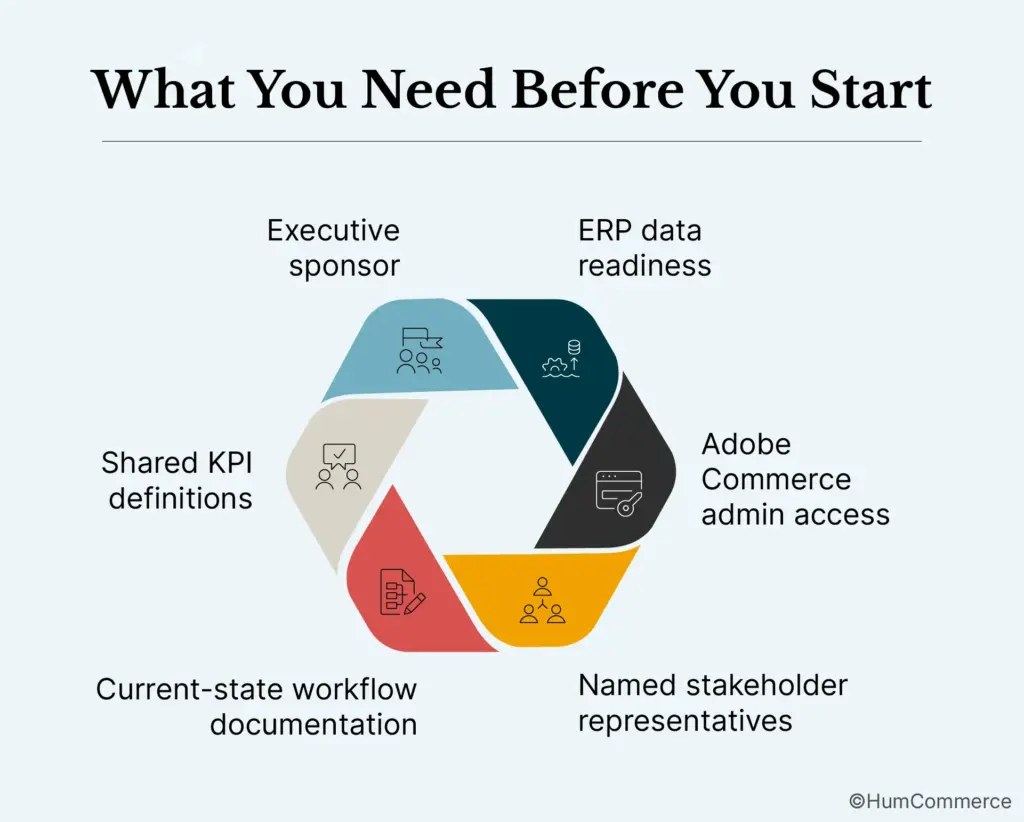
- ERP data readiness: Confirm that your ERP (Epicor, NetSuite, SAP Business One, or Dynamics 365) has clean, current data for customer-specific pricing, inventory levels, and order history. If your contract rates and volume tiers live in spreadsheets outside the ERP, centralize them first.
- Adobe Commerce admin access: At least one technical stakeholder needs admin-level access to your Adobe Commerce instance, including configuration rights for customer groups, pricing rules, and catalog permissions.
- Named stakeholder representatives: Identify one decision-maker from each department: IT, Sales, Operations, and Marketing. These aren’t observers. They need authority to make trade-off decisions on behalf of their teams.
- Current-state workflow documentation: Map your existing order-to-cash process, including how quotes are generated, how orders enter the ERP, and where manual handoffs happen. Shadow customer service calls and audit failed site search logs to capture pain points that don’t show up in dashboards.
- Shared KPI definitions: Agree on 3-5 metrics that matter across departments: order accuracy rate, quote turnaround time, average order value, self-service adoption rate, and time-to-fulfill are strong starting points.
- Executive sponsor: You need one senior leader (typically a COO or GM) who can break ties when Sales and Operations disagree on feature priority. Without this, the roadmap stalls at the first conflict.
How to Align IT, Sales, Operations, and Marketing on a Single B2B Ecommerce Roadmap: Step-by-Step
Step 1: Run a Cross-Functional Discovery Sprint
Block two days for a structured discovery session with your named stakeholders from all four departments. The goal isn’t brainstorming: it’s documenting each team’s top five pain points and their top five desired outcomes from the ecommerce platform. Have each department present independently before any group discussion. This prevents the loudest voice from dominating. Capture everything in a shared document with the department name attached to each item so you can trace priorities back to their source throughout the project.
Step 2: Map Pain Points to Revenue and Cost Impact
Not all pain points are equal. Take the combined list from Step 1 and assign a rough dollar value or time cost to each item. If Sales reports that 40% of their time goes to manual order entry, calculate what that costs in lost selling hours per quarter. If Operations flags that inventory mismatches cause 8% of orders to ship late, estimate the customer churn impact. This step forces every department to justify their priorities in business terms rather than preferences. It also reveals where departments share the same underlying problem: Sales wanting faster quotes and Operations wanting fewer manual approvals often point to the same CPQ integration need.
Step 3: Build a RACI Matrix for Every Roadmap Initiative
For each initiative on your roadmap, define who is Responsible, Accountable, Consulted, and Informed. This is where most B2B ecommerce project stakeholders’ buy-in breaks down. If IT is responsible for an ERP integration but Sales is accountable for adoption, both teams need to agree on that before development starts. In Adobe Commerce projects, common RACI conflicts include catalog management (Marketing vs. Operations), pricing rule configuration (Sales vs. IT), and checkout workflow design (everyone). Document the RACI matrix in a format that’s visible to all stakeholders, not buried in a project management tool that only IT uses.
Step 4: Sequence Initiatives by Dependency, Not Department Politics
Ecommerce roadmap planning for manufacturers requires sequencing based on technical dependencies and business impact, not on which department lobbied hardest. Your ERP integration (connecting Epicor, NetSuite, SAP Business One, or Dynamics 365 to Adobe Commerce for real-time inventory and pricing) almost always comes first because every other feature depends on accurate data. After that, prioritize features that unblock the most revenue or eliminate the most manual work. A common sequence: ERP sync first, then customer-specific pricing and catalog permissions, then self-service quoting, then marketing personalization. Each phase should deliver measurable value on its own so stakeholders see progress.
Step 5: Define “Done” for Each Phase with Shared Acceptance Criteria
Every roadmap phase needs acceptance criteria that all four departments sign off on before development begins. “Launch the self-service portal” isn’t an acceptance criterion. “Customers in Tier 1 accounts can place reorders with contract pricing pulled from NetSuite, with orders flowing to the ERP within 60 seconds” is. When you align IT, Sales, and Ops around ecommerce milestones with this level of specificity, you eliminate the post-launch finger-pointing that kills momentum. Adobe Commerce’s staging environment makes it straightforward to demo features against acceptance criteria before pushing to production.
Step 6: Establish a Biweekly Roadmap Review Cadence
A roadmap that only gets reviewed at quarterly business reviews is a roadmap that drifts. Set a biweekly 30-minute review with your four stakeholder leads. The agenda is simple: what shipped since last review, what’s on track for the next sprint, and what trade-offs need a decision. This cadence catches misalignment early. If Marketing discovers that the product content structure IT built doesn’t support their SEO requirements, you want to know that two weeks in, not two months in. Keep a running decision log so new team members can understand why certain trade-offs were made.
Step 7: Measure Cross-Functional Outcomes, Not Department Metrics
Your roadmap’s success metrics should span departments. Quote turnaround time measures the handoff between Sales, IT, and Operations. Self-service adoption rate reflects whether Marketing drove awareness, IT built a usable experience, and Sales encouraged customers to use it. One HumCommerce client saw quote turnaround time drop from 3-5 days to just hours after automating quote capture, approvals, and ERP/CPQ checks across departments. When you tie your cross-functional B2B ecommerce strategy to shared metrics, no single department can declare victory while others are struggling.
3 Mistakes to Avoid
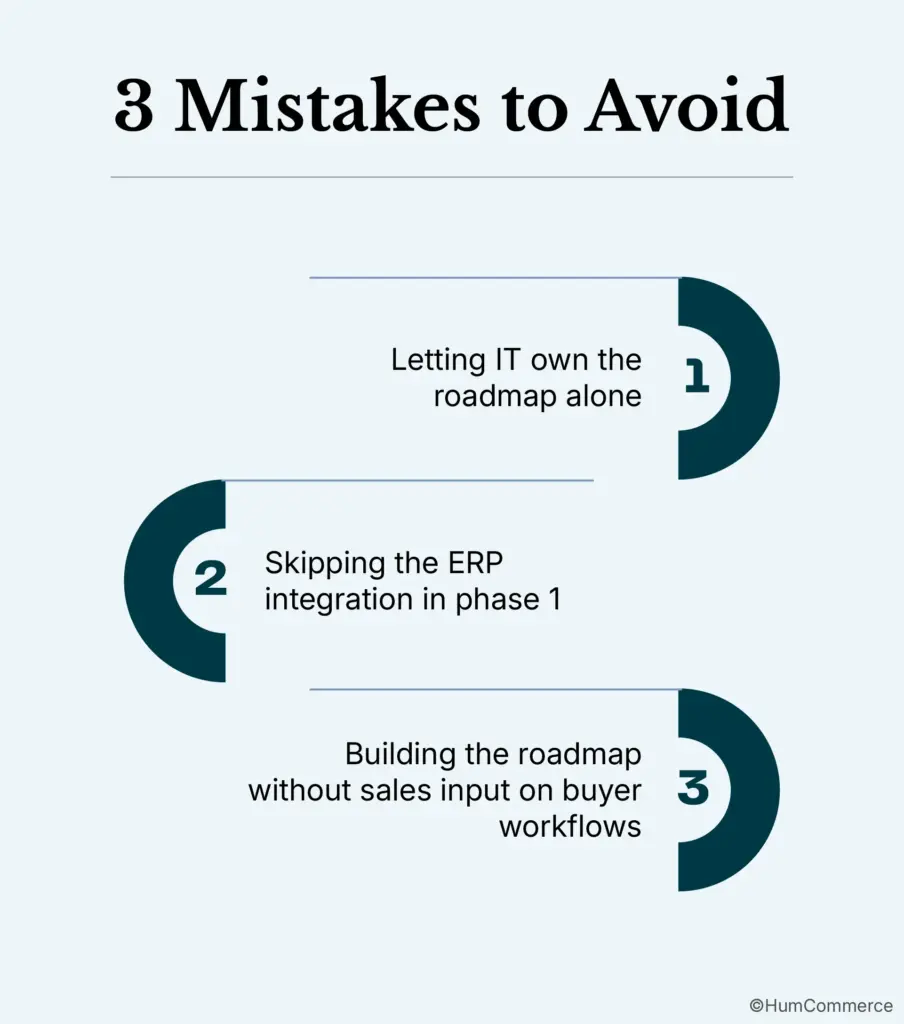
Mistake 1: Letting IT Own the Roadmap Alone
When IT controls the entire roadmap, features get prioritized by technical elegance rather than business impact. Sales and Operations lose trust in the process and start building workarounds outside the platform. Instead, assign roadmap ownership to a cross-functional steering committee with equal representation from all four departments.
Mistake 2: Skipping the ERP Integration in Phase 1
Some teams push ERP integration to Phase 2 because it’s complex and slow. This means Phase 1 launches with manual pricing, disconnected inventory, and no real-time order sync, which guarantees low adoption and frustrated buyers. Treat your Epicor, NetSuite, SAP Business One, or Dynamics 365 integration as the foundation, not a follow-up. The ERP is your single source of truth for contract pricing, credit limits, and inventory: the storefront is only as reliable as the data feeding it.
Mistake 3: Building the Roadmap Without Sales Input on Buyer Workflows
Sales teams interact with buyers daily. They know which accounts need approval chains, which ones require PO-based purchasing, and which product categories generate the most quoting friction. If you build your ecommerce roadmap without this input, you’ll ship features that don’t match how your customers actually buy. Conduct structured interviews with your top five sales reps before finalizing any roadmap phase.
Real Example: Duke Industrial Equipment
Duke Industrial Equipment was running Adobe Commerce alongside their ERP, but had no shared roadmap across departments, which meant Sales, IT, and Operations each had competing priorities and no process for resolving them.
After getting this right:
- Sales cycle reduced from 90 to 52 days (42% faster)
- Sales team admin time reduced from 40% to 15% of working hours
Here’s what specifically changed. Duke’s team built a unified roadmap that sequenced ERP integration first, connecting their commerce platform with real-time pricing and inventory data so Sales could stop manually verifying stock and contract rates. They then implemented self-service quoting tied to their ERP’s pricing rules, which eliminated the back-and-forth that was consuming most of the sales team’s admin hours. The critical shift wasn’t technical: it was getting all four departments to agree on shared acceptance criteria for each phase and reviewing progress biweekly. Marketing contributed to building product content that matched the catalog structure. Operations needed for accurate fulfillment, and IT configured Adobe Commerce’s customer group permissions to reflect the account-based pricing tiers Sales required.
The result was a platform that every department trusted because every department helped define what “working correctly” meant.
Need Help Implementing This?
Getting IT, Sales, Operations, and Marketing aligned on a single B2B ecommerce roadmap is conceptually straightforward. The complexity shows up in execution: configuring Adobe Commerce to enforce your ERP’s pricing rules, mapping approval workflows across customer segments, and building integrations that stay reliable as your catalog and customer base grow. For manufacturing and distribution businesses running Epicor, NetSuite, SAP Business One, or Dynamics 365, these aren’t generic e-commerce problems. They require deep knowledge of how B2B buying workflows interact with ERP logic.
HumCommerce specializes in exactly this type of implementation. Our team has helped manufacturers and distributors build Adobe Commerce platforms that behave like extensions of their ERP, with real-time inventory visibility, contract pricing that always follows ERP rules, and automated quote workflows that cut turnaround from days to hours.
Talk to a HumCommerce consultant about your B2B ecommerce roadmap alignment setup.