
TL;DR
- Manual RFQ processing drains sales teams, introduces pricing errors, and costs manufacturers days of quote turnaround time.
- AI-powered automation changes this equation entirely.
- By connecting your commerce platform to ERP and CPQ systems through intelligent workflows, you can reduce quote cycles from days to hours while eliminating the spreadsheet chaos that leads to margin leakage.
- This guide walks through the complete process: mapping your current state, checking readiness, preparing systems, designing improved workflows, implementing changes, and measuring results.
- The payoff? AI automation delivers a 35% average reduction in operational costs and frees your sales team to focus on relationships rather than data entry.
Why This Matters for B2B Manufacturing
Every quote request that sits in an inbox represents revenue at risk. Your competitors are responding faster, and B2B buyers have grown accustomed to the speed of consumer transactions. The patience threshold has collapsed.
Consider what happens when a procurement manager sends an RFQ to three suppliers simultaneously. The first response with accurate pricing and realistic lead times often wins the order, regardless of whether another supplier might have offered marginally better terms. Speed creates its own competitive advantage.
The manual process compounds this problem. Sales reps toggle between email, ERP screens, and spreadsheets. They check inventory availability, look up customer-specific pricing tiers, calculate shipping for heavy or oversized items, and then manually key everything into a quote document. Each handoff introduces delay. Each manual entry creates error potential.
The global B2B ecommerce market is projected to reach $36.16 trillion by 2026, and companies capturing that growth are the ones removing friction from buyer interactions. RFQ automation isn’t about replacing your sales team. It’s about giving them the tools to respond in hours instead of days.
Why Automating RFQs with AI for Faster Quotes and Fewer Manual Errors in B2B Ecommerce Is a Priority Now
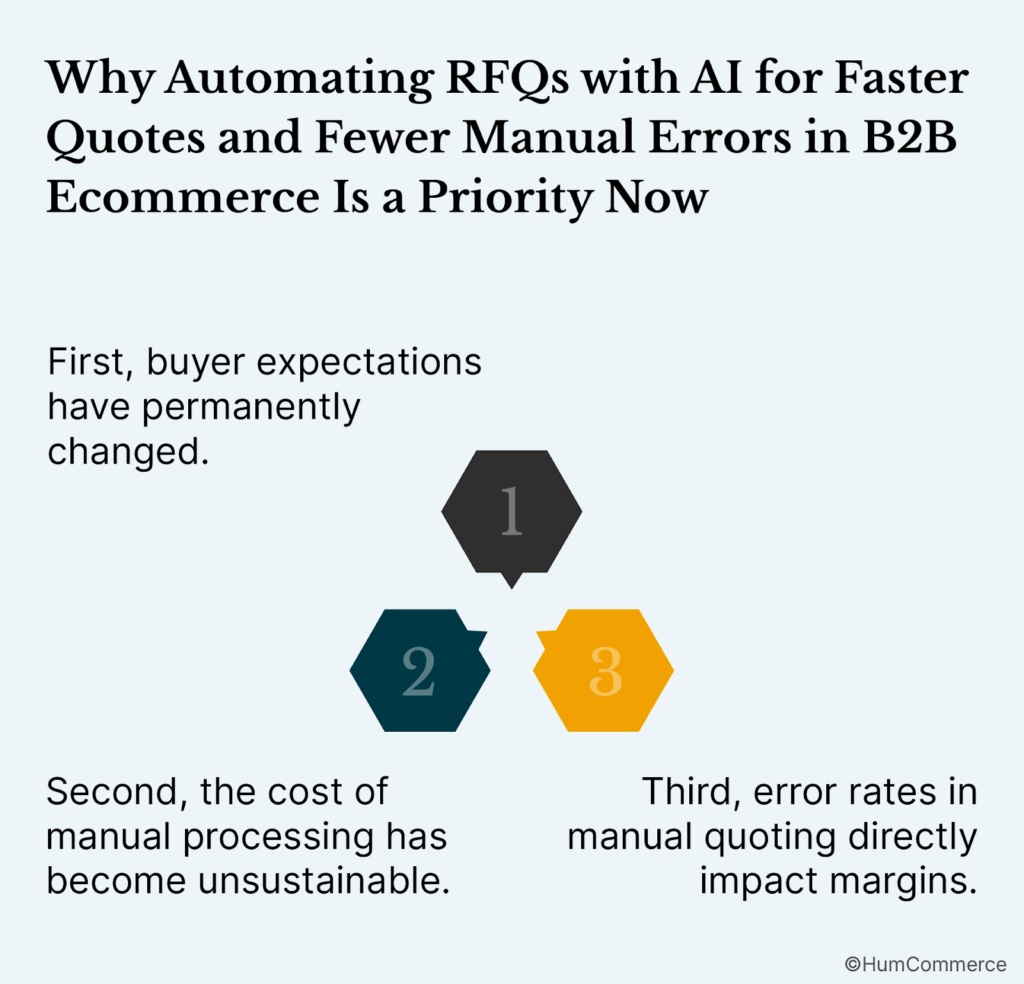
The timing for this investment has shifted from “nice to have” to “competitively necessary.” Three forces are converging.
First, buyer expectations have permanently changed. B2B procurement professionals now use AI tools themselves for product discovery and supplier research. As one industry analysis noted, “AI is now the place where decisions begin”. If buyers are using AI to find you, they expect you to use AI to serve them.
Second, the cost of manual processing has become unsustainable. A single complex quote might require 45 minutes of a senior rep’s time. Multiply that across hundreds of monthly requests, and you’ve buried your most experienced people in administrative work. Meanwhile, the AI automation market is growing at a 23.4% CAGR, reaching $19.6B by 2026, signaling that your competitors are already investing.
Third, error rates in manual quoting directly impact margins. A miskeyed price, an overlooked volume discount, or a forgotten shipping surcharge can turn a profitable order into a loss. Worse, inconsistent pricing across channels erodes customer trust and creates internal confusion.
What ‘Done’ Looks Like When You Automate RFQs with AI for Faster Quotes and Fewer Manual Errors in B2B Ecommerce
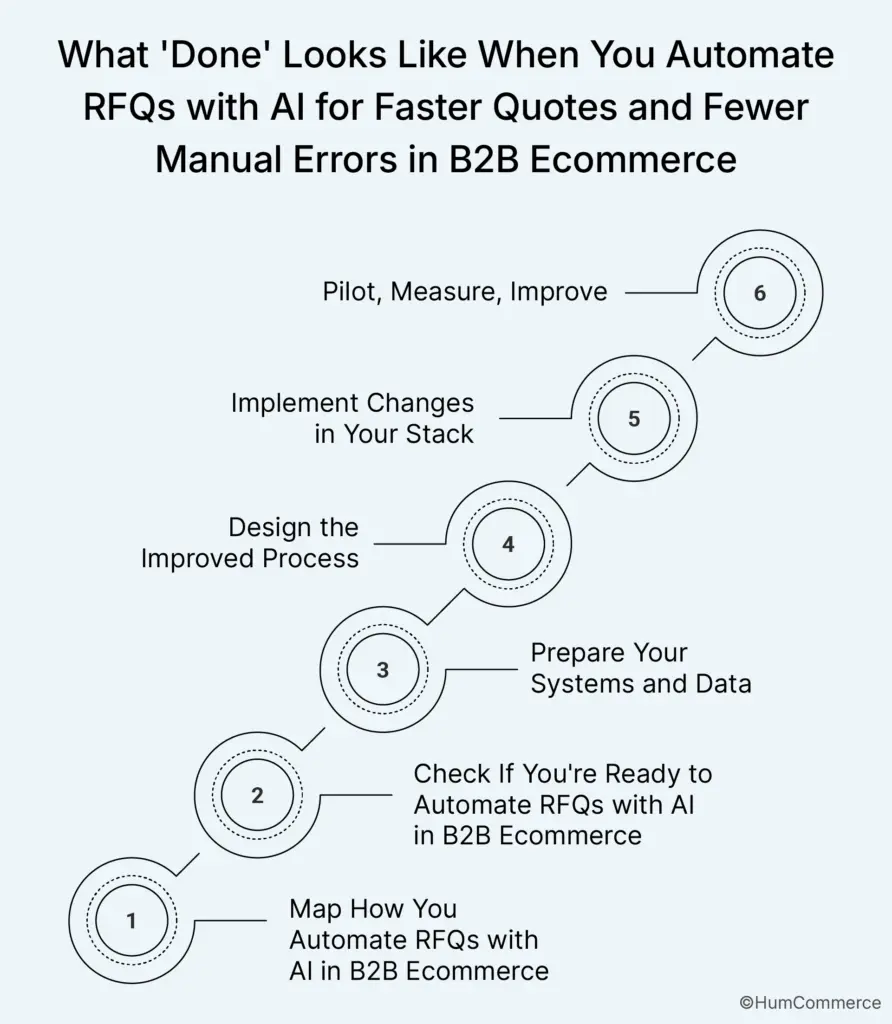
Before starting any implementation, you need a clear picture of the end state. What does successful automation actually look like in daily operations?
Quote requests arrive through multiple channels: your ecommerce portal, email, phone calls logged by inside sales. Within minutes, not hours, the system validates the request against customer account status, checks real-time inventory across warehouses, applies the correct pricing tier, and generates a draft quote. For standard configurations, the quote routes directly to the customer. For complex or high-value requests, it routes to the appropriate rep with all the research already completed.
Your sales team sees a dashboard showing pending quotes, their status, and any that need human judgment. They spend their time on relationship building and complex negotiations, not data entry. Customers receive quotes that match what they’ll see at checkout, because the same pricing rules govern both systems.
Step 1: Map How You Automate RFQs with AI in B2B Ecommerce
You can’t improve what you haven’t documented. Start by mapping your current RFQ workflow in detail, including the informal workarounds your team has developed.
Track a sample of 20-30 recent quotes from initial request to customer response. Document every system touched, every person involved, and every delay point. Common patterns emerge quickly:
- Requests arrive via email and sit until someone manually enters them into the system
- Pricing lookup requires accessing the ERP directly because the commerce platform doesn’t have current data
- Inventory checks involve calling the warehouse or checking a separate system
- Approvals stall when the required manager is traveling or in meetings
- Final quotes get copied from templates and manually adjusted, introducing formatting inconsistencies
Quantify the time spent at each step. Note which steps require specialized knowledge that only certain team members possess. Identify where errors most commonly occur and what their downstream impact looks like.
This mapping exercise often reveals that the actual process differs significantly from the documented process. Your team has built workarounds to compensate for system limitations, and those workarounds need to be understood before you can automate effectively.
Step 2: Check If You’re Ready to Automate RFQs with AI in B2B Ecommerce
Automation amplifies whatever it touches. If your underlying data and processes are sound, automation makes them faster. If they’re broken, automation makes them fail faster and more consistently.
Assess your readiness across four dimensions.
Data quality comes first. Are your product records complete and accurate? Do you have reliable cost data? Are customer pricing tiers documented in a system rather than tribal knowledge? If your product catalog has inconsistent attributes, missing specifications, or outdated pricing, fix that before attempting automation.
System integration capability matters next. Can your ERP share data with other systems via API? Does your commerce platform support the integration patterns you’ll need? Many manufacturers run ERP systems with limited connectivity, requiring middleware or custom development to enable automation.
Process standardization determines how much you can automate. If every sales rep handles quotes differently, you’ll need to establish standard workflows before automation can work. This often requires difficult conversations about “the way we’ve always done it.”
Organizational readiness is the factor most often overlooked. Does your team understand why this change is happening? Do you have executive sponsorship to push through resistance? Automation projects fail when they’re treated as purely technical initiatives.
Step 3: Prepare Your Systems and Data
With your current state mapped and readiness assessed, you can begin preparing the foundation for automation.
Your product information management deserves immediate attention. Every SKU needs complete, accurate data: dimensions, weights, lead times, minimum order quantities, and any configuration options. This data feeds both the AI’s ability to generate accurate quotes and the rules engine that validates them.
Customer master data requires similar attention. Account hierarchies, pricing agreements, credit terms, and approval workflows all need to be documented in systems, not spreadsheets. If customer-specific pricing lives in a rep’s notebook, it needs to migrate to your ERP or commerce platform.
Integration architecture planning happens in parallel. Identify which systems need to communicate: typically your commerce platform, ERP, CPQ tool if you have one, and potentially PIM and CRM. Map the data flows between them. Determine whether you’ll use direct API connections, middleware, or a combination.
HumCommerce approaches this as ERP-first commerce design. The commerce platform should behave like an extension of your ERP, with real-time inventory visibility, two-way order sync, and pricing that always follows ERP rules. This architecture prevents the data discrepancies that cause quote errors.
Step 4: Design the Improved Process
Now you can design the automated workflow that will replace your current manual process. Start with the customer experience and work backward to the systems.
Define the intake channels and how they’ll feed into a unified queue. Whether a request arrives via your portal’s quote request form, an email parsed by AI, or a phone call logged by inside sales, it should enter the same workflow with the same data structure.
Build your rules engine logic. Which requests can be auto-quoted without human review? Typically, these are standard products, existing customers in good standing, quantities within normal ranges, and total values below a threshold. Define the criteria explicitly.
Design the escalation paths for requests that need human judgment. Complex configurations, new customers, unusually large orders, or items with long lead times might require sales review. The system should route these to the right person with all relevant context already assembled.
Establish response time targets by request type. Standard quotes might target four-hour turnaround. Complex configurations might target 24 hours. These targets drive your automation priorities and help measure success.
Quote turnaround time can be reduced from 3-5 days to just hours by automating quote capture, approvals, and ERP/CPQ checks in the end-to-end workflow.
Step 5: Implement Changes in Your Stack
Implementation typically proceeds in phases rather than a single big-bang deployment. This approach reduces risk and allows learning between phases.
Phase one often focuses on data synchronization. Get real-time inventory and pricing flowing from ERP to commerce platform. Ensure customer account data stays synchronized. This foundation enables everything that follows.
Phase two introduces the quote request workflow. Build the intake forms, the routing logic, and the queue management dashboard. At this stage, quotes still require human completion, but the system organizes the work and provides the data reps need.
Phase three adds automated quote generation for qualifying requests. The AI applies pricing rules, checks inventory, calculates shipping, and generates draft quotes. Initially, these might route to humans for review before sending. As confidence builds, you can enable auto-send for appropriate request types.
Phase four expands automation coverage. Analyze which manually-handled requests could be automated with additional rules or data. Continuously expand the percentage of requests that flow through without human touch.
Implementing AI in the RFP process can lead to a 12% improvement in win rates, and that improvement compounds as your team handles higher volumes with consistent quality.
Step 6: Pilot, Measure, Improve
Start your pilot with a constrained scope: perhaps a single product category, a specific customer segment, or one geographic region. This limits blast radius if something goes wrong while generating real data on system performance.
Define your success metrics before the pilot begins. Common measures include:
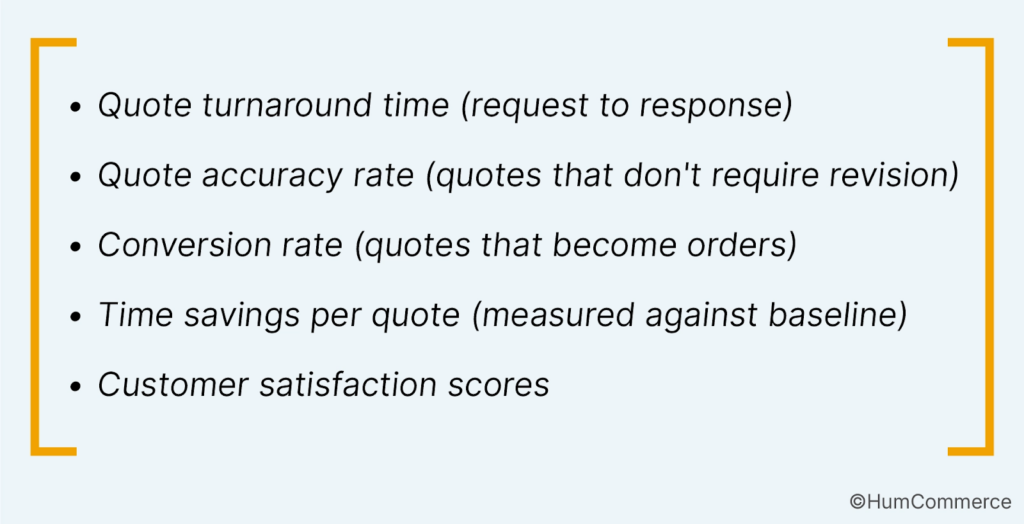
Run the pilot for at least 4-6 weeks to gather meaningful data. Monitor closely during the first week, checking every automated quote for accuracy. As confidence builds, shift to sampling.
Gather feedback from both customers and internal users. Customers will tell you if quotes are arriving faster but missing information they need. Sales reps will identify edge cases the automation doesn’t handle well.
Use pilot learnings to refine rules, improve data quality, and adjust workflows before broader rollout. Businesses that excel at personalization see up to 40% higher revenue, and the personalization insights from your pilot will inform how you scale.
Common Mistakes to Avoid When You Automate RFQs with AI for Faster Quotes and Fewer Manual Errors in B2B Ecommerce
Several failure patterns appear repeatedly in RFQ automation projects. Knowing them in advance helps you avoid them.
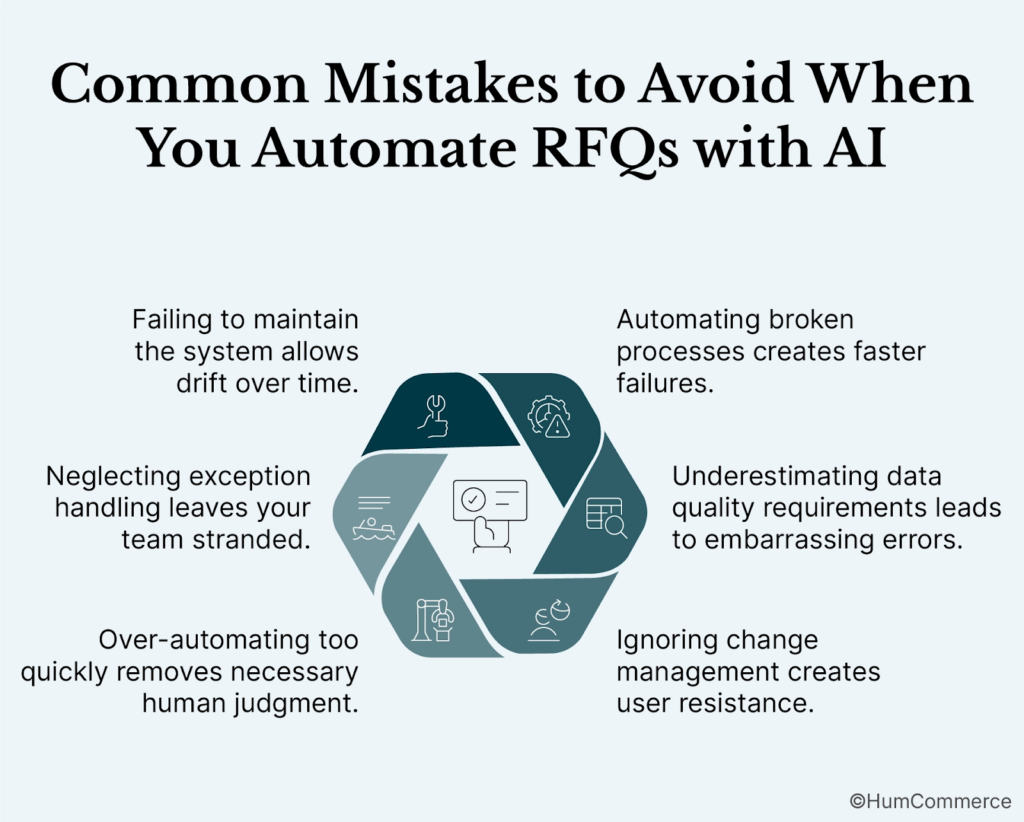
Automating broken processes creates faster failures. If your current pricing logic has inconsistencies, automation will apply those inconsistencies at scale. Clean up the underlying rules before automating their application.
Underestimating data quality requirements leads to embarrassing errors. A quote that shows the wrong price because product data was incomplete damages customer trust more than a slow manual quote would have.
Ignoring change management creates user resistance. Sales reps who feel threatened by automation will find ways to work around it. Involve them early, emphasize how automation frees them for higher-value work, and celebrate wins together.
Over-automating too quickly removes necessary human judgment. Start conservative with what qualifies for auto-send. It’s easier to expand automation than to rebuild trust after sending incorrect quotes.
Neglecting exception handling leaves your team stranded. What happens when a quote request doesn’t fit any defined category? Build clear escalation paths and ensure humans can always intervene.
Failing to maintain the system allows drift over time. Pricing rules change, products get added, customer agreements get updated. Assign ownership for keeping the automation current.
Need Help Putting This Into Practice?
Automating RFQs in B2B ecommerce requires expertise across multiple domains: commerce platforms, ERP integration, AI implementation, and workflow design. Most manufacturers don’t have all these capabilities in-house, and building them takes time you may not have.
HumCommerce specializes in exactly this intersection. We design Adobe Commerce implementations that behave like extensions of your ERP, with real-time data sync, rules-driven pricing, and automated workflows that match how your customers actually buy. Our work with manufacturers has demonstrated that automated, rules-driven quoting tied directly into ERP and CPQ systems eliminates the manual spreadsheet chaos that causes pricing errors and margin leakage.
If you’re evaluating how to approach RFQ automation for your B2B operation, we can help you assess readiness, design the right architecture, and implement in phases that deliver value quickly while building toward full automation. The conversation starts with understanding your current state and your goals.