
TL;DR
- What this is: ERP integration in B2B ecommerce refers to the bidirectional, real-time sync of orders, inventory, pricing, customers, and invoices between an ERP system and a B2B ecommerce platform – the foundation of an automated order-to-fulfillment workflow.
- Who it affects: Director/VP of Operations and IT Director / Digital Transformation Leader at Industrial Manufacturing & Distribution companies.
- The core problem: US B2B manufacturers and distributors using Epicor, NetSuite, SAP B1, or Dynamics 365 face ERP integration failures most often when connecting to an ecommerce platform like Adobe Commerce.
- The cost of inaction: 55% of B2B ecommerce projects cite ERP integration as the #1 cause of go-live delays (Forrester).
- What good looks like: ERP-First B2B Commerce Integration – not Generic ERP Connector.
- Proof it works: FHC Fastener Hardware Co-Op – Order corrections reduced from 18% to 0.8% (95% improvement).
ERP integration is the single most underestimated risk in any B2B ecommerce project. When the sync between your ERP and storefront breaks down, everything downstream breaks with it: pricing errors erode margins, inventory mismatches trigger order cancellations, and your ops team spends hours manually re-keying data that should flow automatically. The gap between “connected” and “correctly integrated” is where most projects stall, and where the real cost hides.
Every year, US manufacturers and distributors invest heavily in ecommerce platforms like Adobe Commerce, expecting their Epicor, NetSuite, SAP Business One, or Dynamics 365 systems to connect without friction. The reality is different. ERP integration failures are the leading cause of delayed launches, ballooning budgets, and post-go-live firefighting. These aren’t abstract risks. They show up as your sales team re-entering orders by hand, your warehouse shipping against stale inventory counts, and your finance team reconciling invoices that don’t match what the customer portal displayed.
This article breaks down the ERP integration problems in B2B ecommerce that most teams don’t see coming until they’re already behind schedule and over budget. Whether you’re a VP of Operations trying to protect fulfillment accuracy, an IT leader evaluating integration architecture, or an ecommerce manager responsible for the platform’s performance, the patterns here will help you identify failure points before they become expensive surprises. The focus is on practical, operations-first guidance for mid-market manufacturers and distributors running complex B2B selling environments.
What Is ERP Integration in B2B Ecommerce?
ERP integration in B2B ecommerce refers to the bidirectional, real-time sync of orders, inventory, pricing, customers, and invoices between an ERP system and a B2B ecommerce platform – the foundation of an automated order-to-fulfillment workflow. This means data doesn’t just flow from the storefront to the ERP when an order is placed. It flows both ways: when a contract price changes in your ERP, the storefront reflects it instantly. When a return is processed online, inventory reconciles automatically in the warehouse.
The distinction matters because most B2B data relationships are inherently two-way. Customer credit limits, payment terms, and account hierarchies live in the ERP. Product master data originates there too. But order status, shipping updates, and customer-facing pricing all need to push back to the storefront in near-real-time. A one-way feed creates blind spots that your ops and customer service teams end up filling manually.
Not all integration approaches are equal, and the difference between them determines whether your ecommerce platform operates as part of your business or as a disconnected storefront.
Generic ERP Connector
- A pre-built plugin for basic field mapping between systems.
- Requires manual workarounds for tiered pricing, approval chains, and multi-warehouse logic.
- Built for simplicity, not B2B complexity.
ERP-First B2B Commerce Integration
- E-commerce platform architected around the ERP as the single source of truth.
- Custom sync logic handles contract rates, volume tiers, credit limits, and order routing.
- Built specifically around how your B2B business runs.
The ERP-first approach treats your back-office system as the authority. The generic connector approach treats it as an afterthought.
Why Most Industrial Manufacturing & Distribution Companies Underestimate This Problem
The financial consequences of a failed ERP integration compound quickly. When order data doesn’t sync correctly between your B2B portal and your ERP, the downstream effects hit fulfillment accuracy, customer trust, and margin. Pricing errors from disconnected systems cause 8-12% margin leakage on roughly 15% of orders for a typical mid-market distributor. Multiply that across thousands of monthly transactions and the revenue loss is substantial. According to Forrester, 55% of B2B ecommerce projects cite ERP integration as the #1 cause of go-live delays – meaning the problem isn’t just operational, it’s strategic. Every month your launch slips is a month your competitors with self-service portals are winning accounts you should be closing.
The generic ERP connector approach fails because it assumes B2B commerce works like B2C. Standard connectors handle basic order push and inventory pull, but they don’t account for the complexity that defines industrial selling. Contract pricing with volume tiers, customer-specific catalogs, approval chains, purchase order requirements, credit limit enforcement, multi-location inventory allocation – none of these map cleanly to a pre-built plugin. When the connector can’t handle the edge cases, your team fills the gap manually. Aberdeen Group research shows that manual re-entry of orders between a portal and an ERP wastes an average of 15-20 hours per week per ops team. That’s not a minor inefficiency. That’s $40,000-$50,000 in annual labor cost per team, spent on work that should be automated.
The pain distributes unevenly across the organization, but two roles feel it most. The Director or VP of Operations watches fulfillment accuracy degrade as sync errors create shipping mistakes, backorders against phantom inventory, and invoice discrepancies that erode customer confidence. They’re the ones fielding calls when a customer’s portal shows “in stock” but the warehouse says otherwise. The IT Director or Digital Transformation Leader, meanwhile, inherits the technical debt. They’re debugging failed API calls at 2 AM, managing middleware that wasn’t designed for their ERP’s specific data structures, and explaining to leadership why the integration that was “90% done” three months ago still isn’t stable. Gartner data reinforces the gap: B2B companies with real-time ERP sync report 95%+ order accuracy, compared to 82-88% without integration. That 10-point accuracy gap translates directly into rework hours, customer churn, and lost revenue.
The pattern is consistent across Epicor, NetSuite, SAP Business One, and Dynamics 365 environments. Each ERP has its own data model, API limitations, and field-mapping quirks. A connector built for one rarely works cleanly with another, and the customization required to bridge those gaps often exceeds the cost of building a purpose-designed integration from the start.
The 5 Most Common ERP Integration Failures in B2B Ecommerce – And How to Avoid Them
Most ERP-ecommerce integration failures follow predictable patterns. Understanding these failure modes before you start your project is worth more than any amount of troubleshooting after go-live.
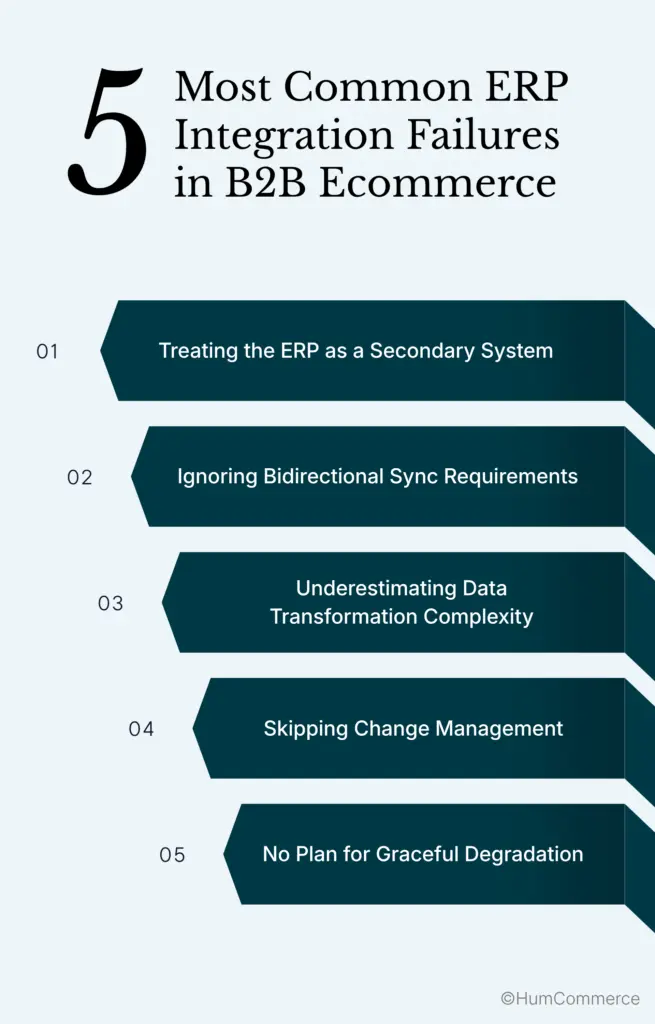
1. Treating the ERP as a Secondary System
The most damaging architectural mistake is building the ecommerce platform first and bolting on the ERP connection later. Gartner reports that 70% of ERP projects fail to meet their stated business goals, and the root cause is rarely technical – it’s architectural. When the storefront is designed independently from the ERP, data models don’t align, field mappings break under real transaction volume, and the integration becomes a fragile bridge between two systems that were never designed to work together. The fix is straightforward: treat the ERP as the single source of truth from day one. Every pricing rule, credit limit, and inventory count should originate in the ERP and flow outward.
2. Ignoring Bidirectional Sync Requirements
One-way data feeds create dangerous blind spots. Pushing orders from the storefront to the ERP is table stakes. But what happens when a return is processed? When a credit memo is issued? When an order is partially fulfilled from a different warehouse? Without bidirectional sync, your customer portal shows stale data, your finance team reconciles manually, and your service reps answer questions they shouldn’t need to answer. Event-driven architecture – where system changes trigger automatic updates through a message queue – provides far better resilience than synchronous point-to-point connections.
3. Underestimating Data Transformation Complexity
Field formats between systems rarely match. Date formats, currency codes, unit-of-measure conversions, alphanumeric SKU structures, and cross-reference tables for superseded parts all require explicit mapping logic. A connector that handles basic product and order fields will choke on the complexity of a 150,000-SKU catalog with application-specific data, multiple packaging units, and customer-specific pricing tiers. Rate limiting, error handling, and authentication all add layers of complexity that generic solutions gloss over.
4. Skipping Change Management
42% of ERP integration failures stem from inadequate change management. The integration isn’t just a technical project – it changes how your sales team processes orders, how your warehouse receives pick lists, and how your finance team reconciles invoices. Without cross-functional alignment between IT, operations, sales, and finance, the technical integration succeeds but the organizational adoption fails. Training programs, clear escalation paths for sync failures, and documentation standards that prevent integration drift are non-negotiable.
5. No Plan for Graceful Degradation
Systems fail. APIs time out. ERPs go offline for maintenance. The question isn’t whether your integration will encounter downtime – it’s whether your architecture handles it gracefully. Queue-based processing, dead-letter queues for failed events, and automatic retry logic ensure that a temporary outage doesn’t cascade into lost orders or corrupted data. Batch-based fallback mechanisms should activate automatically when real-time sync is interrupted.
Most ERP-commerce integration failures are predictable. Here’s what to watch for:
- Constant field-mapping fixes post-launch → usually means ERP was treated as a secondary system, not the source of truth. Rebuild with an ERP-first architecture.
- Stale portal data and manual reconciliation → a sign of one-way sync. Switch to bidirectional, event-driven integration.
- SKU mismatches and edge-case pricing errors → data transformation gaps. Map every field format and unit of measure explicitly.
- Technical success, organizational rejection → no change management. Run cross-functional training and define escalation paths early.
- Lost orders during ERP downtime → no degradation plan. Queue-based processing with automatic retry prevents this entirely.
Real Results: FHC Fastener Hardware Co-Op
FHC Fastener Hardware Co-Op, a fastener distributor managing thousands of SKUs across multiple product lines, faced a common but crippling challenge: their ecommerce portal and ERP operated as disconnected systems, forcing the operations team to manually verify and correct a significant percentage of incoming orders.
What changed after implementation:
- Order corrections reduced from 18% to 0.8% (95% improvement)
- Rework hours cut from 60/month to 8/month
- Order volume scaled 3x (450 to 1,350/month) on same ops team
- Year 1 total operational value: $480K
The difference wasn’t a better connector or a faster API. It was an ERP-first integration design that treated the ERP as the authoritative source for pricing, inventory, and customer account data. Contract rates, volume tiers, and credit limits synced bidirectionally, so the storefront always reflected what the ERP knew to be true. When an order came in, it didn’t need manual verification because the data was already validated at the point of entry. That’s the practical difference between a generic ERP connector and an ERP-first B2B commerce integration: one creates work, the other eliminates it.
How HumCommerce Approaches ERP Integration Differently
Generic ERP connectors fail mid-market manufacturers and distributors because they’re designed for the simplest possible use case. They handle basic product sync and order push, but they don’t account for the operational complexity that defines industrial B2B selling: contract pricing that varies by customer and volume tier, approval chains that require multiple sign-offs before an order processes, multi-warehouse inventory allocation, or the specific data structures of Epicor, NetSuite, SAP Business One, and Dynamics 365. When the connector hits an edge case it wasn’t built for, your team becomes the middleware.
HumCommerce’s approach starts from the ERP outward. ERP-first B2B commerce integration means the Adobe Commerce storefront is architected to behave like an extension of your ERP and operations – not a separate system with a data bridge.
For a Director or VP of Operations, this means contract and tiered pricing always follows ERP rules on the storefront, bulk orders process through the ERP without CSV file handling or manual data entry, and returns and cancellations trigger automatic inventory reconciliation across systems. The three critical sync choke points – contract pricing, bulk orders, and returns – are addressed at the architectural level, not patched after launch.
The implementation experience reflects this philosophy. HumCommerce’s B2B ecommerce consulting begins with discovery activities like shadowing customer service calls, interviewing inside sales teams, and auditing failed site search logs to understand how your specific business processes map to integration requirements. The result is an integration that handles your actual workflows, not a generic template that requires months of post-launch customization. One industrial supply manufacturer that integrated Epicor CPQ with their Adobe Commerce storefront through this approach achieved 75% faster quote workflows, eliminating the manual back-and-forth that had been slowing their quote-to-order cycle. If your current integration approach is creating more work than it eliminates, ERP Integration for B2B Ecommerce is worth a closer look.
Take Action
ERP integration isn’t a technical checkbox on your ecommerce project plan – it’s the operational foundation that determines whether your platform creates value or creates work. The three things that matter most: treat your ERP as the single source of truth from the start, design for bidirectional sync that handles your actual B2B workflows including contract pricing, approval chains, and multi-warehouse allocation, and invest in change management so the organization adopts the integration, not just the IT team.
If your current setup has your ops team manually re-keying orders, your warehouse shipping against outdated inventory, or your finance team reconciling invoices that don’t match what the portal displayed, the architecture is the problem. Fixing individual sync errors won’t solve it. An ERP-first approach will.