
TL;DR
- Implementing conversational AI in B2B ecommerce requires more than dropping a chatbot onto your storefront.
- You need clean product data, ERP connectivity, and a clear understanding of how your buyers actually search for products.
- Start by mapping your current discovery workflows, assessing your data readiness, then pilot with a focused use case before scaling.
- Done right, conversational AI can boost conversion rates by up to 4x and reduce customer service costs by 25% or more.
Why This Matters for B2B Manufacturing & Industrial Supply
B2B buyers have fundamentally changed how they discover products. According to Cubeo AI, 84% of ecommerce businesses now identify AI as their top strategic priority by the end of 2026. For manufacturers and industrial suppliers, this shift carries specific implications.
Your catalogs are complex. A typical industrial distributor manages tens of thousands of SKUs with technical specifications, compatibility requirements, and customer-specific pricing. Traditional keyword search fails these buyers. They’re looking for “a 3/4 inch stainless steel ball valve rated for 150 PSI” and getting irrelevant results because your search index doesn’t understand intent.
Conversational AI changes this dynamic. It lets buyers describe what they need in natural language and receive accurate, contextual responses drawn from your commerce platform, ERP, and PIM systems. The technology connects the dots between buyer intent and your product data in ways that faceted navigation simply cannot.
Why Implementing Conversational AI for B2B Ecommerce is a Priority Now
The timing pressure is real. Research indicates that 77% of all B2B buying processes used AI in 2025, with heavy users growing to 40% of the buyer population. On the buyer side, 94% of procurement professionals now use Large Language Models for product discovery, with prompts like “Find me a supplier for industrial bearings with same-day shipping in the Midwest.”
This creates a visibility problem. If your product data isn’t structured for AI consumption, you’re becoming invisible to the AI agents that increasingly act on behalf of human buyers. Gartner projects that $15 trillion in B2B purchases will flow through AI agents by 2028. The question isn’t whether to implement conversational AI: it’s whether you’ll be ready when your buyers expect it.
The financial case is equally compelling. Envive AI reports that shoppers who engage with AI-powered chat are 4x more likely to buy, resulting in a 12.3% conversion rate versus 3.1% for those who don’t engage. For a B2B operation processing $50 million in annual online revenue, that conversion lift translates to millions in additional sales.
What ‘Done’ Looks Like When You Implement Conversational AI for B2B Ecommerce
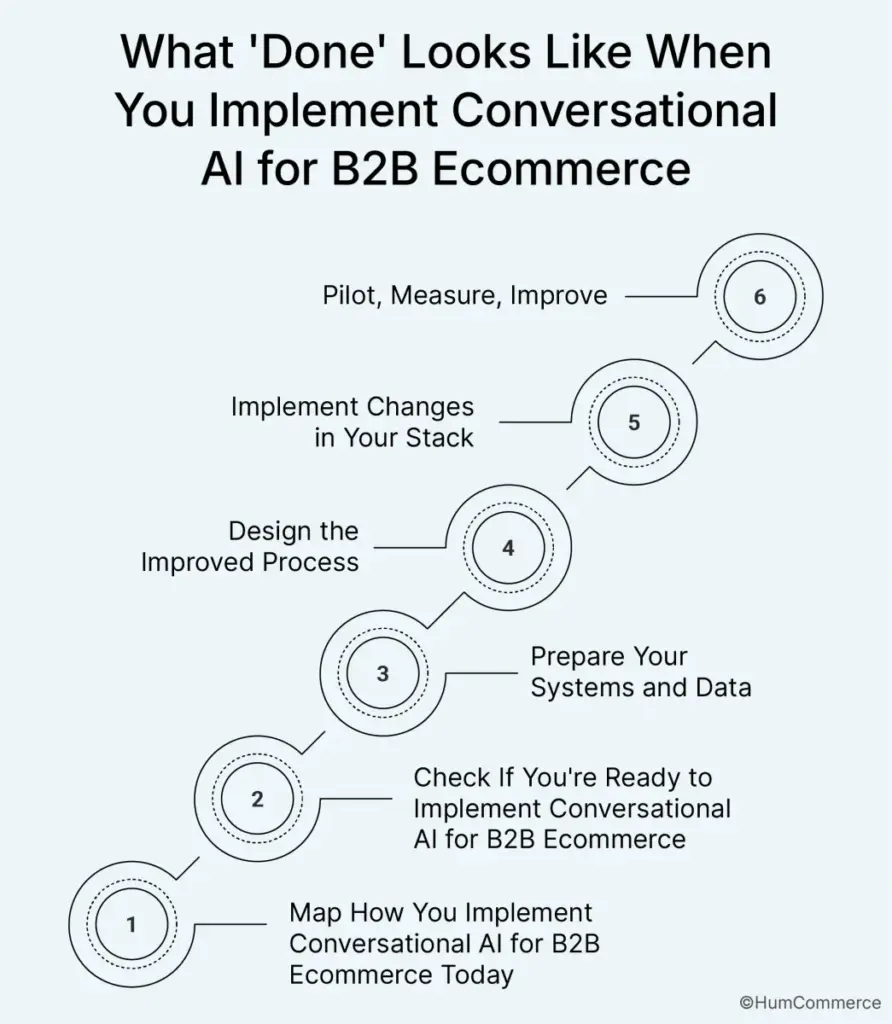
Before diving into implementation steps, establish a clear picture of success. A fully functional conversational AI deployment in B2B ecommerce should deliver these capabilities:
Buyers can ask natural language questions and receive accurate product recommendations with pricing, availability, and technical specifications. The system understands context: if a buyer asks about “the same fitting but in brass,” it remembers the previous query. Customer-specific pricing appears automatically based on account identification. The assistant handles complex queries involving compatibility, certifications, and application requirements.
Behind the scenes, the system pulls real-time inventory from your ERP, respects contract pricing rules, and logs interactions for sales team follow-up. It doesn’t replace your sales team: it handles the routine discovery and qualification work so reps can focus on complex negotiations and relationship building.
One manufacturer working with HumCommerce reduced quote turnaround time from 3-5 days to just hours by automating quote capture, approvals, and ERP/CPQ checks in their end-to-end quote management flow.
Step 1: Map How You Implement Conversational AI for B2B Ecommerce Today
Start with an honest assessment of your current product discovery experience. Shadow five to ten customer service calls and document the questions buyers ask. Review your site search logs for failed queries. Interview your inside sales team about the most common “where is it” and “does it work with” questions they field.
You’re looking for patterns. Common discovery failures in B2B include:
- Part number searches that return zero results due to formatting inconsistencies
- Compatibility questions that require manual lookup in external systems
- Pricing inquiries that force buyers to call because online prices don’t reflect their contract terms
- Technical specification searches that yield too many or too few results
Document the workarounds your team uses today. If your customer service reps have a personal spreadsheet of “tribal knowledge” for answering product questions, that knowledge needs to be captured and structured for AI consumption.
This mapping exercise reveals where conversational AI can deliver immediate value versus where you have data gaps to address first.
Step 2: Check If You’re Ready to Implement Conversational AI for B2B Ecommerce
Conversational AI is only as good as the data it can access. A readiness assessment should examine four dimensions.
Product data quality matters most. Review your PIM or product database for completeness. Do all products have accurate technical specifications? Are part numbers standardized? Do you have clear category hierarchies and cross-reference data for superseded parts? If 30% of your catalog lacks complete specifications, fix that before deploying AI.
ERP connectivity determines whether your assistant can provide accurate pricing and availability. Assess your current integration architecture. Can your ecommerce platform pull real-time inventory? Does it receive customer-specific pricing from your ERP? If these integrations are batch-based or unreliable, conversational AI will give buyers incorrect information.
Search infrastructure readiness involves evaluating your current search technology. Pure keyword search won’t support conversational AI effectively. You need a hybrid approach combining semantic understanding with exact-match capabilities for SKUs and part numbers.
Team capacity is often overlooked. Someone needs to own the implementation, monitor accuracy, and continuously improve the system. Conversational AI isn’t a “set and forget” technology.
Step 3: Prepare Your Systems and Data
With gaps identified, prioritize remediation work. Product data cleanup typically requires the most effort. Focus first on your highest-volume products and most common query types.
Standardize part number formats across systems. If your ERP stores “ABC-123” and your PIM stores “ABC123,” the AI will struggle to match queries. Create explicit cross-reference tables for superseded parts, equivalent products from different manufacturers, and compatibility relationships.
Enrich product attributes beyond basic specifications. Add application data, industry certifications, and common use cases. This contextual information helps conversational AI match buyer intent to products even when queries don’t use technical terminology.
For ERP integration, ensure real-time or near-real-time data flows for inventory and pricing. Voiceflow notes that conversational AI can reduce customer service costs by 25% or more by automating 80% of common inquiries: but only if the AI has accurate data to work with. Stale inventory data leads to oversells and erodes buyer trust.
Step 4: Design the Improved Process
Now design how conversational AI will integrate into buyer workflows. Map the complete interaction journey from initial query through order completion.
Define the scope of what your AI assistant will handle. Start focused. A common first use case is product discovery and specification lookup. The assistant helps buyers find the right product and provides technical details. It hands off to human support for complex quotes, custom configurations, or escalated issues.
Design the handoff points carefully. When should the AI transfer to a human rep? What information should it pass along? A well-designed handoff includes the buyer’s query history, products discussed, and any stated requirements: giving the rep full context without forcing the buyer to repeat themselves.
Consider how the assistant integrates with your quoting workflow. HumCommerce’s work with Epicor CPQ integration achieved 75% faster quote workflows by connecting conversational interfaces directly to CPQ and ERP systems, eliminating back-and-forth manual quoting.
Plan for account identification. B2B buyers expect to see their contract pricing. Your conversational AI needs to authenticate users and pull appropriate pricing tiers from your ERP.
Step 5: Implement Changes in Your Stack
Implementation approach depends on your current platform and integration architecture. For Adobe Commerce environments, you have several options.
A platform-agnostic solution like HumCommerce AI Assist connects to your existing commerce, ERP, and PIM systems without requiring replatforming. This approach works well when you need to move quickly or when your technical team has limited capacity for custom development.
The technical architecture matters. Pure large language models fail on exact-match queries for alphanumeric SKUs and part numbers. If a customer asks for “SKU-38995-WC” and the system relies solely on semantic AI, it may return “not found” even when the product exists. Retrieval Augmented Generation addresses this by combining real-time data retrieval from verified databases with AI-powered contextual understanding.
Implement in phases. Start with a limited product category or customer segment. This controlled rollout lets you identify issues before they affect your entire customer base.
Configure logging and analytics from day one. You need visibility into what buyers are asking, what the AI is answering, and where it’s failing. This data drives continuous improvement.
Step 6: Pilot, Measure, Improve
Launch your pilot with clear success metrics. Track query volume, successful product matches, conversion rate from AI interactions, and customer satisfaction scores. Compare these against your baseline from Step 1.
SlashExperts reports that a well-implemented conversational assistant can boost conversion rates by 7 percentage points, leading to a 24x return on investment for one retailer. Your results will vary, but establish concrete targets before launch.
Review failed queries weekly during the pilot phase. Every “I don’t understand” or incorrect product recommendation reveals a gap in your product data or AI configuration. Create a feedback loop where customer service reps flag AI errors for review.
Expand gradually. Once your pilot segment shows stable performance, extend to additional product categories or customer groups. Each expansion phase should include its own measurement period before proceeding further.
Common Mistakes to Avoid When You Implement Conversational AI for B2B Ecommerce

Launching without clean data is the most common failure mode. Organizations excited about AI capabilities deploy chatbots before addressing fundamental product data issues. The AI confidently provides wrong answers, damaging buyer trust more than having no AI at all.
Ignoring the hybrid search requirement creates frustration for B2B buyers who often search by exact part numbers. If your AI can’t handle “3M-9210+” as a query, it fails the buyers who know exactly what they need.
Treating implementation as a one-time project rather than ongoing optimization leads to decay. Buyer needs evolve, product catalogs change, and AI models require tuning. Budget for continuous improvement, not just initial deployment.
Over-scoping the initial rollout delays time-to-value. You don’t need the AI to handle every possible interaction before launch. Start with product discovery, prove value, then expand to order status, reordering, and complex quoting.
Neglecting the human handoff creates abandoned conversations. Buyers accept that AI can’t answer everything, but they expect a smooth transition to human support when needed.
Need Help Putting This Into Practice?
Implementing conversational AI for B2B ecommerce involves technical complexity that spans your commerce platform, ERP, PIM, and search infrastructure. The organizations seeing the strongest results typically work with partners who understand both the AI technology and the operational realities of B2B selling.

The global AI ecommerce market is projected to reach $64.03 billion by 2034, exhibiting a CAGR of 24.34%. Early movers in B2B are capturing disproportionate benefits while competitors struggle with outdated search experiences.
If you’re evaluating conversational AI for your B2B operation, start with a focused assessment of your data readiness and integration requirements. We’re happy to discuss your specific situation and share what we’ve learned from implementations across manufacturing and distribution.