TL;DR
- B2B cart abandonment rates average 75-85%, well above the retail average of 70%, because pricing mismatches, product uncertainty, and approval delays create friction that keyword search and static checkout flows cannot resolve
- Six-step process: map your current abandonment points, check data and system readiness, prepare your ERP and commerce platform, design the improved intervention workflow, implement changes, then pilot and measure
- AI reduces B2B cart abandonment by 20-30% through real-time ERP pricing sync, RAG-based product matching, and behavior-triggered conversational interventions at the moment of hesitation
- Cicero Supply saw a 40% increase in product click-through rate and 25-35% of orders completed via self-service after deploying AI-powered product discovery
- Built for B2B ecommerce managers on Adobe Commerce or Shopify Plus with SAP, Epicor, or NetSuite who need a structured, ERP-first approach to AI cart recovery
A procurement manager at one of your top accounts spent 40 minutes on your storefront last Tuesday. They added 12 line items, got to the cart summary, saw a unit price that did not match the contract rate their company negotiated six months ago, and closed the tab. No call, no email. Just gone. Your analytics show the session. Your sales rep found out two weeks later when the same order appeared on a competitor’s invoice. For wholesale distributors running Adobe Commerce with SAP or NetSuite behind it, that scenario is not an edge case. B2B cart abandonment rates average 75-85%, and most of the causes are operational, not cosmetic. This guide walks you through a practical, six-step process for using AI to intercept those abandonment triggers before buyers leave.
Why Using AI to Reduce Cart Abandonment in B2B Ecommerce Is a 2026 Priority
B2B ecommerce managers face a specific, measurable problem: buyers abandon carts at rates between 75% and 85%, compared to a 70% average across all ecommerce sectors. Unlike retail, where a forgotten impulse buy drives most abandonment, B2B abandonment stems from operational friction. Pricing does not match the buyer’s contract. Inventory shows “available” on the storefront but “backordered” in the ERP. Approval workflows stall without visibility. These are not UX annoyances; they are revenue leaks tied directly to system disconnects between your commerce platform and your ERP.
The friction compounds when Adobe Commerce or Shopify Plus connects to SAP or NetSuite through batch-based integrations. Contract pricing lives in the ERP, but the commerce platform may cache stale data. A buyer adds 200 units of a specific SKU, sees a price that does not reflect their volume tier, and abandons. Or worse, they call a sales rep, who spends 15-20 minutes navigating disconnected systems to confirm the correct price. Buyers who engage with AI-powered chat convert at 12.3% compared to 3.1% for those who do not, a gap that illustrates how much revenue is lost when buyers cannot get instant, accurate answers.
This guide gives you a practical framework for deploying AI to intercept and resolve these abandonment triggers. By the end, you will understand the difference between AI-powered cart recovery as a strategic capability and simply bolting a chatbot onto a broken checkout flow.
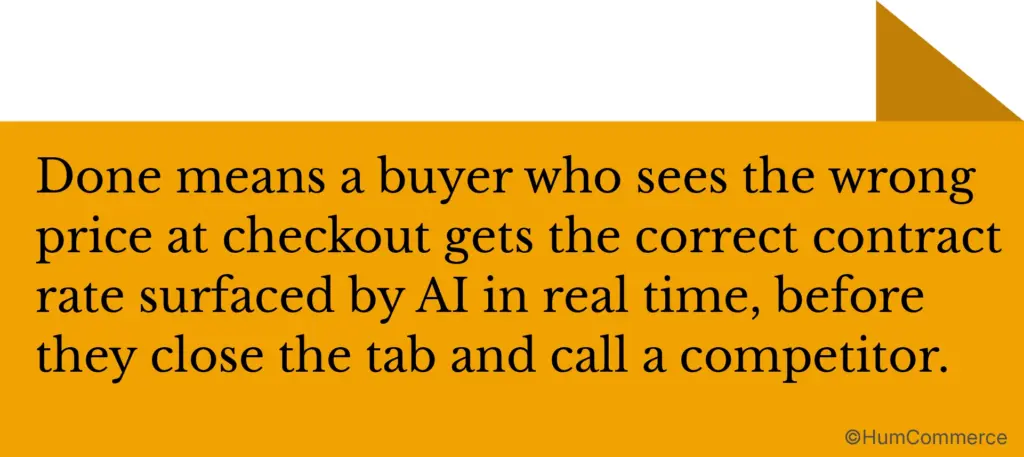
What “Done” Looks Like When You Use AI to Reduce Cart Abandonment in B2B Ecommerce
Vague goals like “add AI to reduce abandonment” lead to stalled projects and vanity metrics. A well-defined “done” state changes how you plan, build, and measure.
Before AI: a buyer searches for “M8 hex bolts in stainless,” gets irrelevant results, cannot confirm their contract price, and abandons. A rep spends 20 minutes manually pulling data from the ERP to follow up. After AI: the buyer types that same query into a conversational assistant, gets the right product with their account-specific price, and completes the order in minutes. The rep gets a notification only if the order needs approval.
Here is what “done” looks like in concrete terms:
- Contract and volume-tier pricing displays correctly at the cart level in real time, pulled directly from SAP or NetSuite, eliminating the most common abandonment trigger in B2B: the “wrong price” moment at checkout.
- AI-powered product discovery resolves at least 70% of “product not found” searches by using a hybrid RAG approach that handles alphanumeric SKUs, cross-references, and superseded part numbers that pure semantic search misses. AI product discovery reduces cart abandonment by 20-30% by eliminating zero-result searches and improving product relevance.
- A self-service completion rate of 25-35% of orders means buyers finish purchases without calling a rep, and your ecommerce manager has a dashboard showing abandonment rate by stage, recovery rate, and average time-to-completion.
- AI-powered cart recovery ties into your broader ecommerce strategy, feeding recovered orders back into your ERP so that every completed transaction follows the same approval, fulfillment, and invoicing logic as a rep-assisted sale.
Step 1: Map Where and Why B2B Ecommerce Cart Abandonment Happens Today
Start with reality, not tools. Before selecting any AI solution, you need a clear picture of where and why buyers abandon carts in your current setup.
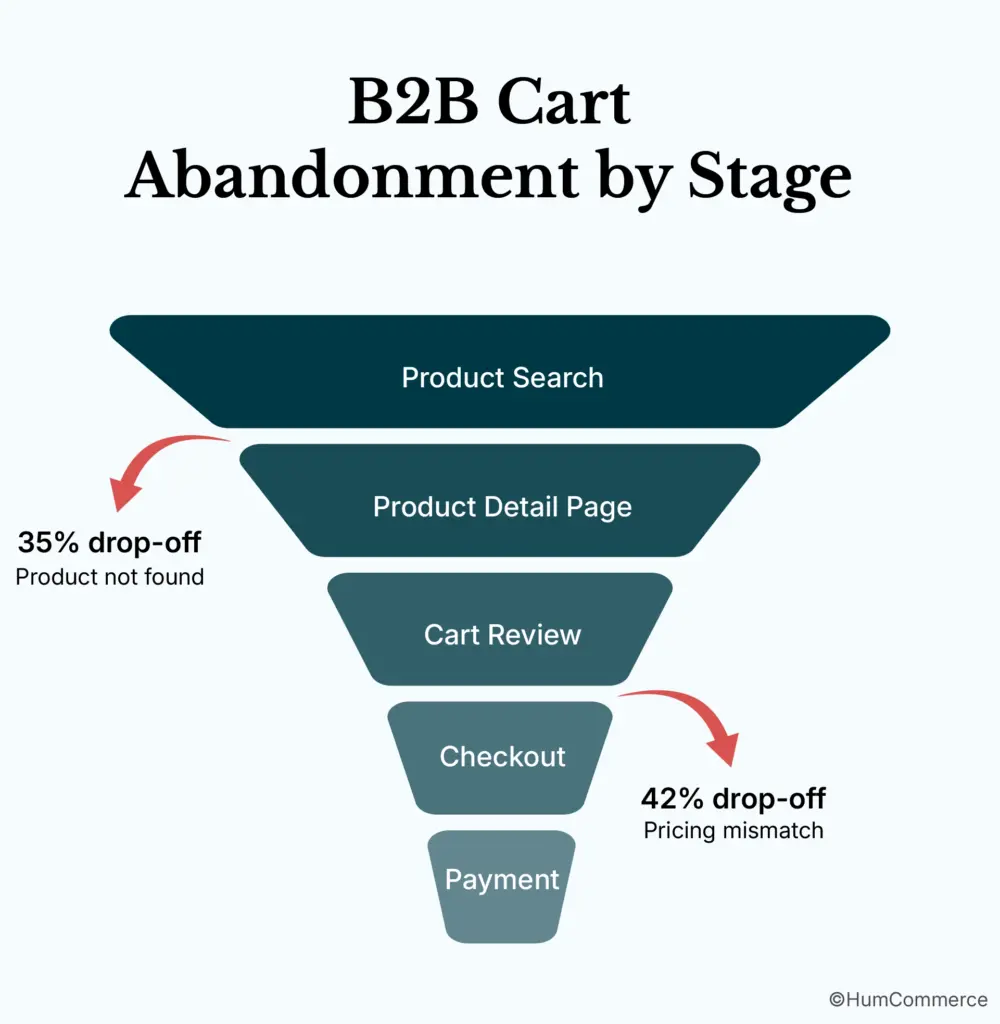
- Pull your abandonment data from Adobe Commerce or Shopify Plus analytics. Identify the top five pages or steps where B2B ecommerce customers exit. Is it the product detail page, the cart summary, or the payment step? Segment by customer type: new versus returning, contract versus spot buyer.
- Trace the data flow between your commerce platform and SAP or NetSuite. Where does pricing get calculated? Is it real-time via API, or does it rely on a nightly batch sync? Stale pricing is one of the most common abandonment causes in B2B, and you cannot fix it with AI if you do not know where the lag originates.
- Interview your sales reps and customer service team. Ask: “What questions do buyers raise after abandoning a cart?” Common answers include “Is this the right part for my application?” and “Why does my price not match my contract?” These questions reveal the gaps an AI chatbot could close before abandonment happens.
- Document the handoff points. When a buyer abandons, who follows up? Is it automated via email, manual via rep call, or nobody? Quote turnaround in many B2B operations runs 3-5 days before automation, which is far too slow for effective cart recovery.
- Map rework loops. If a buyer calls in after abandoning, does the rep re-enter the same items? Does the quote go through a separate approval chain? These loops cost time and money that AI can help eliminate.
- Score each failure point by frequency and revenue impact. A problem affecting 5% of carts but involving high-value orders may matter more than one affecting 30% of low-value sessions.
Step 2: Check If You Are Ready to Use AI to Reduce B2B Cart Abandonment
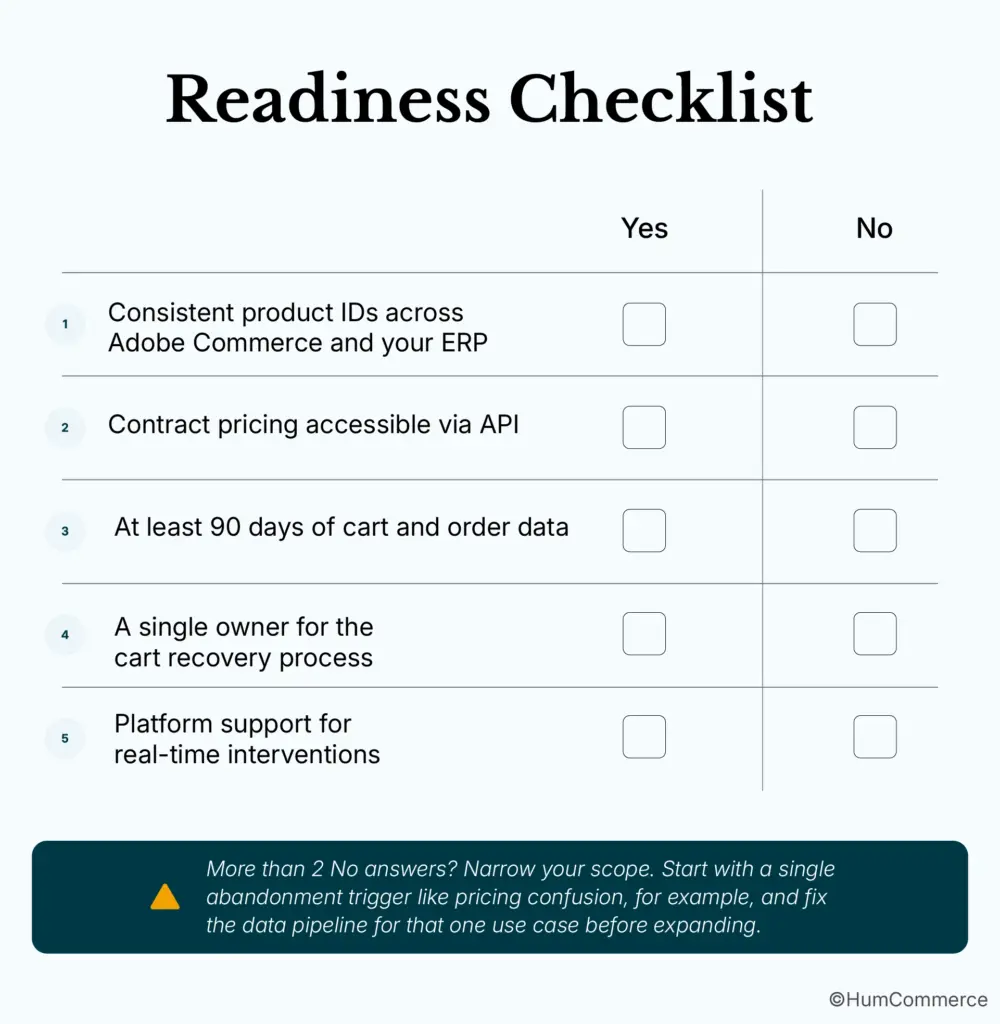
Readiness is not about having perfect systems. It is about having enough foundation to make AI useful rather than another source of bad data.
- Consistent product IDs across Adobe Commerce and your ERP. If your commerce platform uses one SKU format and SAP uses another, AI cannot reliably match products. A basic cross-reference table between systems is the minimum requirement before deploying any B2B cart abandonment AI solution.
- Contract pricing accessible via API. If pricing lives only in spreadsheets or requires manual lookup, AI will not be able to display accurate prices at the cart level. You need at least a read-only API endpoint from NetSuite or SAP that returns customer-specific pricing.
- At least 90 days of cart and order data. AI needs historical patterns to identify abandonment triggers. If your analytics are sparse or unreliable, start with a 30-day data cleanup sprint before moving forward.
- A single owner for the cart recovery process. If abandonment follow-up is split between marketing, sales, and ecommerce with no single point of accountability, nobody owns the outcome. Assign one person, ideally the ecommerce manager, to own the pilot.
- Platform support for real-time interventions. Reducing checkout friction with AI requires the ability to trigger actions based on buyer behavior in real time. Confirm whether your Adobe Commerce or Shopify Plus instance supports event-driven triggers.
Step 3: Prepare Your Systems and Data for AI Cart Recovery
Your ERP is the single source of truth for contract pricing, credit limits, inventory, and customer master data. AI that does not pull from this source will generate incorrect answers, and incorrect answers accelerate abandonment rather than preventing it.
- Standardize product identifiers. Ensure every SKU in Adobe Commerce maps to exactly one item in SAP or NetSuite, including superseded parts, kits, and configurable products. If your catalog includes alphanumeric part numbers common in industrial supply and automotive, pure semantic search in an LLM will not match them reliably. A RAG approach that queries your product database first is essential.
- Validate pricing rules. Export your top 100 B2B ecommerce customers’ contract rates and volume tiers from the ERP and compare them against what Adobe Commerce displays. Flag discrepancies. This audit alone often reveals why buyers abandon: the price they see does not match the price they expect.
- Set up inventory sync. For high-velocity SKUs, real-time sync via API is necessary. A buyer who adds an out-of-stock item to their cart and discovers the issue only at checkout will not return.
- Configure permissions and roles. AI tools that access ERP data need appropriate read permissions, scoped to pricing, inventory, and customer account data. Work with IT to create service accounts with the minimum required access.
- Establish baseline reports. Before changing anything, document your current cart abandonment rate, average cart value at abandonment, recovery rate, and time-to-recovery. These become your before metrics.
- Prepare your AI data layer. A conversational assistant needs structured access to product attributes, SKU-level specifications, application data, and customer-specific pricing. This depth is what separates B2B-native AI from generic retail chatbots that lack ERP and PIM integration.
Step 4: Design the Improved B2B Cart Abandonment Intervention Workflow
This step is about deciding what the better version of your cart recovery workflow looks like, not just adding technology to a broken process.
Defining What AI Handles Autonomously
Pricing confirmation, product matching, and stock availability checks are strong candidates for full AI automation. These are the questions buyers ask most often and where real-time ERP data makes the biggest difference. Approval chain delays and credit limit issues typically require human intervention but benefit from AI-generated alerts that keep the process moving rather than stalling silently.
Designing Intervention Timing for B2B Ecommerce Customers
If a buyer hesitates on a product page for more than 60 seconds, a conversational assistant can offer help. If a cart sits idle for 30 minutes, the system can send a targeted message with the buyer’s contract price confirmed and real-time stock status. Design these flows with your sales team, not just your marketing team, because the questions that trigger abandonment are operational, not promotional.
Mapping the Data Flow and Exception Path
For each automated intervention, define the data source and fallback behavior. For example: buyer adds item to cart, system queries SAP for contract price, AI assistant confirms price and delivery estimate, buyer completes order, order syncs back to ERP for fulfillment. Complex quotes involving custom configurations or new account setups should still route to a rep, with full cart context attached so no information is repeated.
Step 5: Implement AI Cart Abandonment Reduction Changes in Your Stack
Implementation on Adobe Commerce or Shopify Plus with an ERP backend involves both configuration and integration work. Split responsibilities clearly from the start.
What the E-commerce Manager Owns
Your responsibilities include defining the triggers and rules for AI interventions, setting up A/B tests for different intervention types, reviewing the AI assistant’s responses for pricing accuracy, and managing the rollout timeline. You also own the go/no-go decision before AI interventions go live with real B2B ecommerce customers.
What Your Technical Partner Owns
Your technical team or partner handles building or configuring the API connections between the commerce platform and ERP, deploying the AI assistant, and ensuring real-time data sync for pricing and inventory. B2B companies that have automated quote capture and approval workflows report 75% faster quote turnaround, which directly reduces the wait time that causes abandonment after initial cart sessions.
Start with your highest-abandonment product category and your top 20% of B2B ecommerce customers by order volume. This limits risk while generating enough data to validate the approach before expanding. HumCommerce’s AI Assist connects directly to your pricing, inventory, and customer data rather than sitting on top of stale caches, which is the architectural requirement for effective B2B cart abandonment reduction.
Step 6: Pilot, Measure, and Improve Your AI Cart Recovery Program
Treat your first rollout as a controlled experiment with a defined scope, timeline, and success criteria. Pick a subset: one product line, one customer tier, or one geographic region. Run it for 30-60 days.
What to Measure
Your primary metric is cart abandonment rate for the pilot segment compared to your baseline. Secondary metrics include AI intervention rate, conversion rate after AI engagement, average order value for AI-assisted orders, and escalation rate. Cicero Supply’s deployment is instructive: after deploying AI-powered product discovery, they saw a 40% increase in product click-through rate, with 25-35% of orders completed via self-service. Across broader AI cart recovery implementations, businesses recover 28-35% of abandoned carts through AI-triggered interventions, and AI product discovery alone reduces abandonment by 20-30%.
Building the Weekly Review Cadence
Every week, your ecommerce manager should review the numbers, flag any AI responses that were inaccurate or unhelpful, and adjust triggers or rules accordingly. Bi-weekly, bring in sales and operations leads to assess whether AI-assisted orders are flowing correctly through fulfillment. This feedback loop is where AI-powered cart recovery in B2B ecommerce moves from experiment to standard practice. After 60 days, decide: expand to more categories, refine the model with better data, or address underlying system issues that the pilot exposed.
Common Mistakes When Using AI to Reduce Cart Abandonment in B2B E-commerce
Avoiding these mistakes matters as much as following the steps above:
- Skipping the process map. Deploying AI without understanding your current abandonment flow means you are automating guesswork. The AI will intervene at the wrong moments or with the wrong data.
- Treating a chatbot as a complete solution. A chatbot that cannot access your ERP pricing or inventory data is a glorified FAQ page. B2B cart abandonment AI solutions fail when they lack the operational depth to answer real buyer questions like “What is my contract price on this SKU?”
- Ignoring ERP constraints. Your ERP has rules: credit limits, approval chains, minimum order quantities. AI that bypasses these creates orders that get rejected downstream, frustrating B2B ecommerce customers more than the original abandonment did.
- Launching without baseline metrics. If you do not know your current abandonment rate by stage, you cannot prove AI made a difference. Measure before you build.
- Trying to automate everything at once. Start with one or two high-impact abandonment triggers. Expanding too fast spreads your data and engineering resources thin.
- Not involving sales reps in design. Reps know why buyers abandon because they hear it daily. Excluding them from the process design phase guarantees blind spots.
- Confusing a UI tweak with a real fix. Changing button colors or adding urgency messaging does not address the root causes of B2B abandonment: pricing mismatches, product uncertainty, and approval delays. Reducing checkout friction with AI means fixing the data and workflow layer, not just the presentation layer.
Ready to Use AI to Reduce Cart Abandonment in Your B2B E-commerce Store?
If you have followed this guide, you now have a structured approach: map your abandonment points, assess readiness, prepare your ERP and commerce data, design targeted interventions, implement with a narrow pilot scope, and measure against a clear baseline.
HumCommerce helps B2B ecommerce managers move from this kind of framework to a working implementation. Our team specializes in ERP-first commerce architecture, meaning the AI layer we build connects directly to your pricing, inventory, and B2B ecommerce customer data rather than sitting on top of stale caches. Whether your focus is AI-driven cart recovery, conversational product discovery, or quote automation, we scope the work to your specific stack and abandonment patterns. Share your platform details, including your Adobe Commerce version, ERP system, and primary pain point, and we will map these steps to your environment in a technical walkthrough.