
TL;DR
- Product data breaks at scale when you reach 50K–500K+ SKUs across multiple channels
- The three biggest triggers for PIM integration are inconsistent data across channels (pricing, specs, inventory), manual marketplace and B2B listing work that never ends and media and product data that never stay in sync
- Enterprise PIM solves this by creating a single source of truth and automating syndication
- Platform selection must match your data model complexity, integration needs, and SKU volume
- Implementation typically takes 4–8 months; data quality and integration architecture are the critical success factors
- Most PIM failures stem from poor data preparation, weak integrations, and low user adoption, all avoidable with the right approach
In January 2025, the FDA released its annual recall report. The findings were staggering. Label errors caused 45.5% of all food recalls in 2024, which comes to192 recall events out of 422. The estimated cost to the industry: $1.92 billion in direct expenses alone.
The root cause wasn’t negligence or a lack of caring. It was fragmented product data flowing through disconnected systems, where a single wrong attribute made its way from the factory floor to the retail shelf before anyone caught it.
This is what happens when product information management breaks down at scale.
And while recalls make headlines, the quieter failures happen every day.
If you’re managing 50,000 SKUs across multiple channels, you already feel this pain. If you’re scaling toward 500,000 or more, the architecture decisions you make today will determine whether your product data becomes a competitive advantage or a liability that compounds with every new SKU you add.
This guide is built for anyone who knows the current approach won’t scale and needs a clear path forward.
Why Product Data Breaks at Scale
A company with 10,000 SKUs selling across 15 channels faces 150,000 potential points of inconsistency. At 500,000 SKUs, that’s 7.5 million failure points.
Traditional systems weren’t designed for this reality.
Most manufacturing and distribution companies evolved their product data management organically.
This worked when catalogs were small and channels were few. It doesn’t work anymore.
The fragmentation tax is brutal. Research shows that 60% of distributors report product data inconsistencies as a key challenge, with manual data entry contributing to up to 30% of errors in product information. When procurement and supply chain leaders were surveyed about inaccurate supplier information, 63% cited wasted time and 40% reported direct financial loss.
The problem isn’t that people don’t care about data quality. It’s that the architecture makes quality impossible to maintain at scale.
What a Product Information Management System Actually Does
A product information management system isn’t just a database. It’s an architectural layer that sits between your source systems – ERP, PLM, supplier feeds – and your output channels like eCommerce, marketplaces, print catalogs, and sales tools.
The core function is deceptively simple: create one authoritative record for every product, then transform and distribute that record to wherever it needs to go.
But the execution is where most implementations succeed or fail.
An enterprise PIM handles several critical functions. Data modeling defines the structure, what attributes exist, how products relate to each other, what’s required versus optional. Data quality management validates incoming information against rules you define. Workflow management routes products through enrichment, review, and approval before they go live. And syndication pushes the right data in the right format to each channel.
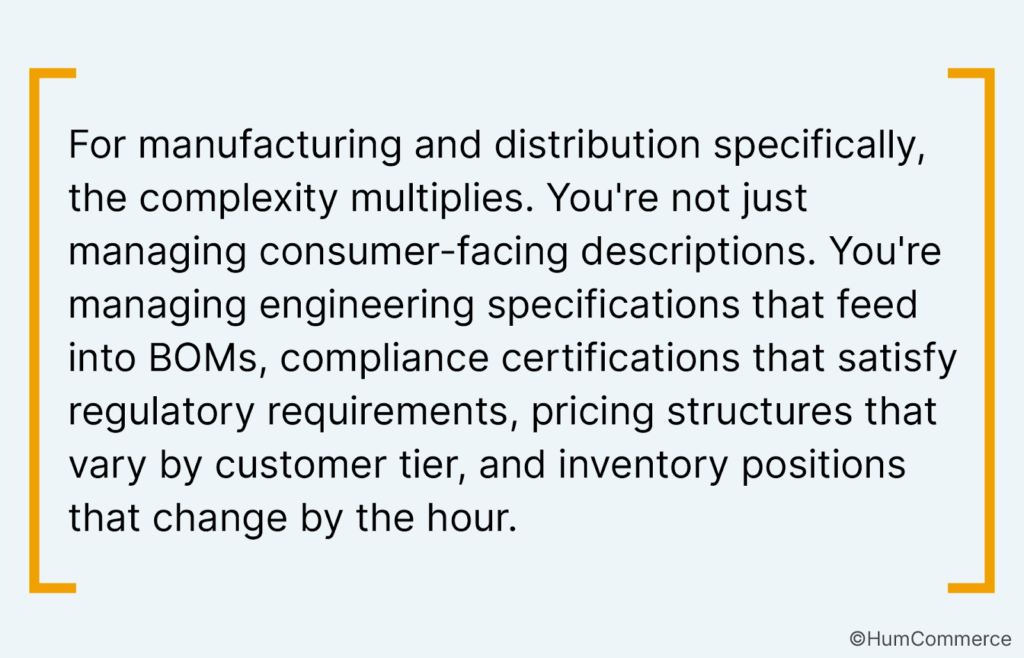
The architecture you choose determines whether all of this works together or fights against itself.
Problem One: Keeping Product Data Accurate Across Every Channel
Let’s start with the most fundamental pain point. You have product data in multiple systems. It needs to be consistent everywhere. And right now, it isn’t.
The surface symptom is easy to spot: pricing mismatches between your website and your Amazon listings, spec discrepancies between your catalog and your quoting system, inventory showing available on one channel while it’s actually committed to another customer.
The root cause runs deeper. Without a centralized source of truth, every system maintains its own version of product information. Updates happen in one place but not another. Manual reconciliation becomes a full-time job and still doesn’t catch everything.
One industrial distributor discovered their fragmented workflows were adding hours, sometimes days, to order fulfillment. The culprit wasn’t slow shipping. It was teams reconciling conflicting data between inventory, CRM, ERP, and order management systems before they could even confirm what to ship.
The architectural solution is a PIM architecture that establishes genuine single-source-of-truth governance. This means defining which system owns which data, your ERP owns pricing and inventory, your PIM owns enriched product content, your DAM owns digital assets and building integrations that respect those boundaries.
PIM ERP integration is the critical foundation here. Your ERP contains the transactional truth: what you have, what it costs, what customers have ordered. Your PIM enriches that core data with everything needed to sell: descriptions, specifications, images, compliance documentation. The integration must be bidirectional and real-time, or you’re just creating another silo.
When this architecture works correctly, a pricing change in your ERP propagates to your eCommerce platform, your marketplace listings, and your sales quoting tools within minutes. Your team stops chasing discrepancies and starts focusing on growth.
HumCommerce has implemented this pattern for manufacturers managing 150,000+ SKUs with zero downtime during migration and full data integrity maintained throughout. The architecture scales because the governance model scales with it.
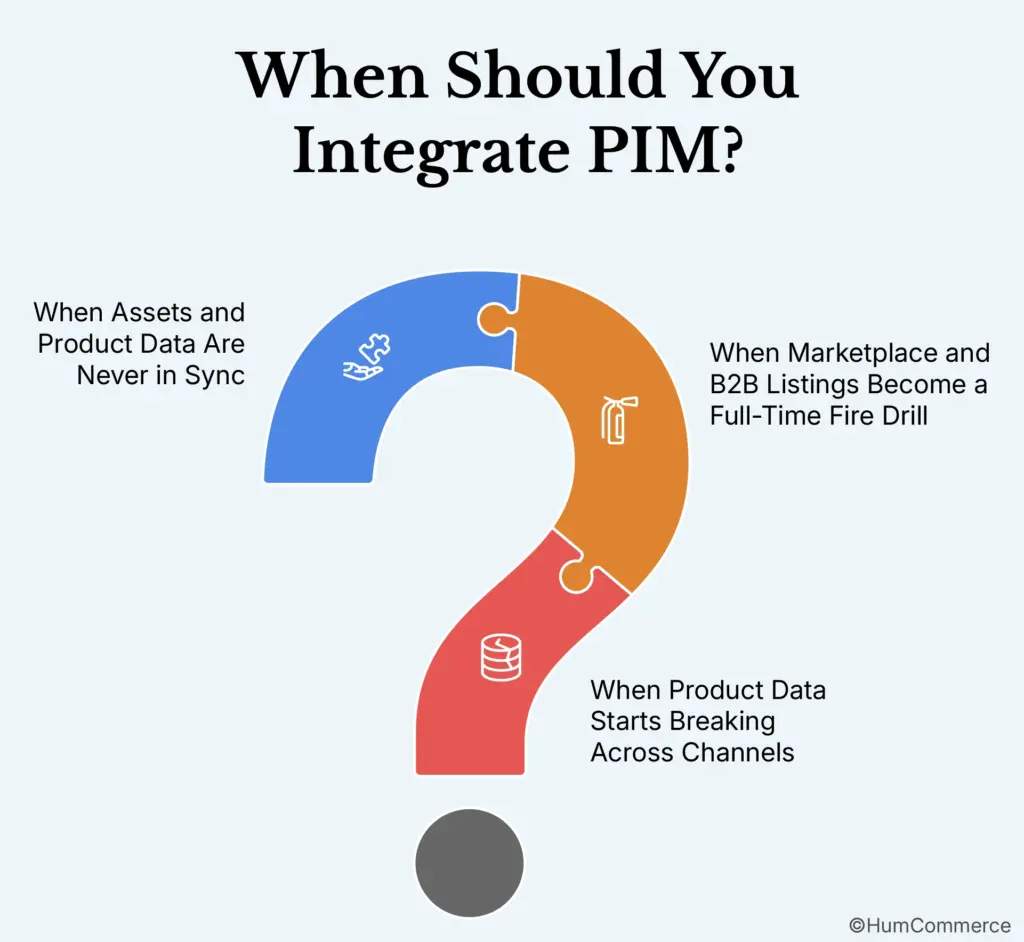
Problem Two: Automating Listings for Marketplaces and B2B Platforms
Every marketplace has its own requirements. Amazon wants titles formatted one way, Walmart another. Your B2B portal needs different attributes than your D2C storefront. Grainger requires specific compliance fields. McMaster-Carr expects data structured differently than your website.
Manual management is a dead end. One retailer learned this the hard way when they struggled to get their products live on Cdiscount. After two years of manual management, only 2,000 of their 11,000 products, just 18%, were actually listed. The problem wasn’t inventory or pricing. It was product title nomenclature that didn’t meet the marketplace’s standards, compounded by insufficient time and resources to fix it manually.
The PIM eCommerce integration challenge is really a transformation challenge. Your canonical product record contains all the information. But each output channel needs a different slice, formatted according to its specific rules.
Attribute modeling is where this gets technical and where many implementations fail. You need a data model flexible enough to capture the full complexity of your products (think: 200+ attributes for an industrial component) while structured enough to map cleanly to each channel’s requirements.
The best PIM for manufacturing implementations build attribute inheritance into the model. Category-level attributes cascade down to products, so you’re not manually entering “voltage range” on every power tool. Product types define which attributes are required versus optional. Variants inherit from parents while allowing overrides where needed.
Once your data model is sound, syndication becomes automation rather than manual labor. Pre-built connectors handle the format transformation for major marketplaces. Scheduled feeds push updates on whatever cadence each channel requires. Error monitoring catches problems before they impact listings.
The shift from manual to automated syndication typically reduces time-to-market by 50%. More importantly, it eliminates the listing errors that get your products suspended or buried in search results.
Problem Three: Smarter Media Management with PIM and DAM Sync
Product data and digital assets are different beasts. Your PIM manages structured information: attributes, descriptions, specifications, pricing. Your DAM manages files: images, videos, PDFs, CAD drawings.
The problem arises when these systems don’t talk to each other.
A product gets updated in your PIM, but the old images stay attached. A new hero shot gets uploaded to your DAM, but nobody updates the product records to use it. Your marketing team creates beautiful lifestyle photography that sits unused because the connection to product data was never made.
PIM DAM integration solves this by creating bidirectional links between product records and their associated assets. The metadata aligns product IDs match asset tags, categories map to folders, status flags sync between systems.
More importantly, the workflows synchronize. When a product enters final review in your PIM, the DAM automatically checks whether approved assets exist. When a new asset gets approved in your DAM, the PIM gets notified to update affected products. Version control ensures everyone works with the latest approved files, no more “which logo is current?” debates.
For manufacturing and distribution, this integration extends beyond marketing images. Engineering drawings need to link to products. Compliance certificates need to be attached to the right SKUs. Safety data sheets need to propagate to channels that require them.
The architecture should treat digital assets as first-class citizens in your product information ecosystem, not an afterthought bolted on at the end.
The Integration Architecture That Actually Scales
Here’s where many PIM implementations go wrong: they focus on the PIM itself while treating integrations as an afterthought.
In reality, for manufacturing and distribution environments, the PIM is only as valuable as its connections to the rest of your technology stack.
PIM ERP integration handles the transactional foundation – pricing, inventory, costs, customer data, order history. This is typically your most complex integration because ERP data models are often rigid and the systems are mission-critical.
PIM eCommerce integration pushes enriched product data to your digital storefronts. For B2B, this includes customer-specific pricing, tiered catalogs, and approval workflows that most B2C platforms don’t handle natively.
CRM integration enables your sales team to access product information without leaving their workflow. CPQ integration powers configure-price-quote scenarios where products have options, bundles, or custom configurations. PLM integration brings engineering data into your PIM so that spec changes flow through to market-facing content.
The integration complexity isn’t linear. Adding your third integration isn’t three times as hard as the first, it’s often harder, because now you’re managing data flows that interact with each other. A price change that affects your ERP, your eCommerce platform, and your CPQ system needs to propagate consistently to all three.
This is where middleware and integration platforms earn their keep. Rather than building point-to-point connections between every system, you build a common layer that orchestrates the data flow. When you add a new channel or replace a system, you only change one connection instead of dozens.
For PIM for distribution environments with 500K+ SKUs, performance becomes an architectural concern. Batch processing handles large catalog updates without overwhelming downstream systems. Delta detection ensures you’re only syncing what changed, not re-processing everything. Caching layers speed up read-heavy operations like catalog browsing.
Choosing the Right Platform for Your Situation
The enterprise PIM market offers several strong options. The right choice depends on your specific situation, not on which vendor has the best marketing.
Akeneo works well for organizations that need rapid deployment and have structured PIM needs. Its Adobe Commerce integration is mature, and the community edition provides a cost-effective entry point. The limitation: complex variant modeling can push you toward the enterprise tier faster than expected.
Pimcore excels in environments with complex, multi-layered data. As an open-source platform combining PIM, DAM, and MDM capabilities, it offers flexibility that commercial alternatives can’t match. The tradeoff is a steeper learning curve and the need for technical expertise to implement well.
Salsify leads in syndication capabilities, particularly for organizations focused on digital shelf analytics and marketplace optimization. It’s powerful for omnichannel scenarios but oriented more toward consumer goods than heavy B2B manufacturing.
inRiver brings strong governance and audit trail capabilities, making it attractive for regulated industries where compliance documentation matters. Manufacturing organizations with complex go-to-market requirements find its market segmentation features valuable.
The platform decision matters less than the implementation approach. A well-implemented mid-market PIM will outperform a poorly implemented enterprise platform every time.
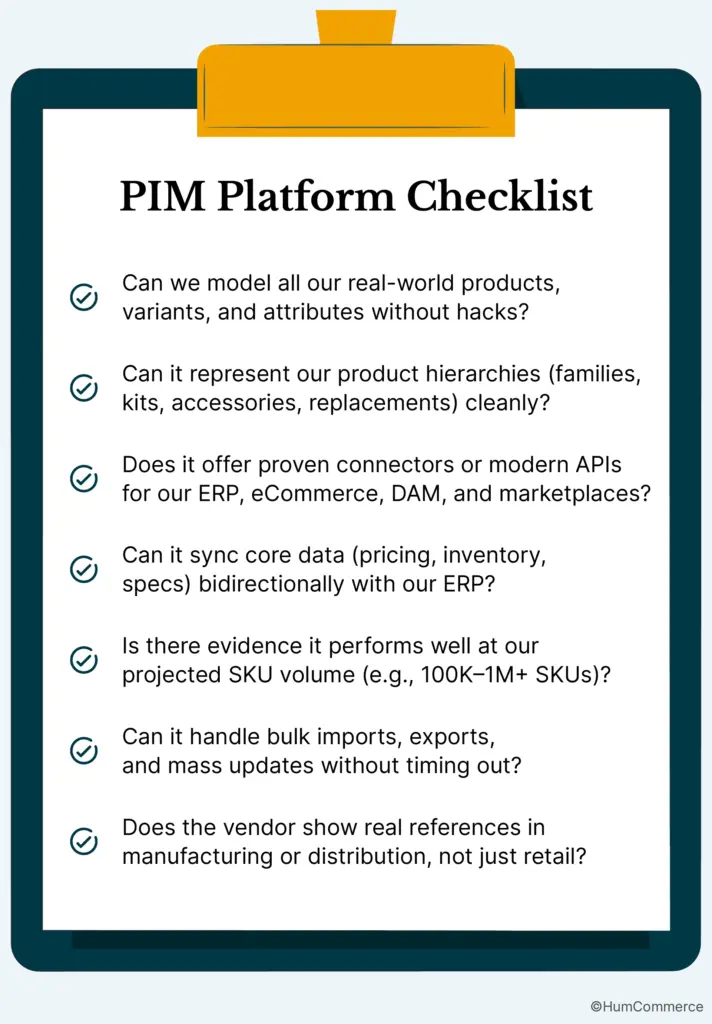
If you’re confused about which one to choose, here is a guide for you.
The Build vs. Buy Decision
Every few months, someone proposes building a custom PIM internally. The reasoning sounds logical: “We know our data better than any vendor. We can build exactly what we need. We’ll save money in the long run.”
The math almost never works out.
Custom builds underestimate maintenance burden. Enterprise systems get continuous security updates, performance improvements, and feature additions. Your custom build gets whatever your team has bandwidth for which, after the initial project ends, is usually not much.
Custom builds also underestimate integration ecosystem value. Commercial PIMs have pre-built connectors for major ERPs, eCommerce platforms, and marketplaces. Your custom build starts from zero with every integration.
Over a five-year horizon, custom builds typically cost 2-3x more than buying and implementing a commercial platform and deliver less functionality.
Build makes sense in narrow circumstances: when your data model is genuinely unique in ways no platform can accommodate, when competitive advantage depends on proprietary product data logic, and when you have deep PIM expertise in-house.
Buy makes sense everywhere else. Your competitive advantage is in your products and operations, not in building software that already exists.
Implementation Timelines: What to Actually Expect
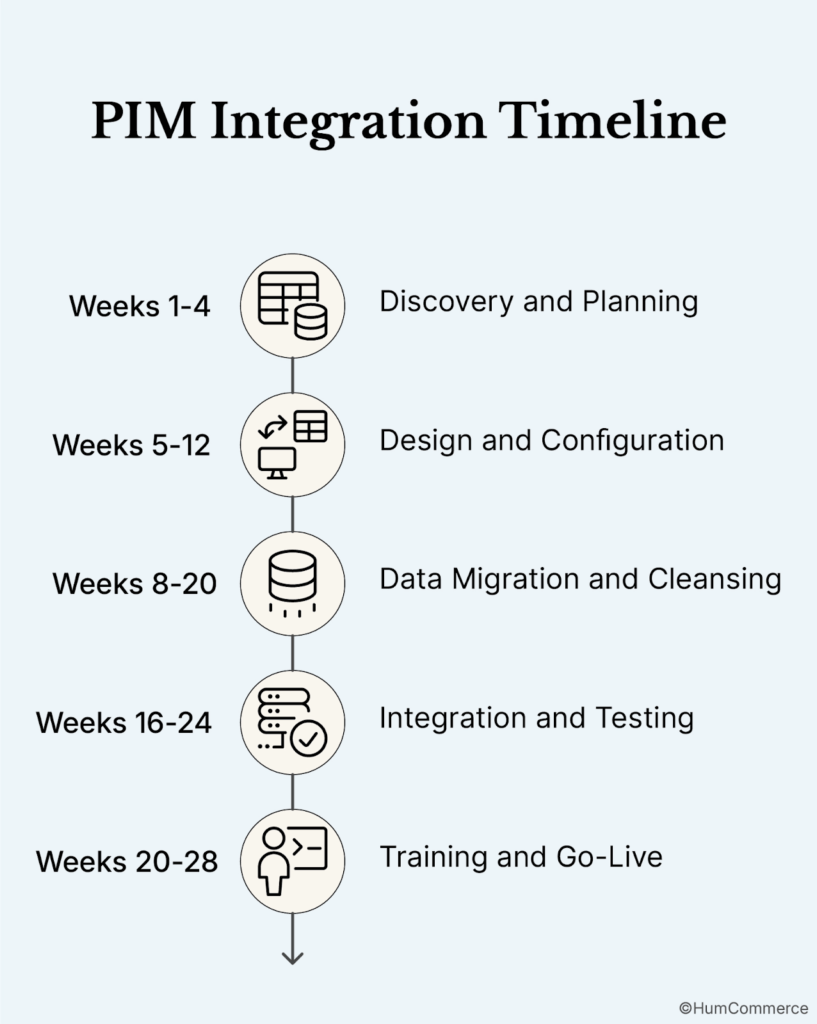
PIM implementations for manufacturing and distribution typically run 4-8 months from kickoff to go-live. Complexity determines where you fall in that range.
Weeks 1-4: Discovery and Planning. Stakeholder alignment, requirements documentation, current state assessment, data audit. This phase gets compressed too often, which creates problems downstream. If you don’t know what data you have and what state it’s in, migration will surprise you.
Weeks 5-12: Design and Configuration. Data model creation, workflow design, user roles and permissions, integration architecture. This is where decisions get made that you’ll live with for years. Invest the time to get the model right.
Weeks 8-20: Data Migration and Cleansing. Here’s the uncomfortable truth: 40-60% of product records are typically incomplete or inconsistent when you start looking closely. Migration isn’t just moving data, it’s cleaning data, enriching data, and establishing quality standards that didn’t exist before.
Weeks 16-24: Integration and Testing. API development, system connections, user acceptance testing, performance validation. Don’t shortcut testing. The errors you catch here cost 10x less to fix than the ones that reach production.
Weeks 20-28: Training and Go-Live. User training, documentation, pilot groups, cutover. Change management matters. The best PIM in the world fails if people don’t use it.
Accelerated timelines (3-4 months) are possible with smaller catalogs, clean data, and simple integration requirements. Complex timelines (8-12+ months) happen with large SKU counts, multiple ERPs, significant data remediation needs, or global rollouts.
The most common timeline mistake: underestimating data preparation. Teams assume their data is better than it is, then discover mid-project that remediation will take twice as long as expected.
Why Most PIM Implementations Fail And How to Avoid It
The research is sobering. Most PIM implementations fail to deliver their projected value. The failure modes are predictable, which means they’re avoidable.
Failure mode one: Data quality disasters. Teams migrate garbage data into a shiny new system, then wonder why garbage comes out. The fix: audit your data before you start. Know what you’re working with. Budget for remediation.
Failure mode two: Integration afterthought. The PIM works great in isolation, but doesn’t connect to the systems people actually use. The fix: design integrations as part of the core project, not as phase two.
Failure mode three: User adoption failure. The system is technically sound, but teams resist using it. The fix: involve users early, demonstrate value quickly, and invest in training that actually teaches people to do their jobs differently.
Failure mode four: Scope creep. The project tries to solve every product data problem in the organization simultaneously. The fix: prioritize ruthlessly, deliver value incrementally, and expand scope only after proving success.
Failure mode five: Wrong platform for the problem. The selection process optimized for features rather than fit. The fix: evaluate platforms against your specific requirements, not generic capability checklists.
Measuring Success: The Metrics That Matter
How do you know if your PIM implementation is working?
Time-to-market measures how long it takes to get a new product from data-ready to live across all channels. Best-in-class implementations show 50% reduction compared to manual processes.
Data quality scores track completeness, accuracy, and consistency across your catalog. Set baseline measurements before implementation so you can demonstrate improvement.
Channel rejection rates monitor how often marketplace listings fail validation. This should approach zero as your data quality and syndication automation mature.
Manual effort reduction quantifies the time teams spend on data entry, formatting, and reconciliation. This time should shift from maintenance to strategic work.
Error-related costs capture the downstream impact of data problems: returns from incorrect specs, pricing mistakes, compliance issues. These should decline significantly post-implementation.
HumCommerce clients have documented 75% faster workflows, 100% real-time quoting accuracy, and effective management of 1 million+ SKUs after implementing integrated PIM solutions. Your specific results will depend on your starting point, but the trajectory should be similar.
The Path Forward
If you’re managing a growing product catalog in manufacturing or distribution, the architecture decisions you make now will determine your operational reality for years to come.
The good news: this is a solved problem. The technology exists. The implementation patterns are proven. Organizations at your scale are successfully managing 500K+ SKUs across dozens of channels without the chaos of fragmented data.
The path forward starts with honest assessment. How accurate is your current product data? How much time does your team spend on manual data management? What’s breaking as you scale?
From there, it’s architecture design. What systems need to connect? What’s the right data model for your products? Where are the integration complexity hotspots?
Then platform selection. Which solution fits your requirements, your team’s capabilities, and your budget?
Finally, implementation. Done right, with realistic timelines, proper data preparation, and change management that brings your organization along.
The companies that get this right gain a genuine competitive advantage. Their products launch faster. Their customers see accurate information everywhere. Their teams focus on growth instead of data cleanup.
The companies that don’t get it right keep fighting the same battles, at ever-increasing scale, until the cost becomes impossible to ignore.
Download the PIM Architecture Planning Checklist to assess your current state and plan your path forward. It’s the same framework we use with enterprise clients to identify gaps, prioritize requirements, and build implementation roadmaps that actually deliver.
HumCommerce specializes in PIM implementation for manufacturing and distribution, with documented success managing 1M+ SKU catalogs and complex B2B integration requirements. If your organization is evaluating PIM solutions, request a consultation to discuss your specific situation.